 تخطي إلى المحتوى

en 13573 en 14960 inflatable is the first checkpoint buyers should lock before they approve a supplier, budget, or production slot. When a supplier tells you their inflatable tent is CE certified, the first question should be: certified to which standard? EN 13573 and EN 14960 are not interchangeable, but I still see RFQs where they get treated that way. The wrong choice can stall customs clearance or trigger a recall notice from a European retailer six months into the season.
The difference comes down to how the structure is classified. EN 13573 covers camping tents designed for sleeping and shelter — think family dome tents or glamping bell tents with inflatable beams. EN 14960 applies to inflatable amusement equipment meant for play and bouncing, which includes large event domes and party shelters. A glamping tent with inflatable frame members sits right in the gray zone between them. Some European buyers now request both standards for those hybrid products, especially when floor area exceeds 50 square meters.
The practical cost of getting this wrong is time. Re-testing under the correct standard adds four to six weeks to your lead time and eats into your margin if FOB pricing was already locked in. A pre-assessment with a notified body before sample approval stage can flag which standard applies — and whether your material choice, particularly PVC-TPU hybrid fabrics, will pass the stricter air retention requirements of EN 14960.
EN 13573:2012 – Camping tents
EN 13573 is the standard for camping shelters; EN 14960 governs inflatable play equipment.
A supply chain manager at a European outdoor retailer once rejected a full container of glamping tents because the CE certificate referenced EN 14960 instead of EN 13573. The supplier had tested to the wrong standard. That container sat at Rotterdam port for six weeks while re-testing was arranged. The cost: €12,000 in storage and demurrage, plus a three-month delay to the retail season.
Scope: for sleeping and shelter
EN 13573:2012 applies to tents designed for human habitation during camping activities. The standard covers any tent structure where people sleep or take shelter — family dome tents, tunnel tents, bell tents, and glamping structures with inflatable beam frames. It does not cover bivouac bags, trailer tents, or play equipment.
Key tests: wind resistance, water penetration, seam strength
The standard runs three core mechanical tests. Wind resistance is assessed by anchoring the tent to a test rig and applying lateral forces that simulate gusts up to 28 m/s (Beaufort force 10). Water penetration is measured by spraying the fabric at 10 L/min per square meter for five minutes — no droplets should form on the inner face. Seam strength requires a minimum tensile force of 200 N per 50 mm width for main seams. These thresholds are non-negotiable for CE marking under this standard.
Typical use cases: family tents, glamping tents
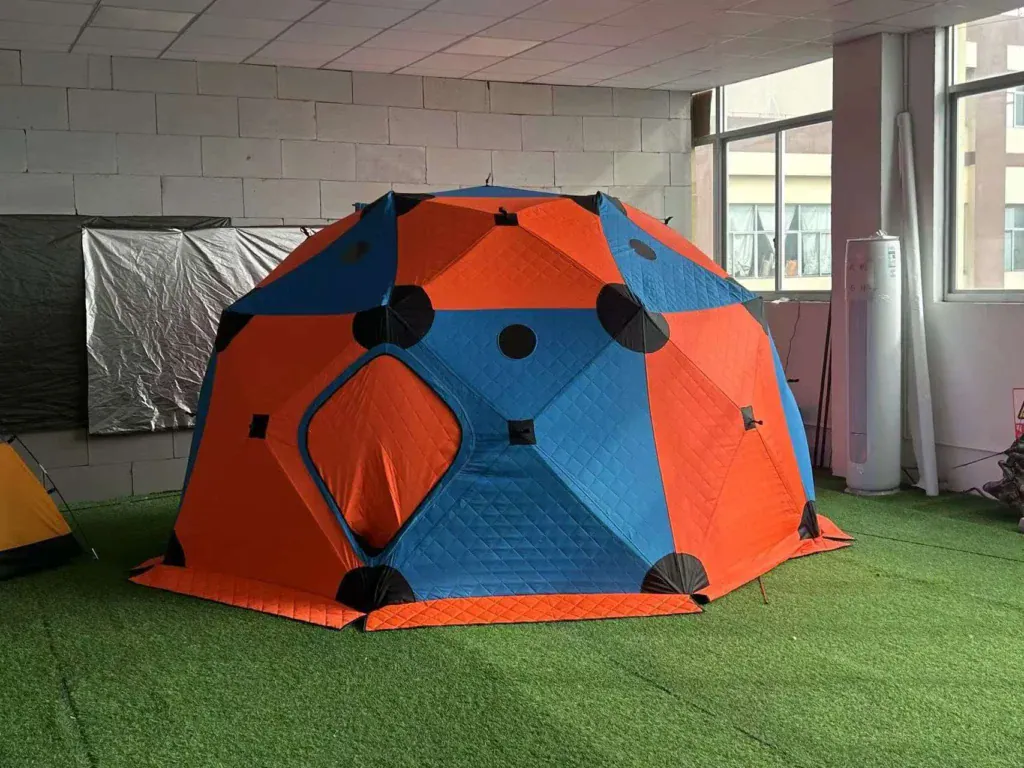
Family camping tents from Kelyland Outdoors’ partner factories in Ningbo and Shaoxing are routinely tested to EN 13573 before shipment to EU buyers. The glamping tent factory in Shaoxing — established in 2019 with an annual capacity of 300,000 units — produces bell tents and yurt-style shelters that must pass these same wind and water tests before receiving CE certification. For inflatable beam models specifically, the frame material (PVC or TPU-coated fabric) must also demonstrate air retention over a minimum period defined in the standard’s annex.
EN 14960:2019 – Inflatable amusement equipment
EN 14960:2019 was written for bounce houses, not camping tents — but retailers now demand it for large inflatable shelters.
If your supplier offers you an EN 14960 certificate for a glamping tent, ask why. This standard was drafted for inflatable amusement equipment — the kind kids jump on at fairs and festivals. Its scope covers play structures where impact attenuation and child safety dominate the test regime. That does not mean it is irrelevant to tents.
What EN 14960 actually tests
The core tests are static load (the structure must hold 4x the manufacturer’s recommended user weight without collapse), air retention (pressure drop must stay under 15% over a set period), and impact attenuation (the surface must cushion a fall from defined heights). These make sense for a bouncy castle. For a glamping tent with inflatable beams, the air retention requirement is the one that matters — and it is stricter than what EN 13573 demands.
-
- Static load test: EN 14960 requires the inflated structure to support 4x the rated user weight without rupture or collapse. For a party dome rated at 20 people, that means holding roughly 2,400 kg distributed across the floor area.
- Air retention test: Pressure loss must not exceed 15% after a defined period (typically 30 minutes). PVC/TPU hybrid fabrics struggle here if seam welding is inconsistent — this is where many Chinese-made inflatables fail notified body testing.
- Impact attenuation: “Head injury criterion” (HIC) values must stay below a threshold. This applies to bouncing surfaces, not tent floors, so it rarely affects camping shelters unless they double as play spaces.
Where EN 14960 gets misapplied
“CE marking requirements inflatable camping tent” searches often return EN 14960 because testing labs offer it as a catch-all for any inflatable structure. The problem: EN 14960 does not test wind resistance, water penetration, or seam strength — three things that matter when your client sleeps inside that tent overnight. A bell tent with inflatable beams that passes EN 14960 could still fail catastrophically in a gust because the standard never checks lateral wind loads.
“Notified body testing inflatable structure EU” — what to expect
“Notified body testing inflatable structure EU” searches typically lead buyers to TÜV Rheinland, SGS, or Bureau Veritas. These labs will test per EN 14960 if you specify it, but they will also flag gaps if your product clearly functions as shelter rather than amusement equipment. Some notified bodies now offer combined assessments covering both standards in one session — this saves weeks of back-and-forth when your product sits in the gray zone.
Side-by-side comparison table
تختبر المعيار الأوروبي EN 13573 سلامة الملاجئ، بينما يختبر المعيار EN 14960 السلامة الهيكلية لضغط الهواء.
يفترض معظم مدي سلسلة التوريد أن معيار CE واحد يغطي جميع الخيام القابلة للنفخ. هذا الافتراض يكلف الوقت والمال. ينطبق معيار EN 13573:2012 على خيام التنزه المستخدمة للنوم والمأوى — مثل خيام الأسر القبة أو خيام التخييم الفاخر ذات الحزم القابلة للنفخ. يغطي معيار EN 14960:2019 معدات التسلية القابلة للنفخ — مثل القلاع المطاطية وقباب المناسبات والملاهي الكبيرة التي يكون فيها المستخدمون نشطين بدلاً من الراحة.
معايير الاختبار التي تفصل بين المعيارين
-
- مقاومة الرياح: يتطلب EN 13573 اختبار حمل الرياح الثابت الذي يحاكي القوى حتى القوة 8 على مقياس بوفورت (حوالي 62–74 كم/ساعة). لا يفرض EN 14960 اختبارات الرياح كمعيار مرور أساسي.
- قوة الخياطة: يحدد EN 13573 قوة شد حد أدنى للدرزات تبلغ 150 نيوتن لكل 50 مم عرضاً للدرزات الهيكلية الرئيسية. يركز EN 14960 على سلامة المفاصل الملحومة تحت ضغط النفخ المستمر بدلاً من سحب درزات القماش.
- الاحتفاظ بالهواء: يفرض EN 14960 اختباراً صارماً للاحتفاظ بالهواء: بعد الوصول إلى ضغط التشغيل، يجب أن يحتفظ الهيكل بنسبة تزيد عن 80% من ذلك الضغط لمدة ساعة على الأقل دون تدخل المضخة. لا يحتوي EN 13573 على مطلب مكافئ للاحتفاظ بالهواء — فهو يفترض النفخ المستمر من مروحة مثبتة.
- الحمل الساكن (محاكاة المشغلين): EN 14960 applies a distributed static load of up to three times the maximum user weight per anchoring point. EN 13573 tests only the floor structure for a uniform load of approximately 1.5 kN/m², reflecting sleeping occupants rather than jumping or bouncing.
Pass criteria and notified body involvement
Gray areas: glamping tents and large shelters
A 6-meter glamping bell tent with inflatable beams can legally fall under either standard — the notified body decides based on intended.
This is where the certification process gets messy. A glamping tent with inflatable beams sits at the intersection of two standards. EN 13573 treats it as shelter for sleeping. EN 14960 treats it as an inflatable structure subject to amusement-equipment loads. The notified body makes the final call based on the declared use, and different bodies in different EU member states sometimes reach opposite conclusions.When both standards may applyThe gray zone opens when a product exceeds roughly 20 square meters of floor area or uses inflatable columns as primary structural supports rather than traditional poles. A shipment was held at Rotterdam because the buyer’s legal team decided the product was an ‘inflatable structure’ under local building codes — even though the same model had cleared customs six months earlier under EN 13573. Some European retailers now require both standards for large inflatable shelters, citing liability concerns.The air retention test is the main friction point. EN 14960 demands a stricter pressure-hold threshold than EN 13573, which becomes a real challenge for PVC-TPU hybrid fabrics where seam welding consistency varies across production batches. One supplier audited by a third party lost six weeks re-engineering their heat-seal parameters because their initial samples bled pressure below the EN 14960 threshold.How to get a single assessment covering bothThe smart play is a pre-compliance gap analysis before you commit to mass production tooling. Send your design drawings and material specs to a notified body that handles both standards — TÜV Rheinland and SGS both offer combined assessments. They will identify which tests overlap (wind resistance, seam strength) and which ones are unique to each standard.A single assessment covering both standards typically adds about three weeks to the timeline but saves four to six weeks versus running separate tests after discovering a gap mid-production. Kelyland Outdoors coordinates this step through its partner factories in Shaoxing and Ningbo, where CE-certified glamping tent lines already carry ISO 9001:2015 protocols that align with both EN frameworks.
Practical advice for buyers
A certificate without a test report is just a piece of paper.
Most suppliers will send you a PDF of their CE certificate when you ask about compliance. That certificate tells you the product was tested against a standard — but it doesn’t tell you the results. A certificate is a summary. A full test report is the evidence. For EN 13573 and EN 14960, the difference matters because each standard has multiple sub-tests, and passing one does not guarantee passing all.Questions to ask before accepting any certificate
- Which standard was tested?: Ask for the exact standard number and year — EN 13573:2012 or EN 14960:2019. Some suppliers list “CE certified” without specifying which standard applies to your product type.
- Was it tested by a notified body?: EN 14960 requires testing by an EU-notified body (e.g., TÜV, SGS, Bureau Veritas). EN 13573 can be self-declared or third-party. If your retailer demands notified body involvement, confirm the lab’s status.
- Which specific tests were passed?: “CE certified for inflatable tents” is vague. Ask whether wind resistance, air retention, seam strength, and static load were all tested individually. For glamping tents with inflatable beams, request the air retention test data specifically.
- What were the actual pass/fail values?: A full report includes measured pressure drop over time (EN 14960 requires less than 25% loss over 30 minutes), seam tensile strength in Newtons, and wind speed thresholds. Without these numbers, you cannot verify if the design margin meets your market requirements.
Certificate vs. full test report: what to requestA CE certificate typically shows the product name, model number, standard reference, and issue date. A full test report runs 10-30 pages and includes photographs of the setup, raw data tables, pass/fail criteria for each clause, and the laboratory’s scope of accreditation. When evaluating a supplier for inflatable tent certification under EN 13573 or EN 14960, always request both documents.The factory network that Kelyland Outdoors works with holds ISO 9001:2015 certification across its core partner facilities — including those producing camping tents in Ningbo (800,000 units annually) and glamping tents in Shaoxing (300,000 units annually). When we evaluate an inflatable tent project for European market entry, we coordinate directly with these factories to obtain pre-compliance test data from their internal quality labs before sending samples to an EU-notified body.One practical benchmark: if a supplier cannot produce a full test report within two weeks of your request — or if they offer only a photocopy of someone else’s certificate — that is a red flag. The cost of re-testing after production can delay your launch by six weeks or more. Pre-assessment with a notified body before mass production saves that timeline.How Kelyland Outdoors handles standard selection
A pre-assessment with a notified body can save 4-6 weeks of re-testing for hybrid structures.
تقع الخيام الممزوجة ذات العوارض المنتفخة (سواء كانت خيام الجرس، الخيام اليورتية، أو الملاجئ الكبيرة على الطراز السفاري) في منطقة رمادية تنظيمية. تعامل معيار EN 13573 الخيام الممزوجة كخيام تخييم عادية، بينما يعاملها معيار EN 14960 كمعدات ترفيهية. لم يُصمَّم أي من المعيارين لهذه الفئة الهجينة، واختيار المعيار الخاطئ يعني أن علامة CE الخاصة بك قد لا تُعتبر صالحة عندما يطلب التاجر تقرير الفحص.عندما ينطبق كلا المعيارين: تنطبق الخيمة المُصدَّرة للنوم والتخييم تحت مظلة EN 13573. لكن إذا كان هيكل الخيمة يتجاوز حجمًا معينًا، أو يتم تسويقها لأحداث يقف فيها الناس أو يمشون أو يقفزون داخلها، فإن بعض التجار الأوروبيين يطالبون الآن بالامتثال لـ EN 14960 أيضًا. إن اختبار الاحتفاظ بالهواء في معيار EN 14960 أكثر صرامة؛ فهو يقيس معدل تسرب الضغط بمرور الوقت عند ضغط ابتدائي أعلى مما تتطلبه EN 13573. غالبًا ما تفشل المواد الهجينة من نوع PVC-TPU هذا الاختبار لأن مناطق اللحام تتسرب تحت الحمل المطوّل.كيفية الحصول على تقييم واحد يغطي الجانبين: المسار الأكثر كفاءة هو إجراء تقييم مُجمَّع مع هيئة مقرَّة واحدة تتعامل مع المعيارين. تتولى كيلياند أوتدورس التنسيق مباشرة مع مصانعها الشريكة؛ حيث تجري.Factory في شاوشينغ (الحاصلة على شهادة ISO 9001) فحص ما قبل المطابقة للاحتفاظ بالهواء ومتانة الغرز قبل إرسال العينات إلى مختبر الفحص في الاتحاد الأوروبي. وهذا يكشف عن عيوب اللحام في مرحلة مبكرة، عندما تكون تكلفة الإصلاح measured بالأيام بدلاً من الأسابيع.الخلاصة: الفجوة بين EN 13573 وEN 14960 ليست مجرد فصل ورقي؛ فهي تحدد اختبارات الخيمة المنتفخة التي يجب أن تمر بها — مقاومة الرياح بسرعة 28 م/ث للخيام، أو حمل ثابت بمقدار 500 كغ لكل متر مربع لهياكل الترفيه. اختر المعيار الخاطئ، وتُحجز شحنتك عند الجمارك أو ترفض من قبل التاجر.
- ينطبق EN 13573 على الخيام المستخدمة للنوم وتوفير المأوى.
- يغطي EN 14960 الهياكل المنتفخة المخصصة للعب أو الفعاليات.
- غالبًا ما تقع الخيام الممزوجة ذات العوارض المنتفخة في منطقة رمادية.
- يمكن لتقييم مسبق مع هيئة مقرَّة أن يوفر أربعة إلى ستة أسابيع.
بالنسبة لمدي سلاسل الإمداد، هنا تكمن النسبة الأخيرة من العناية الواجبة — العشرة بالمئة — كفارق بين إطلاق سلس ودورة إعادة فحص مكلفة. راجع ورقة المواصفات الحالية لمنتجك مقابل معلمات الاختبار الموضحة أعلاه، ولا سيما متطلبات الاحتفاظ بالهواءالخاصة بمواد الـ PVC-TPU الهجينة إذا كنت تستورد ملاجئ كبيرة الحجم. وإذا لم يتمكن المورّد من إنتاج تقرير اختبار صادر عن هيئة مقرّة في الاتحاد الأوروبي يتوافق مع تصنيف سوقك المستهدف، فاعترض قبل أن يؤدي اعتماد العيّنة إلى قفل أدوات الإنتاج.أسئلة شائعة
أي معيار CE ينطبق على الخيام المنتفخة؟
يُعد EN 13573 المعيار الصحيح للخيام التخييمية المنتفخة المستخدمة للنوم وتوفير المأوى. أما EN 14960 فينطبق على معدات الترفيه المنتفخة مثل البيوت القافزة، وليس الخيام. تحقق دائمًا من المعيار الذي يختبره مورّدك قبل الطلب.
ماذا يختبر معيار EN 13573؟
يختبر معيار EN 13573 مقاومة الرياح، ونفاذية الماء، ومتانة الغرز للخيام المستخدمة في التخييم. ويضمن أن الخيمة آمنة للنوم وللتعرّض للعوامل الجوية. اطلب تقرير الفحص الكامل، وليس مجرد شهادة.
Can EN 14960 be used for glamping tents?
EN 14960 is designed for play equipment, but some retailers may request it for large event domes. For glamping tents used as shelters, EN 13573 is the appropriate standard. Confirm intended use with your buyer before selecting a standard.
How do I confirm my supplier’s CE certification?
Ask for the specific standard number (EN 13573 or EN 14960) and a full test report from a notified body. A generic CE certificate without the standard reference may not cover. Insist on seeing the test parameters that match your tent design.

 English
 Español
 Deutsch
 Français
 Português do Brasil
 Русский
 العربية
 한국어
 日本語