 تخطي إلى المحتوى
Most buyers start a luftzelt oder stangenzelt comparison by looking at setup speed and price. For a supply chain manager, the real question is how each structure fails in the field. One buyer lost a $50K order because the العينة قبل الإنتاج matched the spec sheet, but the mass production run carried a different quality tolerance — the kind of gap that never shows up in a photo, only in warranty claims.
Air beams and poles fail in fundamentally different ways. Air beams burst — silently, suddenly, often in sustained winds above 30 mph. There’s no warning, no gradual sag, just a flat tent and an unhappy customer. Poles fail gradually. A 7001-T6 aluminum pole bends 30 degrees before permanent deformation, and it creaks loudly while doing it. That audible warning buys the user seconds, and seconds are the difference between a campsite repair and a product return.
This is why repair logistics matter more than FOB pricing. A snapped pole is a 10-minute field fix with a splint, restoring 80% of the load capacity. A burst air beam takes 30-plus minutes with a patch kit and a spare pump. Factory QC data tells you which failure modes are actually under control — measured weld failure rates, pressure retention test results, cycle-tested ferrules. Without that evidence, you’re sourcing on marketing claims.
How Air Beams Fail: The Silent Burst
Air beams don’t warn you.
Air beam failures are not gradual. A pole tent creaks before it collapses. An air beam at 8 PSI is a pressurized membrane with no warning system. One cut or seam failure and the structure goes flat in under a second. For a supply chain manager, that means a return, a warranty claim, and a brand reputation hit.
Puncture: The Slit That Ends Everything
Rocks, sticks, and zipper teeth are the obvious threats. The TPU or PVC layer slits instantly. There’s no visible abrasion first, no slow leak to catch. The membrane has zero redundancy at the moment of impact. A pole tent can bend and absorb a hit; a beam just bursts.
Wall thickness is the only meaningful defense. Kelyland’s air mattress line uses 0.4–0.6mm TPU/PVC, and that floor should apply to air beams as well. Some factories go thinner to cut cost. If a quote looks too good, ask for the exact film thickness in writing.
Cold-Weather Pressure Sag
Pressure drops about 12% per 10°C temperature fall. An 8 PSI beam at 20°C reads 7 PSI at 10°C. At freezing, the structure softens visibly. The tent starts to wobble, valves twist, and the whole frame loses geometry. No amount of fabric quality fixes physics.
This isn’t a leak. It’s a design constraint. If your customers camp below freezing, air tents become a monitoring exercise. They need to check pressure and re-inflate. If that’s not an acceptable field experience, pole tents are the safer SKU.
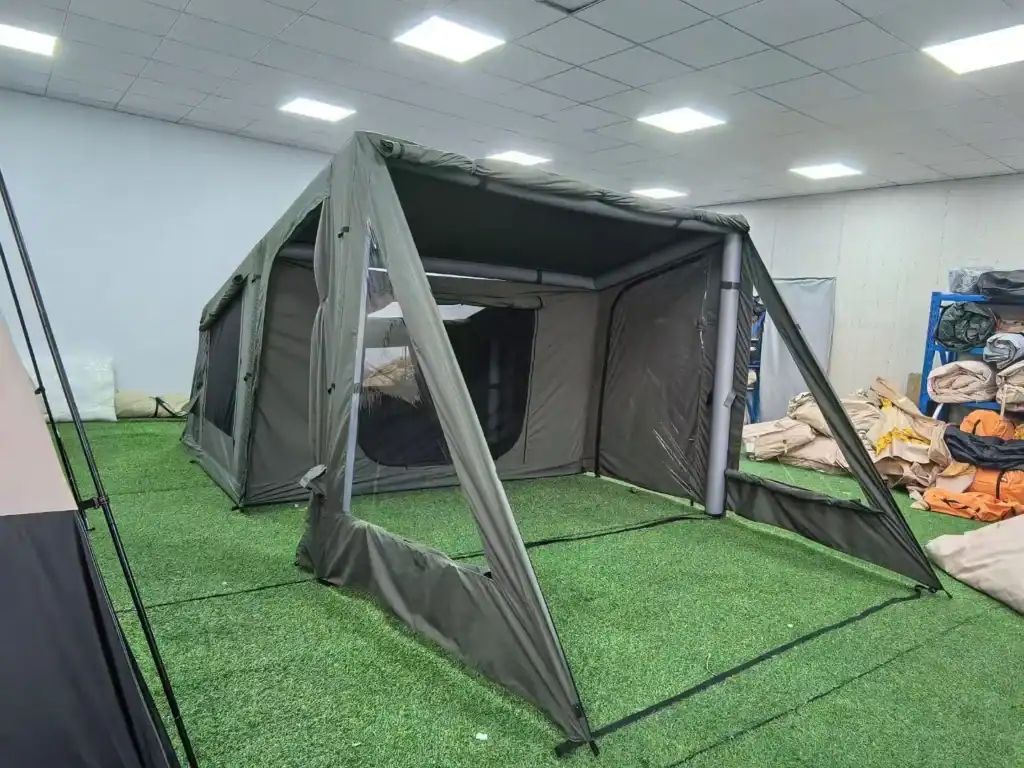
Welded Seams: The Invisible Killer
Punctures get the attention, but microscopic delamination at high-frequency welds causes the biggest failure counts. Air escapes over hours, not seconds. The tent looks fine at setup, sags by 3 a.m., and gets filed as a defect. A 24-hour pressure retention test catches these leaks. Most factories don’t run it.
Kelyland runs through ISO 9001:2015 certified partner factories, with inspections at every production stage. Kelyland’s QC data over 500,000 air tents shows a seam-weld failure rate of 0.8%. That number comes from testing 100% of beams at 1.5x working pressure, not a per-batch sample. Without that same evidence, assume the defect rate is worse.
-
- QC benchmark — puncture resistance: Look for TPU/PVC wall thickness of at least 0.4–0.6mm in written specs.
- QC benchmark — cold weather: Plan for ~12% PSI loss per 10°C drop; confirm pump compatibility for re-inflation.
- QC benchmark — seam integrity: Ask for 24-hour pressure retention test data; Kelyland records 0.8% seam-weld failure across 500,000 units.
How Pole Tents Fail: The Creak and Snap
Poles fail loudly and gradually.
Pole tents don’t fail without warning. The frame creaks, the section bows, and only then does something snap. That sequence is exactly why many supply chain managers prefer pole construction for rental fleets and high-rotation product lines. A failure you can hear is a failure you can repair before it becomes a return.
Aluminum vs Fiberglass Bend Limits
7001-T6 aluminum poles bend up to 30 degrees before permanent set. Fiberglass poles under the same stress splinter with no warning — no creak, no gradual bow, just a broken section inside the sleeve. For end users, that’s a safety difference. For your after-sales ledger, it’s the difference between a customer reporting a bent pole after a storm and a customer returning a ruined tent.
-
- Warning behavior: 7001-T6 aluminum creaks under load before deforming. Fiberglass gives zero audible signal before splintering.
- Field outcome: A bent aluminum pole can often be re-arced and reused. A splintered fiberglass section is dead on the spot.
Ferrule: The Weakest Mechanical Link
The ferrule — the metal connector joining two pole sections — fails at 15-20% of the pole’s rated tensile strength. It’s the first mechanical component to go, long before the pole wall gives out. Quality tolerance at the ferrule crimp determines whether a tent survives 300 setup/teardown cycles or pushes past 800.
Kelyland’s internal cycle testing on pole tents showed visible ferrule wear only after 800+ setup/teardown cycles. The common OEM baseline sits around 300 cycles. The gap comes down to ferrule wall thickness, crimp reinforcement, and how tightly the ferrule tolerance matches the pole’s inner diameter. When auditing a pole tent supplier, ask for the ferrule spec sheet — not just the pole diameter. A supplier that can’t produce that data is guessing.
Field Repair: The 10-Minute Splint
A snapped pole section doesn’t have to trigger a spare-parts claim. A field splint — an aluminum sleeve wrapped with tape — restores about 80% of the pole’s load capacity and lasts 3-5 nights of normal use. That removes the pressure to stock spare pole sections for every SKU. Compare that to an air beam puncture: 30+ minutes with a patch kit, a pump, and a clean dry surface.
For a supply chain manager, repair time is warranty cost. Ten minutes with a $5 splint means the customer stays on site and keeps the tent. Thirty minutes of patching, re-inflating, and waiting for sealant to cure means a higher chance the unit comes back as a return. If you’re comparing FOB pricing between two tent factories, the repair story separates them faster than the frame cost.
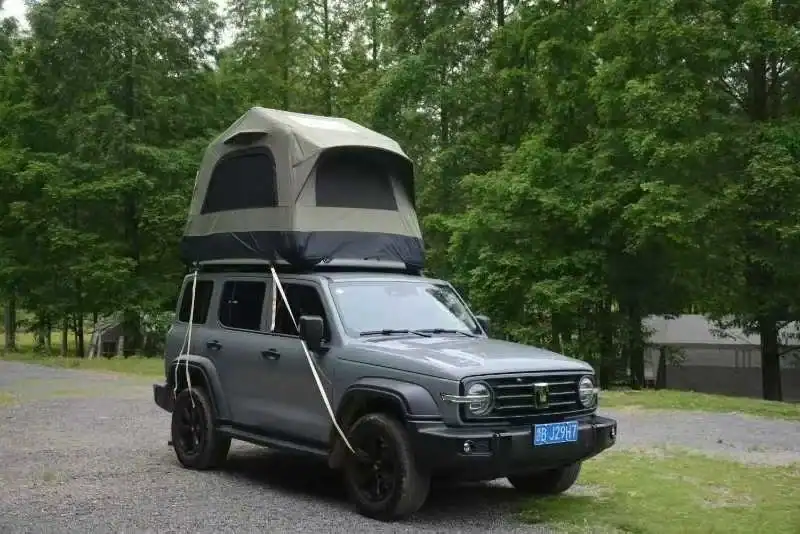
5 Real-World Scenarios: Which Tent Wins?
Air tents fail catastrophically.
Set five tents on the same site and the structure wins on one rule: how the frame announces failure. An air beam bursts in a single gust. A pole bends, creaks, and gives you time to react. For a supply chain manager, that difference controls return rates, injury claims, and brand damage.
Windy Beach Camping
Pole tents take this site. With proper guy lines, a rigid frame holds in sustained winds above 50 mph; air beams flex, then collapse once wind passes 30 mph. Fiberglass poles splinter with no audible cue. 7001-T6 aluminum creaks under stress before bending up to 30 degrees, giving campers a real warning window. Failure risk: Air 4, Pole 2.
Quick Family Weekend
Air tents win the setup race. One pump brings the structure up in under 10 minutes, with no ferrules to align or sections to connect. Families value that speed. The tradeoff is a soft frame that depends on pressure staying right across the whole trip. Failure risk: Air 2, Pole 3.
Sub-Zero Backpacking
Pole tent only. Air beams lose structural pressure when temperatures drop — a 10°C temperature decrease cuts roughly 12% PSI. Below freezing, sagging beams put stress on valves and welded seams. Add a slow leak and you are patching in gloves while the tent deflates. Failure risk: Air 5, Pole 2.
Glamping Festival
Air tents take the aesthetic win. No poles crossing the living space creates a smooth, high-end silhouette. In light festival wind, both frames work fine; the air version simply matches the premium look customers pay for. Failure risk: Air 2, Pole 2.
Long-Term Base Camp
Reliability over weeks points to poles. There is no pressure monitoring, no slow leak at a welded seam, and no pump to carry. A pole frame either holds or bends with warning. Air beams need attention on every setup, and a pinhole leak that empties overnight turns a base camp into a warranty claim. Failure risk: Air 4, Pole 1.
-
-
- Windy beach: Pole wins. Air 4, Pole 2.
- Quick family weekend: Air wins. Air 2, Pole 3.
- Sub-zero backpacking: Pole only. Air 5, Pole 2.
- Glamping festival: Air wins. Air 2, Pole 2.
- Long-term base camp: Pole wins. Air 4, Pole 1.
-
For OEM planners, the scoring matters less than factory evidence. Kelyland’s core tent facility tests 100% of air beams at 1.5x working pressure and logged a 0.8% seam-weld failure rate across 500,000 units. Most factories skip that step and ship beams that fail in the field. ISO 9001-certified welding processes and 24-hour pressure retention checks catch the leaks before your container leaves.
-
- Choose air if: Setup speed and a clean frame matter more than long-term field reliability.
- Choose pole if: Your customers camp in wind, cold, or multi-week trips where gradual failure is acceptable.
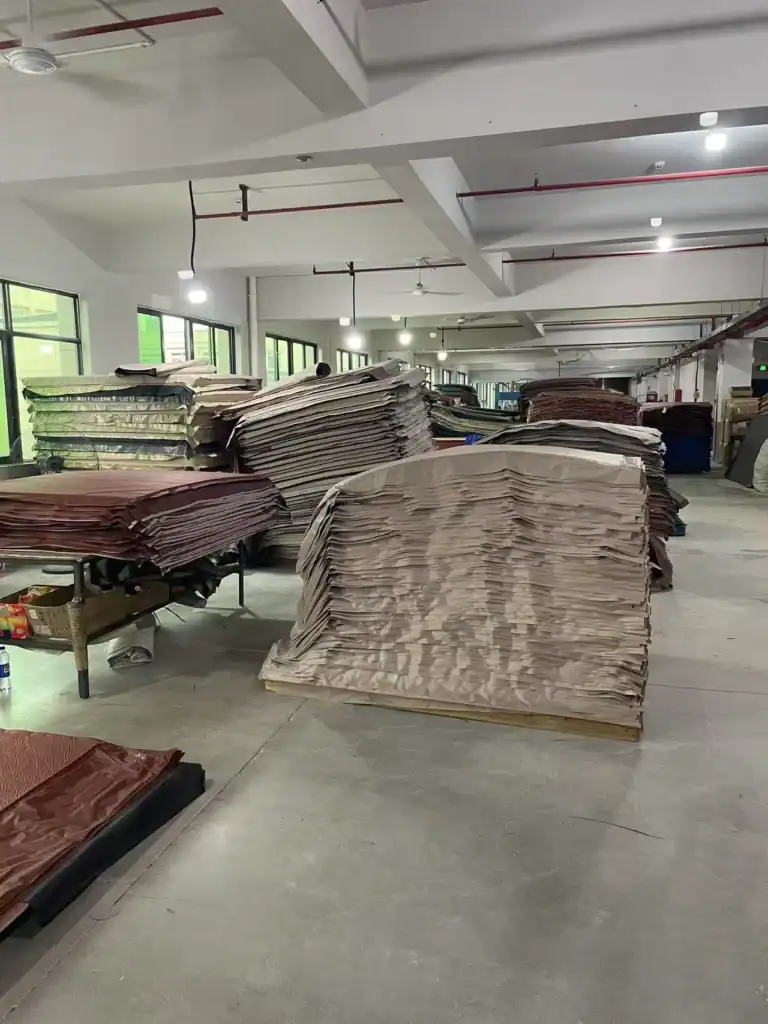
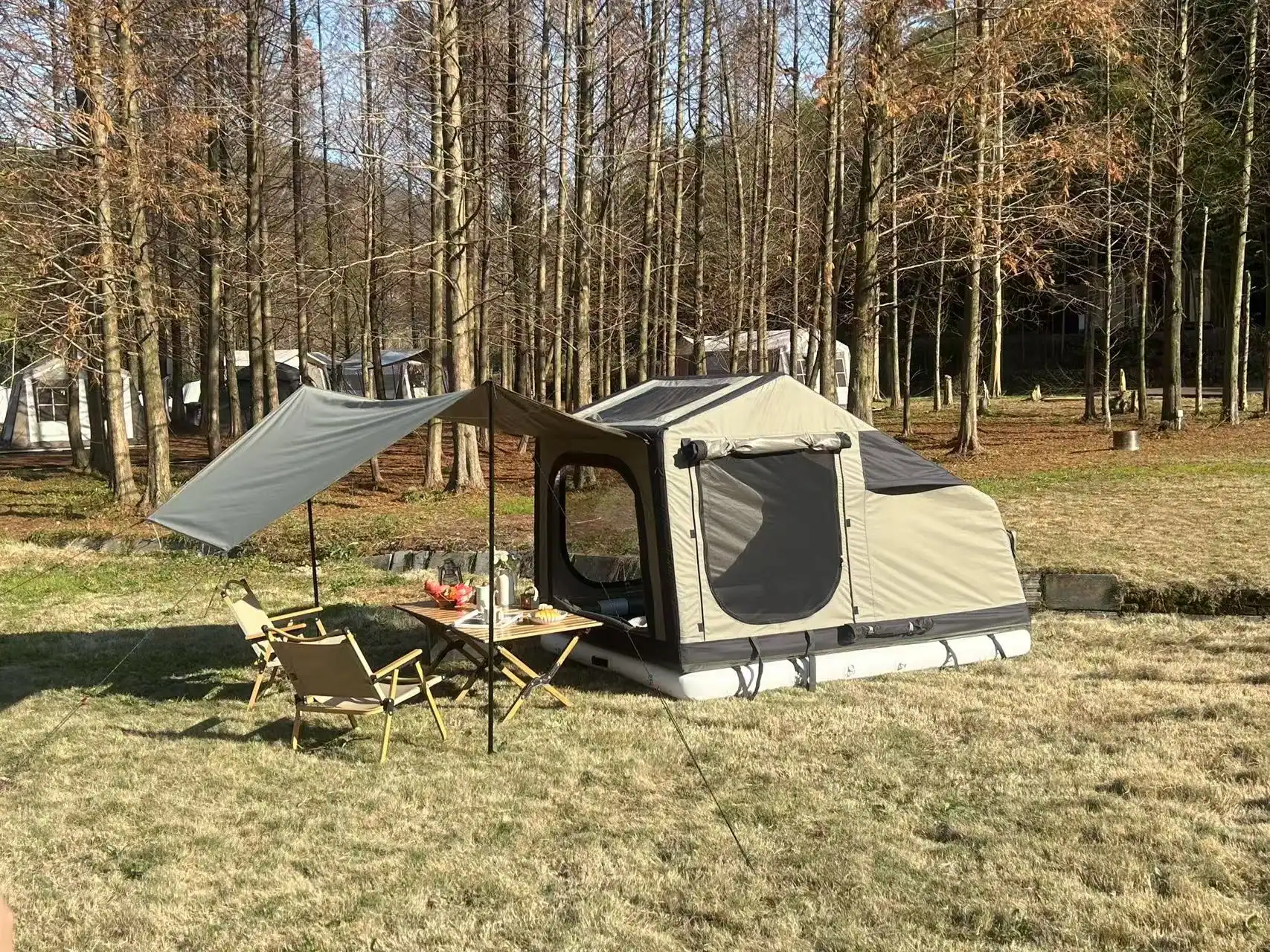
Sourcing Decision: What to Look for in an OEM Factory
Demand 24-hour pressure retention data.
معظم OEM tent quotes look similar on paper: same fabrics, same coatings, similar pricing. The difference shows up in test data. Ask for the QC logs behind each component before you approve a single sample. That is where the real supplier gets separated from the trading company.
Air Beam QC Must-Haves
Air beams fail in three places: the weld seam, the TPU wall, and the valve. A factory that can’t document test results on all three is passing risk to your warranty line. The cost of catching a bad beam inland is cents. The cost of replacing it in the field is the product margin plus a customer complaint.
-
-
- 24-hour pressure retention: Demand batch-level retention tests. Microscopic delamination at high-frequency welds bleeds air overnight and shows up as a sagging tent by morning.
- 100% inflation at 1.5x working pressure: Beams should be inflated at 1.5x working pressure before packing; sample testing only catches the obvious failures.
- TPU wall thickness: Specify 0.6mm minimum wall thickness for TPU beams. Below that, puncture resistance drops sharply on rocky or sandy campsites.
- Pump and valve: Confirm the pump matches the valve fitting and that spare valves are available. A proprietary valve turns a simple field fix into a replacement order.
-
Pole Supplier Stringent Specs
Mechanical failure is the pole tent’s version of a leak. The most important specs are alloy grade, pole diameter, and ferrule construction. If the supplier cannot name the alloy and show a ferrule cross-section, keep looking.
-
-
- Alloy grade: حدد 7001-T6 aluminum. It bends roughly 30° before permanent deformation; fiberglass splinters at the same load without an audible warning.
- Pole diameter: Set 9mm as the minimum for main poles. Anything thinner flexes too much under wind load and accelerates ferrule wear.
- Ferrule: Ask for reinforced ferrules and cycle-test data showing more than 500 setup/teardowns without visible wear. Kelyland’s factory network logged 800+ cycles before ferrule wear appeared.
-
Kelyland’s Manufacturing Edge
Kelyland Outdoors runs air-beam production through an ISO 9001:2015-certified core tent factory. Every beam is inflated at 1.5x working pressure before packing, and batch samples go through 24-hour retention checks. That process produced a 0.8% seam-weld failure rate across 500,000 air tents. Most factories skip this step and hope the leaks surface after the warranty expires.
-
- الاختبار: 100% air beam pressure testing at 1.5x working pressure, plus 24-hour retention checks on batch samples.
- التصديق: ISO 9001:2015-certified production and welding processes across the core partner factory network.
- الحد الأدنى لكمية الطلب (MOQ): Custom tent orders can start at 50 pieces, so you can validate quality before scaling.
- وقت التسليم: Production runs 30-45 days, with export and customs documentation handled by the sourcing team.
Take this list to your next sample approval meeting. Define a written quality tolerance for seam separation, pressure drop, and ferrule wear before signing the production agreement. A factory that can produce the test reports on request is lowering your lifetime warranty cost. A factory that cannot is making you the insurance carrier.
الخاتمة
Air beams burst without warning; poles show a detectable sequence of symptoms before they break. Your warranty liability depends on which failure mode you can predict and repair faster. The difference comes down to minutes and data: a 10-minute pole splint restores 80% of load capacity, while an air patch needs 30-plus minutes plus a spare pump.
-
- Does the factory pressure-test air beams at 1.5x working pressure for 24 hours before shipment?
- Is the pole spec locked to 7001-T6 aluminum with reinforced ferrules audited past 800 setup cycles?
- Can a snapped pole be splinted in under 10 minutes, or does repair require a patch kit and spare pump?
Run these three questions past your current supplier before you commit to another production run. A factory that cannot document pressure retention tests or ferrule cycle data is carrying hidden warranty risk on your behalf. For a benchmark, review the air and pole tent spec sheets on Kelyland’s smart tent sourcing page .
الأسئلة الشائعة
What is the main difference between an inflatable tent and a pole tent?
The main difference is the frame: inflatable tents use pressurized air beams, while pole tents use rigid poles. Air beams fail silently and catastrophically, while poles creak and splinter before gradual collapse. Let this failure mode guide your warranty and field-repair planning.
Do inflatable tents leak air overnight?
They can lose pressure overnight, but a full leak is less common than temperature-related sag. Pressure drops about 12% for every 10°C temperature fall, so a tent inflated at 20°C. Set target pressure at the colder end of your expected overnight range.
How long do inflatable tent beams last before leaking?
With quality TPU or PVC beams and proper care, they can last for years, but seam welds are the weak point. Factory data shows a 0.8% seam-weld failure rate on 500,000 air tents. Specify 24-hour pressure-retention testing before approving a production run.
Can you repair a snapped tent pole in the field?
Yes, a snapped pole can usually be fixed in about 10 minutes with a splint and tape. This is the practical advantage of pole tents: they give audible warning. For air tents, plan for patch kits and a backup inflation method instead.
Which tent type is better for windy conditions?
Pole tents are generally the safer choice in high wind because they give audible warning before failure. Air beams can burst silently under gusts above roughly 30 mph, while poles. Choose pole-frame designs for high-wind markets or require full beam burst testing.

 English
  Español
  Deutsch
  Français
  Português do Brasil
  Русский
  العربية
  한국어
한국어  日本語
日本語