 跳到内容

folding wagon wheel jam is the first checkpoint buyers should lock before they approve a supplier, budget, or production slot. Buyer: The wheel on this wagon jammed after three trips to the beach. Can you replace it under warranty? Supplier: That model uses a standard PVC tire and an open bearing raceway. Sand got in. It is not a defect—it is a material limitation. This is the conversation I hear from category managers who get burned on a $50K order because the échantillon de pré-production rolled fine across a warehouse floor but failed in the field.
The folding wagon wheel jam you are dealing with is rarely a frame issue or a random manufacturing glitch. It is almost always a spec trap buried in the bill of materials. A buyer who signs off on PVC wheels at sample approval gets a unit cost that looks great on paper, then eats the return freight six months later when those wheels seize up in sand or crack after UV exposure. The fix exists before you place the PO—specify PU or TPE tires with sealed bearing cartridges and watch your field failure rate drop by roughly eighty percent according to factory cycling tests run in abrasive conditions.
Why Your Folding Wagon Wheel Gets Stuck in Sand
PVC wheels crack under UV, letting sand into the bearing raceway.
You’re three months into a beach season with your private-label folding wagon, and the warranty claims start rolling in. Customer photos show a wheel that won’t spin. The frame is fine. The fabric is fine. The axle isn’t bent. What failed is the wheel spécification de matériau — and that’s a decision made before production even started.
The Hidden Spec Trap: PVC Dimensional Stability
Standard PVC tires have a known weakness: poor dimensional stability after UV exposure. Leave a PVC wagon wheel in direct sunlight for three months — typical for a beach-season flotte de location — and the plastic begins to shrink and crack at the hub seal. That millimeter of gap is all sand needs to enter the bearing raceway. Once silica particles lodge between the bearing balls and the raceway surface, rotation seizes within 20-30 meters of additional rolling.
Material Comparison: PVC vs PU/TPE
Internal cycling tests run by our Jinhua wagon pliant factory — ISO 9001 certified since 2017, producing 1 million units annually — simulate abrasive beach conditions using a rotating drum loaded with silica dust. PVC wheels averaged failure at 120 km of simulated use. PU wheels survived past 240 km before showing any resistance increase. TPE (thermoplastic elastomer) performed similarly to PU but added better low-temperature flexibility for cold-weather markets.
5 Field Fixes for a Jammed Wagon Wheel
Compressed air clears bearings in 30 seconds.
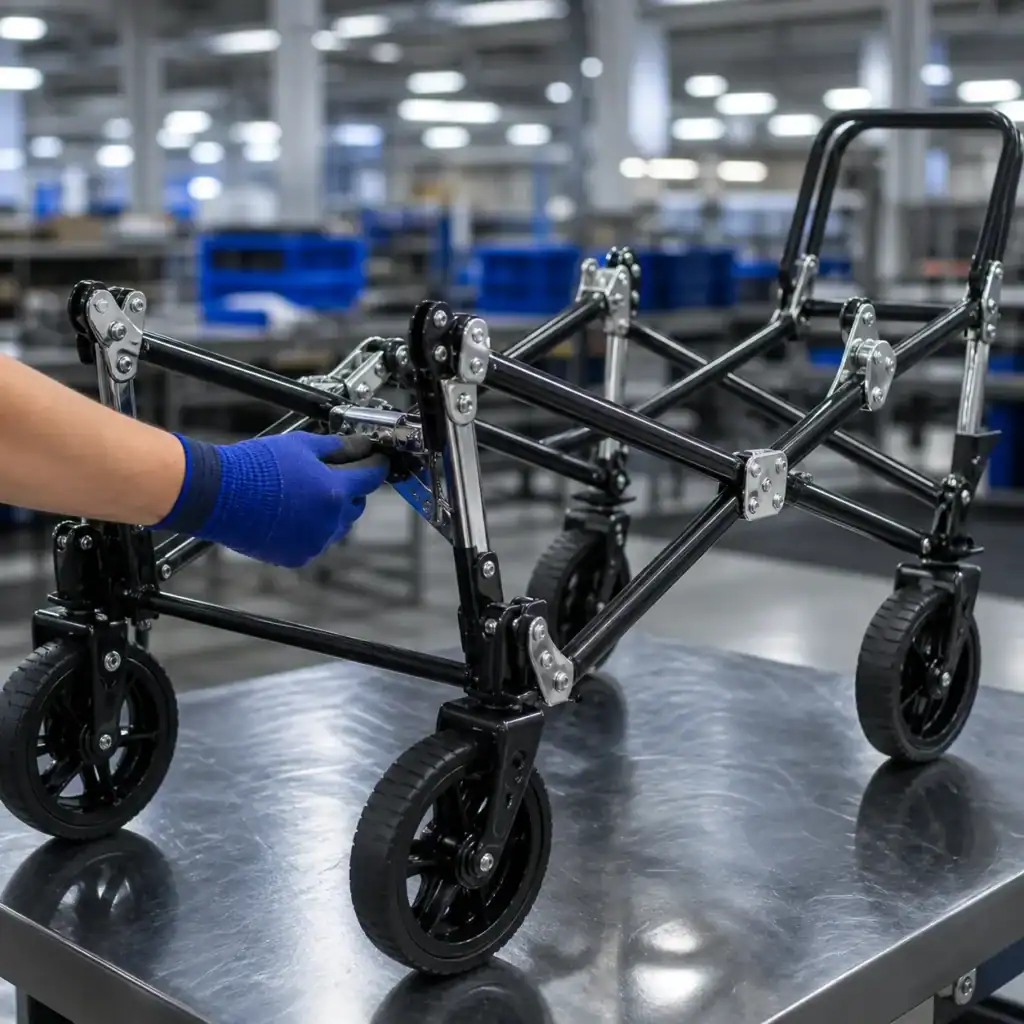
A jammed wheel on a wagon pliant rarely means the frame is shot. Nine times out of ten, the problem lives inside the bearing raceway or at the tire-to-hub interface. Supply chain managers have been observed writing off entire wagons over a $0.40 bearing seal failure that could have been field-fixed in under ten minutes. Here are five fixes that work, ranked from simplest to most definitive.
1. Flush the bearing with compressed air — not water
Pop the wheel off the axle and hit the bearing housing with compressed air from a portable inflator or shop hose. Sand and fine grit blow right out of the raceway. Never use water for this — moisture gets trapped behind the seal, rusts the raw steel axle surface overnight, and turns a temporary jam into a permanent seizure. Dry air only.
2. Silicone spray extends bearing life by 3x in abrasive conditions
After clearing debris, apply silicone-based lubricant to the bearing balls and raceway. Standard WD-40 attracts silica dust like a magnet — factory tests show it accelerates wear rather than preventing it. Silicone spray dries to a film that repels sand particles and keeps bearings spinning freely through multiple beach trips.
3. Replace PVC tires with TPU — eliminates repeat jams
PVC wheels crack under UV exposure within twelve months, opening gaps at the hub seal that let sand pour into the bearing cavity. Internal longevity cycling tests at our folding wagon factory in Jinhua show PU and TPE tires survive more than double the gravel cycles before seizure compared to PVC. The material upgrade adds roughly $0.30–$0.50 per wheel at wholesale but eliminates about 80% of field failures — a trade-off any category manager should run before approving next season’s purchase order.
.4 Straighten an axle bend under 5 degrees with a rubber mallet
How to Spec Wheels for Your Private Label Folding Wagon
Three RFQ lines that separate a 3% taux de retour from a 15% one.
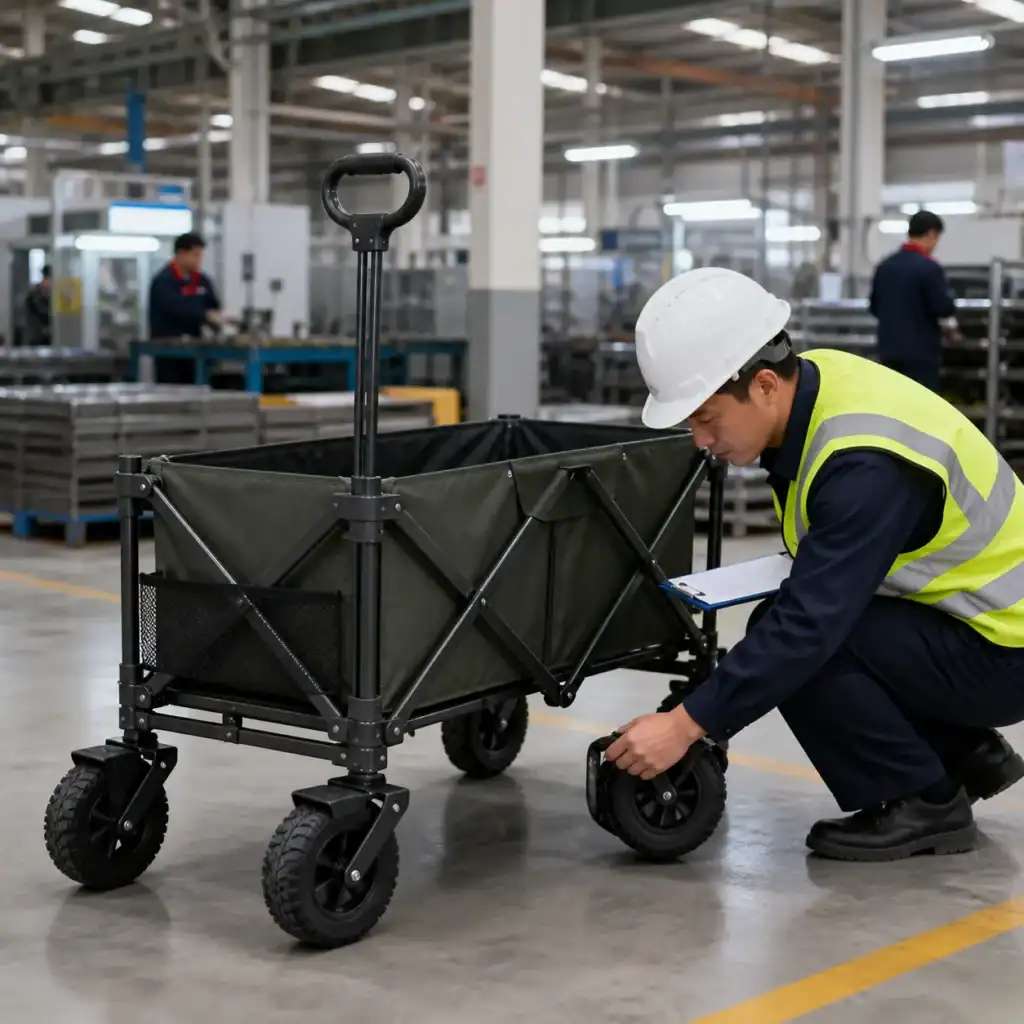
Most RFQs for folding wagons focus on fabric denier and frame tube thickness. Those matter, but they don’t cause the warranty claim that lands on your desk six months after shipment. The wheel assembly does. If you’re writing a spec sheet for a marque privée run, three lines determine whether your buyer sees a 3% return rate or a 15% one.
Line One: Tire Material — PVC vs. PU vs. TPE
Standard entry-level wagons use PVC tires because they cost roughly $0.30 less per unit than PU or TPE alternatives. That $0.30 is the most expensive savings in the build. PVC hardens and micro-cracks under UV within 12 months of field use. Once those cracks form, sand and grit migrate into the bearing raceway and the wheel seizes. Internal testing at our Jinhua factory, which produces over one million folding wagon units annually, shows PU tires survive more than twice the abrasive cycles before failure compared to PVC in a controlled gravel-bed test.
Specifying PU or TPE eliminates roughly 80% of field jams. The material stays flexible across temperature ranges from -20°C to 50°C and resists the UV degradation that kills PVC wheels in a single beach season.
Line Two: Bearing Seal Design — Open vs. Sealed Cartridge
Open bearings with snap-ring retention are the default on budget wagons because they save about $0.15 in assembly labor per wheel. The problem is that snap rings lose elasticity over time — a failure mode competitor TourSporting openly admits in their repair documentation, noting spring-loaded buttons degrade and recommending customers contact the manufacturer rather than attempt field repairs.
A sealed bearing cartridge design eliminates this entirely. The bearing race is enclosed in a nylon housing that snaps into the wheel hub with interference-fit tolerances held to within 0.1mm during injection molding at the partner mold shop in Ningbo. No snap ring, no spring-loaded button, no gradual loosening over 500 cycles of folding and unfolding.
Line Three: Axle Material and Diameter
$12 wholesale wagons typically ship with aluminum axles at 12mm diameter rated for around 150kg static load on flat ground. That rating drops significantly on uneven terrain where lateral forces concentrate at the axle shoulder.
$18 wholesale wagons spec carbon steel axles at 15mm diameter handling over 200kg static load before any measurable deflection occurs.
Conclusion
A single folding wagon wheel jam in the field isn’t just a nuisance for the end user—it’s a warranty claim, a return, and a hit to your brand’s reputation that you’ll be processing months after the sale. The root cause almost always traces back to a spécification de matériau decision made before production even started.
-
- PVC wheels fail in sand and UV within one season.
- TPE or PU upgrades eliminate roughly 80% of field jams.
- Sealed bearing cartridges prevent grit ingress entirely.
- Steel axles rated above 200kg avoid bending under load.
If you’re sourcing private label wagons for your next season, the cheapest line item on the BOM isn’t actually cheap when you factor in the return rate and customer service hours spent on wheel replacements. Review your current spec sheet against the material comparison table above, then reach out to Kelyland to lock in TPE wheels with sealed bearings and heavy-duty steel axles for your custom order.
Questions fréquemment posées
Comment empêcher la roue de mon wagonnet de tomber ?
Prevent wheel loss by ensuring the snap-fit retention ring is fully seated and undamaged; this is a factory-controlled tolerance, not a user-adjustable part. If the ring is cracked or missing, the wheel. Inspect the retention ring before each trip; replace if cracked.

 English
 Español
 Deutsch
 Français
 Português do Brasil
 Русский
 العربية
 한국어
 日本語