 跳到内容
跳到内容 
Vous avez lu le indice de colonne d'eau de la tente guide que votre usine potentielle vous a envoyé. 3000mm semble bien sur la fiche technique. L'échantillon de pré-production a réussi le test en laboratoire avec zéro fuite. Six mois plus tard, votre commande de production en série de $50 000 unités génère des retours, et la fiche technique n'explique pas pourquoi le double toit s'humidifie après deux week-ends. La réponse honnête qu'aucun fournisseur ne veut admettre ? La valeur de charge hydrostatique sur l'échantillon de tissu n'a presque rien à voir avec ce qui arrive dans votre entrepôt.
Le véritable chemin de fuite se situe quelque part entre la salle d'approbation des échantillons et l'atelier de production. Une buse d'air chaud pour ruban de jointure qui devrait fonctionner entre 550-650°C avec un temps de maintien de 0,8 à 1,2 secondes est bâclée. Lorsqu'une usine s'active pour respecter un délai de 30 jours pour votre accord de tarification FOB, la buse descend sous 500°C. La liaison semble terminée. Elle passe une inspection visuelle rapide. Vingt cycles de montage plus tard, le ruban se délamine, et la couture devient une gouttière. Ce mode de défaillance n'apparaît pas lors d'un test de charge hydrostatique ponctuel. Il ne se manifeste qu'après que la tente a été pliée, tendue et montée à plusieurs reprises.
Ignorer le problème et il s'aggrave. Les tissus enduits de polyuréthane se dégradent silencieusement par hydrolyse dans tout entrepôt où l'humidité dépasse 60%. Une tente qui passe le contrôle qualité avec une lecture HH parfaite en juin peut fuir en décembre sans avoir été utilisée une seule fois — les polymères à base d'ester absorbent l'humidité ambiante et se décomposent au niveau moléculaire. Vous supportez le coût des retours, l'atteinte à la marque et la prochaine commande, tout cela parce que le contrat d'achat initial comportait une tolérance de qualité pour les chiffres de laboratoire, et non pour les conditions de stockage réelles.
Résoudre ce problème ne commence pas par un objectif de charge hydrostatique plus élevé. Cela commence par comprendre quelles variables de fabrication contrôlent réellement les performances sur le terrain, et savoir comment rédiger des clauses techniques qui obligent l'usine à prouver la liaison, pas seulement le tissu.
La réalité de la charge hydrostatique : pourquoi l'eau traverse le tissu
Le chiffre de la fiche technique ne signifie rien si le test de laboratoire ignore la pression dynamique réelle.
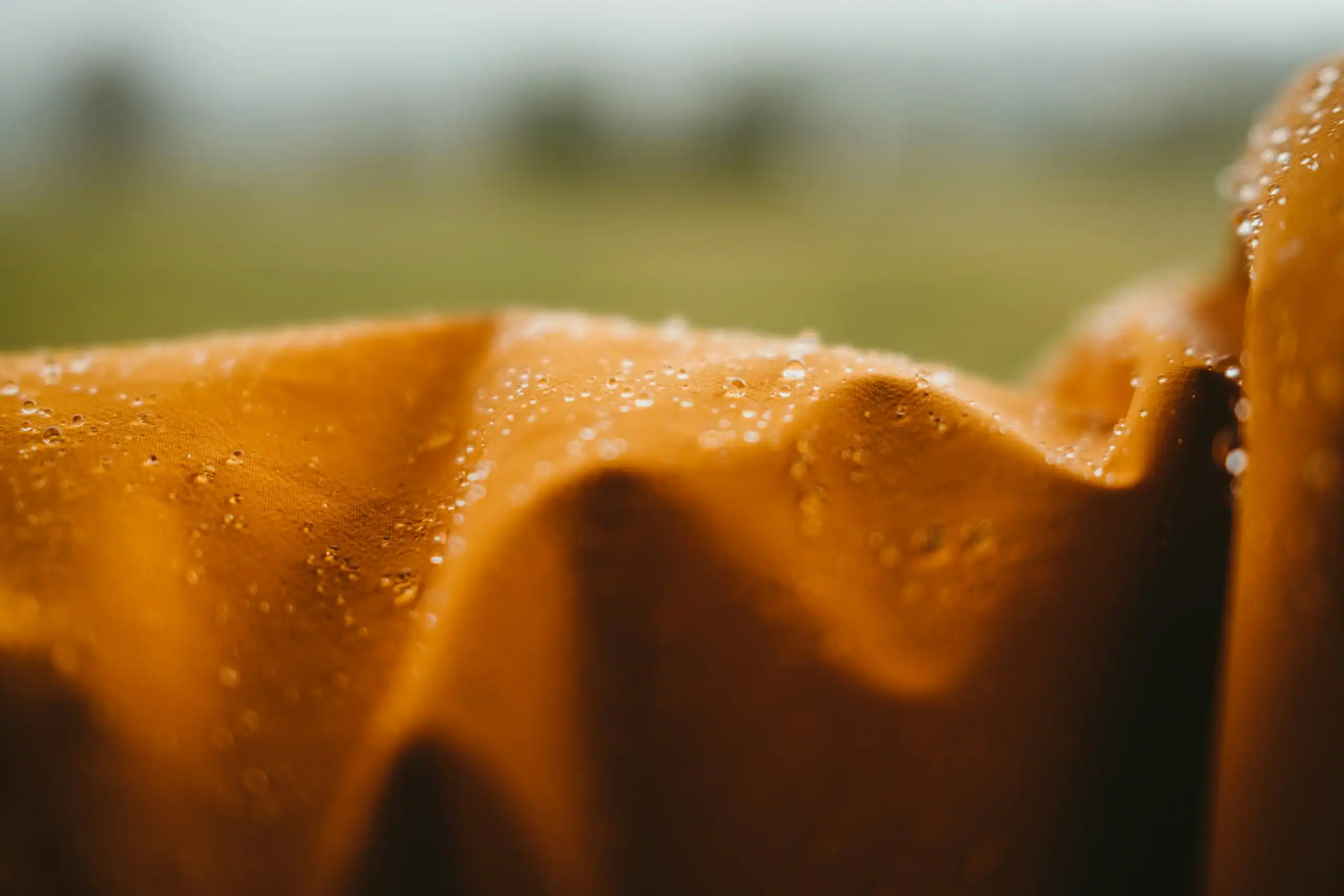
Un double-toit de tente avec un indice HH de 3000 mm échoue lors d'une tempête non pas parce que le tissu est défectueux, mais parce qu'un test de laboratoire sur un seul point ne reproduit pas la pluie poussée par le vent frappant un polyester étiré et saturé. Les rapports SGS et Intertek montrent un tissu maintenu à plat sous une colonne d'eau verticale. Le terrain est différent. Un tissu sous tension ouvre le tissage. La pluie se déplaçant à 40 mph exerce une force latérale qu'une colonne statique ne simule jamais. Cet indice de 3000 mm chute effectivement de moitié lorsque le double-toit est haubané serré et que le vent pousse l'eau latéralement à travers les intersections des fils.
-
- Protocole ISO 811 / AATCC 127: Un échantillon de tissu de 100 cm² est fixé sous une colonne d'eau montante à un débit de 10 cm H₂O/min ou 60 cm H₂O/min. Le test enregistre la pression lorsque trois gouttelettes pénètrent. Il s'agit d'une réussite ponctuelle. Il ne dit rien sur ce qui se passe après 50 cycles de montage lorsque le revêtement PU commence à se microfissurer au niveau des plis.
- Écart dynamique vs statique : Un test de pression répété importe plus que le chiffre maximal. Un tissu qui réussit 3000 mm une fois mais échoue à 1800 mm après 10 000 cycles de pression d'eau sur un testeur de fatigue hydrostatique est un risque. Demandez une courbe de fatigue, pas un seul point de données.
- Réalité de la pression au sol : Un adulte agenouillé exerce une pression d'eau localisée de 3000 à 4000 mm sur le plancher d'une tente. C'est pourquoi les indices de 5000 mm et plus pour le tapis de sol ne sont pas du battage marketing — ils constituent le minimum pour empêcher l'eau de traverser le plancher en cuvette et d'atteindre votre matelas de sol.
Le véritable échec n'est pas le chiffre HH imprimé sur l'étiquette. C'est l'usine qui produit un certificat de laboratoire ponctuel sur un revêtement neuf, puis expédie des unités de production dont la couche PU a été amincie de 15 à 20 % en raison des variations de pression des rouleaux pendant l'application. J'ai prélevé des échantillons de lots où le panneau central testait 3100 mm mais les panneaux d'angle — enduits à partir du bord du rouleau — atteignaient à peine 2100 mm. Même rouleau, même spécification, performance radicalement différente.
La solution consiste à rédiger une clause dans l'accord d'achat exigeant des tests HH à trois points par panneau — centre, bord et point médian diagonal — sans qu'aucune mesure ne tombe sous 80 % de l'indice nominal. La plupart des usines accepteront cela si vous le demandez avant l'acompte. Peu le proposent d'elles-mêmes. Celles qui résistent vous en disent long sur leur calibrage des rouleaux.
Exigez un rapport de test de fatigue sur 10 000 cycles. Un testeur de pression hydrostatique applique des cycles de pression d'eau contre la surface du tissu à plusieurs reprises, simulant des années d'impact de pluie, de compression dans le sac, et de pression du poids du corps. Ce que vous voyez au 5000e cycle est ce que votre client voit en deuxième saison. L'amincissement du revêtement et la micro-abrasion sont invisibles lors d'une réussite ponctuelle mais flagrants sur une courbe de fatigue. Si l'usine ne peut pas produire ce rapport, négociez un échantillon de pré-production et envoyez-le vous-même à SGS ou à Bureau Veritas avant de valider la production de masse.
PU contre silicone contre PVC : le combat à mort des enductions
L’horloge cachée d’hydrolyse du PU commence à tourner le jour où le tissu sort du bain d’enduction.
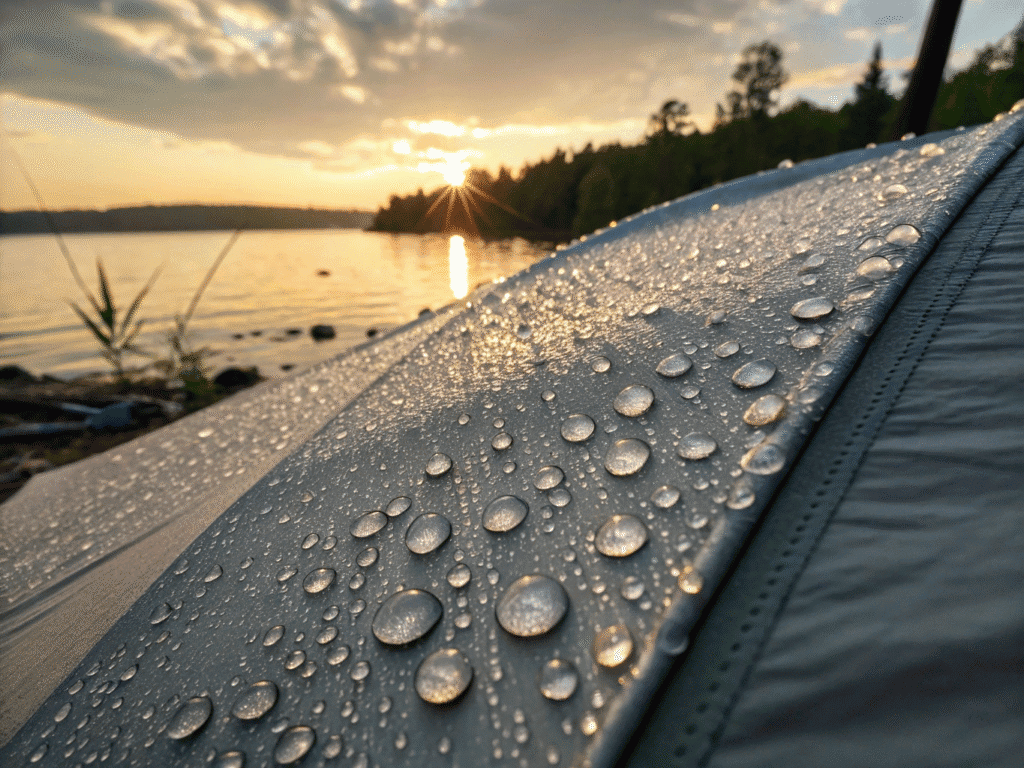
La plupart des acheteurs considèrent encore le PU comme l’option sûre par défaut. Cet instinct coûte aux marques des millions en réclamations de garantie. Les enductions de polyuréthane échouent par hydrolyse — une réaction chimique où les liaisons ester de la chaîne polymère absorbent l’humidité ambiante et se rompent. Le résultat est un désordre collant et qui pèle. Dans un entrepôt à 60% d’humidité relative, un flysheet parfaitement bon de 3 000 mm HH peut se dégrader jusqu’à moins de 1 000 mm en 18 mois sans voir une seule goutte de pluie. Les tests de vieillissement accéléré à 70 °C et 95% RH pendant 7 jours simulent cet effondrement en 3 à 5 ans. Si votre fournisseur ne peut pas produire des relevés HH avant/après de ce test, vous achetez une bombe à retardement.
Les enductions silicone contournent entièrement l’hydrolyse. Appliquée via un bain à base de solvant, la silicone pénètre dans le faisceau de fils plutôt que de rester en surface. Cette saturation profonde ajoute 15 à 25 kg de résistance à la déchirure par bande de 5 cm — un chiffre qui se traduit directement par moins d’éclatements par vent fort. Le polyester traité à la silicone offre une durée de vie de 8 à 10 ans, mais il y a un inconvénient de fabrication : la surface lisse résiste à l’adhérence des rubans de couture standard. Les usines doivent utiliser des rubans spéciaux compatibles silicone ou des composés liquides d’étanchéité des coutures, ce qui ajoute environ 20-40% au coût du flysheet. Pour une tente de détail de milieu de gamme, cette augmentation de coût disparaît après la première saison sans retour pour hydrolyse.
Les matériaux de sol vivent dans un univers différent des flysheets. Le débat ici oppose le PE au treillis PVC/TPU. Les bâches de sol standard en PE à 120 g/m² développent des microfissures après 50 à 100 cycles de pliage par temps froid — chaque pli est un futur chemin de fuite. Le treillis enduit PVC/TPU à 500 g/m² élimine les microfissures et offre une résistance à la perforation à une épaisseur de 0,4 à 0,6 mm, mais il est 30-50% plus lourd et plus volumineux une fois plié. Pour les tentes d’expédition ou les canaux vendant en terrain rocheux, la pénalité de poids est triviale par rapport à un taux de retour pour fuites de sol.
-
- PU : Durée de vie de 3 à 5 ans ; se dégrade par hydrolyse à >60% RH ; coût le plus bas par yard mais risque de retour caché le plus élevé. Spécifiez un test de vieillissement accéléré de 7 jours à 70 °C/95% RH dans votre contrat d’achat.
- Silicone : Durée de vie de 8 à 10 ans ; augmente la résistance à la déchirure de 15 à 25 kg/5 cm ; nécessite un ruban de couture ou un mastic spécialisé. La prime est rentabilisée par la protection de la marque.
- Sol en treillis PVC/TPU : Couche résistante à la perforation de 0,4 à 0,6 mm ; classe de poids 500 g/m² ; zéro microfissure même après des milliers de pliages. Utiliser là où les conditions du sol constituent le principal mode de défaillance.
L'autopsie du ruban de jointure : pourquoi votre tente fuit au niveau des coutures
Le délaminage du ruban d'ourlet n'est pas de l'usure—c'est un défaut de production que vous pouvez détecter avec un ongle.
Le ruban en polyuréthane thermoplastique (TPU) qui scelle les trous d'aiguille est lié au tissu par une buse à air chaud fonctionnant à 550–650°C. La buse doit rester sur la couture pendant exactement 0,8 à 1,2 seconde. Une durée plus courte—fréquente lorsqu'une usine accélère la cadence pour respecter un délai de 30 jours—et la couche adhésive ne fond jamais complètement dans le fil. Le résultat est une fixation de surface faible qui semble intacte à l'inspection finale mais commence à se décoller après 20 à 30 cycles de pitch.
-
- Liaison correcte : Buse à 600°C, temps de maintien de 1,0 seconde. Le TPU s'écoule dans le tissage et forme une crête lisse et translucide. Lorsque vous passez un ongle le long du bord, il glisse sans accrocher.
- Liaison précipitée : Buse sous 500°C ou temps de maintien sous 0,6 seconde. Le ruban n'adhère qu'au duvet de surface. Un test à l'ongle soulève immédiatement le bord, et vous verrez souvent des bulles d'air piégées sous le ruban.
Ce contrôle par grattage à l'ongle est l'audit terrain le plus rapide que vous puissiez effectuer. Parcourez la ligne de production, prélevez une tente de chaque lot, et passez votre ongle sur trois points de chaque couture principale—arête du double-toit, fourreaux de mât et coins de la baignoire. Si le ruban se soulève, le lot est refusé. Aucun équipement de laboratoire requis.
Pour une assurance qualité documentée, spécifiez les essais de pelage ASTM D3330 ou ISO 11339 dans votre contrat d'achat. Une force de crête minimale de 15 N/25mm est le seuil industriel pour une imperméabilisation durable. Exigez un rapport de résistance au pelage par lot de production, pas seulement un certificat unique. Les usines partenaires du réseau de Kelyland peuvent fournir ces rapports—ainsi que des données HH testées en fatigue et des résultats de vieillissement accéléré—avant la libération de l'expédition, afin que vous ayez des preuves concrètes que le joint ne se dégradera pas après l'arrivée du conteneur à l'entrepôt.
Ce qui brûle les acheteurs, ce n'est pas le matériau du ruban lui-même. C'est l'écart entre la tente d'approbation d'échantillon—toujours fabriquée avec des réglages de maintien parfaits—et la production en série, où l'on grignote des secondes. Inscrivez la fenêtre de 0,8 à 1,2 seconde dans le point de contrôle qualité. Si un fournisseur ne peut pas contrôler la température de la buse à cette tolérance, ses coutures fuiront.
Au-delà du tissu : les matériaux de sol et les points faibles des fermetures éclair
Les fuites au sol ne sont pas aléatoires—ce sont des défaillances de spécifications que vous pouvez attribuer à deux éléments : le grade du matériau des coins et le type de fermeture éclair.
En 12 ans de gestion de l'approvisionnement en tentes à travers l'Asie du Sud-Est, le point de défaillance le plus négligé reste le coin du sol en cuvette. Un tissu de sol standard en PE 120g/m² développe des micro-fissures après 50 à 100 cycles de pliage. Cela semble beaucoup jusqu'à ce que vous réalisiez qu'une tente subit 4 pliages à chaque fois qu'elle est emballée, et que votre client final atteindra ce seuil avant la deuxième saison de camping. La solution est un sol en treillis PVC à 500g/m², qui survit à des milliers de cycles de pliage sans perdre son intégrité. C'est plus lourd, oui, mais l'alternative est un taux de retour qui ronge votre marge sur toute la commande.
-
- Sol en PE 120g/m² : Développe des micro-fissures après 50 à 100 pliages. L'eau pénètre aux points de contrainte dans les coins de la cuvette. Acceptable uniquement pour les tentes de festival jetables ou les articles promotionnels à usage unique.
- Sol en treillis PVC 500g/m² : Résiste à des milliers de cycles de pliage. Ajoute environ 200 à 300 g au poids emballé d'une tente 4 personnes, mais élimine les fissures aux coins. Utilisez des pièces de renfort d'angle avec des coutures scellées pour une durabilité de qualité expédition.
L'infiltration d'eau par les fermetures à glissière est l'autre tueur de marge silencieux. Les fermetures à glissière à spirale standard #5 ou #8 n'ont aucune capacité d'étanchéité : l'eau traverse directement les dents imbriquées et sature le ruban. Sous une forte pluie, une seule fermeture à glissière à spirale standard sur la porte principale peut canaliser un demi-litre d'eau dans le corps de la tente en 20 minutes. La solution technique est une fermeture à glissière étanche comme la YKK AquaGuard, qui utilise un laminage polyuréthane sur le ruban et une lèvre d'étanchéité qui bloque l'entrée de l'eau. L'écart de coût est de $3 à $8 par fermeture à glissière, selon la longueur et le volume. Pour une tente familiale à deux portes, cela représente un impact BOM de $16. Mais l'alternative est un client qui ouvre une tente au camping et découvre une flaque à l'intérieur—un retour qui vous coûte $60 à $80 en remboursements, expédition et atteinte à la marque.
L'équation coût-retour est simple. Passer d'un sol en PE à un sol en treillis PVC ajoute environ $2.50 par tente au prix FOB. Les fermetures à glissière étanches ajoutent encore $3 à $8 par porte. Ensemble, une mise à niveau entièrement étanche du sol et des fermetures à glissière revient à $10 à $15 par tente. Mais les données internes du contrôle qualité d'approbation des échantillons d'usine montrent une réduction de 40% des retours pour fuite du sol et une baisse de 80% des réclamations pour infiltration d'eau liée aux fermetures à glissière lorsque les deux mises à niveau sont spécifiées. Pour un détaillant commandant 5 000 unités, cette augmentation de nomenclature de $50 000 à $75 000 évite environ 200 retours à $60+ chacun—une économie directe de $12 000, plus l'érosion de la marque évitée qui n'apparaît jamais au bilan.
Dans votre bon de commande, précisez trois éléments sans aucune ambiguïté : (1) Le matériau du sol en cuvette doit être un treillis enduit de PVC de 500g/m² avec des pièces d'angle scellées et renforcées cousues avec une couture à point noué à double aiguille ; (2) Les fermetures à glissière de la porte principale doivent être des YKK AquaGuard #10 ou équivalentes avec une certification d'étanchéité documentée ; et (3) Le contrôle qualité en ligne doit inclure une inspection des coutures d'angle à un grossissement de 30x pour détecter les micro-fissures et un test de fonctionnement de la fermeture à glissière sous une colonne d'eau de 200 mm pendant 3 minutes. Sans ces clauses, vous acceptez ce que l'usine décide d'avoir le plus facile à produire—et le plus facile à échouer.
| Composant | Matériau | Pour | Cons | Note d'approvisionnement |
|---|---|---|---|---|
| Fond en cuve (PE) | PE 120 g/m² | Léger, faible coût | Micro-fissures après 50 à 100 pliages ; fuites aux angles de contrainte | Ajouter des renforts d'angle pour les tentes à usage intensif |
| Fond en cuve (maille PVC/TPU) | Maille PVC/TPU 500 g/m² | Haute résistance à la perforation, supporte des milliers de pliages, résistant aux fissures | 30 à 50 % plus lourd, ajoute environ $2,50 par unité | Spécifier un plancher PVC 500 g/m² avec coins renforcés dans le bon de commande |
| Fermeture éclair (spirale standard) | Fermeture éclair à spirale #5 ou #8 | Faible coût, facile à se procurer | Aucune résistance à l'eau ; infiltrations à travers les dents et le ruban | Limiter aux poches intérieures ou aux ouvertures non exposées |
| Fermeture à glissière (imperméable/étanche à l'air) | YKK AquaGuard (ruban stratifié PU et lèvre d'étanchéité) | Bloque entièrement l'entrée d'eau par la ligne de fermeture à glissière | Augmentation du coût de 3 à 5 fois ($3–8/fermeture), processus de liaison plus strict | Exiger YKK AquaGuard #10 sur la porte principale ; test fonctionnel en contrôle qualité |
Conclusion
Identifier les modes de défaillance réels — l'hydrolyse qui ronge les revêtements PU de l'intérieur, le délaminage des rubans de couture dû à un temps de maintien manqué de 0,2 seconde, et la fissuration du tissu de sol sous la pression des genoux — change la conversation de la lutte contre les garanties à la protection des marges. Écrire ces modes de défaillance dans un contrat d'achat avec des seuils de réussite/échec transforme une fiche technique d'un espoir en un contrat.
Comparez votre prochaine commande à la résistance au pelage ASTM D3330 de 15 N/25 mm et à un test de fatigue de 10 000 cycles sur le matériau du sol. Lorsque vous discutez des prix FOB et des délais d'approbation des échantillons avec une usine, demandez le rapport de vieillissement accéléré provenant du même lot de production. Ce seul document distingue un fournisseur qui comprend tolérance de qualité de celui qui expédie une bombe à retardement de taux de retour.
Questions fréquemment posées
Quelle est une bonne valeur de colonne d'eau pour une tente de camping ?
Un bon indice dépend du composant : 1500 mm pour les doubles toits en cas de pluie légère, 3000 mm pour les tentes par gros temps, et 5000 mm+ pour les sols en cuvette qui résistent à la pression des genoux. Le vrai test est. Toujours préciser l'indice par composant et demander le protocole de test dynamique de l'usine.
Comment réparer les coutures de tente qui fuient sans remplacer toute la tente ?
Re-scellez les coutures défectueuses en appliquant un produit d'étanchéité liquide le long des trous d'aiguille à l'intérieur, ou recollez le ruban délaminé avec un ruban de réparation thermocollant et un fer domestique. Vérifiez l'adhérence du ruban de couture à la réception d'un lot—décollez-le pour détecter les défauts de production dès le début.
Pourquoi le sol de ma tente semble-t-il humide même s'il n'y a pas de trous ?
La condensation d'un sol chaud rencontrant un sol froid, ou un revêtement usé avec une colonne d'eau inférieure à 3000 mm, laisse passer l'humidité sous le poids du corps même sans déchirures. Un simple test sur le terrain avec. Remplacez le tapis de sol si le revêtement s'est dégradé au-delà de tout re-scellement.
Quelle est la différence entre les revêtements de tente PU, silicone et PVC ?
Le PU est abordable mais se dégrade par hydrolyse en 3 à 5 ans ; le silicone dure 8 à 10 ans et est plus léger ; le PVC est lourd, totalement imperméable et utilisé pour les épais tapis de sol. Le type d'enduction a un impact direct. Choisissez le silicone pour les double-toits sensibles au poids et le PVC pour les sols soumis à haute pression.
Combien de temps le revêtement imperméable d'une tente doit-il durer avant de devoir être ré-étanchéifié ?
Les revêtements en PU nécessitent généralement une nouvelle étanchéité après 3 à 5 ans en raison de l'hydrolyse, tandis que les revêtements en silicone peuvent durer 8 à 10 ans avec un entretien approprié. Un stockage humide et non ventilé réduit considérablement. Planifiez la durée de conservation des stocks en fonction du type de revêtement et encouragez les utilisateurs finaux à bien sécher les tentes avant de les ranger.

 English
  Español
  Deutsch
  Français
  Português do Brasil
  Русский
  العربية
  한국어
한국어  日本語
日本語