 跳到内容
跳到内容 
Folding wagon warranty claims start on the factory floor, not at the customer’s door. The operator hears the defect first: a clean X-frame weld snaps with a sharp crack under the flex test, while a rushed one pops dull — the unmistakable sound of shallow penetration. That gap between the hand-finished pre-production sample and the mass production run is where most first-90-day warranty exposure begins, and it never shows up in the sales presentation.
A buyer who got burned on a $50,000 order understood this too late. The sample matched the spec sheet exactly: fabric weight, frame gauge, powder coating, all within the approved quality tolerance. The container held a different wagon. Weld penetration was shallow, the stitch pattern had been simplified to shave assembly time, and the axle bowed under the first real load. OEM folding wagon quality standards only hold when they’re enforced at line speed, not just on the sample bench. So the most valuable conversation in folding wagon sourcing isn’t about que le prix FOB. It’s about what the supplier commits to after the order lands in your distribution center.
Take this benchmark to your next supplier call: before signing a China supplier after-sales agreement, negotiate a 1-2% warranty parts provision baked into the unit price, and require replacement parts — frames, wheels, fabric bodies — rather than full-unit returns. That single clause cuts camping wagon warranty repair cost by roughly 40-70%, because return freight on a bulky wagon usually exceeds its value. Also ask for the weld inspection records and a salt-spray test report on the exact model you’re ordering before you accept a quote. Those two documents tell you more about a wagon’s lifespan than any sample approval ever will.
Folding Wagon Warranty Claims: 5 Common Failures and Fixes
Most folding wagon warranty claims hit inside the first 90 days, and the root cause is almost always a substandard weld, not.
Folding wagons fail in five predictable places: the X-frame weld, the fabric anchor points, the axle, the brake, and the coating. Each carries a different repair cost and a different design fix — and each should be settled at sample approval, not after units reach the shelf.
1. Welded Joint Fractures at the X-Frame
The X-frame absorbs the full load transfer every time the wagon rolls over cracked pavement or trail ruts. Substandard welds — low penetration, cold laps, porosity — crack because the joint was never sound, not because the user overloaded it. That is why weld inspection records matter more than the brochure load rating.
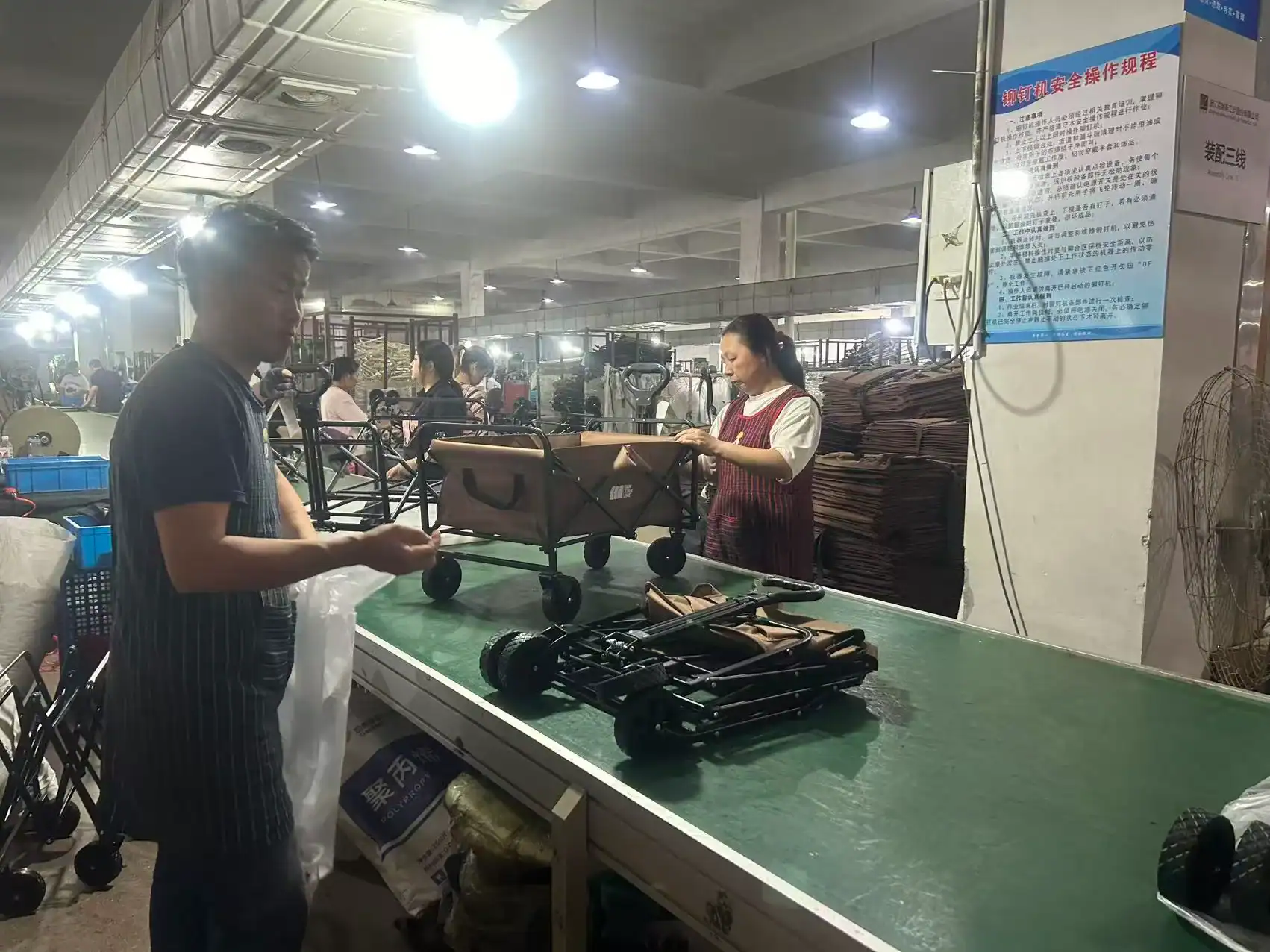
The folding wagon partner factory in Jinhua, Zhejiang, has been in continuous operation since 2017 with 1,000,000 units of annual capacity under ISO 9001:2015 procedures, and its quality checks cover every production stage. A supplier that can show those records is selling an inspectable product. One that cannot is selling a price.
2. Fabric Tearing at Stress Points
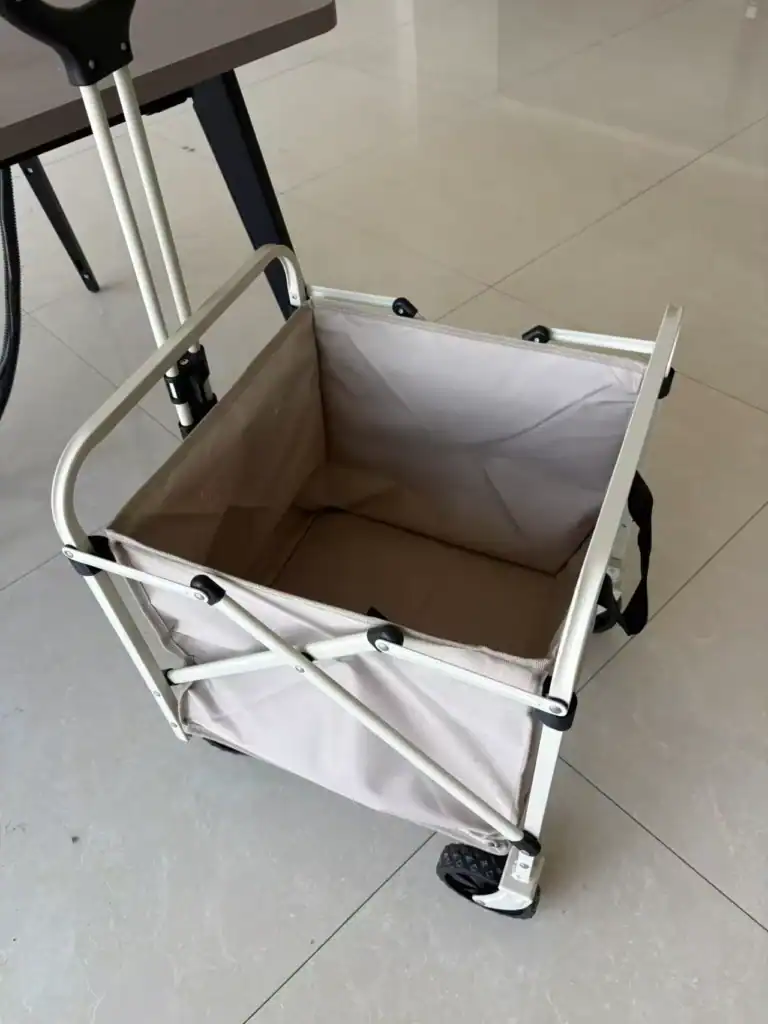
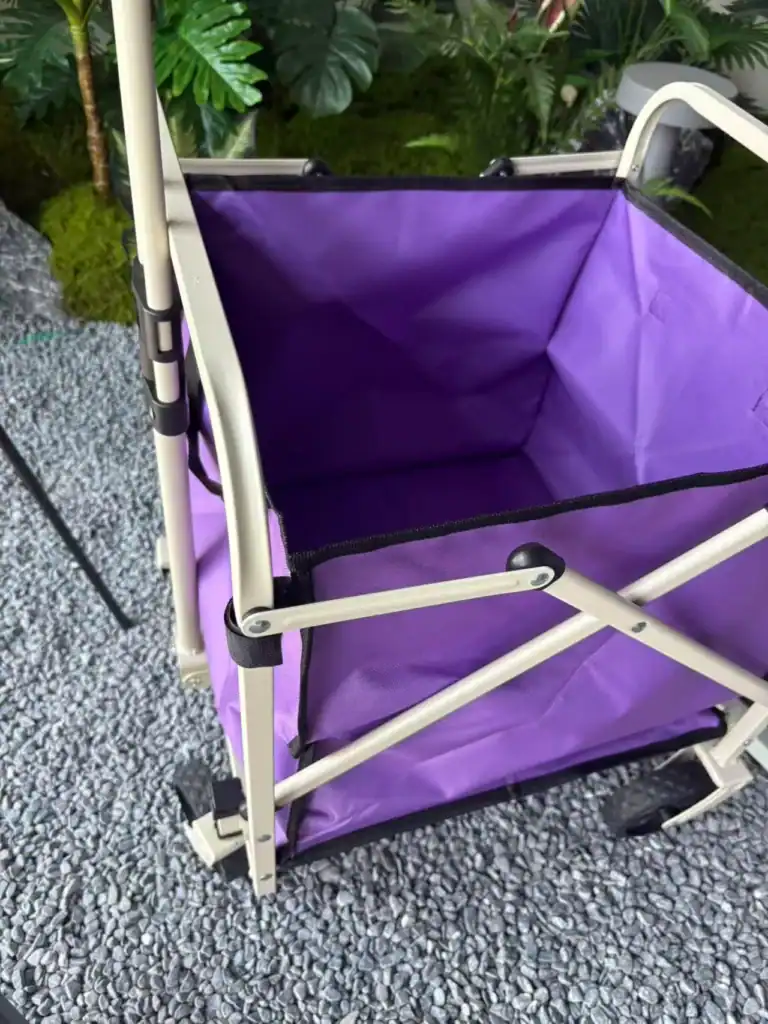
Fabric fails where it meets the frame: the basket corners, the handle mount, and the baseboard pockets. Single-layer 600D cloth frays at these points under load. The internal production standard for this category is 600D–900D double-layer Oxford fabric, with a PP or MDF baseboard carrying the weight instead of letting the fabric stretch against the frame.
Tearing becomes a full warranty claim only when the supplier cannot supply a replacement fabric body. If the after-sales agreement includes spare bodies, the repair cost stays small. If it does not, the retailer absorbs the whole unit cost.
3. Wheel Axle Bending or Tread Separation
Axle bending is a load-rating problem. A 50kg wagon and a heavy-duty model above 200kg need different axle specs, and quoting the wrong one guarantees a bending claim. Tread separation usually comes from a poorly pressed hub or low-grade wheel material. The wheel options in the production spec run PVC, PU, EVA, or TPE tires with 360° rotation — ask which one is in the quotation, because the claim rate follows the material.
4. Brake Failure and Handle Locking Issues
Brake failure on a swivel wheel is almost always a seized brake pin or a misaligned brake plate. Handle collapse comes from a lock pin that does not seat fully, so the handle folds under steering load. Both are cheap failures when the supplier ships parts. Whole-unit returns turn a minor component into a freight-heavy claim, which is why the parts-stocking clause belongs in the contract before you place the first order.
5. Rusted Frames After Coastal Use
Salt corrosion shows up fast on powder-coated carbon steel frames. A standard coating passes warehouse inspection and fails after six months of beach trips. That is why the folding wagon salt-spray test report belongs in your supplier file before signing. For coastal retail programs, aluminum frames cost more per unit but eliminate the corrosion claim entirely. Know which frame material the quotation is using.

How OEM Design Prevents Warranty Failures
Most folding wagon warranty claims hit in the first 90 days and trace back to weld quality, not fabric.
Take a failed wagon apart and the pattern shows up fast. The X-frame weld cracks, the fabric tears at a stress point, or the frame rusts through after a season near salt water. In most cases the failure starts in the design phase, not in the buyer’s hands. The fix is a set of engineering decisions that cost pennies per unit at the factory but save dollars in warranty logistics.
Reinforced Gussets and Weld Inspections
The X-frame is the load-bearing core of any folding wagon, and the weld at the pivot joint is where cheap units fail. A single-pass weld with no gusset plate concentrates stress at one point. The engineering fix is a reinforced gusset that distributes load across a wider surface, plus a weld inspection protocol that verifies penetration before powder coating hides the defects.
When a factory claims ISO 9001 compliance, ask to see weld inspection records. The folding wagon factories Kelyland works with in Jinhua produce over a million units a year and hold CE and ISO 9001 certification — the audits only matter if the line documents each weld batch. If the supplier cannot produce records on request, the warranty claims become your problem.
Fabric Reinforcement Stitching and Heat-Sealed Edges
Fabric failures cluster at three points: the handle attachment, the lower corners where the frame rubs, and the wheel-well openings. A single-needle straight stitch rips out under load. The fix is bartacking at stress points, double-stitched seams, and heat-sealed or bound edges that stop fraying before it starts.
The material spec matters just as much. Kelyland’s wagon factory uses 600D to 900D double-layer Oxford fabric as the standard body material, with heavier grades for load ratings up to 200 kg. But reinforcement matters more than fabric weight — a wagon rated at 150 kg needs bartacks at the handle, not just a thicker panel. Ask where the reinforcement stitching sits before approving the sample.
Corrosion-Resistant Coating Specifications
Rust claims spike in coastal markets, usually around month eight or nine. Powder-coated carbon steel is the minimum for a wagon frame; aluminum frames skip the rust problem entirely but cost more. The decision comes down to your target market and expected product lifecycle.
Ask for the folding wagon salt spray test report before you accept the price. If the supplier cannot produce one, assume the coating will fail in coastal use. The coating process matters too — powder coating over a properly cleaned and phosphate-treated surface is not the same as a quick spray job. That single spec separates wagons that last several seasons from warranty return candidates.
What a Best-Practice Warranty Policy Looks Like
Strike return-to-China clauses.
The default warranty from most China-based folding wagon suppliers is 12 months from the shipment date. That term covers manufacturing defects — weld fractures, broken hinges, failed brakes — but not fabric abrasion, overloading, or normal wear. A 24-month warranty is not a free concession; it is a structural statement. A factory only offers 24 months when it has confidence in the welds, the powder coating, and the spécifications de l'ensemble de roues.
1-Year vs 2-Year Warranty Terms
For a folding wagon, the gap between a 1-year and 2-year term is mostly about the frame. Fabric and wheels wear differently than the frame, so a blanket 24-month consumer warranty drags the factory into wear-and-tear disputes. If the supplier can produce weld inspection records and a salt-spray test report for the frame, a 2-year structural warranty is reasonable. Make sure the warranty language separates the frame from the fabric and wheels.
Most folding wagon warranty claims happen in the first 90 days, and the cause is usually the X-frame weld, not the fabric. That timing makes sample approval the critical control point: if the pre-production sample’s weld passes visual and load testing but the production run skips weld inspection, you only discover the problem after the first batch is already in stores.
Replacement Part Logistics vs Full Unit Return
Returning a failed wagon from the US or Europe to a Chinese factory is economically absurd. Return freight on a bulky wagon almost always exceeds the landed cost of the unit itself. Any clause that requires a full-unit return to China is effectively a zero-warranty policy. The buyer absorbs the freight, the customer waits weeks, and the claim cost balloons.
The practical model is parts-based warranty fulfillment. A supplier with spare frames, pre-assembled wheel sets, fabric bodies, and brake components can ship only the failed part. That cuts the per-claim cost by 40-70% compared with sending a whole replacement wagon. For the factory, stocking a few hundred spare parts is far cheaper than replacing a full wagon every time a weld or axle fails.
-
- Warranty parts provision: Negotiate a 1-2% warranty parts allocation in the unit price. That funds a parts stock at the factory, so the after-sales team can ship a frame or wheel immediately instead of waiting for a claim decision.
- Return-to-China clause: Strike it. If the supplier insists on it, the effective warranty is worthless for a product this bulky. Push for advance replacement with parts or a full unit before the defective item is returned.
This is where the factory network matters. Kelyland Outdoors coordinates with a folding wagon factory in Jinhua that produces one million wagons a year across single-fold, multi-fold, and heavy-duty lines. Because the manufacturing partner runs at that scale, it can hold spare frames and wheel assemblies without inflating your unit cost. Ask any prospective supplier for their spare-parts inventory list and per-claim logistics process before signing the production agreement.
Questions to Ask Your Factory Before Signing a Contract
Warranty clauses protect you only when backed by weld inspection records and salt-spray test results.
Folding wagon warranty claims cluster in the first 90 days. The cause is almost always the same: substandard welds at the X-frame joint, not the fabric. A supplier that cannot produce weld inspection records or a salt-spray test report during negotiation is showing you how they will handle a defect claim later.
MOQ and customization scope
MOQ is the first lever to pull. Ask for two numbers: the MOQ for a stock model with your logo, and the MOQ for a full custom run under your private label. Standard models typically range from 300-1,000 pieces, but some custom items start at 50-100 pieces when material is already in stock. The gap between those quotes tells you how flexible the production line is.
-
-
- Approbation de l'échantillon : Confirm the pre-production sample is built on the same line, with the same welding jig and tooling, as the mass run. A hand-assembled sample that skips the production process will not predict weld quality at scale.
- OEM scope: Clarify whether fabric dyeing, printing methods, custom-molded plastic parts, and powder-coated frame colors sit inside the quoted price or carry separate tooling charges. This is where per-unit quotes drift.
-
ISO 9001 and quality control
ISO 9001:2015 certification is a baseline, not a guarantee. Ask which partner factories actually hold it and request the audit report. For a folding wagon, the inspection must cover welds, axle tolerance, and brake function, not just fabric stitching and packaging.
-
- Inspection timing: A factory that allows mid-production weld checks is different from one that only shows finished units pre-shipment. Put the inspection stage in the contract.
- Defect liability: Negotiate a 1-2% warranty parts provision in the unit price instead of a return-to-China clause. Return freight on bulky wagons usually exceeds the product’s value, so a full-unit return clause is a paper promise neither side wants to execute.
Warranty term and spare parts commitment
One-year warranties are standard, but the cost structure matters more than the duration. A supplier that stocks spare frames, wheels, and fabric bodies can send parts instead of whole units, cutting warranty claim costs by 40-70%. The folding wagon partner factory in Jinhua, Zhejiang produces 1,000,000 units a year, which is the kind of output that makes a parts-based warranty program practical. Ask how many spare sets the factory holds for your model before you sign.
After-Sales Support: What Kelyland Outdoors Does Differently
Return freight on a broken wagon exceeds its value.
The economics of folding wagon warranty claims break down fast when the fix is a full unit replacement. A collapsed frame or torn fabric body does not justify shipping a bulky wagon back across the Pacific. The freight alone often exceeds the product’s landed cost. That is why the after-sales model matters more than the warranty period itself.
Replacement Part Logistics: the 40–70% Cost Cure
A good OEM stocks spare frames, wheels, and fabric bodies so the after-sales team can send parts instead of entire wagons. This single shift cuts claim costs by an estimated 40–70%, depending on the failure type. For a welded joint fracture, the fix is a replacement frame section—not a new wagon. For a torn 600D Oxford fabric body, a replacement body ships flat and costs a fraction of the assembled unit.
Kelyland Outdoors coordinates this through its network of 17 core strategic factories, including the Jinhua-based folding wagon plant that produces 1,000,000 units annually. That production scale allows the sourcing team to pull spare components from the same batch runs that fulfill bulk orders, so replacement parts match the original spec—same 600D-900D double-layer Oxford, same powder-coated carbon steel frame, same 360° rotating wheels.
Extended Warranty Coverage on OEM Orders
Most China suppliers quote a 1-year warranty as standard. That is the floor, not the ceiling. For OEM and private label orders, a 2-year term is achievable if the buyer negotiates it as a warranty parts provision—typically 1–2% of unit price—rather than a return-to-China clause. The provision funds a stock of spare frames, wheels, and fabric bodies held at the factory or a regional hub, so claims get resolved without a single container shipment.
Ask suppliers to break out this provision explicitly. A quote that buries warranty costs in the unit price leaves you paying for failures you never see. An itemized provision shows exactly what the supplier budgets for claims, and it gives you leverage to push for a 2-year term on high-turnover models.
Dedicated After-Sales Structure
Warranty claims live or die on response time. A dedicated after-sales manager who owns the claims process beats a generic customer service inbox every time. Kelyland Outdoors assigns a named after-sales specialist—not a ticket system—to manage claims handling, with a separate operations lead following up on order corrections and replacement part shipments. Internal data from their 10-step process shows this structure compresses the gap between claim submission and resolution.
Warranty Data Feeds Design Fixes
Every returned frame or failed wheel should end up as a design input. The Jinhua wagon factory’s ISO 9001:2015 quality system documents weld inspection records and salt-spray test reports, so recurring failures become actionable spec changes—thicker gussets, additional reinforcement stitching, or a more corrosion-resistant powder coating. That loop is what turns a 1-year commodity warranty into a 2-year relationship asset: the supplier uses claims data for continuous improvement, not just cost recovery.
Conclusion
The return pattern is consistent: most folding wagon failures show up in the first 90 days and trace back to welded joints, not fabric. Weld inspection records and a salt-spray test report separate a factory that controls quality from one that just quotes a price.
-
- Most folding wagon warranty claims occur within 90 days and trace back to substandard welds, not fabric.
- Sending spare frames and wheels instead of full replacement units cuts claim costs by 40-70%.
- Negotiate a 1-2% warranty parts provision in unit pricing instead of a return-to-China clause.
Write down two benchmarks for your next supplier call: a 1-2% warranty parts provision in the unit price, and a supplier that stocks spare frames, wheels, and fabric bodies. Then review the folding wagon product page to see how those standards look on a real production line.
Questions fréquemment posées
Quelles sont les réclamations de garantie les plus fréquentes sur les chariots pliants ?
Les réclamations les plus courantes portent sur les fissures de soudure des cadres en X, la déchirure du tissu aux points de contrainte, les dommages aux essieux des roues ou le décollement des bandes de roulement, les défaillances des systèmes de freinage et de verrouillage des guidons, ainsi que la corrosion des cadres après une utilisation en bord de mer. La majorité de ces problèmes surviennent lors des premiers mois d'utilisation. Inspectez ces cinq zones avant d'approuver la production.
Comment la conception OEM permet-elle de prévenir les défaillances des chariots ?
La conception OEM permet d’éviter les défaillances en ajoutant des entretoises renforcées aux soudures, en renforçant le tissu aux points de contrainte avec des bords thermoscellés et en spécifiant des revêtements anticorrosion. Ces modifications ciblent les modes de défaillance réels à l’origine des réclamations. Demandez ces spécifications par écrit avant la création des outillages.
Que doit couvrir une politique de garantie pour wagonnet ?
Une politique de référence couvre les soudures du cadre, les coutures du tissu, les roues, les freins et la corrosion pour au moins un an. La condition clé à comparer est la logistique des pièces de rechange versus le retour de l'unité complète, car les clauses de retour en Chine peuvent anéantir votre marge. Confirmez les délais de livraison des pièces de rechange avant de signer.
What should you ask a factory before ordering wagons?
Ask how they inspect welds, which fabric stress-point reinforcements they use, and what corrosion-resistance test they apply. Also confirm warranty response time and whether defective units must be shipped back to China. Get every answer written into the supply agreement.

 English
  Español
  Deutsch
  Français
  Português do Brasil
  Русский
  العربية
  한국어
한국어  日本語
日本語