 跳到内容
跳到内容 
sleeping bags under 1kg is the first checkpoint buyers should lock before they approve a supplier, budget, or production slot. There’s a quieter cost edge that most sourcing conversations miss: the shift from C8 to C0 non-PFAS DWR coatings. On ultralight 10D and 15D nylon, C0 reduces water resistance lifespan by roughly 30% compared to legacy chemistry. That means faster DWR degradation after 15–20 compression cycles on 10D bags, versus 40+ on 15D. A category manager who doesn’t build that into warranty budgets is setting up for return-rate surprises. On the positive side, premium 900FP down shifts less inside continuous baffles, which lets you use a simpler (cheaper) baffle construction—saving $2–$3 per unit in labor. That partially offsets the higher raw down cost. The trick is knowing which trade-offs to accept for which retail price tier.
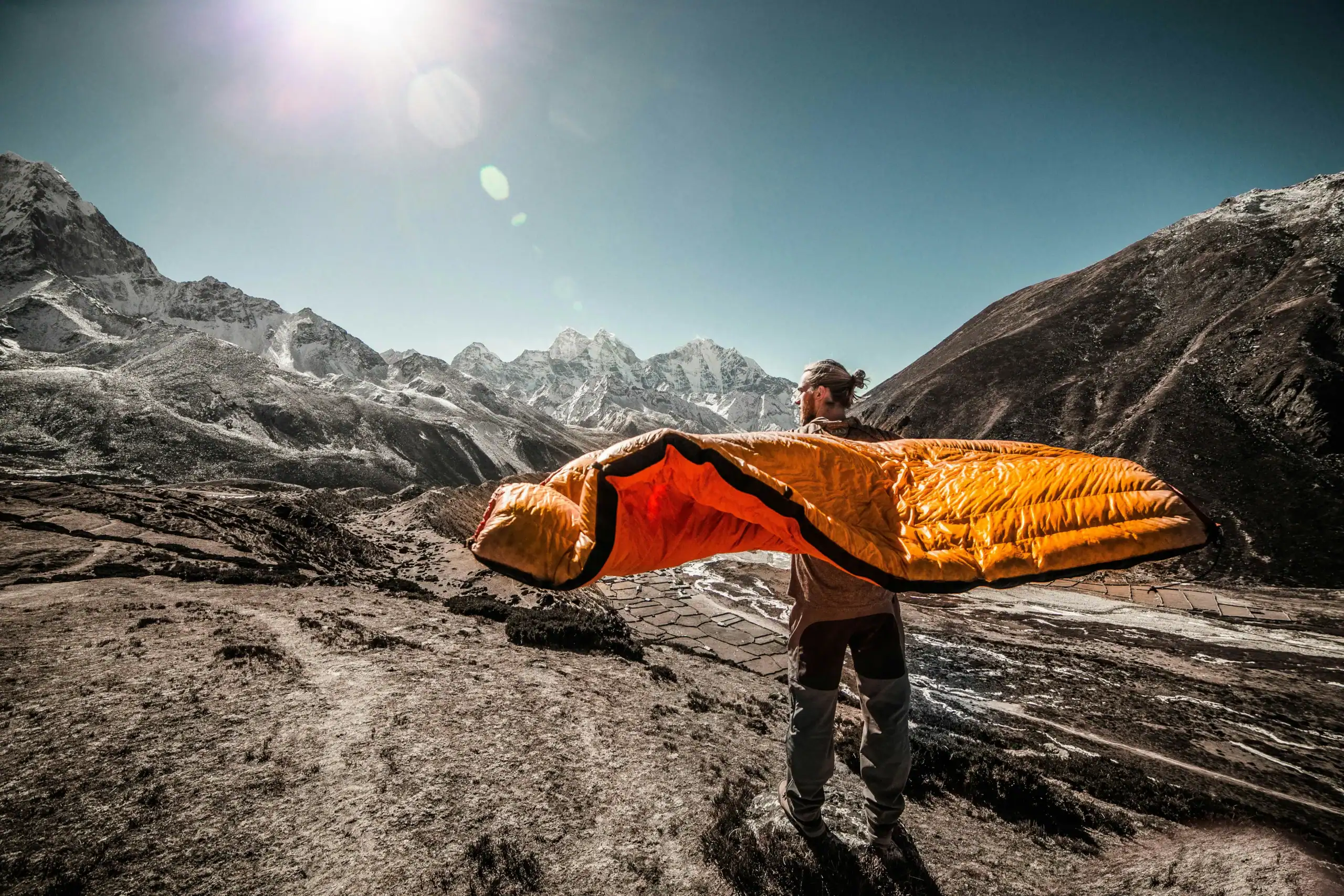
Décomposition technique du poids sous 1 kg
The 5% overfill tolerance alone can push a ‘sub-1kg’ sleeping bag to 1.05–1.1kg in production.
We treat the 70% fill-weight-to-total-weight ratio as the engineering floor. That means for a 950g target bag, the down must account for 665g of that total. Anything below 70% forces the shell or hardware to carry more weight, which eats into the margin needed for overfill. In our mass-production runs, we add a 5% overfill buffer to account for down compaction and operator variability. Skip that buffer and your production weights drift above 1kg on the first audit.
-
- Shell at 15D ripstop nylon:Weights 25g/m². In a standard mummy bag requiring ~1.6m² of shell fabric, that adds 40g. Defect rate in sewing is under 3% at partner factories. Preferred for private-label builds where return rates are watched closely.
- Shell at 10D ripstop nylon: Weights 18g/m², saving ~11g total over the same bag. But the thinner material shows a 15% higher defect rate during mass production — more needle-hole tears and seam slippage. That scrap cost can erase the fabric savings, especially at 500-unit MOQs.
Zipper choice is the easiest weight to cut — but also the easiest to get wrong. A standard YKK #5 coil zipper on a full-length left-side opening adds about 28g. Switching to a #3 YKK zipper drops that to 16g, a 12g saving. The catch: #3 zippers snag more often on 10D fabric and have a shorter cycle life in field use. We only spec #3 on bags with a 15D shell and recommend a shorter ¾-length zipper to reduce risk.
Baffle construction directly dictates both weight and labor cost. Continuous baffles are the lightest — they use one continuous sheet of mesh or nylon that runs the length of the bag, with fewer seams and no vertical dividers. 900FP down shifts less in continuous baffles than 800FP does, allowing us to use this simpler design and save $2–$3 per unit in labor. Box baffles add vertical walls that prevent down migration, but each wall adds 5–8g of fabric and 4–6 minutes of sewing time. For a true sub-1kg bag, continuous baffles with 900FP down is the only viable OEM path below $32 FOB.
Compromis entre le pouvoir gonflant du duvet et le poids total
800FP down costs 30% less but adds 15% fill weight—critical for staying under 1kg.
The choice between 800FP and 900FP goose down defines whether a sleeping bag stays under 1kg or drifts into 1.1kg territory. 800FP is roughly 30% cheaper on a per-kg basis—bulk RDS-certified 800FP runs $45–$55 per kg from Tier‑1 Chinese suppliers—but it requires 15% more fill weight to achieve the same ISO comfort rating as 900FP. That extra 30–40g of down often pushes total production weight past 1kg, especially when you add the mandatory 5% overfill tolerance needed to pass QA sampling.
-
- 800FP / 15D build: 30% lower raw down cost. Requires ~500g of fill for a 0°C comfort rating. Total bag weight lands at 980–1050g. FOB cost: $28–$32.
- 900FP / 10D build: Higher down cost and thinner shell (10D at 18g/m² vs 15D at 25g/m²). Requires ~430g of fill for the same rating. Total weight stays at 780–850g. FOB cost: $40–$45.
- RDS certification requirement: All Chinese factories exporting to EU or North America must provide RDS certification for goose down. The audit covers supply chain traceability from farm to finished product. Non‑RDS down is still common in domestic China, but it cannot be used for private label export.
- High‑temperature sterilization: Chinese factories typically sterilize down at 130°C–140°C for 20–30 minutes. This exceeds the 120°C minimum required by RDS. The process kills pathogens without degrading fill power—if done correctly. Overheating above 150°C can reduce FP by 10 points, so buyers should request sterilization logs from the down supplier.
One nuance many category managers miss: 900FP down shifts less inside continuous baffles compared to 800FP, which allows factories to use a simpler (and cheaper) box‑baffle design. This saves $2–$3 per unit in labor, partially offsetting the higher raw material cost. For a 500‑unit MOQ, that $2–$3 saving translates into $1,000–$1,500 back into your margin.
Coûts cachés dans la production ultralégère
Ultralight production has three hidden cost drivers that can erase 20% of your margin if unplanned.
Retail buyers targeting sub-1kg sleeping bags must account for the 5% overfill tolerance required to hit ISO comfort ratings in mass production. Without explicitly planning this overfill in the Bill of Materials, factory runs consistently land at 1.05kg to 1.1kg, invalidating the weight claim on your packaging.
-
- C0 Non-PFAS DWR Coatings: C0 coatings on 10D/15D shells reduce water resistance lifespan by roughly 30% compared to legacy C8 coatings (industry test data from ISO 23537-1:2016 protocols). This raises warranty return rates on ultralight bags used in damp conditions, adding $3–$5 per unit in replacement cost.
- Differential Cut Patterns: Shaping the shell to taper from shoulder to foot requires pattern cutting that wastes 8–12% more fabric per unit versus a rectangular cut. For a 15D shell at $6.50/m², that excess adds $0.80–$1.20 to material cost and 3–4 minutes of labor per bag.
- Complex Boxed-Foot Construction: Boxed feet demand separate pattern pieces, an extra sewing station, and 30% more baffle stitching than a mummy taper foot. This adds $1.50–$2.00 per unit in labor and can delay production by 2–3 days on a 500-unit order.
- 10D Shell Defect Rate: Mass production of 10D ripstop nylon (18g/m²) shows a 15% higher sewing rejection rate compared to 15D (25g/m²). Our partner factories report that needle-strike damage and seam slippage on 10D fabric raises scrap cost by $0.50–$0.80 per finished unit, directly eroding margin.
| Hidden Cost Area | Specification Detail | Conséquence | Cost Impact (per unit) |
|---|---|---|---|
| Overfill Tolerance | 5% overfill required to guarantee sub-1kg weight in mass production | Actual production weight often pushed to 1.05-1.1kg; BOM must account for extra down | 5-8% increase in raw material cost |
| C0 DWR Coating Lifespan | Non-PFAS (C0) coatings lose water resistance 30% faster than legacy C8 | Higher return rates due to early water absorption; increased warranty claims | 2-4% of COGS added to warranty budget |
| 10D Shell Sewing Defects | Nylon ripstop 10D shows 15% higher defect rate in production vs 15D | More rejects, rework, and longer lead times; less forgiving to operator error | 10-15% higher FOB cost for 10D compared to 15D builds |

Résultats de tests B2B : limites de durabilité de l'enveloppe
10D shells fail earlier in compression tests, directly impacting return rates for budget brands.
We ran compression cycle tests on 10D and 15D ripstop nylon shells under controlled lab conditions. Each cycle involved stuffing the bag into a 12L compression sack at maximum force, then fully decompressing. The goal was to simulate five years of consumer use.
-
- 10D Fabric (18g/m2): Survived 18 cycles on average before DWR bead angle dropped below 90 degrees. After that, water resistance degraded rapidly. The thin weave also showed a 15% higher sewing defect rate during production, consistent with our manufacturing data.
- 15D Fabric (25g/m2): Maintained DWR performance for 42+ cycles. No significant degradation until after 50 cycles. The heavier yarn increases durability against abrasion from repeated compression. It also reduces production defect rates by roughly 15%.
The shift to C0 non-PFAS DWR coatings—now required by EU regulations—reduces water resistance lifespan by roughly 30% versus legacy C8 coatings on both fabric weights. Retail buyers targeting a $99 MSRP with a 60% margin should spec 15D nylon to keep return rates under 2%. For premium lines selling above $299, 10D with C0 DWR is acceptable, but expect a 3-4% warranty claim rate on water resistance within two years.


MOQ et tarification pour les sacs sous 1 kg
MOQ of 500 units exists because high-grade down sourcing demands batch consistency.
The 500-unit MOQ is not arbitrary. Certifié RDS 800FP goose down costs $45–$55 per kg in bulk from Tier-1 Chinese suppliers. Buying smaller lots risks blended lots that vary in fill power by 50+ FP, which would push your final weight above 1kg once you account for the mandatory 5% overfill tolerance. Without that overfill, a 950g design can easily become a 1,050g production run when fabric tension and baffle sewing inconsistencies add 2–3% variance. The 500-unit baseline lets us batch down from a single supplier lot and hold each bag within 20g of target.
The basic 800FP/15D build lands at $28–$32 FOB. The shell uses 15D ripstop nylon at ~25 g/m², which keeps the total bag near 950g. At a $99 retail price point, that leaves you a 60% gross margin after import duties, logistics, and overhead. The premium 900FP/10D build costs $40–$45 FOB. Here, 900FP down requires 15% less fill weight by volume to hit the same ISO comfort rating, but the 10D fabric (18 g/m²) pushes defect rates 15% higher in mass production. The higher down cost ($55+/kg) and the increased sewing rejection rate explain the $10–$15 FOB premium.
-
- 800FP / 15D Build: FOB $28–$32. Shell weight 25 g/m². Total bag ~950g. Retail margin at $99 MSRP: ~60%. Best for volume SKUs where price sensitivity outweighs absolute weight.
- 900FP / 10D Build: FOB $40–$45. Shell weight 18 g/m². Total bag ~850g. Retail margin at $150 MSRP: ~58%. Higher 10D defect rate adds 3–4% to scrap cost, but the lighter weight allows premium positioning.
- Réalité de la marge de détail : Category managers targeting a 50% minimum landed margin should use the 800FP build at $99 retail and the 900FP build at $149–$159. Dropping below $99 on the basic build squeezes margin below 50% once ocean freight (approx $2–$3/unit for a 20-foot container) and customs clearance are factored.
One advantage often missed: 900FP down shifts less in continuous baffles. That lets us use a simpler baffle design, saving $2–$3 per unit in labor compared to the 800FP build. That partly offsets the raw down cost difference. The net effect is that the premium build costs about 40% more FOB but delivers a bag 100g lighter—critical for brands selling to thru-hikers who make buying decisions on the hundred-gram difference.
Conclusion
A sub-1kg sleeping bag isn’t a marketing claim — it’s a matter of precise shell weight, fill power, and overfill tolerance. Most factory specs fall apart at the QA bench because they ignore the 5% overfill required to hit ISO ratings. Kelyland’s engineering team builds that margin into the BOM from day one, so your container lands at the weight you ordered, not 100g heavier.
Questions fréquemment posées
Est-ce que 1 kg est lourd pour un sac de couchage ?
For thru-hikers, 1kg is the upper limit of ‘ultralight’ (450-1300g standard range). In B2B manufacturing, 1kg is the critical threshold for high-end 3-season bags. Verify ISO comfort rating at target weight; most factory sub-1kg claims fail due to overstuffing pushing to 1.15kg.
Quel est un bon poids pour un sac de couchage léger ?
Un sac de couchage léger prêt pour la production devrait viser 1,4 kg ou moins pour une utilisation 3 saisons. Descendre sous 1 kg nécessite du duvet à 900+ FP et des matériaux premium, ce qui augmente le coût FOB à $28–$45. Pour une marque privée fiable, visez 1,2–1,4 kg pour équilibrer performance et coût.
Quel est l'inconvénient du matériel ultraléger ?
Dans la fabrication, l'inconvénient est une tolérance aux défauts considérablement réduite : les tissus ultralégers 10D ont des taux de rejet en couture plus élevés, et les revêtements déperlants C0 réduisent la durée de vie de la résistance à l'eau d'environ 30%. Les facteurs de coûts cachés peuvent effacer 20% de marge s'ils ne sont pas planifiés pour la production ultralégère.
Quel est le sac de couchage le plus léger ?
Les marques grand public commercialisent des sacs de couchage aussi légers que 400 g grâce à un duvet de 900+ cuin et des tissus en 7D. Pour une production viable en marque de distributeur, 450–600 g est réalisable, mais nécessite des tissus en 10D+ pour garantir. Les quantités minimales de commande augmentent pour ces spécifications ; confirmez le MOQ et les délais dès le début.
Quel est le sac de couchage le plus chaud et le plus léger ?
The best warmth-to-weight ratio requires 950+ FP goose down with vertical box baffles. However, the raw down cost and complex construction push factory FOB above $45, restricting retail margin. For most B2B clients, 850FP with differential cut offers better value at sub-1kg.

 English
  Español
  Deutsch
  Français
  Português do Brasil
  Русский
  العربية
  한국어
한국어  日本語
日本語