 跳到内容
跳到内容 
ポップアップビーチテントは、サプライヤー、予算、生産枠を承認する前にバイヤーが最も重視すべき最初のチェックポイントです。「サンプル承認前にハブで何回の 砂cycle を実施しましたか?」サプライヤーは一旦黙り込み、「生地はUVカットと防水性をテストしました。フレームはショールームでは問題ありませんでした」と言いました。このやり取りは、$50Kの注文を受注したバイヤーが、3回の海水浴後にポップアップビーチテントが折りたたまれなくなってしまった理由を如実に示しています。生産前のサンプルは完璧でした――屋内で清潔なコンクリート床の上ならね。量産品もサンプル通りでした。しかし、どちらも海浜環境とは一致しませんでした。.
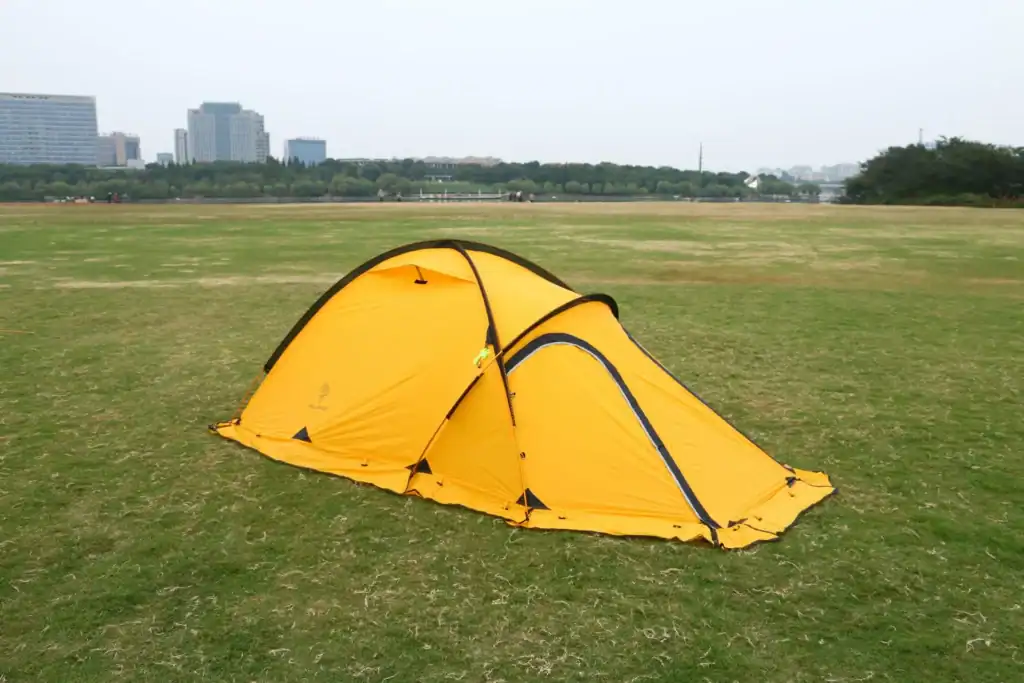
破損事例 #1: 砂詰まりハブ —— なぜ折れなくなるのか
ナイロンワッシャー付きオープンハブは3〜4回の海水浴で使用で失敗しますが、アセタールワッシャー付き密封型ハブは100回以上の砂cycleに耐えます。.
低価格のポップアップビーチテントはすべて、露出したロックボタンまたはリング付きのオープンハブを採用しています。風で吹き上げられた砂や湿った粒がその接合部に入り込み、塩分湿度と混ざり合って研磨性のペーストを形成します。このペーストがナイロンワッシャーを摩耗させます。3〜4回の海水浴後には、軽やかなクリック音から硬いストップへと折りたたみ抵抗が増加します。.
バイヤーが実施すべき20秒間の現場テスト
-
- セットアップ: ベージュの砂をすべてのヒンジ点とロックリングに塗布してください。.
- サイクルチェック: 20回の開閉サイクルを実行し、硬さや異音がないか確認します。.
- 合格基準: 100回の砂_cycle_折りたたみを詰まらずに完了できないサンプルは全て不合格とします。.
ナイロンワッシャーは水を吸収して膨張するため、研磨を加速させます。一方、アセタール(POM)ワッシャーは自己潤滑性があり、寸法安定性に優れ、塩水にも強い特性を持っています。ワッシャー素材の変更によるコスト増はハブあたり数セントですが、密封構造のハブと304ステンレス鋼製ヒンジピンを組み合わせることで、着地コストは約$1.80増加します。しかし内部生産データによると、このアップグレードによりポップアップビーチテントのリターン率が最大40%削減できることが示されています。.
これこそが、砂Cycleテストが大規模生産承認後の返品対応 desk ではなく、生産前のサンプル確認フェーズに組み込まれるべき理由です。KelylandのISO 9001:2015認証取得パートナー工場では、各ヒンジ点に砂を塗布した状態でテストを実施し、100サイクルプロトコルの中の25サイクルごとの抵抗値を記録しています。バイヤーは量産承認前に、必ず当該テストレポートの提出を依頼すべきです。.
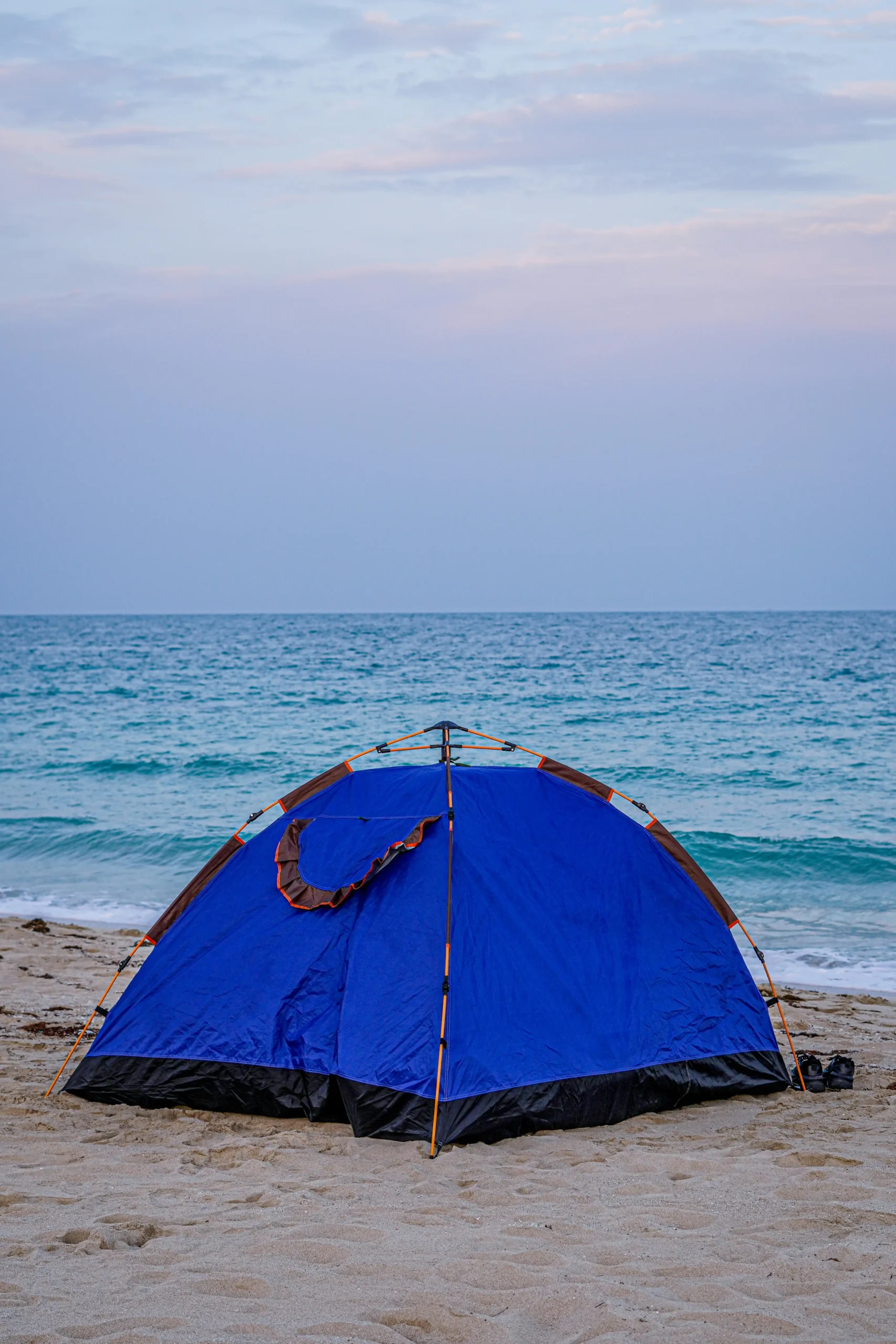
破損事例 #2: ファイバーグラスの splinter による怪我と flex 疲労
ひび割れたファイバーグラスポールは、次の折りたたみ時の安全事故の火種となります。.
バジェットタイプのポップアップビーチテントは、単体コストが他のフレーム素材を凌駕するため、7〜9mmのファイバーグラスポールを採用しています。しかし、紫外線による樹脂の劣化、塩霧による繊維への浸入、そして繰り返し曲げによる応力集中箇所のひび割れが発生すると、その節約効果は完全に消滅します。さらに砂で詰まったハブはこの問題を悪化させます。ユーザーが力を込めて押し込むほどポールは限界を超えて湾曲し、最も弱い部分がSnapします。するとしばしば、手を切りつける鋭い繊維が剥き出しになります。この失敗は公衆の前で突然起き、かつ記憶に残るものとなります。.
砂場で7〜9mmファイバーグラスが失敗する理由
ファイバーグラスは芝生の上で設置し、芝生の上で撤収するテントであれば許容範囲内です。しかしビーチ環境はまったく異なるテスト条件です。直射日光は樹脂を脆化させます。塩分と grit が織り込みの中に浸入し、折りたたみごとに同じ部位に負荷がかかります。ハブメカニズムが抵抗を示すと、ポールは設計上の許容を超ねじれ力を吸収することになります。ひび割れが始まる前に現実的な使用寿命は2シーズン程度であり、これは複数年にわたる製品プログラムを展開するブランドにとって短すぎます。.
11mmアルミニウムへのアップグレードの費用対効果計算
移行することで 11mmアルミニウムポール は重量を増やしフレームCOGSを上昇させますが、ひび割れによるクレームカテゴリを完全に排除します。アルミニウムは過負荷下で歪みますが、ファイバーグラスは粉々に割れます。ハブが詰まった際、アルミニウムであれば「折りたたみに硬さを感じる」で済み、ファイバーグラスであれば「テント壁面を貫通するほどのひび割れ」を引き起こします。ファイバーグラスを使用し続けるブランドにとっては、全ポールセクションに防裂スリーブ(braided anti-splinter sleeves)を取り付け、プラスチックジャケット付きのハブ接続を採用することが最低仕様となります。これはポールが破損した際の安価なコンテインメント策です。.
-
- ガラス繊維(7~9 mm): コストは低いが、UVによる脆化と砂の研磨作用により、2シーズン以内に割れが発生する。 splintering防止スリーブの併用が必須。.
- アルミ(11 mm): COGSと重量は増加するが、繰り返し折りたたみによる砂の摩耗や海岸線の紫外線暴露にも耐え、破断しない。.
寧波のKelylandコアテント工場はISO 9001:2015およびCE認証ラインを運用し、年間80万テントを生産しています。OEM/ODMプロジェクトのフレーム選択肢にはガラス繊維とアルミの両方が含まれ、出荷前検査チェックリストにはメカニズム機能が含まれます。つまり、購入者はfabric test reports alongsideとともにpole-inspection recordsを要求することができ、これこそが、フレーム故障によるwarranty claimが届いた際にcategory managerが求めるdocumentationです。.
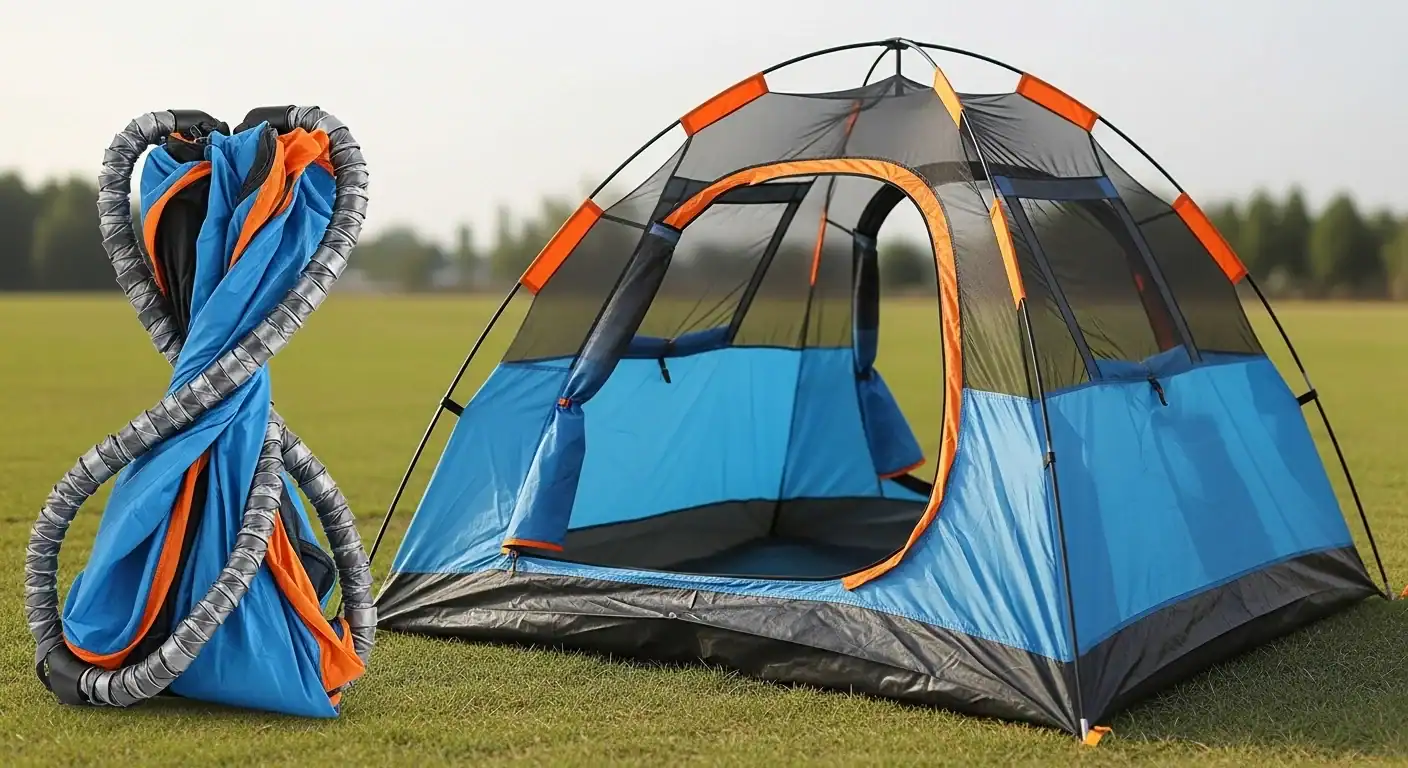
破損事例 #3: 1シーズンの海辺使用後のヒンジピン錆び
めっき鋼ピンは、海沿いの季節1つで失敗します。.
めっき鋼ヒンジピン はビレッジテントで最初に失敗する部品です。塩害スプレーがめっきを腐食させ、砂が露出した鋼を磨耗させ、ハブがザラザラとした状態になり、海沿いの季節1つ以内に機能が低下します。ロックが固まり、折りたたみ抵抗が急増し、フレームが固着します。これが返品であり、これがnegativesなレビューです。.
塩害スプレー vs めっき鋼
すべての回転ジョイントには、304ステンレス鋼ヒンジピンを使用する必要があります。めっき炭素鋼ではありません。マーケティング名を持つコーティング合金でもありません。304グレードは72時間塩害スプレーテストに耐えます。Kelylandの17コア戦略工場および200以上の製造パートナーネットワーク(ほとんどがISO 9001:2015認証)は、生産の全工程でメカニズムのQC検査を実施しています。塩害スプレー結果は出荷前レポートに含まれます。.
アセタールワッシャーはナイロンより長持ちする
ナイロンワッシャーは水分を吸収して膨張します。濡れた砂で満たされたハブ内では、この膨張が grinding を促進し、折りたたみがロックされます。アセタール(POM)ワッシャーは自己潤滑性、寸法安定性、耐海水性を持ちます。コスト差はハブあたり数セントです。304ピンとシールドハブを組み合わせれば、テントあたりの総アップグレードCOGSは約$1.80追加となります。.
-
- ヒンジピン仕様: めっき鋼ではなく、すべての回転ジョイントに304ステンレス鋼を使用。.
- ワッシャー仕様: ナイロンではなくアセタール(POM)素材 — 吸湿や膨張が生じません。.
- 試験仕様: ヒンジピンとワッシャーには72時間の塩水喷雾試験を実施し、QCレポートに記載済み。.
- コスト影響: フルシールドハブ、ステンレスピン、アセタールワッシャーへのアップグレードにおける総生産原価は約$1.80。.
- コスト計算: One avoided return ($15–$30) covers the upgrade across roughly ten units.

破損事例 #4: エラスティックコードの断裂 —— フレーム全体が崩壊する時
A snapped shock cord collapses the entire hub-and-spoke frame — and most beach tents ship without a spare.
Shock cord is the cheapest component in a pop-up beach tent frame and the one that kills the whole product when it breaks. That cord pulls every pole into tension. Snap it, and the poles go slack, the hub loses its geometry, and the tent becomes an unusable pile of fabric and fiberglass. No consumer can repair that on the beach.
Why the cord snaps after one season
Repeated bending does most of the damage. Each fold stretches the cord around the hub, and UV exposure breaks down the rubber over time. Sand adds fold resistance, so the user pushes harder — the extra force snaps a cord already weakened by flex fatigue. This is why the “pop up beach tent won’t fold” complaint shows up after the first summer.
What to spec and what to ship in the box
Require UV-stabilized elastic cord rated for at least 5,000 flex cycles. Demand a 72-hour UV exposure report from the factory, not a sales sheet. That report shows measurable tensile retention after accelerated sunlight aging, and it separates suppliers who actually test from suppliers who guess.
-
- Cord spec: UV-stabilized elastic cord rated for at least 5,000 flex cycles with no visible fraying or tensile loss.
- UV test report: 72-hour accelerated UV exposure data showing tensile retention, shared before production approval.
- Spare hub-and-cord kit: Adds under $2 per unit at factory cost and turns a total frame collapse into a five-minute field repair.
Kelyland’s partner factory in Ningbo, certified to CE, BSCI, and ISO 9001, runs a 100-cycle sand-fold test on every hub-and-spoke model. The shock cord is inspected at fixed intervals for fraying and tension loss, and the results go into the QC report. If a supplier can’t produce that document, the cord is unverified.
A returned beach tent costs $15–$30 in freight, restocking, and lost margin. A spare kit costs under $2 at factory level. Skip the kit and those pennies of savings become a chargeback every time a cord snaps. Add it, and you kill the most common field failure before your brand takes the blame.
破損事例 #5: 風によるフラップ —— なぜ安物のアンカーが海岸の突風で失敗するのか
A beach tent is a shade sail with a floor.
The 35 mph wind rating often quoted for engineered pop-up canopies comes from heavy steel frames and deep foot plates. A hub-and-spoke beach tent shares none of that. Low-slung polyester panels act like sails once a gust gets under the eave, so the whole structure lifts at 15–20 mph when the stakes are 12 cm plastic pins and the corners have no extra tie-downs.
Most suppliers test fabric waterproofing and UV, then call it windworthy. That is not a wind test. Demand anchor hardware and a wind-rating engineering report, not a marketing line.
Anchor specifications that hold on sand
-
- Pre-attached sandbag pockets: Sewn into the lower seams, not clip-on bags that customers lose. Each pocket should hold at least 4–5 kg of sand.
- Four guy-out points with webbing: One per corner, with high-visibility webbing that allows 20 cm+ stakes at a 45° angle. Two points is insufficient in coastal gusts.
- Stakes at least 20 cm long: Budget tents ship with 12 cm stakes. Dry sand cannot hold them. Spec 20 cm steel or aluminum sand stakes with a wide head.
- Wind-rating engineering test report: Ask for the test protocol that produced the number. If the supplier cannot produce one, treat the rating as fiction.
A sourcing partner with ISO 9001-certified factories can produce these anchor features without tooling changes, and low MOQs of 50–100 pieces let you validate the upgrade on a pilot run before committing to a full container. That is how you turn a beach tent wind flip from a season-ending return driver into a spec you control.
密封型ハブとアセタールワッシャーが賢明な低コストアップグレードである理由
A $1.80 sealed-hub upgrade removes the most common beach tent return trigger.
Most return dollars on pop-up beach tents trace back to one part: the open hub. Sand works into the joint, grinds the nylon washers, and after a few trips the frame locks up. The customer does not repair it. They return it.
The $1.80 COGS decision
Sealed hubs with 304 stainless steel hinge pins and acetal washers add roughly $1.80 to landed cost. A single returned unit runs $15–$30 once freight, restocking, and lost margin are counted. One avoided return per ten units pays for the upgrade across the entire order.
-
- Sealed hub: Keeps sand out of the pivot point, where most jams start.
- 304 stainless hinge pins: Resist salt corrosion far longer than zinc-plated steel.
- Acetal washers: Dimensionally stable in water, unlike nylon, which swells and grinds.
The 40% return reduction benchmark
Sand-cycle folding tests — 100 open-close cycles with beach sand applied to hinge points — show that sealed-hub construction can cut beach tent returns by up to 40%. On 10,000 units with a 6% return rate, that is roughly 240 fewer returns and several thousand dollars of recovered margin each season.
The fix is straightforward to spec. Kelyland’s partner factories run 72-hour salt spray tests on hinge pins and washers and document sand-cycle results before shipment, and select items carry MOQs as low as 50–100 pieces. That makes a pilot batch realistic before you commit to full production.
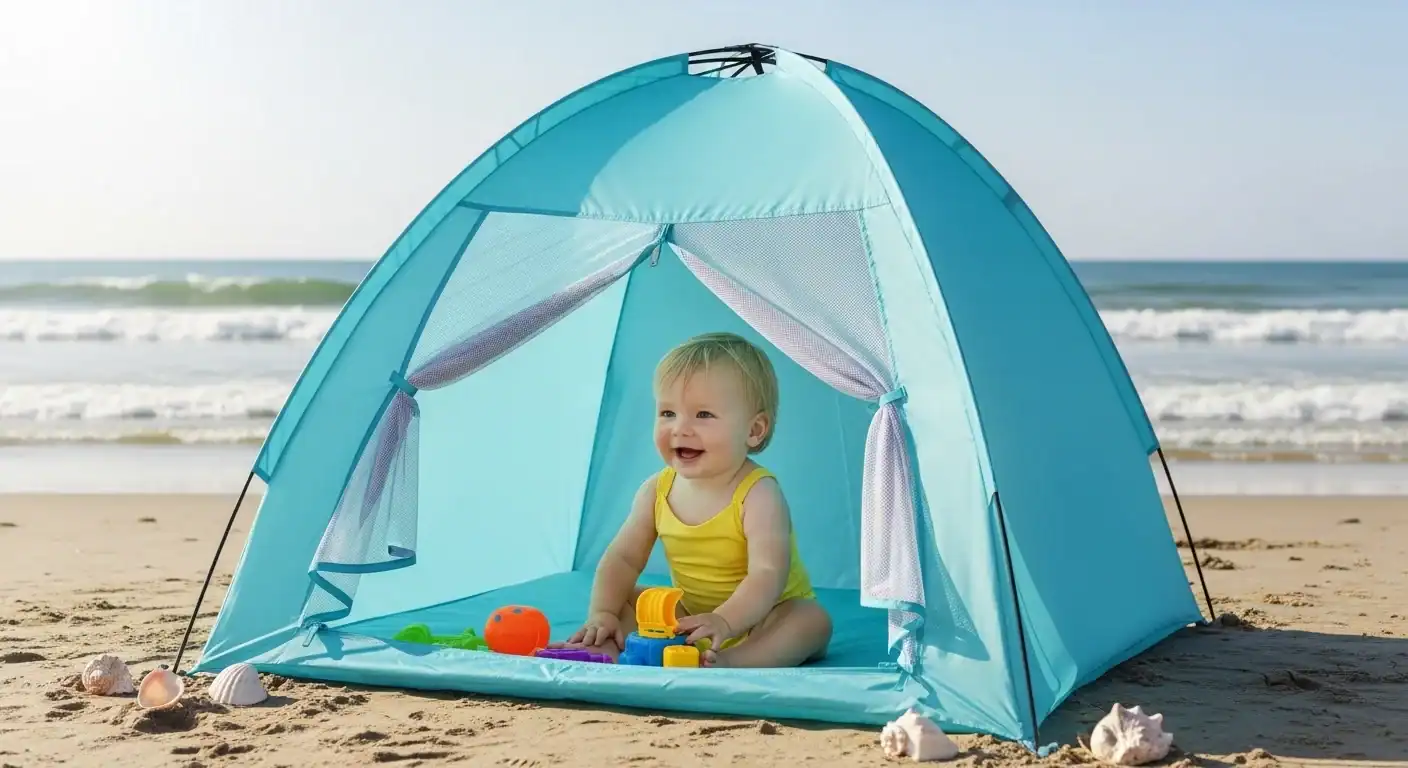
ブランド向けポップアップビーチテント輸入時の仕様ポイント
Sealed hubs, stainless pins, and acetal washers add ~$1.80 per unit and cut beach tent returns by up to 40%.
ほとんどの場合 import spec sheets for pop-up beach tents cover fabric denier, coating, and UV rating. Rarely do they cover the hub — the mechanical joint that decides whether the tent survives a season. That gap is why buyers approve beautiful samples, then watch return rates climb after the summer rush.
Eight specs that prevent beach-frame failure
-
-
- Sealed hub: Keeps sand and salt moisture out of the folding joint. An open hub collects grit, mixes it with water, and grinds the mechanism into a hard stop.
- 304 stainless steel hinge pins: Zinc-plated pins corrode in salt spray, bind the hub, and seize the frame. Stainless removes that failure entirely.
- Acetal (POM) washers: Nylon washers absorb water, swell, and grind faster when sand enters. Acetal is self-lubricating and dimensionally stable in salt air.
- 11 mm aluminum or anti-splinter fiberglass poles: Budget 7–9 mm fiberglass splinters under UV and repeated bending. Aluminum, or fiberglass with a braided anti-splinter sleeve, removes the shard hazard.
- UV-stabilized shock cord: Standard elastic cord fatigues fast when sand adds fold resistance. UV-stabilized cord keeps the frame under tension for the life of the tent.
- Anchor kit: Sandbag pockets, four guy-out points, and stakes at least 20 cm long. Without anchors, a beach tent flips at 15–20 mph gusts.
-
Two factory tests to write into the contract
-
- 72-hour salt spray test: Hinge pins and washers sit in salt spray for 72 hours. Any corrosion on the hardware fails the spec.
- 100-cycle sand-fold test: Beach sand is applied to every hinge point, then the tent opens and closes 100 times. The hub must not jam or stiffen.
Most low-cost suppliers never run these tests. Their QC stops at fabric waterproofing and UV checks; the hub gets a visual inspection and nothing else. Kelyland’s network of 17 core factories, most ISO 9001:2015 certified, doesn’t stop there. Factory QC applies beach sand to every hinge point and completes 100 open-close cycles, logging resistance after every 25 cycles.
MOQ, lead time, and sampling protocol
Kelyland works with MOQs as low as 50–100 pieces on select items, with standard production lead times of 30–45 days. Order a paid sample first — the fee is potentially refundable at bulk order confirmation. Then run the sand-cycle test on that sample’s hub before approving mass production.
The upgrade math makes the spec an easy sell: sealed hubs, stainless pins, and acetal washers add about $1.80 per unit. One avoided return saves $15–$30 in freight and restocking. The sealed-hub spec pays for itself after one prevented return in every ten units.
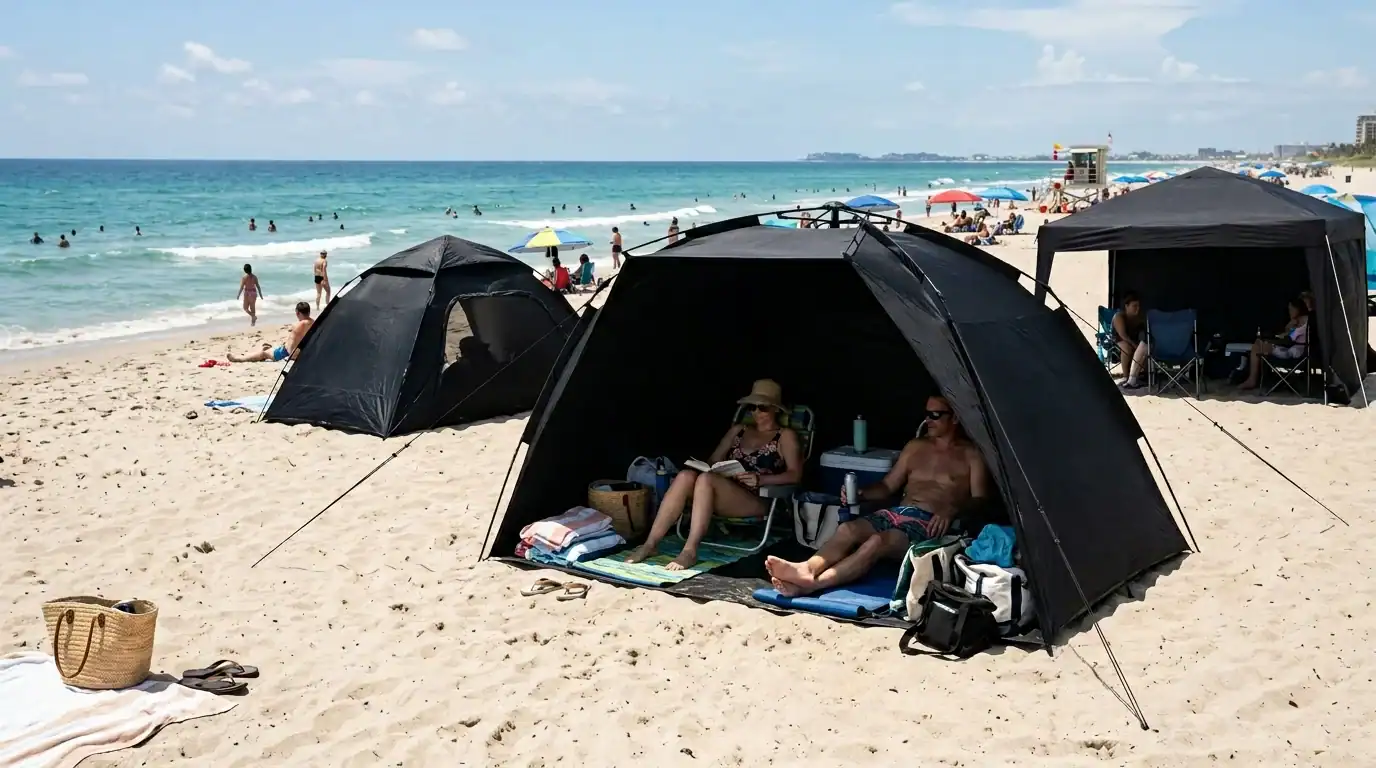
ケーランドの砂・塩・UVに対するビーチテントテスト手法
Sealed hubs and 304 stainless pins pass 100 sand cycles and 72 salt-spray hours before a unit ships.
Most suppliers test the fabric: waterproofing, UV fade, seam strength. The mechanism that fails on a beach — the hub-and-spoke fold — gets no test. Kelyland’s QC treats the folding system as the primary failure point.
Sand-cycle folding test
Factory QC applies beach sand to every hinge point, then completes 100 open-close cycles. Every 25 cycles, inspectors check the hub, washers, hinge pins, and shock cord. Resistance gets logged in the inspection report, not just marked pass or fail. Buyers receive that report before shipment.
This test exists because sand works into open hubs, mixes with salt moisture, and grinds nylon washers into paste. A sealed hub with acetal washers and 304 stainless steel hinge pins passes 100 cycles. Open nylon hubs rarely reach 50.
Salt spray and UV exposure
Hinge pins and washers go through a 72-hour salt spray test. Fabric and elastic shock cord go through UV exposure, measuring color fade, tensile loss, and cracking. One test targets the metal joint; the other targets the materials holding tension.
Pre-shipment inspection checklist
-
- Hub lock function: Every hub opens and locks cleanly, three times, with no grit sound.
- Fold smoothness: Full fold sequence runs even; no resistance spike at a single pole.
- Stitch integrity: Seam tension checked at canopy stress points and webbing junctions.
- Anchor attachment strength: Tug-test webbing loops, sandbag pockets, and stake loops — loose anchors fail at 15 mph.
- Packaging and photo proof: Confirm carton sizing and poly-bag protection, then ask for video of the sand-cycle test on the production sample.
Kelyland’s 17 core strategic factories run these checks under ISO 9001:2015, and the inspection report is shared before shipment approval. That report is the only ‘trust us’ that matters when importing beach tents from China.
結論
Pick the frame before you pick the fabric. A pop-up beach tent’s return rate comes down to three components that rarely appear on a standard spec sheet: the hub seal, the hinge pin alloy, and the washer material. Put all three in writing, then verify them on a production sample before you commit to a bulk order.
-
- Ask for sealed hubs with acetal washers and 304 stainless steel hinge pins on every rotating joint.
- Demand a 100-cycle sand-fold test report before approving the pre-production sample.
- Confirm hinge pins pass a 72-hour salt spray test, not just fabric and UV checks.
- The $1.80 sealed-hub upgrade offsets the $15–$30 cost of a returned unit.
Put those three questions to your supplier in writing, then request a sand-tested sample from Kelyland’s beach tent line. Run the 100-cycle fold test on the actual hub, compare the inspection report to your spec sheet, and use a 50–100 piece trial run to benchmark return rates before the season window closes.
よくある質問
ポップアップビーチテントが詰まりやすい理由とは?
砂がハブ内のナイロンワッシャーを削り、数回のビーチ利用後に折りたたみ機構が固着します。アセタルワッシャーとステンレス鋼ヒンジピンを搭載したシールドハブを使えばこの問題を回避できます。サンプル承認前にシールドハブの仕様を確認してください。.
ポップアップテントを発注する前に購入者が確認すべきポイントは何ですか?
ハブに20回のサンドサイクル折りたたみテストを実施し、100回連続でジャムなしで動作しないサンプルは却不とする。ほとんどのサプライヤーは生地とUVのみをテストし、砂塵下でのフレームは検証しない。サンドサイクルテスト結果を書面での提出を求めること。.
フレームの詰まり修理の費用はいくらですか?
密封ハブへのアップグレードはテント1台あたり約$1.80、返返品1台あたり$15〜$30の費用がかかります。アップグレード費用は配送費、再入荷手数料、利益損失を圧倒的に下回るコストです。アップグレード価格を設定する際は、お客様の返品率を基準に見積もってください。.
なぜグラスファイバーポールは破損しやすいのでしょうか?
ガラスファイバーのポールは繰り返しビーチフォールドにより曲げ疲労を起こし、ヒビや破片が生じて安全上の危険を招きます。アルミニウムやカーボンファイバー製のフレームはコストは高いものの、破損やひび割れを軽減します。ターゲット市場に応じてポール材を選びましょう。.
ポップアップテントの蝶番はどれくらいでサビますか?
ズincメッキヒンジピンは1シーズン目で錆びる可能性があります。沿岸地域での利用にはステンレススチール製ピンが現実的な解決策です。仕様書にステンレススチール製ピンを記載してください。.

 English
  Español
  Deutsch
  Français
  Português do Brasil
  Русский
  العربية
  한국어
한국어  日本語
日本語