 跳到内容

On the folding wagon line in Jinhua, the packer hears the loose wheels shift every time she tips a carton onto the pallet. That sound is 折りたたみワゴンの容積重量 in its most practical form — the space you are paying to ship but not to use. The sales rep quoting FOB pricing rarely mentions it, and the 量産前サンプル won’t show it either.
Plug the numbers into a folding wagon DIM weight calculator and the result hinges on one thing: which divisor the carrier applies. Measure the outer carton in centimeters, multiply length × width × height, and divide by that factor. Ocean LCL typically uses 1,000 kg per CBM, while air express runs 5,000 or 6,000 depending on the lane and carrier. So a 0.35 CBM wagon carton weighing 12 kg can be charged as 70 kg by air. That’s not an edge case. That’s a standard folding wagon freight chargeable weight quote.
Before you give sample approval, ask for carton engineering drawings and stack test results. A supplier that can nest the wheels and frame to shrink carton height will cut your folding wagon shipping cost per CBM more than any rate negotiation. Quality tolerance on the carton matters too — a sidewall bulge of even one centimeter adds volume the carrier charges for. Skip this step and you’ll absorb the penalty on every reorder for as long as the product lives.
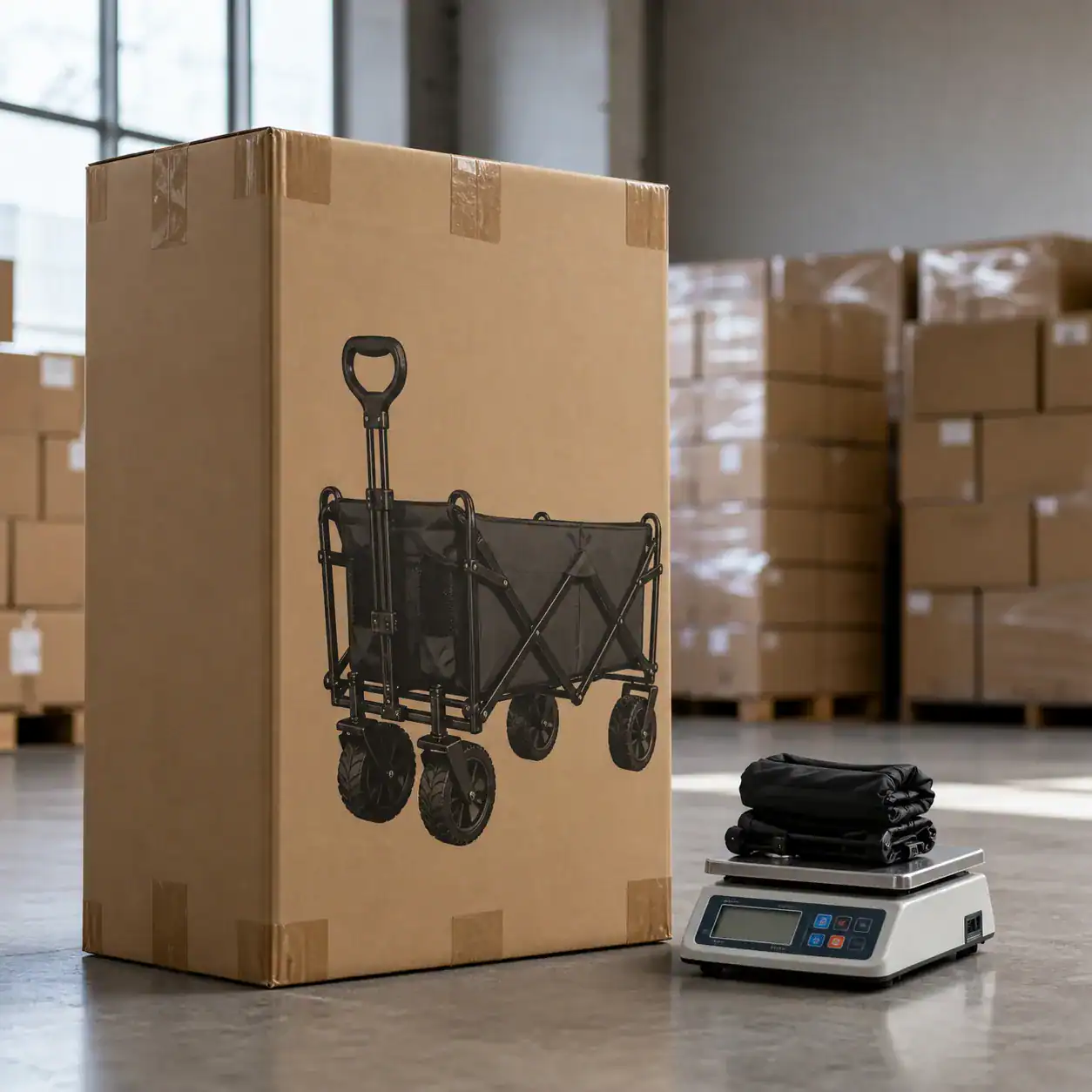
Why Folding Wagon Freight Quotes Surprise You
A 12 kg folding wagon carton can be billed as 70 kg by air.
Most freight quotes for folding wagons look high not because a forwarder padded the rate, but because carriers bill on chargeable weight. Once you know how your folding wagon freight chargeable weight is calculated, the quote makes sense. That number is the larger of two figures: actual weight and volumetric weight.
Actual Weight vs Volumetric Weight
Actual weight is what the carton reads on a scale. Volumetric weight, or DIM weight, is the weight the carton would have if its full cube were filled with air. A folded wagon in a box is mostly air — the frame, wheels, and fabric take up only part of the carton. Carriers charge for the empty space too.
Kelyland’s folding wagon partner factory in Jinhua builds wagons with 600D-900D double-layer Oxford fabric and powder-coated carbon steel or aluminum frames, so actual weight depends on the spec. But the carton cube, not the product weight, is what inflates the freight bill.
Take a 0.35 CBM wagon carton that weighs 12 kg. Under an air express rate with a 5,000 divisor, that carton is billed as 70 kg. The volumetric number is far above the physical weight. That is why a folding wagon freight quote can look unreasonable until you understand the calculation.
How Carriers Apply the DIM Divisor
Carriers convert carton volume into chargeable weight using a DIM divisor. Different modes use different divisors, and the result changes your freight cost. Air express carriers commonly apply 5,000 or 6,000 cm³ per kg. Ocean LCL uses 1 CBM treated as 1,000 kg, with rates quoted per CBM.
-
- Air express: Volume in cm³ ÷ 5,000 or 6,000 = chargeable kg.
- Ocean LCL: 1 CBM = 1,000 kg for the chargeable comparison; space is priced per CBM.
Run the same 0.35 CBM carton through a folding wagon DIM weight calculator. At 5,000, the chargeable weight is 70 kg. At 6,000, it drops to 58.3 kg. Either way, the actual 12 kg never matters because the volume takes over. That is the real difference between volumetric weight air freight vs ocean LCL.
The fix is not a cheaper rate. It is reducing folding wagon carton size. A few centimeters of height removed from the carton cuts the cube directly, and that reduction applies to every unit you ship. With LCL priced per CBM, the carton height sets your folding wagon shipping cost per CBM.
Before committing to an order, ask for carton engineering drawings and stack test reports. Kelyland’s folding wagon partner factory in Jinhua holds CE and ISO 9001 and has an annual output of 1,000,000 units, so packing documentation should be available. Make this part of your folding wagon packing density supplier audit. If the drawing shows wasted headroom, push for a revised carton before production.
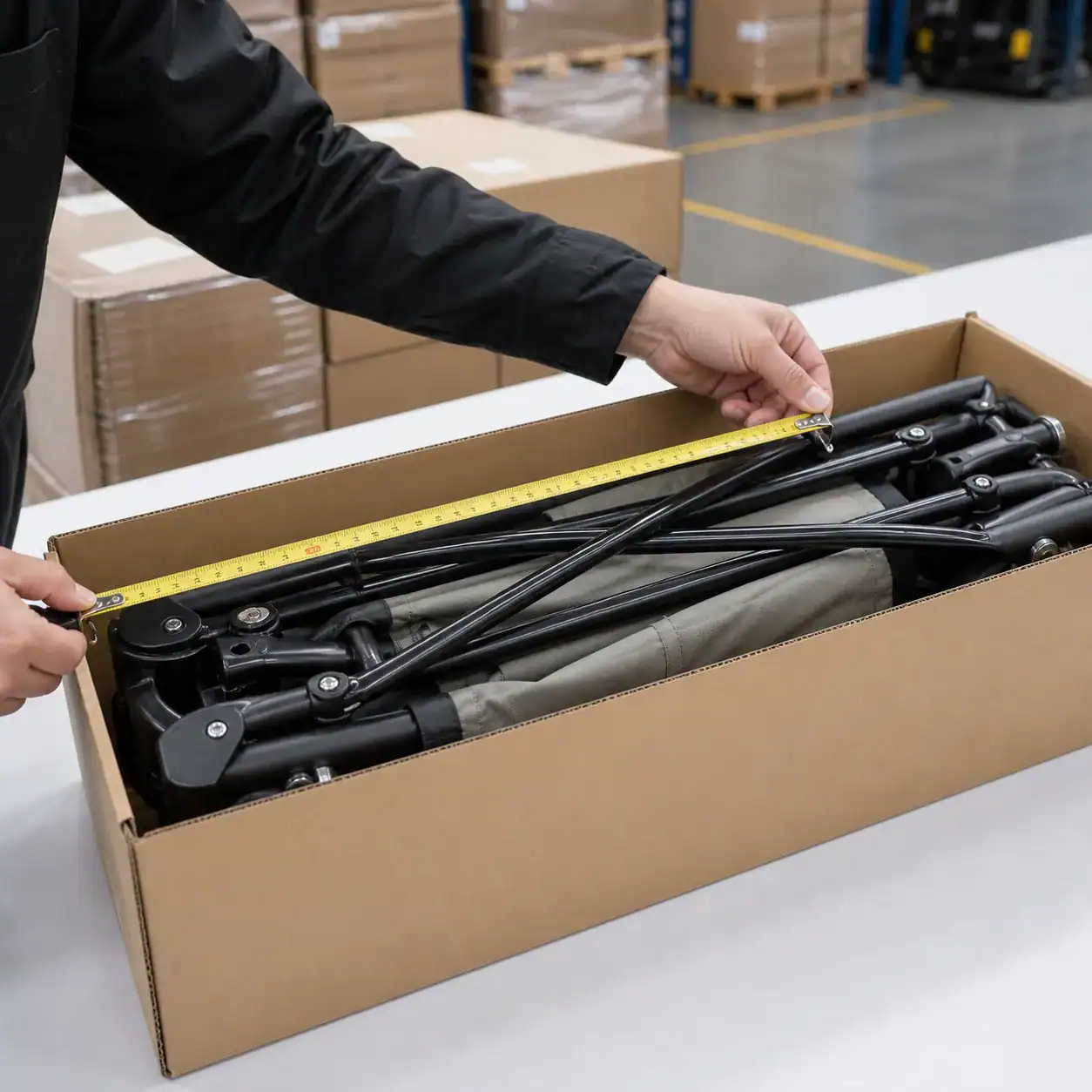
Step-by-Step Volumetric Weight Calculation
A 12 kg folding wagon carton can bill at 70 kg by air.
Folding wagon freight quotes start to diverge the moment the carrier applies a DIM divisor. That divisor converts carton volume into a phantom weight called volumetric weight, and for a bulky wagon packed into a box full of air, the phantom number can be five to six times the real weight. Buyers who skip this calculation often approve a purchase order where freight exceeds the factory price.
A typical heavy-duty folding wagon carton comes in around 0.35 cubic meters. When the actual weight is 12 kg, the chargeable weight by air express—using a 1:5,000 divisor—jumps to 70 kg. Ocean LCL uses a different baseline: 1:1,000 kg per cubic meter, so the same carton bills as 0.35 CBM rather than 12 kg. That gap explains why forwarders quote wildly different numbers for the same goods.
Measuring Carton Dimensions Correctly
Carriers calculate volumetric weight from the outer carton edges, including flaps, tape, and any protruding labels. Use a calibrated tape measure on a flat surface. Measure length and width at the widest points; measure height at the highest point, usually the taped flap seam. Record each dimension to the nearest whole centimeter, and when in doubt, round up by 1 cm.
Measure the production carton, not the hand-picked sample on a showroom shelf. Corrugated boxes used for folding wagons can compress during container loading, and a carton that starts at 62 cm can settle to 59 cm by the time it reaches the warehouse. Ask your supplier for the carton engineering drawing, or measure a random carton from the production line during a pre-shipment inspection.
Kelyland’s folding wagon line runs through a dedicated factory in Jinhua with an annual production capacity of one million units. That volume means carton engineering data exists for every batch, and the sourcing team can provide measured outer dimensions before production. A supplier who only quotes unfolded wagon sizes or hand-waves the carton cube is hiding the real shipping cost.
Air Freight vs Ocean Freight Formulas
Air express and standard air freight use the same core formula: (Length × Width × Height in centimeters) divided by a DIM divisor. Express carriers commonly use 5,000; standard air freight often uses 6,000. Ocean LCL skips the divisor: you convert to cubic meters and compare actual weight against 1,000 kg per CBM. The higher chargeable figure wins.
-
- Air express: 0.35 CBM = 350,000 cm³. Divide by 5,000 = 70 kg chargeable weight against a 12 kg actual weight. Run a folding wagon DIM weight calculator before you accept an air quote.
- Ocean LCL: 0.35 CBM × 1,000 kg = 350 kg theoretical volumetric weight. Since that exceeds 12 kg, the shipment bills by volume, but the rate basis stays at 0.35 CBM—usually far cheaper than 70 kg of air freight.
So the practical answer for most e-commerce entrepreneurs is clear: folding wagons are a sea-freight product. The air freight math only works for emergency restocks of a best-selling SKU, and even then, you should ask the factory to rework the carton to remove internal air gaps before paying for 70 kg of phantom weight.
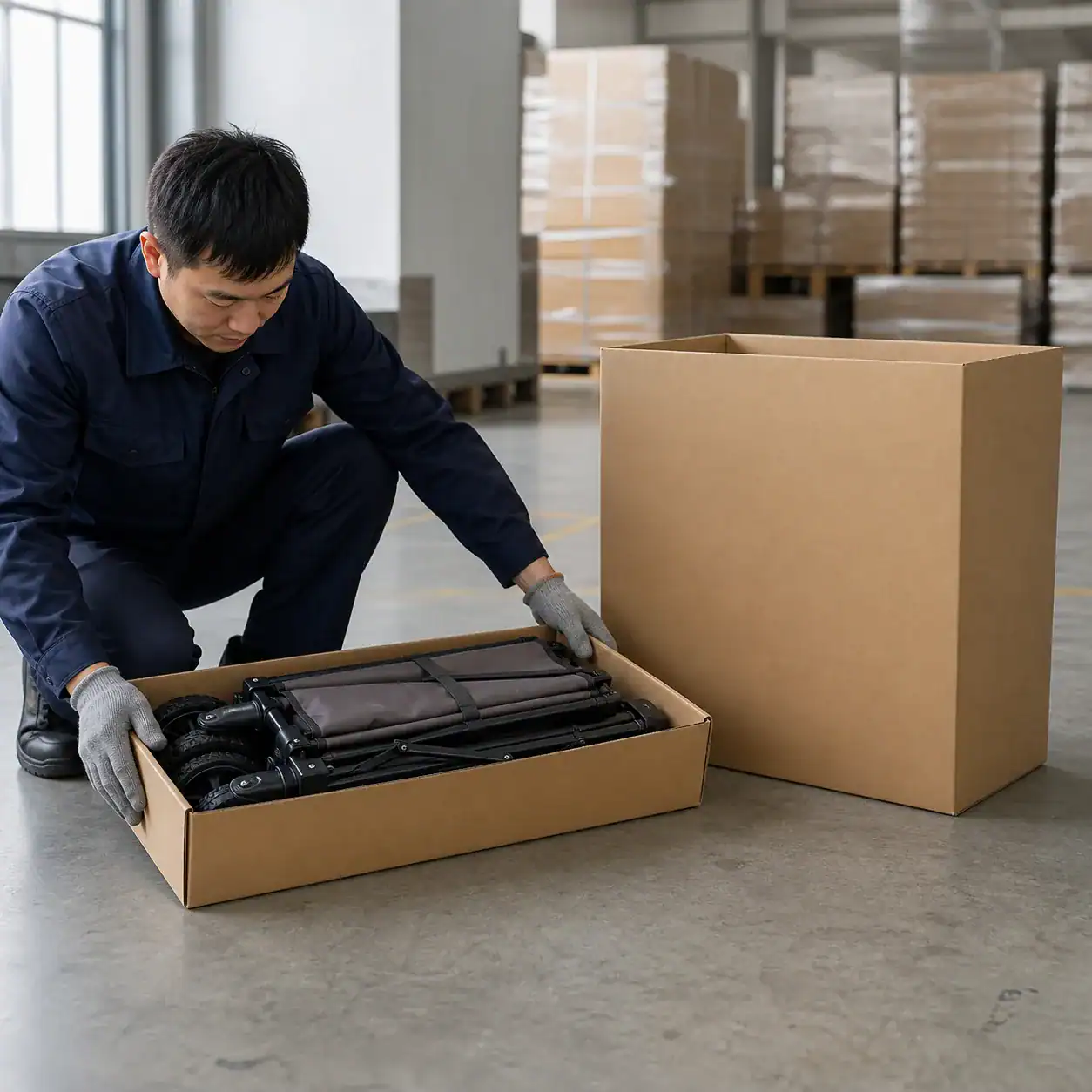
Reducing Chargeable Weight at the Carton Level
You pay for the air inside the carton.
A folding wagon carton that takes 0.35 CBM of space and weighs 12 kg can be charged as 70 kg by air express on a 1:5,000 DIM divisor. That is a serious cost leak, and it is completely avoidable.
Remove Internal Air Gaps
Folding wagon components do not naturally fill a carton. The 600D-900D double-layer Oxford fabric body sits loosely, the powder-coated carbon steel or aluminum frame takes one plane, and the 360°回転ホイール with foot brakes take another. If those parts are not nested inside each other, the void becomes chargeable volume.
The fix starts in the design phase. Ask the supplier for the carton engineering drawing and a stack test report. A well-run factory will show you exactly how the frame, baseboard, and wheel set fit together inside one carton. If the drawing shows a visible void, the packing design is incomplete.
For wagons with PP or MDF baseboards, that baseboard can sit flat at the bottom of the carton while the folded frame and wheel housings nest around it. No custom tooling is required. It requires a supplier who treats packing density as a packaging design criterion instead of an afterthought.
Nest Wheels and Frames to Shrink Carton Height
For folding wagons, height is where most of the packing waste happens. Reducing the carton from 40 cm high to 33 cm high cuts total carton cube by roughly 17.5 percent without touching the wagon itself. Height reduction also means more cartons per pallet layer and more layers per container.
Wheels should be disassembled and placed in two rows on each side of the folded frame, not stacked randomly in a plastic bag. The frame can sit flat with the fabric body folded to the same height. When wheels and frame share the same horizontal plane, carton height is set by the tallest component rather than the sum of all components.
One of Kelyland’s strategic folding wagon production partners is based in Jinhua, Zhejiang, with CE and ISO 9001 certification and annual capacity of one million wagons. The company’s ten-step process covers packaging design and 出荷前検査 before cargo moves, so carton engineering is negotiated before mass production, not after the freight quote is locked.
When the quote arrives, request the palletizing layout as well. A pallet that holds 10 wagon cartons flat instead of 8 becomes critical when you are paying for ocean LCL space by the CBM. The supplier who can show the pallet diagram is the supplier who has already won the freight fight.

結論
Folding wagon freight quotes surprise buyers because carriers charge the larger of actual weight or volumetric weight. A 12 kg wagon in a 0.35 CBM carton can be billed as 70 kg on air express, so understanding the DIM divisor is not optional. Getting the carton dimensions right before you quote freight has a direct impact on your landed cost.
-
- Air express uses DIM divisors around 1: 5,000 or 1:6,000; ocean LCL typically uses 1:1,000 kg/CBM.
- A 0.35 CBM folding wagon carton weighing 12 kg can be charged as 70 kg by air.
- Ask suppliers for carton engineering drawings with stack test results before comparing freight quotes.
- Reducing internal air gaps and nesting wheels and frames shrinks carton height and chargeable weight.
Before you approve the next factory quote, request the carton drawing that shows the folded wagon’s exact length, width, and height, and ask for the stack test report. If the supplier cannot produce either, you are not comparing freight charges; you are guessing. Compare those figures against the folding wagon specifications on the Kelyland product page using the DIM formula from this article, and you will know which quote actually lands at the lowest cost.
よくある質問
折りたたみワゴンの容積重量はどう計算しますか?
Measure the sealed carton’s length, width, and height in centimeters, then divide the product by the carrier’s DIM divisor. For air freight the divisor is commonly 6000; for ocean freight it is often. Confirm the divisor with your forwarder before comparing quotes.
Why is my wagon billed more than actual weight?
Carriers charge on chargeable weight, which is the greater of actual weight and volumetric weight. A compact 12 kg wagon carton can be billed as 70 kg by air when its volume is. Ask for a DIM breakdown before accepting a quote.
What DIM divisor do air freight carriers use?
Most air freight carriers use 6000 cm³ per kg, meaning you divide the carton volume by 6000 to get volumetric weight. Some express services use 5000, so verify the divisor with your specific carrier. Always confirm the divisor before booking.
How do I reduce volumetric weight on wagons?
Reduce the carton size by folding the wagon as flat as possible and nesting wheels or collapsed parts inside the frame. Removing internal air gaps is the main lever to lower the DIM. Request a compressed-packaging sample before committing to bulk cartons.
What carton dimensions count for DIM weight?
Measure the sealed carton’s outer length, width, and height in centimeters, not the product’s dimensions. For palletized air freight, carriers may also include pallet height, so clarify whether the quote is per carton. Measure the actual export carton, not a hand-folded prototype.

 English
 Español
 Deutsch
 Français
 Português do Brasil
 Русский
 العربية
 한국어
 日本語