 跳到内容

inflatable tent materials tpu pvc is the first checkpoint buyers should lock before they approve a supplier, budget, or production slot. A buyer’s checklist for an inflatable tent line looks solid on paper: confirmed denier, approved coating spec, signed-off color swatch. Then the $50K shipment lands and three things happen — the air beams lose pressure overnight in sub-zero temps, the fabric feels stiff enough to crack at the fold lines, and your retail partners start asking questions. The one item nobody checks before production is the welded seam peel strength on the air beam itself. That number determines whether your tent holds air for a season or fails during the first cold snap.
Most brand managers I work with get caught in the TPU vs PVC cost debate — and they should. TPU air beams run roughly 25-40% lighter than PVC and stay flexible well below freezing, but they cost anywhere from 50% to double what PVC does. That’s why most wholesale inflatable tents coming out of China still use PVC. The real gap shows up when you compare a cheap PVC beam that cracks at -5°C against a properly formulated TPU beam that flexes at -20°C without losing air retention. The price delta makes sense once you map it to your target market’s climate and expected product lifespan.
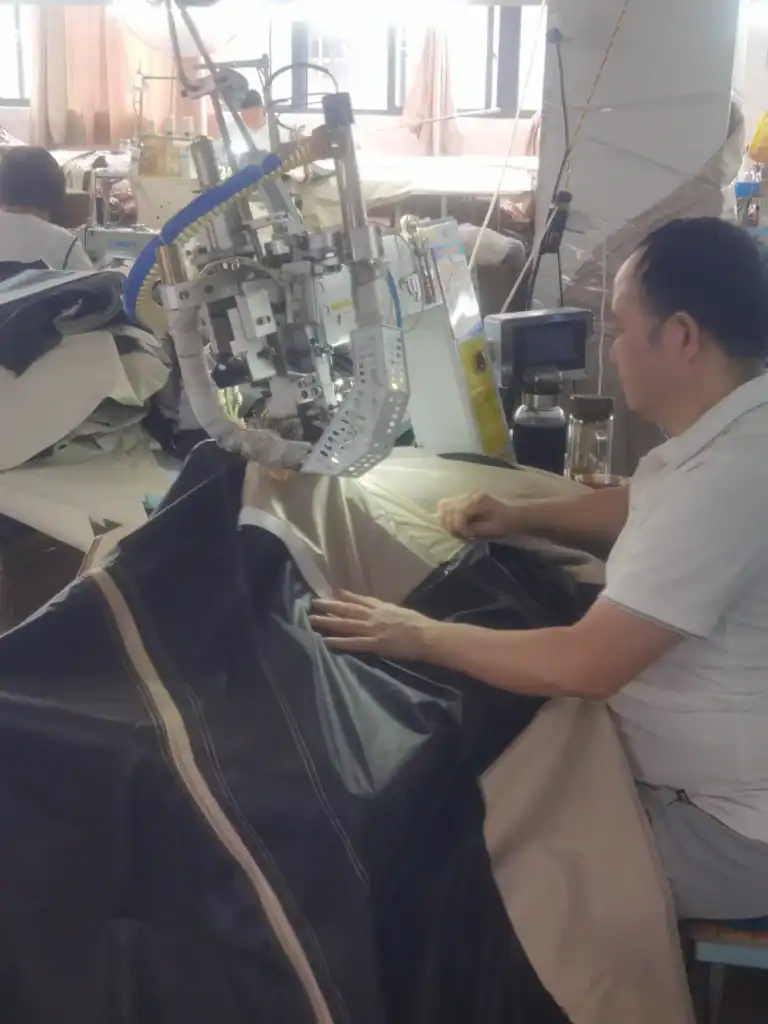
Inflatable Tent Material Basics
Fabric denier alone won’t predict field failure — coating thickness and seam peel strength will.
The single biggest mistake brand managers make when sourcing inflatable tents is treating fabric weight as the primary quality indicator. A 210D polyester with a thin PU coating will delaminate after two seasons in UV exposure, while a 150D fabric with a properly applied 0.3mm PU coating can hold up for five years. The coating system determines waterproofing longevity, not the denier number.
Why material choice determines product lifespan
An inflatable tent fails in one of three ways: air beam delamination at the weld seam, fabric coating breakdown from UV exposure, or puncture from abrasion against the ground sheet. The first two are material chemistry failures, not structural failures. PVCエアビーム lose plasticizer over time — in high-heat environments, they stiffen and crack at the folds after 18-24 months. TPU beams don’t have that problem because TPU doesn’t rely on migratory plasticizers; it remains flexible down to -30°C without embrittlement.
The fabric shell faces a different degradation path. Polyester resists UV better than nylon — nylon loses roughly 40% of its tensile strength after 500 hours of direct sunlight exposure, while polyester drops only about 15% under the same conditions. But even polyester needs a robust coating layer to block moisture ingress through the weave. A supplier that skimps on coating thickness saves maybe $0.08 per square meter at the raw material stage, but that savings translates directly into warranty claims when the tent starts leaking in month 14.
How to read a technical specification sheet from a Chinese supplier
ほとんどの場合 spec sheets from Chinese factories list fabric composition (100% polyester), denier (150D or 210D), and 耐水圧定格 (2000mm or 3000mm). Those three numbers tell you almost nothing about real-world durability if they aren’t paired with two critical data points: coating thickness in microns and welded seam peel strength in Newtons per centimeter.
TPU vs PVCエアビーム
TPU air beams are 25–40% lighter than PVC and flex down to -20°C, but cost 50–100% more per unit.
The choice between TPU and PVC air beams comes down to a direct trade-off: performance per gram versus cost per unit. TPU (thermoplastic polyurethane) delivers better cold-weather flexibility, lower weight, and higher UV resistance. PVC (polyvinyl chloride) holds the price advantage — roughly half the material cost in most Chinese supply chains. For a brand manager deciding between a premium glamping line and a mid-range camping tent, this gap defines the product tier.
Cost and Weight Comparison
TPU typically costs 50–100% more than PVC for the same beam dimensions. The weight difference is equally stark: TPU beams weigh about 25–40% less. A standard 4-meter PVC beam for a 4-person inflatable tent weighs roughly 1.2 kg; the same beam in TPU drops to around 0.8 kg. That adds up fast across a full shelter frame — saving up to 2 kg on a family-sized tent.
Cold Weather Flexibility and Crack Resistance
PVC becomes brittle below -10°C. Below -15°C, field failures are common — the material cracks at stress points where the beam bends over the tent geometry. TPU stays flexible down to -20°C without embrittlement. This matters for alpine or winter camping products where warranty claims spike due to 低温亀裂を防ぎます。.
UV Stability and Long-Term Air Retention
TPU resists UV degradation significantly better than PVC. After three months of continuous sun exposure, PVC loses roughly 30% of its tensile strength; TPU retains over 90%. Air retention follows the same pattern — TPU holds pressure longer because it doesn’t plasticize or leach stabilizers over time.
Repair Difficulty in the Field
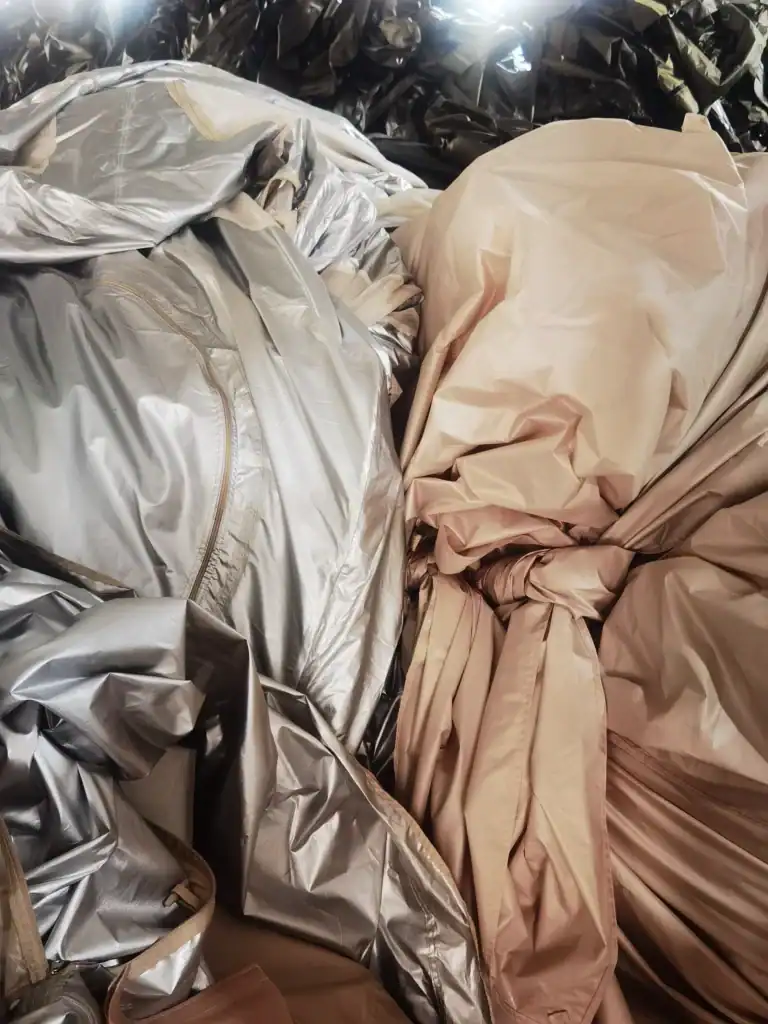
Tent Fabric Options for Inflatable Shelters
Fabric weight alone won’t tell you if the tent lasts — coating and seam construction decide that.
Most brand managers start by asking for a denier number. That’s useful, but it’s not the full picture. A 150D polyester with a thick PU coating can outperform a 210D fabric with a thin coating in real-world use. The coating system and seam construction determine where failures actually happen.
Polyester vs Nylon vs Blended Fabrics
Polyester dominates inflatable tent shells because it resists UV degradation better than nylon and costs less. Nylon is stronger per denier and more abrasion-resistant, but it absorbs water and sags when wet — a problem for large inflatable structures. Polyester-cotton blends (TC fabric) are common in glamping tents where aesthetics matter more than weight savings.
For inflatable shelters specifically, polyester ripstop is the standard choice. The reinforcing grid stops small tears from running across the panel. Nylon makes sense only for ultralight backpacking inflatables where every gram counts, but expect shorter lifespan under constant sun exposure.
Fabric Weight (Denier) and Durability
Denier measures thread thickness — higher numbers mean heavier, theoretically tougher fabric. A 150D fabric runs around 110-130 gsm; 210D runs closer to 170-190 gsm. For family-size inflatable tents, 150D to 210D polyester covers most needs. Heavy-duty glamping models often use 300D to 600D Oxford fabric for puncture resistance against rough ground sheets.
Hydrostatic Head and Waterproofing
A 3000mm hydrostatic head rating is the minimum for reliable rain protection in a glamping tent.
Hydrostatic head (HH) measures how much water pressure a fabric can withstand before leaking. The test is simple: a column of water rises against the fabric, and when the first droplet penetrates, that height in millimeters becomes the rating. A 1500mm fabric handles light drizzle. A 3000mm fabric handles sustained rain. For glamping tents where guests expect dry shelter regardless of weather, anything below 3000mm creates return risk.
What rating your product line actually needs
For three-season camping tents sold to weekend users, 2000mm to 3000mm on the fly and 4000mm on the floor is the industry standard range. Glamping tents with canvas or poly-cotton blends need a different approach — those fabrics rely on fiber swelling rather than coating alone, so the HH figure matters less than weave density and seam construction. For inflatable tents using polyester or nylon shells with PU coatings, specify a minimum of 3000mm on the fly and 5000mm on the groundsheet if you want zero complaints during an overnight downpour.
Why seam taping fails more often than fabric
The fabric itself rarely leaks first. The needle holes from stitching create thousands of micro-channels for water to follow, especially under wind pressure that forces water sideways through the thread path. On inflatable tents, every seam where two panels join must be taped or welded. PVC-coated fabrics get high-frequency welded seams that fuse the material — no tape needed, no failure point. PU-coated fabrics require hot-air seam taping with a polyurethane tape strip applied over every stitched seam.
- Welded seams (PVC): No tape required. The base material fuses under RF welding into a single monolithic bond. This eliminates the most common leak path entirely.
Air Retention and Valve Quality
A 0.1mm thickness difference can cut pressure retention by 40%.
素材の厚さが圧力保持に与える影響
空気の保持はビーム素材そのものから始まります。大手卸売インフレータブルテントで使用されるPVCエアビームの壁厚は通常0.4mm〜0.6mmです。0.4mmの場合、加圧時に素材がより伸展し、48時間以内に微細な多孔性を通じて空気が漏失します。一方、0.6mmでは、同じビームが补给なしで4〜5日間実用上の圧力を維持することができます。.
TPUビームは異なります。なぜなら、ポリマー構造自体がより低いガス透過性を持っているからです。壁厚0.3mmのTPUビームは、空気保持性能のみにおいて0.5mmのPVCビームを上回ることがあります。ただし、その代わりに耐穿刺性が低下します — 薄い壁は岩場や風の中でテントペグがずれた際に損傷を受けやすくなります。.
バルブの種類と漏れが発生しやすい箇所
ほとんどの現場での故障はビーム壁自体ではなく、バルブアセンブリで発生します。大量生産されているインフレータブルテントでは、以下の3種類のバルブ設計が一般的です:フラップバルブ(最も安価、脱気が遅い)、ツイストロックバルブ(中間価格帯、密封性が高い)、またはハifarlowダンプバルブ(高速脱気、可動部品が多い)。それぞれに特有の故障モードが存在します。.
Comparing Long-Term Cost per Use
4.80米ドルのPVCテントは、3年間で16.20米ドルのコストがかかる可能性があります。
多くのブランドマネージャーはスプレッドシートで単価を比較しています。しかし、その比較では実際の指標を見逃しています——それは製品のライフサイクルにおける「1回あたりのコスト」です。14ヶ月目に故障するグラミング用テントは、単なる返金だけでなく、ネガティブなレビュー、失われた顧客、そして保証内での交換輸送をも生み出します。
PVCの交換サイクル計算
中国産の典型的なエントリーレベルPVCインフレータブルテントは、壁厚0.4mmビームを使用した2人用モデルで、単体あたり約4.80~6.00米ドルのFOB価格で小売に出回っています。最初の故障箇所はほとんどが生地ではなく、ビームの溶接継目またはバルブ基部です。ISO 9001:2015認証工場からの内部生産データによれば、この価格帯で出荷されたPVCテントのうち、約4分の1が断続的な季節使用後12~18ヶ月以内に緩やかに空気漏れを起こすことが示されています。
つまり、1,000個を販売した場合、約250個が 保証請求 またはネガティブなレビューとして2シーズン以内に返ってくる可能性があるということです。交換にかかるコスト(送料、取扱手数料、失われる利益を含める)は、しばしば元の販売利益を上回ります。
同じビーム径および壁厚のTPUエアービームは、PVCと比較して約50~100%の材料コストプレミアムがかかります。これにより、PVCチューブの代わりにTPUチューブを使用した同等のテントシェルでは、FOB単価が7.50~12.00米ドルまで上昇します。
7.50ドル対5.00ドルは紙面上は明確な選択に見えます——しかし、3年間のプロジェクションを実行してみると話は別です。
結論
| インフレータブルテントの素材選定は、そのパフォーマンスの上限と故障モードを決定づけます。PVCは単体あたりの最低コストを提供しますが、-10°C未満での冷間割れのリスクをもたらします。TPUは重量削減と氷点下での耐久性を実現しますが、価格プレミアムは100%に達することもあります。生地デニールだけでは、テントが3シーズン持つのか3年持つのかは分かりません——塗布厚と継目ピール強度が真の指標なのです。
Before you lock in your next production run, review your supplier’s technical datasheet against these three questions. Does the air beam material match your target climate? Is the fabric coating thick enough to hit a hydrostatic head of at least 3000mm for camping or 5000mm for glamping? And does the factory provide a documented peel strength test for welded seams? If you need a partner who answers all three with verifiable data, browse Kelyland Outdoors’ inflatable tent and air mattress product range to start a conversation about your specific spec requirements. |
よくある質問
How to get a quote for Inflatable Tent Materials: TPU vs PVC vs Fabric Weights?
| 正確な答えは、製品仕様、数量、および注文設定によって異なります。最も安全なアプローチは、最終要件シートが確定した後にのみ商取引条件を確認することです。. |
最初にサンプルを依頼できますか?
| 正確な回答は、製品仕様、数量、注文設定によって異なります。最も安全な方法は、最終的な要件シートが確定した後にのみ、商取引条件を確認することです。. |

 English
 Español
 Deutsch
 Français
 Português do Brasil
 Русский
 العربية
 한국어
 日本語