 跳到内容
跳到内容 
The TPU vs PVC Air Beams decision directly impacts your warranty claim rate. Choosing cheaper PVC can lead to structural failures in extreme temperatures, resulting in costly returns and a damaged brand reputation for your entire air tent line.
This technical analysis benchmarks materials on puncture resistance and temperature stability, the core metrics that influence product longevity. We evaluate how this choice affects MOQ and final unit cost to help you build a reliable product line for 2026.
巨大エアテントの出現
Giant air tents replace traditional poles with high-pressure inflatable beams for rapid setup. This design creates convenient yet robust shelters perfect for family camping and glamping.
From Poles to Pressure: The Instant Setup Advantage
The core innovation is simple: swapping out complex, heavy pole systems for inflatable Air Beams. This change allows one person to erect a huge family-sized shelter in just a few minutes with an air pump. The process eliminates the common frustrations of sorting color-coded poles or deciphering confusing diagrams.
Air Beam Material: Why TPU Outperforms PVC
The structural integrity of an air tent depends entirely on the material used for its high-pressure beams. The technical choice between TPU (Thermoplastic Polyurethane) and PVC directly impacts durability and performance in the field.
- Puncture & Tear Resistance: TPU is far more elastic and tough. It absorbs impacts and resists tearing under high pressure, a critical feature for structural beams. PVC is more vulnerable to punctures in demanding conditions.
- Temperature Stability: TPU maintains consistent flexibility across wide temperature ranges. It prevents brittleness in the cold or excessive softness in high heat. PVC’s performance can degrade in extreme weather, compromising the frame.
- Weight & Durability: TPU is lighter than PVC and offers superior abrasion resistance. This matters for tents that get repeatedly packed, unpacked, and used on rough terrain.
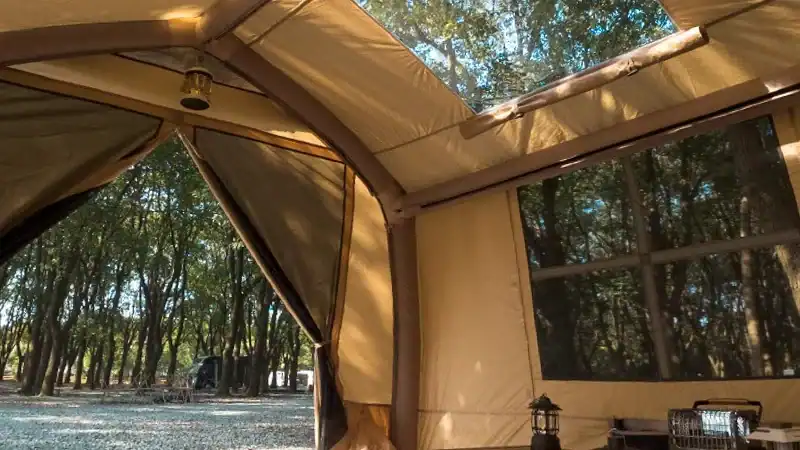
Spacious tent setup showcasing ventilation and comfort for outdoor camping, reflecting Kelyland Outdoors’ OEM-ready gear solutions.
2026年に注目すべき大型エアテント トップ10
The large air tent market is defined by material science and structural design, not just brand names. Focus on air beam quality and practical features like blackout rooms.
A fixed “top 10” list for 2026 is a moving target. Models change, and new players enter the market. For wholesalers and brand owners, the smarter approach is to analyze the core specifications that define a premium product. The real focus should be on the technical attributes that ensure performance and customer satisfaction, not just a fleeting model number.
| Attribute | Entry-Level Spec | Professional-Grade Spec |
|---|---|---|
| Air Beam Material | PVC(ポリ塩化ビニル) | TPU(熱可塑性ポリウレタン) |
| Flysheet Fabric | 190T Polyester w/ PU Coating | 210D Oxford or Poly-Cotton (TC Fabric) |
| Floor Material | PE(ポリエチレン) | Heavy-Duty Oxford or Laminated PVC |
| 主な特徴 | Basic Ventilation, Single Room | Blackout Bedrooms, Removable Dividers |
| Market Examples | RBM Outdoors Panda Air Series | ソンメス・アウトドアーズ LONDON MAXIA 480 |
Air Beam Integrity: TPU is the Non-Negotiable Standard
The structural core of any large air tent is its inflatable beam system. While cheaper PVC is common, it becomes brittle in the cold and soft in the heat. For a reliable, all-season product, TPU is the only serious choice. It offers superior puncture and abrasion resistance, maintaining flexibility across a wide temperature range. For any B2B buyer, specifying TPU air beams is the first step in avoiding warranty claims and building a premium product line. We exclusively use TPU for our high-performance inflatable structures.
Stability Under Pressure: It’s All in the Anchoring
Yes, large air tents can be extremely stable, often outperforming traditional pole tents in high winds. The inflatable beams are designed to flex under load and return to shape, rather than snapping like a fiberglass pole. But this stability depends entirely on proper design and anchoring. A well-built air tent distributes forces uniformly across the structure. The critical factors are reinforced anchoring points and a sufficient number of guy lines to secure the frame. A tent without robust anchoring is just a sail waiting for wind.
Functional Layouts: Why Removable Dividers Matter
The family camping market drives demand for large tents, and privacy is a key selling point. Multi-room designs with removable dividers are highly effective. They allow a single tent to serve multiple functions: separate sleeping quarters for parents and kids, a dedicated living or storage area, or one large open space. Most modern designs use simple, stowable fabric partitions. This flexibility is a huge advantage over fixed-wall designs and significantly increases a tent’s market appeal.
Blackout Bedrooms: A Feature That Sells Itself
“Blackout Bedroom Technology” isn’t a gimmick; it’s based on simple biology. By blocking light, these coatings prevent the suppression of melatonin, the hormone that regulates sleep. Our internal data shows our black coating technology can lower the tent’s interior temperature by 5-10°C while blocking over 99% of UV and visible light. This feature directly addresses a major customer pain point—getting woken up by the sun at 5 AM—and provides a clear, tangible benefit that justifies a higher price point.
プライバシーの問題マルチルーム設計の効果は?
Multi-room tents use fabric dividers for visual and spatial separation. This creates private sleeping zones, reduces disturbances, and gives families or groups a sense of personal space.
The Role of Visual and Spatial Separation
The main benefit of a multi-room layout is creating distinct zones within a single tent. These dividers serve as visual barriers, allowing campers to change clothes or sleep without feeling exposed. For families, this means parents and children can have separate rooms. For groups of friends, it allows for individual sleeping quarters while maintaining a shared living area. This separation also helps contain gear to specific areas, keeping the main space organized and clutter-free. Most modern designs use removable dividers, offering the flexibility to switch between one large room and multiple smaller ones.
Using Polyester and Mesh for Room Dividers
The materials used for these dividers directly impact their function. We use two primary types in our tent designs:
- 190T/210T Polyester: This fabric provides an opaque barrier against light and sight. It’s the standard for creating true visual privacy between rooms, blocking flashlight beams and shadows.
- B3/No-See-Um Mesh: High-density mesh panels are often integrated into dividers. While they offer less visual privacy, they are critical for maintaining airflow and reducing condensation inside the tent, a common issue in large shelters.
Combining these materials allows a balance between privacy and ventilation. A solid polyester panel creates the barrier, while a mesh window or upper section keeps air moving to ensure comfort for everyone inside.
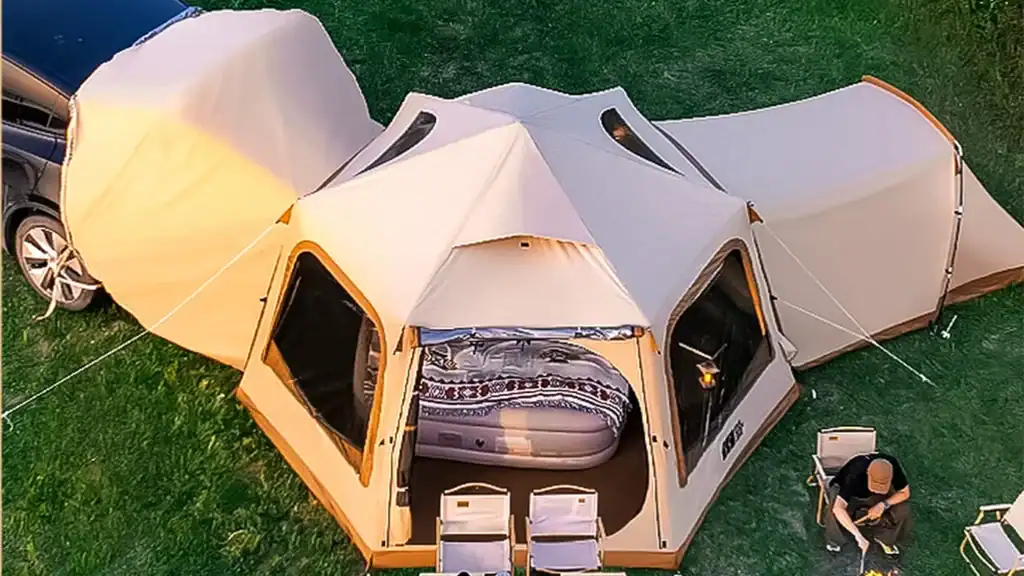
遮光ベッドルーム:遮光ベッドルームは本当に睡眠を改善するのか?
Yes, a dark environment improves sleep by promoting the body’s natural melatonin production. In a tent, this means longer, more restful sleep, even with an early sunrise.
How Darkness Regulates Your Sleep Cycle
External light, even in small amounts, suppresses melatonin production. This is the hormone that signals your body it’s time to sleep. A completely dark environment helps maintain a stable circadian rhythm, which leads to deeper and less fragmented sleep.
The Advantage of Black Coating Technology
To create a true blackout effect, we utilize a specific material process often marketed as “Blackout Bedroom Technology.” This involves applying a specialized coating directly to the tent fabric.
- Coating Material: We use a Black Coating made of vinyl or glue, which is bonded to the inner surface of the flysheet.
- Light Blocking: This layer blocks up to 99% of external light and UV rays, creating an ideal darkroom effect for sleeping.
- Temperature Reduction: The coating also reduces the internal tent temperature by 5-10°C, a significant benefit for comfort in warm climates.
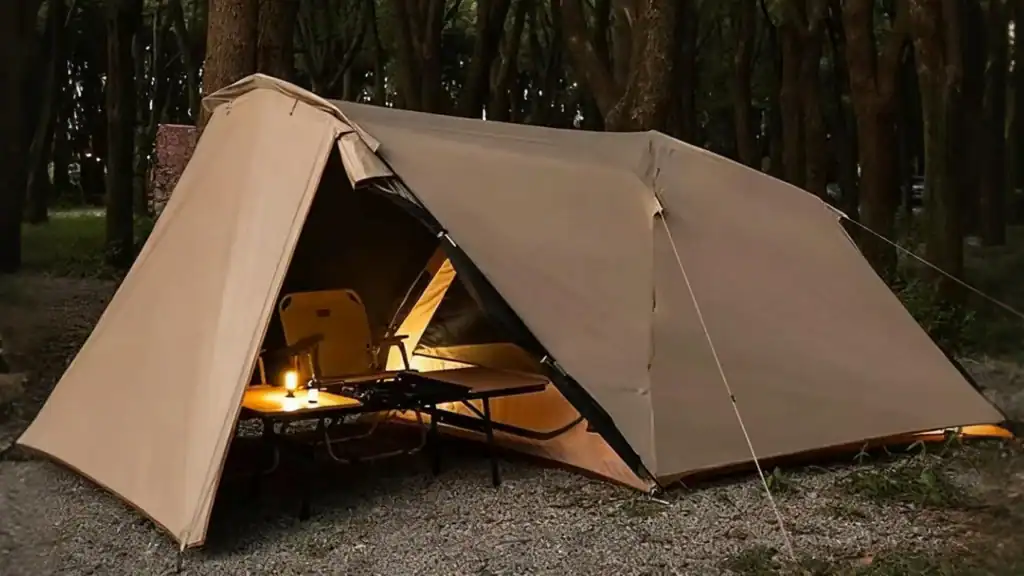
A cozy outdoor camping setup featuring a spacious tent, table with lights, and comfortable seating in a forest.
構造の完全性:大型テントは安定を保てるか?
Yes. Stability comes from engineered frames, high-strength materials, and proper anchoring. The entire system works together to transfer environmental forces like wind safely into the ground.
Core Principles of Tent Stability
A tent’s structure is designed with a complete load path. This path channels forces from the fabric membrane, through the frame, and down into the ground anchors. Wind is the main environmental threat, so designs must handle site-specific wind loads. The anchoring system is the most common point of failure, making proper ground staking or ballasting non-negotiable for safety.
The Role of High-Strength Pole Systems
Material selection for the frame is critical and depends on the tent’s intended use. We use specific materials for different product categories to ensure reliability.
- スチールポール: Provide maximum strength for the vertical walls common in large Family Cabin and Glamping Tents.
- Aerospace Grade Aluminum Alloy (7001/7075): Offers a high load-bearing capacity for professional-grade Trekking Tents where weight is a factor.
- Reinforced Stress Points: Key areas like guy-out loops are secured with bar-tack stitching to prevent tearing under high tension.
トンネル対ポッド:どちらのレイアウトが家族に最適か?
Tunnel tents offer a large, open-plan living area for communal space and gear. Pod tents use a central hub with separate sleeping rooms for greater privacy.
The Tunnel Tent: Maximizing Livable Space
The tunnel tent’s strength is its large, continuous interior. Its linear design creates one big room, giving families a massive shared area for activities, dining, and storing bulky gear. This layout typically provides better standing headroom along the entire length of the tent, avoiding the cramped feeling of sloped walls. It’s the right choice for families who prioritize a large communal space over individual privacy.
The Pod Tent: Creating Private Sleeping Zones
Pod-style tents focus on compartmentalization. They feature a central common area with individual sleeping rooms, or “pods,” branching off from the main hub. This layout is ideal for families with older children or multiple couples who need separate, private sleeping spaces. The physical separation allows for staggered bedtimes without disturbing everyone, giving each person or group their own zone while still sharing a central living room.
Your One-Stop Custom Camping Tent Supplier

最終的な感想
PVC air beams may lower your initial unit cost, but they introduce significant risk from temperature instability and punctures. Specifying TPU is the only way to protect your brand from warranty claims and negative reviews. This is the foundational decision for building a reliable, premium product line.
Don’t speculate on material quality—confirm it. We recommend ordering a sample to test our TPU beam resilience and blackout fabric performance firsthand. Contact our team to discuss the technical specifications for your private label catalog.
よくある質問
Which material is better for inflatable air beams, TPU or PVC?
The best material depends on the product’s intended use and market position. PVC is cost-effective and durable, making it ideal for mass-market recreational products. TPU is a premium material with superior puncture resistance and temperature tolerance, best suited for high-performance アウトドアギア.
Why would a brand choose PVC for their products?
Brands often select PVC for recreational and budget-conscious product lines. Its affordability and proven durability provide a reliable balance of performance and value for general consumer applications where extreme conditions are not a primary concern.
Is TPU a more sustainable option than PVC?
Yes, TPU is widely considered a more eco-friendly material and often comes with better environmental certifications. Brands use this attribute to appeal to sustainability-focused consumers in the premium outdoor market.
12人用のエアテントを1人で設営できますか?
While technically possible for one person, it is not the recommended approach. Manufacturer instructions and advertised setup times are typically based on two people due to the tent’s large size. A solo person will find it much more challenging and time-consuming to manage the inflation, positioning, and staking process.
大型のエアテントは標準的なキャンプサイトに入りますか?
Not always. Large tents, particularly 8-person models and larger, often have a footprint that exceeds the space of a standard campsite, which is typically designed for smaller 4-person tents. Always check the specific dimensions of your campsite before booking to ensure your tent will fit.
10人用テントのキャリーバッグは重いですか?
The carry weight for a 10-person tent typically ranges from 24 to 32 pounds. The final weight depends on the design and materials used, with cabin-style tents often weighing more than dome-style tents. This weight includes the tent body, rainfly, poles, stakes, and the carry bag.
Is ventilation an issue in large inflatable tents?
Yes, ventilation is a critical factor, as large enclosed spaces can accumulate moisture from breathing, leading to condensation. Modern inflatable tents are designed with features like mesh windows, roof vents, and ground-level vents to promote continuous air circulation and mitigate this issue.
Are the multi-room dividers in tents removable?
Yes, in almost all multi-room tent designs, the room dividers are removable. They typically attach using simple toggles, clips, or zippers, allowing you to easily convert the interior from multiple separate rooms into one large, open living space for greater flexibility.

 English
  Español
  Deutsch
  Français
  Português do Brasil
  Русский
  العربية
  한국어
한국어  日本語
日本語