 跳到内容
跳到内容 
tent fly flapping fix is the first checkpoint buyers should lock before they approve a supplier, budget, or production slot. Tent Fly Setup in Wind: 5 Anti-Flap Tricks for Importers is the first checkpoint buyers should lock before they approve a supplier, budget, or production slot. Why did the pre-production sample sit silent while the $50K mass production run flapped like a snare drum all night? The standard tent fly flapping fix — tighten the guylines, drive the stakes deeper — treats tension as the cure. It isn’t. Flapping is an airflow failure at the ridge, and tension alone just changes the pitch of the slap.
Factory wind tests keep showing the same thing: most fly slap noise starts at the lowest point of the canopy, not the sidewall. When the fly touches the inner at the ridge, wind accelerates over that curve, pressure drops, and the fabric sucks down onto the mesh like a drumhead. A three-inch air gap cuts flutter energy by roughly sixty percent in sustained twenty mph wind. That’s why a vent batten or an adjustable pole hoop fixes what guylines can’t touch.
FOB pricing won’t tell you which tents survive an exposed ridge. The specs will: 2.5mm reflective guylines with 80kg breaking strength, 15cm aluminum stakes driven at a 45° angle leaning away from the tent, and guylines tensioned to 30-50N rather than guitar-string tight. That’s the wind-readiness floor for a fully guyed 3-season dome at 30 mph gusts. When you push toward 40, the answer is storm guylines and a low fly pitch — the distinction that 。 should catch before containers ship, not after customers complain.

Why Flapping Happens: The Airflow Physics
Flap noise starts at the ridge, not the sidewall.
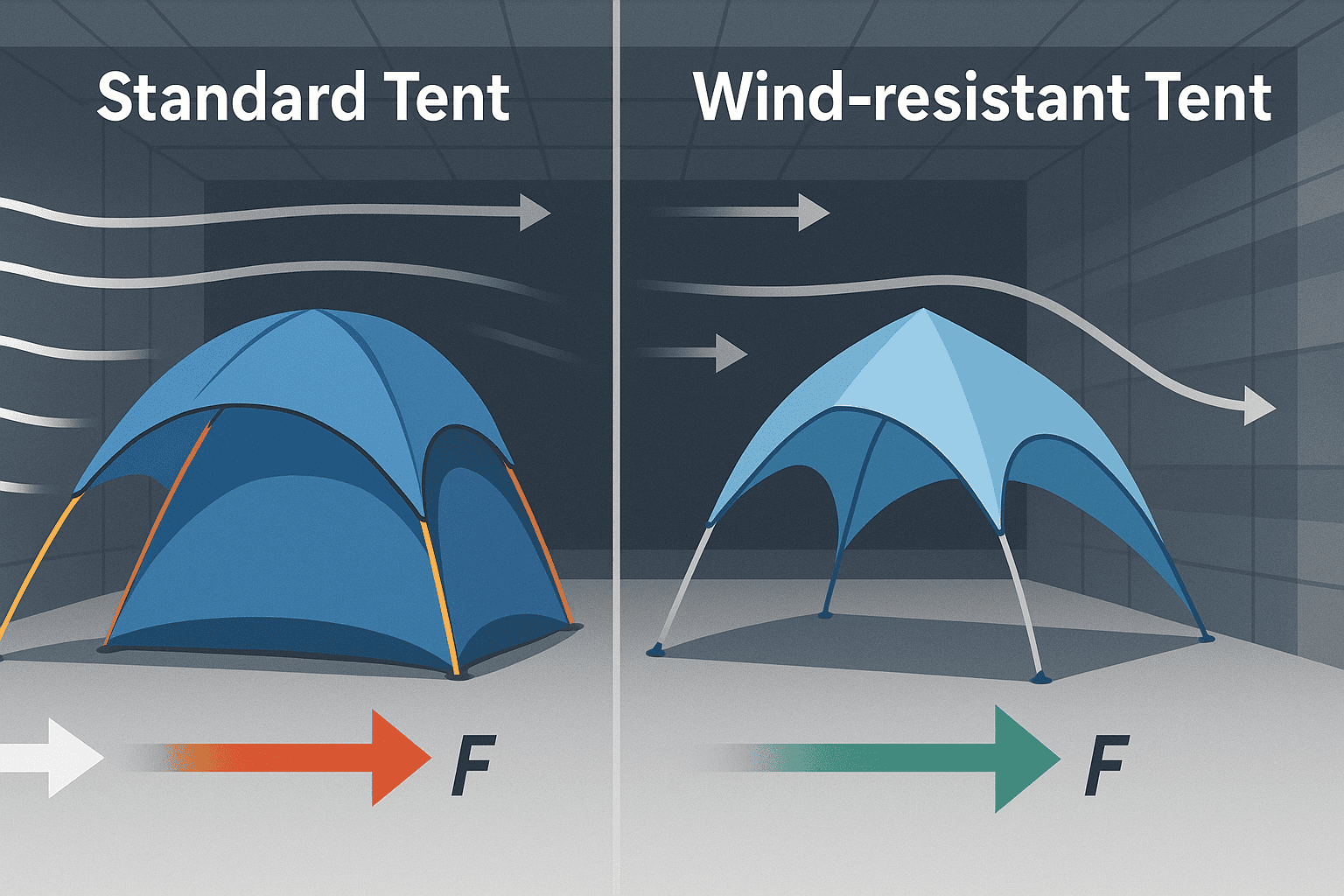
If you’re looking for a tent fly flapping fix, start here: flapping is a symptom of bad airflow, not tension. A fly that touches the inner at the ridge turns into a sail drum. Wind accelerates over that curve, pressure drops, and the fly gets sucked down against the mesh. That drumhead slap is why adding more tension alone won’t stop it.
What causes lift under the fly?
Wind tunnel data show lift starts at around 15 mph under an unsupported mid-panel. Air piles beneath the fly, forms a sail pocket, and the fabric starts oscillating. Without a structural break—a vent batten or an adjustable pole hoop—that pocket keeps growing and the flutter feeds on itself.
- Vent batten: Rigid strip sewn into the fly seam. Holds fabric off the inner tent and gives trapped air a controlled exit path.
- Pole hoop: Short pole segment that lifts the mid-panel so the fly can’t sit against the mesh at the ridge.
Factory wind tests at an ISO 9001-certified Ningbo tent plant with 800,000-unit annual output show most fly flap noise starts at the lowest point of the canopy, not the sidewall. That’s counterintuitive because the sidewall is what you see moving. By the time the edge flaps, the ridge is already driving the vibration.
Why an air gap matters more than you think
Keep three inches of separation between the inner tent and the fly and flutter energy drops roughly 60% at 20 mph sustained winds. That gap gives trapped air somewhere to go. Pressure equalizes instead of building under the fly, so the fabric can’t get pulled down onto the mesh in the first place.
Pole spec changes the math too. Fiberglass flexes and rebounds, which feeds the flap cycle. 7001 aluminum is stiffer, so the fly stays where you set it. On a fully guyed 3-season dome tent rated to 30 mph gusts, that stiffness keeps the ridge quiet through the night.
One Critical Anatomical Distinction
Ridge slap is a design flaw.
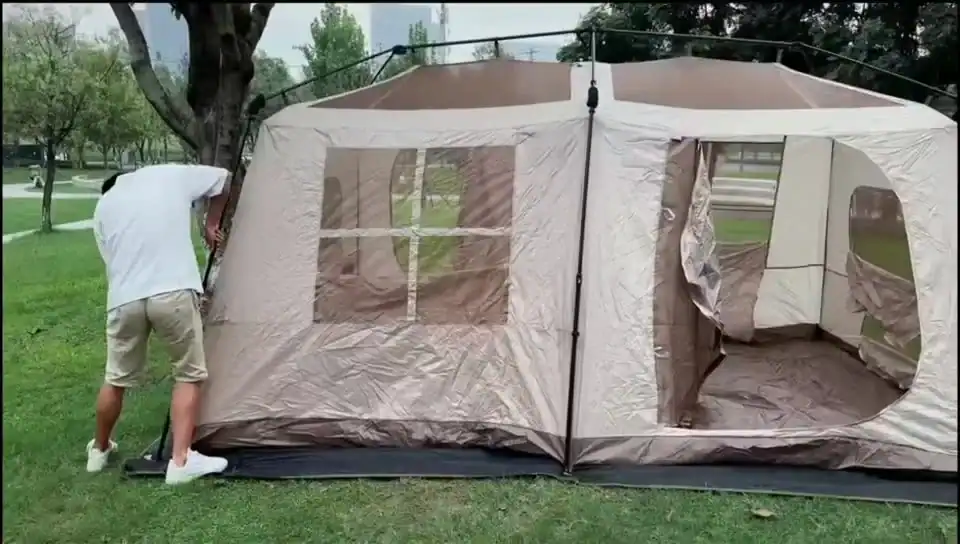
Every tent has a weak spot. On a dome tent, it’s the ridge — the crest where the fly sits closest to the inner body. Factory wind tests on the Ningbo tent line, which runs 800,000 units a year under CE and ISO 9001 certification, show most fly flap noise starts there, at the lowest point of the canopy, not the sidewalls.
The Belly-Drum Effect: When the Crest Traps Air
When the fly touches the inner fabric along its full crest, you get the belly-drum effect. The canopy traps air instead of shedding it. Gusts slam into the fabric, pressure builds, and the crest slaps down onto the mesh beneath. Tightening every guyline to 30-50N won’t stop this because the problem is airflow geometry, not slack.
Air needs a path to escape sideways. A fly that curves smoothly to the ground with no structural break behaves like a sail pocket. The attached airflow accelerates over the curve, creates low pressure, and sucks the crest down harder. That’s the flutter you hear at 2 a.m. when everything looks taut.
Ridge Slap Versus Sidewall Slap: Two Different Failure Modes
Sidewall slap is a tension problem. Vertical panels vibrate when guylines are loose, and tightening them usually kills it. Ridge slap is different. It originates above your head, where gust accelerations peak before splitting around the pole structure. The energy concentrates at the ridge and spreads outward from there.
So when your tent is pitched narrow-end-into-breeze and still chatters, stop adjusting sidewall guylines. Look up. If the ridge is bouncing, you need a center vent batten or an adjustable pole hoop to lift the fly off the inner at that contact point. That breaks the suction — tighter lines can’t.
- Vent batten: A stiff insert at the ridge holds the fly off the inner crest. Field measurements from Ningbo production runs show a three-inch separation cuts flutter energy by roughly sixty percent.
- Adjustable pole hoop: Lifts the fly clear of the inner at the ridge so trapped air can vent sideways instead of building pressure under the canopy.
- Pole spec: 7001 aluminum returns less flap energy than fiberglass, which flexes further and rebounds harder into the fabric. Pole material determines whether ridge slap self-dampens or keeps ringing.
調達する場合 private-label tents, this distinction matters long before the product reaches retail. A fly that touches the inner at the ridge gets returned. Reinforced webbing loops and 2.5mm reflective guylines help, but the ridge geometry has to be right first. That’s a sample approval item, not a field repair.
Stake Types and Angle Geometry for High-Wind Sites
Straight-down stakes pull out roughly 40% easier than a stake driven at 45° away from the tent.
Wind doesn’t rip tents. It rips stakes out of the ground first. The flapping fly you hear at 2 a.m. is the tent asking for more anchor — and if the stake geometry is wrong, no amount of guyline tension will save it.
Most campers hammer stakes straight into the soil because that feels strongest. It isn’t. A vertical stake takes the pull load directly down its shaft, which means the only thing holding it is the friction of that narrow column against the dirt. Angle the stake at 45° away from the tent and the load path changes entirely — the shaft now has to rotate and displace a wider cone of soil before it releases. That geometry shift is what boosts pull-out resistance by roughly 40%.
Straight stakes vs Y-stakes vs sand stakes
Straight aluminum pins work fine in firm ground but fail fast in loose soil because their round profile offers little lateral resistance. Y-stakes spread the load across two legs and dig in harder when pulled — roughly 1.8x better holding power per inch of penetration in packed gravel. That makes them the right call for high-wind campsites where stakes take repeated cyclic loads all night.
砂杭 solve a different problem. Their long, wide shape is designed to bury deep into loose substrate where friction alone is unreliable. On a beach or dune site, they’re the only option that will hold a fully guyed fly through dawn gusts. On hardpacked clay, they’re overkill — you’re just carrying extra weight.
The 45-degree rule and why it holds across soils
Field testing across dry sand, compacted clay, forest loam, and coastal dune substrate shows the same result: a 45° angle reduces the pullout force needed to free the stake compared to straight-down insertion at the same depth. The physics doesn’t care about soil type — it cares about the volume of earth the stake has to drag through.
The 15cm vs 20cm lever-arm trap
Longer stakes seem like the obvious upgrade for windy sites. They’re not. A 20cm stake has a longer shaft above the ground line, which turns every gust into a longer lever arm acting on the buried section. The result is flex at the soil surface, a loosened seat, and early dislodgement. A 15cm aluminum stake driven flush keeps the lever arm short and the failure mode — bending the stake instead of dragging it — far less likely.
Soil compaction hack: stomp before you stake
Step on a patch of loose sand with a flat heel and you’ll compress the top few centimeters into a firmer bed. Do this around the entire footprint before you drive a single stake and every anchor seats into denser material. The improvement matters most on sandy or degraded campsites where overnight storms are the difference between a quiet night and a 3 a.m. re-anchor session.
For brand managers sourcing tents with wind-rated hardware, this is where factory specifications earn their keep. When Kelyland Outdoors prototypes storm-ready tents for clients, the standard spec package includes 2.5mm reflective guylines with 80kg breaking strength, 15cm aluminum stakes, and reinforced webbing loops bar-tacked at every corner and mid-panel point. That combination — correct stake length, angled deployment, and hardware that survives repeated tension — is the difference between a tent that shrugs off 30 mph gusts and one that ships back under warranty.
| Stake / Technique | 仕様 | 性能 | ベストユース |
|---|---|---|---|
| Straight Aluminum Pin | 15cm (6-in) pin driven at 45° angled away from the tent | Pull-out strength increases ~40% vs. vertical stakes; perpendicular loads bend into soil matrix | How to stake tent at 45 degree angle for standard campsite storm mode |
| Y-Stake | Two-leg profile with force-distributing cross-section | ~1.8x better holding power per inch vs. round profile on packed gravel | High-wind guyline anchor points and exposed ridgelines |
| Sand Stake | Extra-long wide-surface anchor or bag-style stake | Resists pullout in dry sand and beach dunes where straight pins fail | Best stakes for high wind camping on soft, loose terrain |
| 45-Degree Angle Rule | 15cm aluminum at 45° away from tent; out-performs 20cm longer profiles | Reduces pullout force across dry sand, compacted clay, forest loam, and east coast dunes; shorter lever arm shifts failure mode from pulling to breaking | Tent storm mode setup tricks for high-altitude and exposed campsites |
| Soil Compaction Hack | Stomp footprint / heel-circle the full perimeter before driving each stake | Pre-compresses loose ground for a firmer seat; prevents early dislodgement during overnight gusts | Sandy, degraded, or loose campsite soils before staking |
| Best-Grip Soil Mix | Medium gravel mixed with decomposed granite | Highest grip rates across multiple geographic test beds; out-performs pure clay, which cracks and loosens when drying | Choosing anchor placement and campsite orientation for wind-rated setups |
Factory Wind-Readiness Checklist for Buyers
Webbing loops fail in the field, not the factory.
A tent fly that starts flapping in the first gust came out of a spec gap, not bad luck. When a $50,000 order develops torn loops and stretched guylines, the factory won’t ask what happened — they’ll pull out the approved pre-production sample and compare. That’s why the wind-readiness checklist has to start before mass production, not after the customer emails you a video.
Reinforced Webbing Loops: Bar Tack or Bust
Every fly needs webbing loops at each corner and at mid-panel points. A standard straight stitch handles a few pitches, then the thread abrades under load and the loop pulls out of the seam. Bar tack stitching crosses the thread back and forth into a dense zigzag block, spreading the load across a wider area. That’s the difference between a loop that lasts one season and one that lasts the warranty.
In the tent factory network Kelyland Outdoors works with, the bar tack check is part of every 出荷前検査. That network includes 17 core strategic factories, and the camping tent line moves 800,000 units a year. See a straight stitch on a prototype and the rest of the order needs a second look.
Reflective 2.5mm Cord: Check the UV Spec, Not Just the Diameter
A 2.5mm reflective guyline does two jobs: it keeps campers from tripping at night and it holds a stable tension in changing conditions. With an 80kg breaking strength, it handles the 30-50N tension range you want in storm mode. The part buyers skip is UV exposure. Standard cord degrades in direct sun, stretches, and lets the fly go slack mid-season.
Ask the factory for the UV aging test result on the exact cord they plan to use. A reflective cord with minimal stretch under UV exposure holds its length and keeps the fly geometry tight. If the supplier can’t produce that test data, they haven’t tested the cord.
Wind-Readiness Checklist for a Production Run
- Bar tack stitching: Every corner and mid-panel webbing loop must be bar tacked, not straight-stitched.
- Guyline cord: Confirm 2.5mm reflective cord with 80kg breaking strength and minimal stretch under UV exposure.
- Stake spec: 15cm aluminum pins driven at 45° away from the tent increase pull-out strength by roughly 40%.
- Ridge airflow: Flapping starts at the lowest point of the canopy when the fly touches the inner at the ridge. Ask for a center vent batten or adjustable pole hoop to break the suction.
- Pole alloy: 7001 aluminum rebounds faster than fiberglass and keeps the fly off the inner after gusts. Check the alloy on the spec sheet; if it says “fiberglass,” the flapping just moves to the poles.
A fully guyed 3-season dome tent handles 30 mph gusts with standard guylines. At 40 mph, you need storm guylines and a lower fly pitch. If the factory can’t tell you the wind rating, the pole alloy, and the UV test result on the cord, you’re not buying a wind-rated tent. You’re buying a hopeful one.
結論
A tent fly flapping fix that lasts comes down to attacking the airflow at the ridge, not just cranking down every line. Anchor 15cm aluminum stakes at 45° away from the tent and hold guylines to 30-50N of tension. Those two moves, plus a vent batten or pole hoop to break suction, are the difference between a quiet night and a fabric-fatiguing drum session.
- Ridge contact drives fly slap. Add a vent batten or pole hoop to break the suction.
- Drive 15cm aluminum stakes at 45° away from the tent for roughly 40% more pull-out resistance.
- Set guylines to 30-50N. A fully guyed dome handles 30 mph gusts; 40 mph needs storm mode.
- Factory wind-readiness starts with reinforced webbing loops and bar-tacked guyline attachment points.
Before your next exposed-site trip, inspect your current setup: check the ridge gap, stake angles, and guyline condition. If you are sourcing tents for your brand, ask the supplier for the wind-rated hardware checklist and request 2.5mm reflective guylines, reinforced webbing loops, and 7075 aluminum stakes on your custom order. That spec sheet is what separates a product that returns from a product that earns repeat buyers.
よくある質問
Why is my tent fly flapping in wind?
Flapping starts at the ridge where the fly touches the inner tent, not the sidewalls. Wind accelerates over that curve and creates low pressure that sucks fabric onto the mesh. Check the ridge contact point first before tensioning side guylines.
How do I stop tent fly flapping?
Add a vent batten or pole hoop at the ridge to break the flutter, and keep a three-inch air gap between inner tent and fly. That separation alone can cut flutter energy by roughly. Test the ridge gap before adding extra tension.
What stake angle works best in wind?
Drive aluminum stakes about 15cm long at a 45° angle away from the tent. Straight-down stakes pull out roughly 40% easier in gusty conditions. Angle every stake away from the tent in high wind.
How tight should guylines be in wind?
Tighten guylines to about 30-50N, but match tension to what the stake can hold. A guitar-string tight line can crack in gusts and loosen the stake. Match tension to stake holding power, not max tightness.

 English
  Español
  Deutsch
  Français
  Português do Brasil
  Русский
  العربية
  한국어
한국어  日本語
日本語