
For serious backpackers, selecting the right traditional dome tents is the critical decision standing between a successful multi-day trek and catastrophic gear failure in the field. The market is flooded with “instant” models that promise convenience, but this focus on setup speed often ignores the fundamental engineering that dictates how a shelter performs under stress. Choosing a tent based on marketing claims alone is a significant risk, leading to unnecessary pack weight or a collapsed shelter in the first real storm.
This guide provides a technical breakdown of the core differences between these two designs. We will analyze why the geodesic shape of a dome tent offers superior strength against wind and compare the weight-to-strength ratio of aluminum crossover poles to the heavy steel hubs used in instant tents. We’ll also evaluate long-term maintenance, looking at how easily individual components can be replaced, and explain the key factors behind the difference in cost. This is a direct comparison of the engineering, not just the setup time.
Geometry: Why is the Geodesic Shape Stronger?
The exceptional strength of a geodesic dome comes from its triangular geometry, which creates an inherently rigid structure that distributes stress evenly across its entire surface.
The dome tent is a staple in the camping world, and its resilience isn’t an accident. The design borrows principles from geodesic architecture, leveraging specific geometric properties to create a shelter that is both lightweight and incredibly stable, especially against wind and snow loads. This structural integrity comes from three core principles: the use of triangles, even stress distribution, and an efficient strength-to-weight ratio.
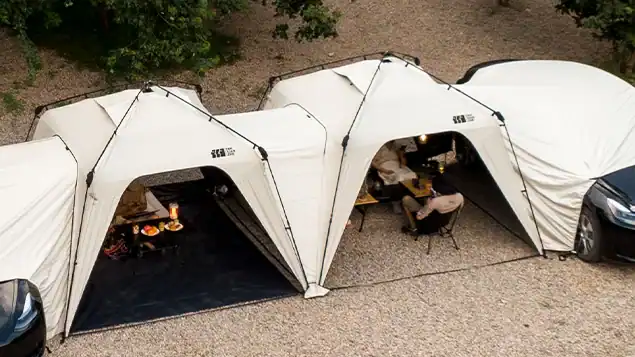
Structural Geometry and Triangles
The foundational strength of any geodesic structure lies in its use of triangles. A triangle is the most rigid polygon; its sides cannot be distorted or bent without changing their length. This makes it a self-supporting shape. When multiple triangles are connected, they form a robust shell that resists deformation from lateral pressure. This stands in stark contrast to rectangular or box-like structures, which can be easily flattened or skewed when force is applied to their corners.
Even Stress Distribution
A dome’s curved surface distributes any load—whether from heavy snowfall or strong gusts of wind—evenly across the entire structure. This prevents stress from concentrating at specific weak points, which is a common failure point in conventional rectangular designs where loads are transferred at right angles. By spreading forces uniformly throughout its network of triangles, the dome effectively neutralizes external pressures without needing heavy internal supports.
Strength-to-Weight Efficiency
Geodesic domes achieve an extremely high strength-to-weight ratio. Their structural integrity comes from their shape, not from heavy or thick materials. This efficiency allows them to withstand significant force using surprisingly lightweight components, like aluminum or fiberglass tent poles. A unique property of this design is that a dome’s structural strength actually increases with its size, making larger domes proportionally stronger. This geometric advantage means a dome can be built with roughly 30% less material than a conventional building of the same size, a principle that scales down effectively to camping tents.
Weight: Aluminum Poles vs. Heavy Steel Hubs?
The industry-wide shift to aluminum poles is a direct result of their superior strength-to-weight ratio and natural corrosion resistance, justifying a higher material cost for nearly all portable tent applications.
Aluminum’s Advantage in Portability
For most modern camping tents, aluminum is the default material choice over steel, primarily due to its excellent strength-to-weight ratio. The anodizing process allows manufacturers to produce thicker-walled poles that resist bending under load without adding significant weight. This makes tents far easier to pack, carry, and set up. Aluminum’s inherent corrosion resistance also provides a major advantage for gear that is consistently exposed to moisture and varied weather conditions.
| 素材 | Primary Advantage | Typical Application |
|---|---|---|
| Aluminum Alloy (7001/7075) | High strength-to-weight ratio, corrosion-resistant | Trekking, Backpacking & All-Purpose Camping |
| スチール | Maximum strength and structural rigidity | Large Family Cabin Tents & Semi-Permanent Shelters |
| カーボンファイバー | Absolute lightest weight available | Ultralight Backpacking & Mountaineering |
Material Cost vs. Long-Term Value
Aluminum carries a significant material cost premium, often 50-60% higher than comparable steel components. This increased upfront investment is balanced by superior durability and low maintenance needs, which deliver better long-term value. For both manufacturers and end-users, the extended product lifespan and enhanced performance of aluminum justify the initial expense, solidifying its position as the market standard for reliable outdoor shelters.
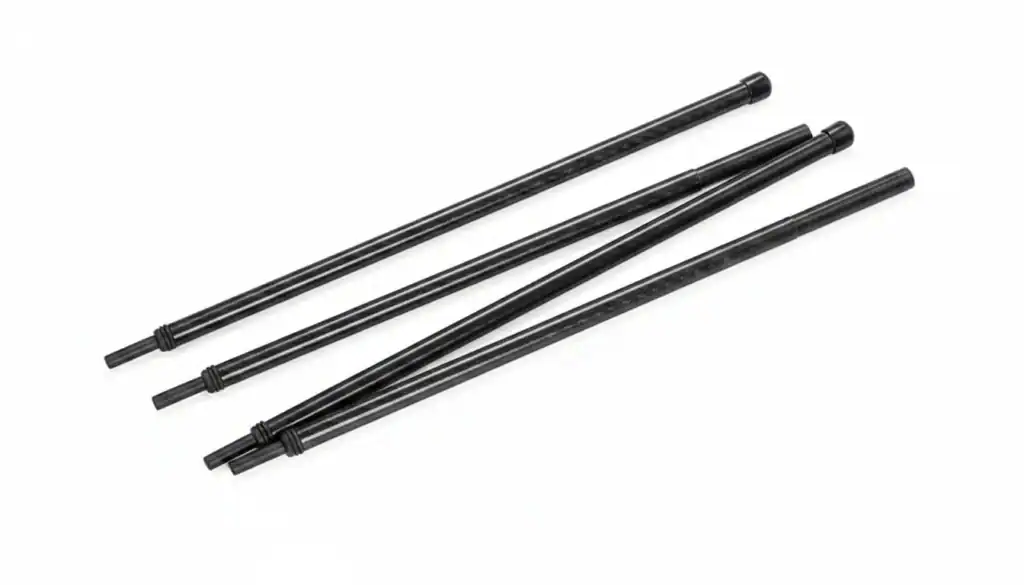
Niche Applications for Steel and Carbon Fiber
Steel hasn’t disappeared from the market; it has just become more specialized. It remains the best choice for large, heavy-duty cabin tents or semi-permanent shelters where maximum stability against extreme weather is the primary concern and portability is not a factor. At the other end of the spectrum, carbon fiber is emerging as the premium material for niche users. It offers the absolute lightest weight possible, making it the top choice for ultralight backpackers and mountaineers who count every gram.
Source High-Quality, Brandable Tents with Ease.

Maintenance: Are Crossover Poles Easier to Replace?
The ease of replacing a tent pole depends less on its crossover geometry and more on practical design choices, such as using external clips over fabric sleeves and the availability of standardized parts.
Standard Tent Pole Repair Methods
Most tent pole maintenance relies on universal techniques that apply regardless of the specific pole layout. Common failures like snapped sections or worn-out elastic cords are addressed with a few standard field repairs. These methods form the basis of any tent maintenance kit.
- A pole repair sleeve temporarily splints a broken or cracked section, restoring its structural integrity until a permanent fix can be made.
- Replacing a frayed or stretched internal shockcord is a routine procedure that keeps the pole segments properly tensioned and connected for quick assembly.
- For a permanent solution, you can replace individual pole sections if they are bent or broken beyond the help of a temporary splint.
Factors Affecting Replacement Simplicity
The ease of swapping out a tent pole often depends more on the tent’s construction and parts availability than the crossover design itself. Certain manufacturing features can make the process simpler or much more complex.
- Tents using external clips are generally easier to repair than those with long, continuous fabric pole sleeves that require tedious threading.
- Access to standardized replacement pole sections simplifies repairs, whereas proprietary or uniquely sized parts are difficult and expensive to source.
- The complexity of the pole network and the integrity of the shockcord also play a role in how quickly a repair can be completed.
Lack of Direct Comparative Data
There is currently no specific industry information or analysis that directly compares the ease of replacing crossover poles versus other configurations. The available resources simply do not address this question, focusing instead on general repair methods.
- Repair guides focus on techniques applicable to all pole types rather than highlighting maintenance differences between designs.
- Maintenance difficulty is more often linked to component accessibility and tent design features than the geometric layout of the poles themselves.
- Without targeted studies, it’s not possible to state that one pole configuration is definitively easier to maintain than another.
Cost: Why Are Dome Tents So Much Cheaper?
Dome tents achieve a significant cost advantage through material efficiency, standardized production, and minimal need for expensive, permanent foundations.
Material Efficiency and Options
The most direct cost advantage of dome tents comes from efficient material use. The structure allows for a wide range of cover materials, from affordable PVC and polycarbonate to high-end glass panels, giving buyers a broad budget spectrum to work with. This flexibility, combined with lower raw material volumes, creates substantial savings over traditional construction methods that rely on brick, steel, and concrete.
- Lightweight PVC and polycarbonate covers are common, reducing raw material and shipping costs.
- The cost is 50-75% lower compared to permanent hotel or sports structures built with traditional materials like brick and steel.
Standardized Production and Installation
Dome tent manufacturing benefits heavily from standardization and modular design. This industrial approach streamlines production by using repeatable components and systems, such as prefabricated flooring. The result is not just lower manufacturing costs but also much faster and simpler on-site assembly, which directly reduces labor expenses and the need for specialized construction crews.
- Industry innovation is focused on faster installation methods.
- The use of standardized components and modular flooring systems helps reduce overall production costs.
- Simplified assembly requires less specialized labor compared to constructing permanent buildings.
Reduced Structural and Foundation Needs
Perhaps the largest cost-saving factor is the minimal site preparation required. A dome tent’s self-supporting geodesic structure distributes loads so efficiently that it does not need the deep-set, engineered concrete foundations that are mandatory for permanent buildings. Bypassing extensive excavation and foundation work eliminates a huge portion of a typical construction project’s timeline and budget.
- These structures can be erected without costly, deep-set foundations.
- The absence of heavy structural demands bypasses the need for complex engineering and prolonged construction timelines.
Verdict: Best for Backpacking or Car Camping?
Your primary camping style dictates your tent choice, but modern crossover designs now offer impressive versatility, blurring the lines between dedicated backpacking and car camping shelters.
The Rise of Crossover Designs
The distinction between pure backpacking tents and car camping tents is less rigid than it was five years ago. We’ve seen a clear market shift towards versatile crossover models that serve both activities well. Manufacturers in 2026 are engineering tents with a balanced weight-to-comfort ratio, using innovations in lightweight yet durable materials and smarter ventilation. This allows a single, well-designed tent to provide solid weather protection and livability for a wide range of recreational scenarios, reducing the need for customers to own multiple, category-specific shelters.
When Car Camping Priorities Take Precedence
If your primary use is vehicle-based camping, packed size and weight are not major constraints. This allows you to prioritize comfort, space, and features. Car キャンプ用テント can have larger footprints, taller peak heights for standing room, and spacious vestibules for storing gear. They often use heavier, more robust materials like 150D Oxford fabric and thicker fiberglass or steel poles for enhanced durability. These models frequently include features that are impractical for backpacking, such as room dividers, multiple doors, and large PVC windows.
| 属性 | Dedicated Backpacking Tent | Dedicated Car Camping Tent |
|---|---|---|
| Primary Goal | Minimum weight and packed size | Maximum interior space and comfort |
| ポール・システム | Lightweight Aluminum (7001/7075) or Carbon Fiber | Heavier Fiberglass or Steel for structure |
| 生地 | Ripstop Nylon (20D/40D), often with Silicone coating | Polyester (190T/210T) or heavy Oxford fabric |
| 内部空間 | Minimalist, lower peak height, just enough room to sleep | Spacious, high peak height, often allows standing |
Why Backpacking Demands Remain Specific
For multi-day treks where you carry everything, low weight and a compact packed size are non-negotiable. A dedicated backpacking tent is engineered specifically for this purpose. Every component is optimized to reduce weight, from the lightweight 20D ripstop nylon fabric to the high-strength 7001-series aluminum poles and minimalist stakes. The design focuses on delivering reliable weather resilience and stability in a package that disappears in a pack. While a backpacking tent works perfectly well for car camping, a heavy car camping tent is almost never a viable option for a serious trek.
Final Recommendation: Choose for Your Main Activity
The best tent is the one that aligns with your most frequent style of camping. A good tent chosen for your primary use will likely be versatile enough for occasional trips outside that category, especially with modern designs.
- If you primarily backpack, invest in a quality backpacking tent. It will serve you perfectly for car camping trips as well.
- If you only car camp, you can take advantage of the extra space, height, and comfort features of a larger, heavier model without penalty.
- For those who truly do both activities equally, a modern crossover tent offers the best balance of weight, space, and durability.
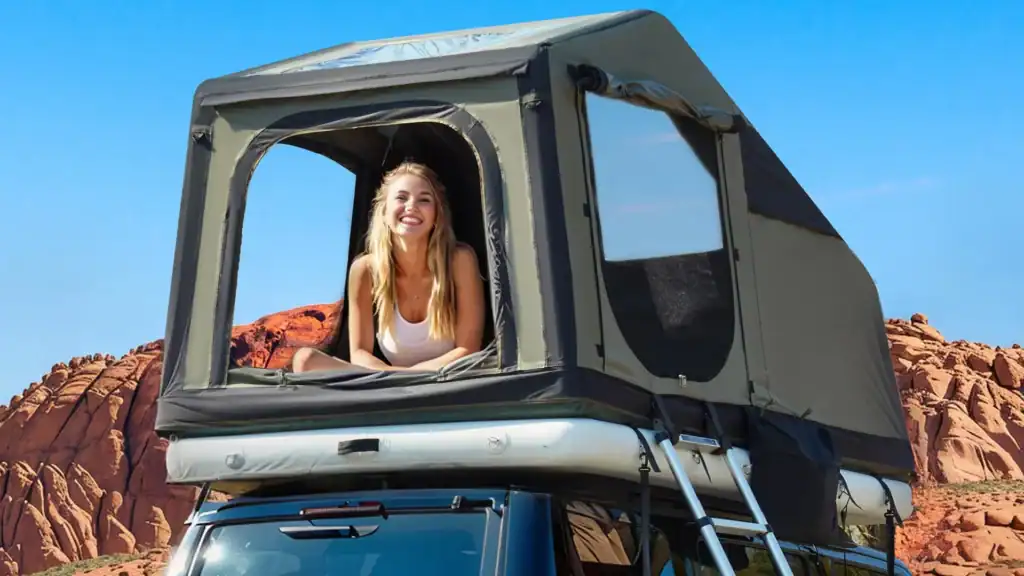
Enjoying the great outdoors in a rooftop tent with stunning views.
結論
Choosing between a classic dome and an instant tent depends entirely on the end user’s priority. Traditional dome tents provide a proven balance of low weight, storm resistance, and repairability, making them ideal for trekking. Instant tents trade that portability and component simplicity for unmatched setup convenience, a critical feature for the family car camping market.
Review whether your current product catalog effectively targets both the performance-focused backpacker and the convenience-driven family camper. Contact our team to explore custom manufacturing solutions that align with these distinct customer needs.
よくある質問
Why should I buy a traditional pole tent instead of an instant tent?
You should choose a traditional pole tent for its superior durability, lighter weight, and better performance in adverse weather. Traditional designs have fewer mechanical parts, reducing the number of potential failure points compared to the complex hub systems of instant tents. This simplicity also makes them easier to repair in the field, a critical factor for serious camping or backpacking. While instant tents offer convenience, traditional tents provide greater long-term reliability and weather resistance.
Are aluminum tent poles significantly better than fiberglass ones?
Yes, aluminum poles are significantly better. They offer a superior strength-to-weight ratio, making them both lighter and more durable than fiberglass. Under stress, aluminum poles will bend and return to their shape, whereas fiberglass poles can splinter or snap, potentially tearing the tent fabric. Aluminum also performs reliably in cold temperatures where fiberglass can become brittle. They are the standard for high-quality tents designed for performance and longevity.
How long do the elastic shock cords inside the poles typically last?
Elastic shock cords typically last between 5 and 10 years. Their lifespan is affected by usage frequency and storage conditions, as prolonged exposure to UV light and extreme temperatures can degrade the elastic. When the cord loses its stretch or becomes frayed, the poles will no longer snap together firmly. Fortunately, replacing a shock cord is a standard maintenance task, and repair kits are widely available.
Is a dome tent shape better for handling high winds than a cabin tent?
Yes, a dome shape is vastly superior for handling high winds. Its strength comes from its geodesic geometry, which distributes wind stress evenly across the entire structure. The low, curved profile allows wind to flow over it rather than pushing against it. In contrast, the tall, flat walls of a cabin tent act like sails, catching the wind and concentrating force on specific points, which creates structural weaknesses and increases the risk of failure in severe weather.
What is the hardest part of setting up a traditional dome tent?
For most people, the hardest part is threading the long poles through the tight fabric sleeves of the tent body, which can cause the fabric to bunch up and snag. A close second is applying the final tension required to bend the last pole and secure its end into the corner grommet or pin. This step can require significant physical force, especially with a new tent where the fabric has not yet stretched. Both of these challenges are more pronounced when setting up the tent alone.
Can I upgrade the fiberglass poles to aluminum later?
Yes, you can upgrade from fiberglass to aluminum poles. This is a common and effective way to increase the strength, reduce the weight, and extend the life of an entry-level tent. To do this, you must carefully measure the exact length and diameter of your original fiberglass poles to source a compatible aluminum pole set. You can either purchase a pre-made set or a DIY kit to cut the new poles to size and re-thread the shock cord yourself.

 English
  Español
  Deutsch
  Français
  Português do Brasil
  Русский
  العربية
  한국어
한국어  日本語
日本語