 콘텐츠로 건너뛰기

inflatable tent factory audit checklist is the first checkpoint buyers should lock before they approve a supplier, budget, or production slot. Two inflatable tents sit side by side in a warehouse, and their spec sheets look nearly identical. Same TPU air beam construction, same 5,000mm waterproof rating, same style number pulled from the same catalog. One supplier quotes 30% more on FOB pricing. An 인플레이터블 텐트 공장 감사 체크리스트 tells you what that premium actually buys: a heat-sealing line that holds above 180°C through production hours, batch-level quality tolerance, and a factory that will show you the thermal logger data to prove it.
Most buyers learn this lesson after a $50,000 order derails. The pre-production sample arrives with clean welds and matched fabric color. The mass production run shows up with thinner TPU film, valves that leak at the seams, and a seller that stops returning messages. That gap between sample approval and bulk delivery is where trading companies hide. It is also where a genuine manufacturer with in-house equipment earns the extra 30% — the same machines, the same operator settings, the same material lot from start to finish.
Write this benchmark down before your next supplier call: a real inflatable tent factory holds ISO 9001, CCC, and CE certification on the specific product category, not just on the company letterhead. That combination narrows the legitimate factory pool in China to fewer than 50 suppliers nationwide. If a candidate can’t produce those certificates with matching product scope, treat the low quote as the risk it is.
Why 60% of ‘Factories’ on Alibaba Are Actually Trading Companies
The markup is the least of your costs.
A TPU heat-sealing operator in a tent factory watches one number all day: the machine temperature. On legitimate production lines it stays above 180°C, and that setpoint determines whether your air beam seams survive a burst test at 3.5x working pressure. The sales rep who sold you the order has never looked at that readout.
That gap is the real cost of buying from a middleman instead of the manufacturer. It’s not the markup layer on the quote — it’s the loss of control over everything that happens after your deposit clears.
What the middleman can’t fix when production goes sideways
-
- Markup with zero influence: A trading company doesn’t own the production schedule. When the actual factory gets busy with bigger customers, your order gets deprioritized and nobody tells you until the ship date slips.
- Sample-to-run drift: Pre-production samples get extra care because they’re tied to winning the order. Mass production runs are judged by speed. Materials get swapped, quality tolerance stretches, and the difference shows up in burst tears and leaking seams.
- Dispute dead-ends: When a shipment fails inspection, the trading company blames the factory and the factory says you were never their client. Without a direct relationship, your recourse is an invoice dispute across international borders.
This is why verifying an inflatable tent factory in China starts with physical proof of production. Kelyland’s 17 core strategic factories — including the Ningbo tent facility that produces 800,000 units annually under ISO 9001:2015 — open their doors to buyers before a contract is signed. That open-door policy is the baseline for any supplier claiming to be a manufacturer.
Skip this verification step, and the cost isn’t just the middleman’s margin. It’s the container that arrives with failed seams, a retail season that stalls, and a brand reputation that takes the hit.
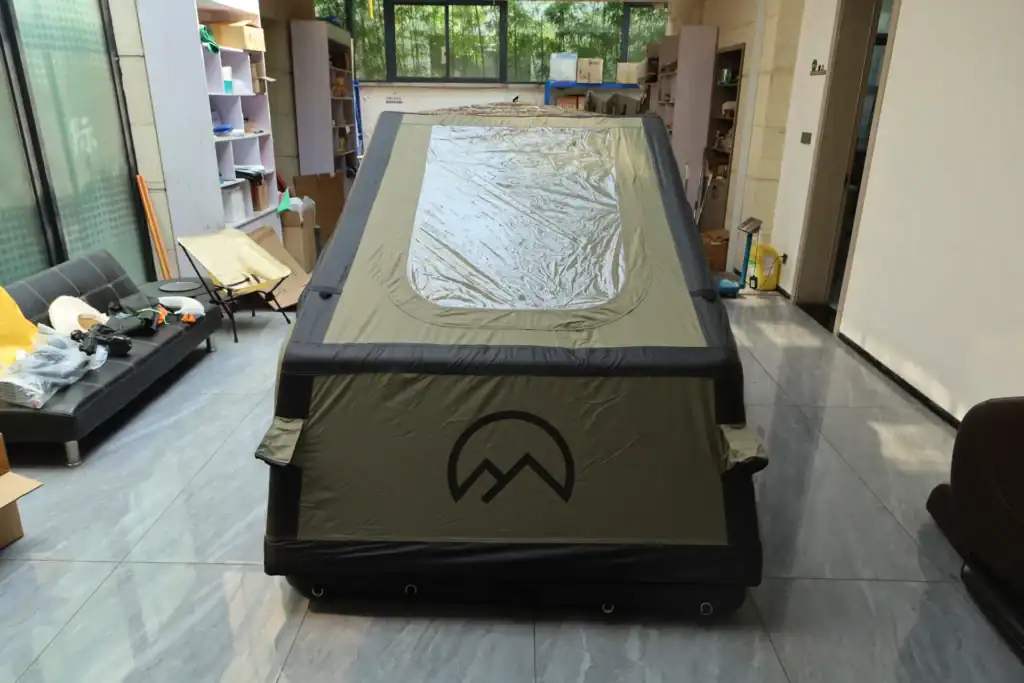
Red Flag #1: Generic Product Photos with No Custom Variations
If the same tent photo appears on three supplier sites, none of them built it.
Generic product photos are the cheapest tell. A factory with real production lines shoots dozens of angles, material swatches, and in-progress frames. A trading company reuses the same five images from Alibaba or a competitor listing.
Reverse image search exposes this fast. Take the supplier’s main product photo and drop it into Google Images or TinEye. If the same tent shows up on multiple supplier sites under different company names, you are not talking to the maker.
What reverse image search actually proves
It proves the photo is stock. It does not prove the supplier is fake on its own, but it shifts the burden of proof. Ask the salesperson for a fresh photo of the same model holding today’s newspaper or writing your company name on a piece of paper.
-
- Upload: Drop the supplier’s hero image into Google Images or TinEye.
- Check matches: If the image appears on foreign brand sites or multiple unrelated supplier pages, the listing is borrowed.
- Look for process shots: Genuine factories photograph heat-sealing lines, half-built air beams, and workers on the floor. Those images rarely get copied.
A real manufacturer can send fresh photos on demand. Kelyland’s tent factory in Ningbo, which produces 800,000 units annually, keeps a live showroom and a warehouse of finished models. A trading company has no production floor to show, so it recycles the same generic shots.
Red Flag #2: They Can’t Show You a Live Video of Their Production Line
A live video walkthrough is the fastest way to expose a trading company.
Ask any supplier for a live WeChat video call and watch what happens next. A genuine manufacturer agrees immediately and walks you to the production floor within minutes. A trading company pauses, offers a photo album instead, or schedules the call “for next week” — time zones never seem to work out.
Inflatable tent production is noisy, hot, and visually unmistakable. Rolls of TPU film, heat-sealing machines with hissing pneumatics, half-welded air beams hanging from workstations. That scene cannot be staged in an office.
What to Ask for on the Live Video Call
-
- A beam in the heat-sealing machine: 지금 진행 중인 에어빔 용접 장면을 요구하세요 — 테이블 위에 놓인 완성된 빔이 아닌, 작업자가 프레스 안에서 두 층의 TPU 필름을 융착시키는 모습을 직접 보여달라고 하세요.
- 온도 표시: 합법적인 중국산 인플레이터블 텐트 공장들은 생산 시간 중 TPU 열 sealing기 온도를 계속 180°C 이상으로 유지합니다. 작업자에게 현재 온도를 크게 읽게 하세요.
- 열 기록 장비 로그 데이터: 이것은 가장 많은 구매자들이 건너뛰는 단계입니다. 실제 공장들은 이음새의 무결성이 일정한 열에 달려있기 때문에 교대별로 sealing 온도를 추적합니다. 8시간 생산 이력을 보여주는 기록 장비 화면을 요구하세요. 사진은 연출될 수 있지만, 기록 장비 데이터는 운영상의 입증 자료입니다.
- Raw material rack: Have them walk to the TPU film inventory. Rolls carry batch numbers, thickness specs, and supplier labels. No raw film on site means no in-house welding.
Why This Matters for Your Order
The factory that welds your air beams controls the most critical failure point of the entire tent. Kelyland’s core tent factory in Ningbo — 800,000 units annually, with CE, BSCI, and ISO 9001:2015 certification — lets buyers walk the floor via live video before contracts are signed. That openness is not a courtesy. It is the natural behavior of a factory that actually makes what it sells.
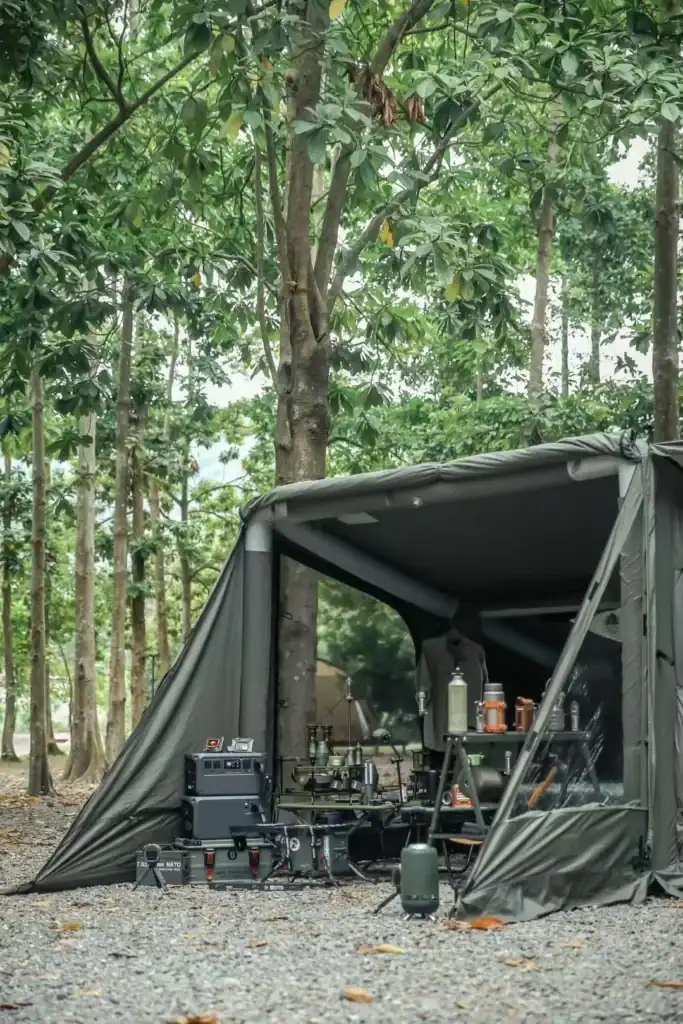
Red Flag #3: No In-House TPU Heat Sealing Equipment
A supplier without in-house TPU heat sealing equipment is an assembler, not a manufacturer.
TPU heat sealing is the one process that determines whether an inflatable tent survives its first season. It is also the process trading companies cannot fake. Stitching, framing, packing, and even design can all be subcontracted. High-frequency welding that fuses TPU beams into an airtight structure cannot.
When a supplier lacks in-house heat sealing equipment, they send beam panels to a third-party welding shop. Your pre-production sample comes from one line. Your mass production order comes from another. Welding width, dwell time, and temperature settings change. The sample inflates perfectly; the batch starts leaking along the seams on the fourth camping trip.
How to verify in-house capacity
Photos of a heat-sealing machine prove nothing—every trading company can pull those from the internet. Ask for thermal logger data instead. A legitimate inflatable tent factory keeps TPU welding heads above 180°C continuously during production hours. The logger records temperature, pressure, and dwell time per cycle. That data is harder to fake than any photo.
-
- Ask for: the welding machine’s thermal logger report covering a full production day. Confirm temperature stayed above 180°C and cycles align with your order quantity.
- Walk away if: the supplier offers only one scanned photo of a welding machine and no data logs. That means the machine is not theirs.
Scale is another hint. One of the air mattress factories in the Kelyland network—located in Xiangyang, Hubei—holds CE and ETL certifications and turns out 2.5 million units annually. That output is only possible when heat sealing sits on the factory’s own production floor, not routed to an outside workshop.
Red Flag #4: They Refuse Third-Party Testing of Air Beam Burst Pressure
No third-party burst test report means no safety claim.
Burst pressure is the number that separates an engineered air tent from an inflatable toy. Safety-certified tents must withstand 3.5 times their working PSI before a beam ruptures. A tent running at 7 PSI needs beams that survive past 24 PSI. That margin covers material fatigue, weld weakness, and TPU that degrades in UV.
Why in-house testing is not enough
A supplier that refuses third-party testing will claim their in-house rig is calibrated and trustworthy. That’s not the same as an independent lab with no financial stake in your order. ‘We tested it ourselves’ usually translates to ‘we inflated it until we got nervous and stopped.’.
The factories in Kelyland’s network operate under ISO 9001:2015 standards, with inspections at every production stage and reports available on request. The Ningbo tent factory holds CE and BSCI alongside ISO 9001. When a partner says a beam passed, there is a paper trail.
What a real factory audit requests
-
- Burst pressure ratio: Demand a third-party report showing minimum 3.5x working PSI. That ratio is a floor, not a quality tolerance to negotiate down.
- Thermal logger data: Legitimate factories keep TPU heat-sealing machines above 180°C during production hours. Logger readouts beat photos of machinery every time.
- 배치 추적성: A burst test on one sample beam proves nothing. The report must reference the production batch, weld parameters, and operator.
If a supplier hesitates on any of these three, consider the audit complete. An independent burst test runs a few hundred dollars. A collapsed tent in a customer’s campsite costs your brand far more — plus the recall, the chargebacks, and the trust.
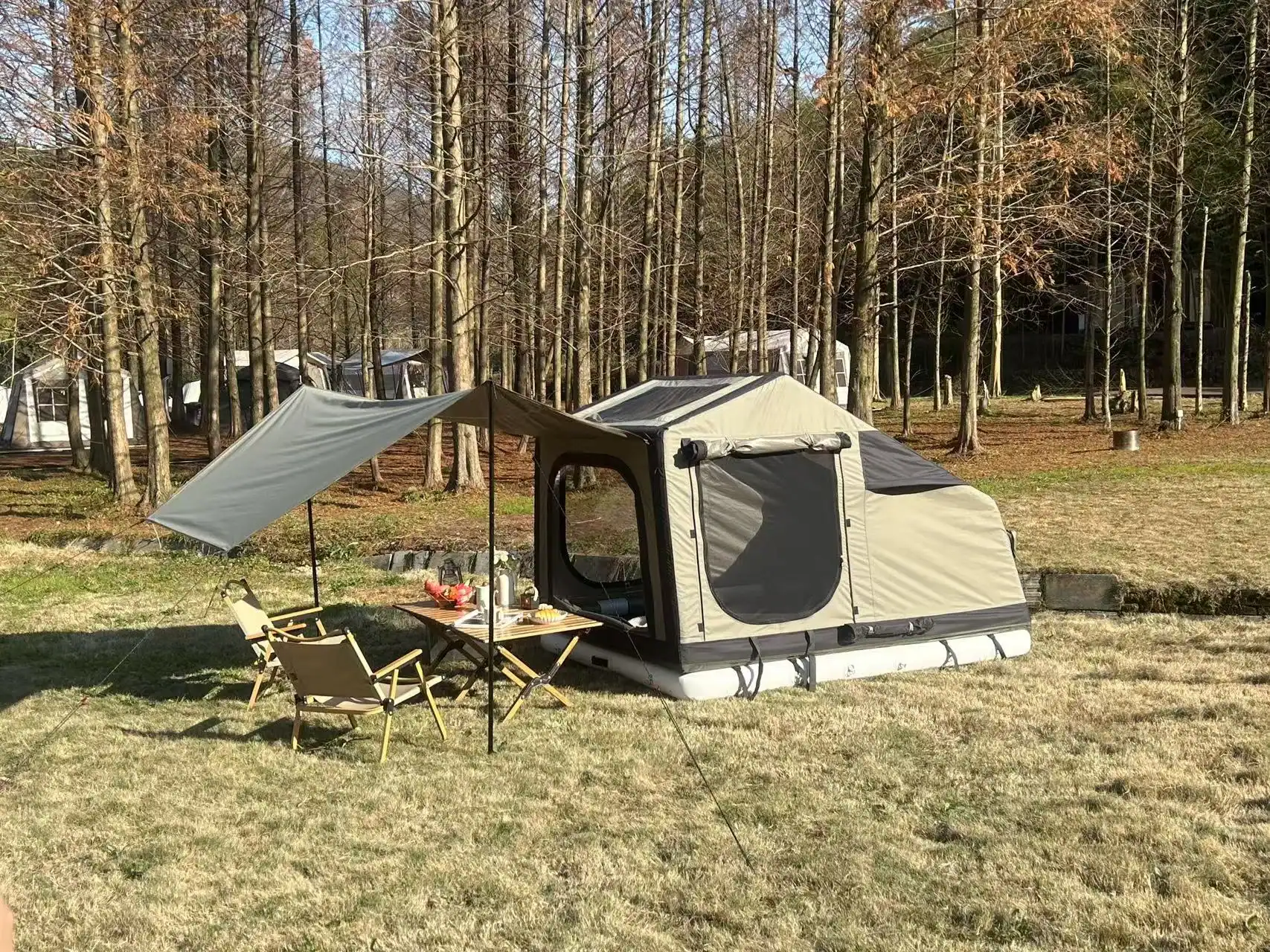
Red Flag #5: Certification Documents Are Scanned Copies Only
Fewer than 50 suppliers nationwide hold ISO 9001 + CCC + CE for the same product line.
A scanned PDF certificate from a Chinese supplier proves nothing. Editing software makes it trivial to alter a real certificate and resave it as a fresh PDF. The question every buyer should ask is not ‘can the certificate be seen?’ but ‘can the certificate be verified with the issuing body?’.
Verify ISO 9001 Through CNCA’s Public Database
In China, ISO 9001 certificates are issued by certification bodies accredited by CNCA, the Certification and Accreditation Administration under the State Administration for Market Regulation. CNCA maintains a public registry of valid certificates. The certificate number should match the supplier’s legal company name and certification scope exactly on that database.
Most buyers never run that check, which is why expired or cancelled certificates still circulate in sales decks. Ask for the certificate number first, then run it through the CNCA portal before quoting FOB prices or discussing sample timelines. A number that fails to resolve means the ‘factory’ just failed the most basic credibility test.
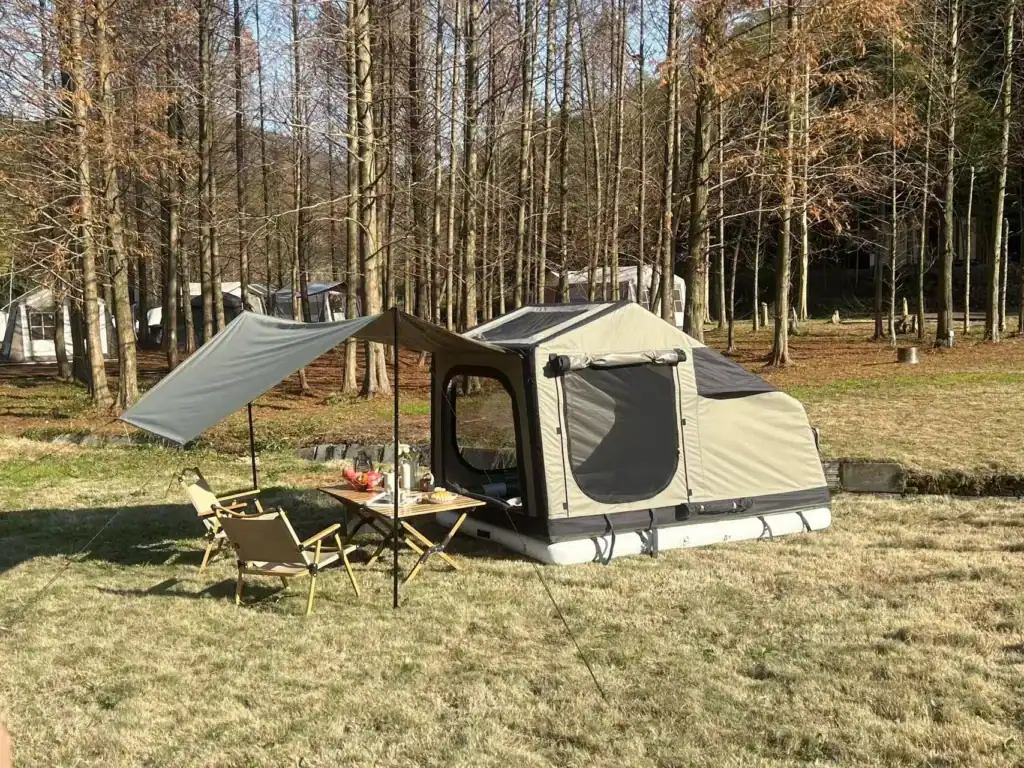
CE and CCC: Check the Notified Body and CQC
CE-marked inflatable tents must show a Notified Body number on the certificate. That body’s website should confirm the certificate exists. For China’s domestic market, CCC certificates come from CQC. Holding ISO 9001, CCC, and CE simultaneously for the same product category narrows the genuine supplier pool to under 50 nationwide.
At Kelyland Outdoors, the factory network’s certifications — ISO 9001:2015, CE, CCC, BSCI — vary by product line and factory, and those records are open for client verification. That is the level of transparency a buyer should expect. If a supplier hesitates to share their certificate number for third-party verification, the hesitation itself is the answer.
Red Flag #6: MOQ Claims Below 50 Units for Complex Inflatable Tents
Below 50 units, the math on welded TPU beams and machine setup doesn’t work — unless the ‘factory’ isn’t making them.
An inflatable tent is one of the most capital-intensive products in the camping category. TPU air beams must be welded on heat-sealing machines that hold above 180°C, every beam goes through air-retention testing, and each size needs its own pattern set plus prototype rounds. That fixed cost structure collapses at 30 units.
Compare that with what real factories quote. Kelyland’s standard inflatable tent models run 300–1,000 pieces per order; only the simplest items flex down to 50–100. Their Ningbo tent partner alone produces 800,000 units a year. A factory operating at that volume cannot justify sacrificing line hours for a three-dozen-unit order.
Some suppliers still promise 30 units as their minimum order quantity. That quote is either a loss or a bait-and-switch. Tooling amortization, TPU film roll minimums, and machine setup make the math impossible at that volume. Buyers discover which one it was when the first batch fails pressure testing or the ‘TPU’ beams stiffen in cold weather.
What the low quote actually hides
-
- Material substitution: PVC film swapped in for TPU to protect margin. It’s cheaper, but it loses flex in cold weather and bleeds air retention noticeably faster.
- Hidden frame structure: 에어빔처럼 보이는 외관을 내도록 설계된 유리섬유 인서트로, 텐트를 실제 팽창 없이도 세워줍니다. 그러나 이는 무게를 추가하고 설계 의도를 해칩니다.
- 현물 시장 브로커리지: 중개상들은 그 주에 잉여 생산능력을 가진 공장으로부터 제품을 구입합니다.每一次 재주문 시마다 다른 솔기 테이프, 밸브 위치 및 색상으로 납품됩니다.
피해는 첫 배치 때가 아니라 재주문 시점에서 명확히 드러납니다. 30개에서 200개로 규모를 확장해도 두 번째 주문량은 사양 이탈 상태로 도착합니다. 계절의 영업 기한은 이미 지나갔고, 소매 구매자들은 주문을 취소합니다. 이는 과도하게 낮은 최소 주문 수량(MOQ)에 쫓겨 일어난 진정한 비용입니다.
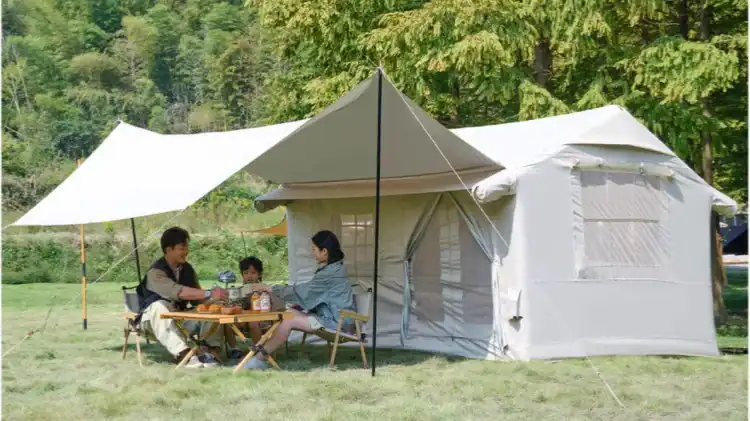
How Kelyland Outdoors Opens Factory Doors to Clients Before Contract Signing
PO(수주서) 이전에 생산 라인을 공개하는 공장은 감사를 받으리라고 기대하는 공급업체입니다.
Most supplier meetings happen in conference rooms. Kelyland flips that order. Before any contract is signed, buyers can schedule a factory walkthrough at the production facilities Kelyland manages, including the Ningbo inflatable tent line. The point is not a showroom tour; it’s a look at the actual workflow that will build your order.
The Ningbo open-door policy in practice
The Ningbo tent factory runs about 800,000 units a year and holds CE, BSCI, and ISO 9001 certification. Buyers who visit can inspect incoming TPU film, watch heat-sealing stations operate, and see how beam seams are finished before the tent moves to inflation testing. The factory manager explains the pass/fail criteria on the spot.
-
- 확인할 사항: Ask to see a beam inflated to rated pressure and then held for 30 minutes. A real inflatable tent line does this as a standard QC step, not a special demo.
- What to request: Ask for the QC report from the previous order, not just the production calendar. Kelyland’s partner factories keep stage-level inspection records and share them on request.
- What to avoid: If the supplier redirects you to a showroom and avoids the line, treat it as a fake inflatable tent supplier red flag.
The same logic applies across Kelyland’s network of 17 core strategic factories. A pre-contract visit lets the buyer confirm tooling, material stock, and shift capacity before a deposit is paid. It also forces the supplier to treat the audit as part of the negotiation, not an afterthought.
For a supply chain manager, this open-door policy changes the risk calculation. You can validate the production line, review certifications, and see exactly how QC is documented. If a supplier won’t open the floor before contract signing, that alone tells you a lot.
결론
Separating a genuine inflatable tent maker from a trading company is not about who has the slickest catalog. It comes down to evidence: live production video, in-house TPU heat sealing, third-party burst pressure reports, and certifications you can verify through CNCA/CQC. A supplier that passes these checks protects your order from the two most expensive outcomes — collapsed beams on site and brand damage that follows a failed summer season.
-
- Demand live factory video over a phone call; a genuine production line can be shown in real time.
- In-house TPU heat sealing at 180°C continuously is stronger proof than photos of equipment.
- 샘플 승인 전에 작업 압력의 3.5배에서 제3자 에어 빔burst pressure 테스트를 받으세요.
- CNCA/CQC를 통해 인증 스택(ISO 9001 + CCC + CE)을 검증하고 스캔본만 수용하지 마세요.
견적에 동의하기 전에 체크리스트를 단기 목록과 비교하고, 열기록장치 데이터, 시험 보고서, 공장 실물 견학 등 위장할 수 없는 문서를 요청하세요. 공급업체가 일곱 가지 검증 사항 중 어느 것에서도 주저한다면 이를 협상의 문제가 아닌 의사결정 포인트로 간주하세요. Kelyland Outdoors 사이트의 에어 빔 및 인플레이터블 텐트 제품군을 검토하여 공장 직접 운용 사례를 확인하세요.
자주 묻는 질문
공급업체가 실제 공장인지 어떻게 확인할 수 있나요?
Ask for a live video walkthrough of their production line and check for in-house TPU heat sealing equipment. Generic photos that appear on multiple supplier sites are a strong sign you are dealing with. Audit the line live before signing any contract.
Why are very low MOQs suspicious for inflatable tents?
복잡한 구조의 인플레이터블 텐트는 고가의 공구와 자재 준비가 필요하므로, 실제 공장에서는 50개 미만의 MOQ는 경제적으로 거의 성사되지 않습니다. 극도로 낮은 최소 주문량은 보통 공급업체가 중개상이거나 재판매업자일 가능성을 의미합니다. 50개 미만의 MOQ는 혜택이 아니라 위험 신호로 간주해야 합니다.
What burst pressure should air beams meet?
안전 인증을받은 에어베이션 텐트는 일반적으로 작업 PSI의 최소 3.5배 이상의 공기 빔 파열 압력이 필요합니다. 공급업체가 제3자 파열 압력 시험을 거부하면 심각한 경고 신호로 간주하십시오. 생산 승인 전에 시험 보고서를 확인하세요.
Why does TPU heat sealing equipment matter?
자체 TPU 열 접합 장비를 보유한 것은 실제 인플레이터블 텐트 제작사와 무역상을 구분하는 핵심 역량입니다. 해당 장비가 없으면 솔기 강도와 방수 성능을 통제할 수 없어, 이는 가장 비용이 많이 발생하는 부분입니다. 주문 전에 공장 해당 장비 보유 여부를 반드시 확인하시기 바랍니다.
Can I audit an inflatable tent factory before signing?
진정성 있는 제조사는 계약 체결 전 구매자 감사 검증을 환영하며, 대개 개방형 출입 정책을 통해 이를 지원한다. 최소한 생산 라인 실시간 영상 호출을 요청하고, 해당 업체의 ISO 인증 여부를 확인하라. 감사나 실시간 영상을 거부하면 거래를 즉시 중단하라.

 English
 Español
 Deutsch
 Français
 Português do Brasil
 Русский
 العربية
 한국어
 日本語