
Day 45 the container lands at LA/Long Beach, and your supply chain manager gets the customs hold notice. The inflatable tent shipping China process stalled because the HS code on the commercial invoice read as a general PVC product, not as a camping tent under 6306.22. That reclassification cost 3 extra days in exam and a $1,200 storage fee — all because the battery-operated air pump inside each unit triggered UN38.3 documentation nobody had prepared.
The difference between a smooth port release and an expensive delay often comes down to how well your factory partner understands container loading patterns and destination-specific duty treatment. A freight forwarder who knows outdoor gear can shave 2-3 days off detention charges by getting the stuffing pattern right from the start — inflatable tents pack differently than rigid-frame tents, and that affects CBM calculations across a 20ft or 40ft container.
Understanding the Shipping Process for Inflatable Tents
Miss a fumigation certificate, and your container sits at port for 3 weeks — plus detention fees.
An inflatable tent order doesn’t end when the last seam is sealed. The real test starts when the container leaves the factory gate. For supply chain managers, the gap between production completion and warehouse delivery is where hidden costs accumulate. A missed document, a wrong HS code, or a poorly stuffed container can erase your margin before the product hits the shelf.
The Five Milestones You Can’t Skip
Every inflatable tent shipment from China passes through five distinct stages. Understanding each one lets you predict delays before they happen.
-
- Factory Pre-Shipment Inspection:This happens before anything moves. The QC team checks stitching integrity, air valve sealing, and pump function against the sample approval spec. At Kelyland Outdoors, partner factories follow ISO 9001:2015 protocols during this stage — any deviation in seam tolerance or fabric coating consistency is flagged before packing begins.
- Container Loading & Stuffing: Inflatable tents are volume-heavy but weight-light. A 20ft container typically holds 150–250 packed units depending on tent size and pole configuration. A 40ft HC handles 350–500 units. The stuffing pattern matters — a freight forwarder who specializes in outdoor gear knows to distribute weight evenly to avoid container imbalance fines at the terminal.
- Port Export Clearance (China Side): The supplier submits the commercial invoice, packing list, bill of lading, and certificate of origin to Chinese customs. If your tents include battery-operated air pumps, UN38.3 certification must accompany the shipment — many generic forwarders miss this and cause a 5-day hold.
- Ocean Transit & Port Arrival: Transit time from Ningbo or Shanghai to Los Angeles averages 18–22 days. To Melbourne it’s 16–20 days. To Rotterdam it’s 28–32 days. These windows are baseline — weather rerouting and port congestion add variability that you build into your safety stock calculation.
- Destination Customs Clearance: The importer of record files entry paperwork using HS code 6306.22 (tents). Duty rates vary: USA (0% under certain conditions), EU (7.5%), UK (7.5%), Australia (5%), Canada (8%). PVC-heavy inflatable structures may trigger anti-dumping reviews in some markets — request material composition documentation from your factory upfront to avoid reclassification delays.
Why Specialized Forwarders Save You Money
A general freight forwarder treats your inflatable tents like any other cargo box. A forwarder who understands outdoor gear knows that deflated tents need compression packing to reduce CBM, that pump components require separate labeling for battery regulations, and that consolidation of multiple orders into one FCL container can cut freight costs by 20–30%. Ask your supplier if they offer LCL consolidation options — many factories will combine smaller runs into shared containers if you coordinate timing.
Choosing the Right Incoterm
The difference between an EXW and DDP quote on the same container can be $3,000–$6,000.
EXW (Ex Works)
You take ownership at the factory gate. The supplier loads the goods; you arrange everything after that — trucking to port, export customs, ocean freight, import clearance, and final delivery. For a supply chain manager importing inflatable tents for the first time, EXW means you control every handoff but also carry every risk.
The hidden cost here is detention. If your trucker arrives late because the factory wasn’t ready with the packing list, you pay waiting time. If export customs flags your HS code classification — inflatable tents fall under 6306.22, but if they include battery-operated pumps, UN38.3 certification applies — your container sits while you sort out documentation.
8. FOB(본선 인도 조건): 공급업체가 지정된 항구까지 물품을 인도하고, 수출 통관을 마친 후 선박에 적재합니다. 위험은 컨테이너가 선박 갑판에 도착하는 순간부터 귀하에게 있습니다. 귀하가 해상 운송을 예약하고, 포워더에 비용을 지불하며, 도착지 비용과 통관을 처리합니다. 기존의 포워더 관계를 보유하고 있으며 경쟁력 있는 해상 요금을 협상할 수 있는 물량이 있는 구매자에게 적합합니다. 아마존 FBA나 소매 유통을 위해 중국에서 캠핑 조명을 조달하는 대부분의 B2B 구매자는 이 조건에서 시작합니다. 중국 측 비용을 명확히 확인할 수 있을 뿐만 아니라 미국/유럽 구간을 직접 통제할 수 있기 때문입니다.
This is the default for most China-based outdoor gear orders, and it’s what Kelyland Outdoors uses as a standard reference point in quotes. The supplier handles inland transport and loading onto the vessel. Risk transfers to you once cargo crosses the ship’s rail.
For inflatable tents, FOB works well because factories in Ningbo or Jinhua are close to major ports like Ningbo-Zhoushan. You get a clean split: the supplier manages factory-to-port logistics (where they have leverage with local carriers), and you control ocean freight and destination-side costs.
CIF (Cost, Insurance & Freight)
The supplier adds ocean freight and insurance to their price. On paper this looks simpler — one quote covers more legs — but it introduces a principal-agent problem. The supplier picks the carrier and route, often choosing the cheapest option rather than the most reliable one.
Container Loading Optimization
A 40ft container holds roughly twice the units of a 20ft, but only if the stacking pattern is correct.
The difference between a profitable shipment and a costly one often comes down to how many inflatable tents fit inside a single container. Most buyers focus on unit price and forget that freight is the second-largest cost line. Get the loading wrong, and you either pay for an extra container or leave paid-for air gap.
Inflatable tent counts per container size
A standard 20ft dry container has ~28 CBM of usable space after accounting for door clearance and wall curvature. A 40ft container gives ~58 CBM. For a typical 4-person inflatable tent packed in a carry bag measuring roughly 60x40x35 cm (0.084 CBM), you can load approximately 300–330 units in a 20ft and 650–700 in a 40ft. These numbers assume no pallets — floor-loaded, block-stacked, with bags oriented to minimize air gaps.
Larger glamping-style inflatable tents with separate rooms change the math completely. A 6-person model with integrated floor and multiple air chambers packs to about 0.18 CBM per unit. That drops the count to around 140 units per 20ft and 310 per 40ft.
Packaging dimensions that kill your fill rate
HS Code Classification for Inflatable Tents
PVC inflatable tents may face anti-dumping duties in the EU and US.
Most customs authorities classify inflatable tents under HS code 6306.22, which covers “tents of synthetic fibers.” This is the primary subheading within Chapter 63 (other made-up textile articles). The full 10-digit code varies by destination — for example, 6306.22.9030 for the US and 6306.22.00 for the EU — but the first six digits remain consistent.
Duty Rates by Destination
Duty rates differ significantly across markets. The US rate under 6306.22.9030 is free for many countries including China, though Section 301 tariffs on Chinese goods add an extra 7.5% to the landed cost. The EU applies a standard rate of around 8% on tents from China, while the UK maintains a similar rate post-Brexit at roughly 8%. Australia offers duty-free entry under most conditions, and Canada charges approximately 8-10% depending on the specific fabric composition.
Anti-Dumping Risks for PVC Products
A critical distinction: if your inflatable tent uses PVC-coated fabric rather than standard polyester or nylon, anti-dumping duties may apply in both the EU and US on certain PVC products from China. These are separate from regular tariffs and can add substantial cost — sometimes exceeding 20%. Not all PVC tent fabrics trigger these measures; it depends on the specific product scope of each order.
Required Shipping Documents
Missing one document can hold your container at port for weeks.
Every shipment of inflatable tents from China requires a standard set of documents. The core four are the commercial invoice, packing list, bill of lading, and certificate of origin. The invoice must match the declared HS code exactly — a mismatch on the fabric composition or unit value triggers a customs hold. The packing list needs to show individual carton dimensions and weight; vague entries like ‘mixed goods’ get flagged.
Inspection and Fumigation Certificates
A pre-shipment inspection report from a third-party lab (like SGS or Bureau Veritas) is not always mandatory, but it saves you from claims when the quality tolerance varies. If your inflatable tents are packed on wooden pallets, the supplier must provide a fumigation certificate stamped with the IPPC logo. Ship without it, and the destination country will fumigate at your cost — plus detention fees.
EU-Specific Certificates
For the European market, CE certification is mandatory for tents with built-in pumps or electrical components. Many suppliers slap a CE sticker without the actual test report. You need the Declaration of Conformity and the technical file. For inflatable tents with battery-operated pumps, the batteries must carry a UN38.3 test certificate — a detail that catches 60% of first-time importers off guard.
Kelyland Outdoors handles all export documentation as part of its standard process. The logistics team prepares the commercial invoice, packing list, bill of lading, and certificate of origin, and coordinates with the partner factories to supply CE/EN certificates for products bound for Europe. The quality control reports from the ISO 9001:2015 certified factories are available on request, covering stitching strength, fabric coating thickness, and inflation pressure tests.
Customs Clearance Best Practices
Missing or incorrect HS code is the #1 reason containers get flagged for inspection.
A supply chain manager at a major retailer once told me his container of inflatable tents sat in Long Beach for 11 days because the broker used a general ‘camping goods’ code instead of 6306.22. The difference? About $4,200 in storage fees and a missed shelf date.
Common Mistakes That Cause Holds
-
- HS code mismatch: Inflatable tents fall under HS 6306.22 (tarpaulins, awnings, and sunshades). Using a generic 6306.90 or misc. camping code triggers manual review in most ports.
- Battery-powered pumps: If your tent includes an integrated air pump with a lithium battery, UN38.3 certification is mandatory. Miss this and customs holds the entire shipment for hazardous goods verification.
- Fumigation certificate missing: Wood pallets without ISPM-15 stamping are rejected at EU and Australian borders. Your supplier must provide a fumigation certificate dated within 21 days of loading.
How to Handle Random Inspections
Random inspections happen — roughly 3-5% of containers get pulled for physical exam at major US ports. The key is preparation. Keep digital copies of your commercial invoice, packing list, bill of lading, certificate of origin, and quality inspection report accessible to your broker within 2 hours of notification. A factory that has ISO 9001:2015 certification — like Kelyland Outdoors’ partner factories — can provide production batch records that satisfy most documentation requests on first submission.
Working with a Customs Broker
A broker who specializes in outdoor gear knows the exact subcodes and duty rates by destination — USA (3.7% under 6306.22), EU (6.5%), Australia (5%). They also flag anti-dumping risk on PVC-heavy products from China before you ship. Ask your broker for a pre-clearance review of your packing list and HS code before the container leaves the factory.
Kelyland Outdoors’ Logistics Support
Export documentation errors cause roughly 40% of container holds at destination ports.
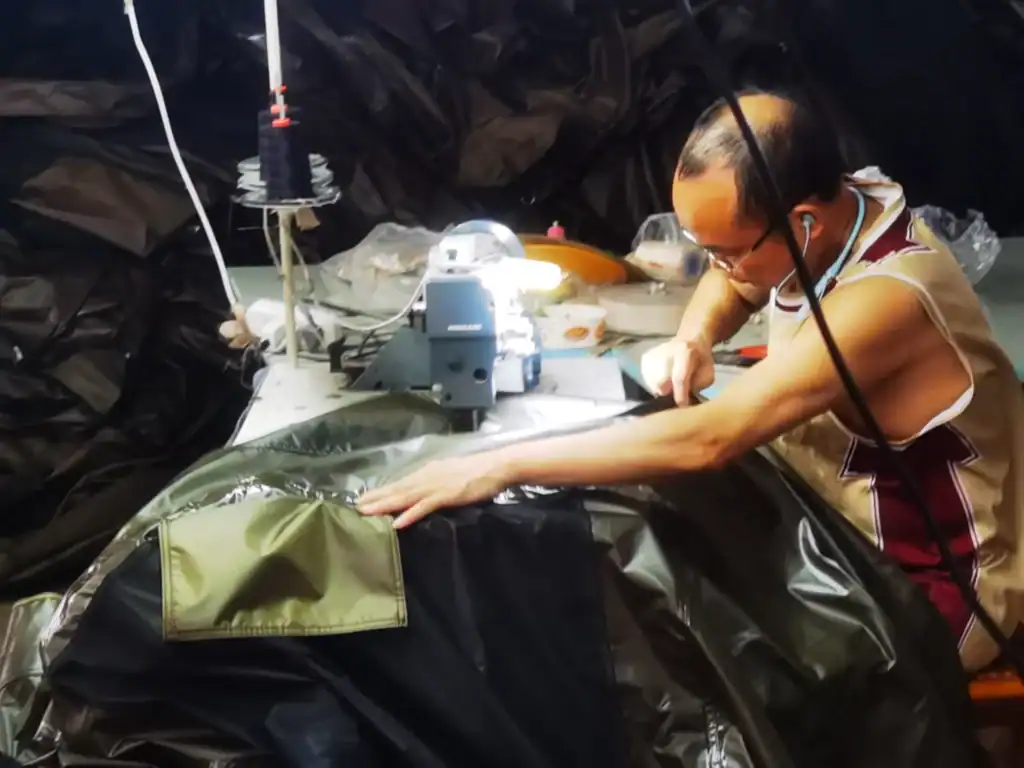
A supply chain manager’s biggest headache isn’t the factory — it’s the customs broker calling at 4 PM on a Friday with a missing certificate of origin. For inflatable tent shipping from China, that call can cost you $200–$400 in demurrage per day while the container sits. Kelyland Outdoors handles all export paperwork internally, which means one less variable in your landed cost calculation.
Export Documentation We Prepare
-
- Commercial invoice & packing list: Generated from the final inspection report, with HS 코드 6306.22 pre-verified against your destination country’s duty schedule.
- Bill of lading & certificate of origin: Coordinated through our logistics center in Ningbo, Zhejiang — a major port city where our core tent and tarp factory is located.
- CE/EN certificates for EU shipments: The partner factories hold ISO 9001:2015 and CE certifications, so the compliance docs are ready before production finishes.
- Fumigation certificate (if needed): Issued when wooden pallets or crates are used. Ship without one and your container gets flagged for inspection — guaranteed delay.
결론
The difference between a smooth first shipment and a container stuck in customs often comes down to the last 10% of preparation — specifically, how you handle the battery-operated pump declaration and whether your freight forwarder knows the correct container stuffing pattern for inflatable gear. Get those two details right, and you cut detention risk by days.
-
- Verify HS code 6306.22 applies unless the tent includes a battery pump, which triggers UN38.3.
- A specialized outdoor-gear forwarder can reduce detention charges by knowing the correct container load pattern.
- Ask about FCL/LCL consolidation options to save up to an estimated third on freight costs.
Before you lock in your logistics partner for custom inflatable tents, run through your documentation checklist against the requirements for your destination market — especially the CE certificates needed for Europe and any anti-dumping rules on PVC materials. A supplier like Kelyland Outdoors handles export paperwork and customs guidance as part of its end-to-end service, so you can focus on landing costs rather than chasing down certificates. Review their logistics support options on the product page to see how they manage port-to-port consolidation and real-time tracking for bulk orders.
자주 묻는 질문
에어텐트의 MOQ(최소 주문 수량)는 어떻게 되나요?
맞춤형 대형 텐트의 최소 주문량(MOQ)은 특정 품목의 경우 50~100개부터 시작할 수 있으며, 일반 표준 모델은 일반적으로 300~1,000개 범위입니다. 이러한 유연성을 통해 시장 테스트를 먼저 진행하실 수 있습니다. 정확한 MOQ는 맞춤화 수준을 정의하신 후 확정해 드립니다.
생산에 얼마나 걸립니까?
표준 생산 리드타임은 샘플 승인 후 30~45일입니다. 이 기간은 주문의 복잡성, 수량 및 맞춤화 수준에 따라 변동될 수 있으니, 이 30~45일 기간을 기반으로 주문 일정을 계획하시기 바랍니다.
초보 수입자에게 가장 적합한 인코텀즈는 무엇입니까?
FOB(위치 인도)는 수출 통관을 공급업체가 처리하는 동안 배송 비용에 대한 통제권을 가질 수 있기 때문에 첫 번째 수입자에게 가장 흔한 시작점입니다. 운송대행사가 있다면 FOB로 시작하고, 손길이 전혀 필요 없는 경험을 원한다면 DDP를 선택하세요.
컨테이너에 몇 개의 인플레이터블 텐트를 적재할 수 있나요?
20피트 컨테이너는 일반적으로 크기와 포장 방식에 따라 약 150~250개의 인플레이터블 텐트를 수납할 수 있으며, 40피트 컨테이너는 이 수량의 약 두 배를 적재합니다. 실제 적재량은 다양한 요인에 따라 크게 달라질 수 있으므로, 주문 수량을 최종 확정하기 전에는 반드시 공급업체로부터 적재 계획을 요청하시기 바랍니다.
인플레터블 텐트에 적용되는 HS 코드는 무엇인가요?
인플레이션 텐트의 주류 HS 코드는 합성섬유로 만든 텐트를 포괄하는 6306.22이며, 관세율은 목적지에 따라 다릅니다: 미국은 약 8%, 기타 지역은 최대 12%까지 적용됩니다. 출하 전 반드시 라이센스를 받은 통관 대행사를 통해 관세율을 확인하세요.

 English
  Español
  Deutsch
  Français
  Português do Brasil
  Русский
  العربية
  한국어
한국어  日本語
日本語