 콘텐츠로 건너뛰기
Trekking pole tip replacement usually surfaces as a problem months after the container lands, not on the sample bench. That’s the moment a buyer realizes the $50K order carries a flaw the pre-production sample never exposed — the mass production run used a marginally different collar compound, and the first field returns start filtering back from dealers. The gap between sample approval and the actual production batch is where most tip-related warranty claims begin.
The metal point is rarely the first thing to fail. Tungsten carbide runs 89-91 HRA and lasts 500-800 miles on mineral soil; hardened steel sits around 58-62 HRC and wears flat in 150-250 miles. But carbide is brittle, and it chips on granite. Neither material survives a deformed retention collar — if the nylon or aluminum base loosens under repeated side-load impacts, the whole tip assembly walks out of the shaft.
Factory buyers should specify at least 15mm of protrusion length and a shock-absorbing collar, then compare how suppliers hold those dimensions before digging into FOB 가격. A tip that costs ten cents less per unit but fails the 25kgf pull-out test is the most expensive part on the pole.

Why Trekking Pole Tips Fail on the Trail
The tip rarely fails first.
Tungsten carbide outlasts hardened steel on abrasive soil—500–800 miles against 150–250 miles on mineral ground. But on granite, an 89–91 HRA carbide insert chips. Hardened steel at 58–62 HRC bends instead of shattering. Neither survives a sloppy retention system.
Most field failures start at the collar-to-shaft junction, not the metal point. When an insert shank below 6.5 mm catches a rock at an angle past 30 degrees, lateral force concentrates where the collar grips the shaft. Repeated hits create micro-fractures in nylon collars or galling in aluminum sleeves. The tip gets wobbly. Then it leaves.
Impact mechanics: point diameter and side-load forces
Shank diameter is a structural number, not a fitment detail. Standard insert shanks run 6.5 mm, 7 mm, or 8 mm, with thread pitches of 15 mm or 20 mm. The 6.5 mm option saves weight, but gives the collar less gripping surface. On rocky descents, that smaller contact area transfers more stress into the collar.
Kelyland’s trekking pole partner factory in Ningbo, Zhejiang, produces 3,000,000 units per year under ISO 9001 and CE certification. When their engineers talk tip retention, the conversation starts with pull-out force, not material hardness. A horizontal pull test at 25kgf before shipment catches loose collars before they reach customers.
Abrasive soil wear pattern
Gritty dirt and decomposed granite grind a point flat when protrusion length sits under 12 mm. The conical tip becomes a nub. Contact area grows from roughly 1 mm² to over 10 mm², and bite efficiency drops by more than a factor of two. The pole starts skating instead of planting.
Internal production logs from trekking pole lines show points with protrusion of at least 15 mm keep functional bite through twice as many trail miles. That’s the number to put in your spec sheet. If a supplier quotes a shorter protrusion, expect warranty claims filed under ‘tip wears too fast.’.
Collar loosening sequence
The failure progression follows a predictable order. First, vertical play appears at 0.5–1 mm. Then you hear clicking during side-load planting. Finally, the whole assembly separates on the trail. Buyers often blame the tip material. The retention collar was the problem from the start.
Spec a shock-absorbing collar and a protrusion length of at least 15 mm. Test every batch to 25kgf pull-out. When a collar does need replacing, never dry-fire it off with an open flame—heat softens carbon shafts. A warm water soak releases the collar without compromising the shaft material.
-
- Carbide on mineral soil: 500–800 miles, 89–91 HRA, high edge retention, but chips on granite.
- Steel on mineral soil: 150–250 miles, 58–62 HRC, lower edge retention, bends under impact.
- Retention spec: 25kgf pull-out minimum, shank 6.5/7/8 mm, protrusion ≥15 mm.
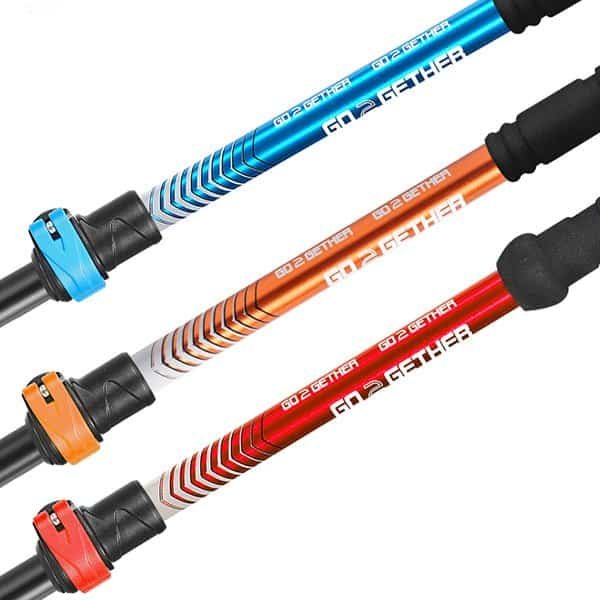
Carbide vs Steel: The Numbers That Matter
Carbide wins on lifespan.
Here’s the short version: tungsten carbide tips (89–91 HRA) outlast hardened steel (58–62 HRC) by 500–800 miles vs 150–250 miles on mineral soil. But carbide chips on granite, and steel bends before it breaks. For retail buyers, the decision comes down to where your customers actually hike.
Material Hardness (HRA / HRC)
Hardness is the first spec buyers ask for, but the scales get mixed up. Tungsten carbide sits at 89–91 HRA, while hardened steel is typically 58–62 HRC. They are different Rockwell scales — HRA and HRC are not directly interchangeable. That spec alone tells you why carbide holds a bite through gritty soil longer.
Density also separates the two. Carbide’s density is 15.6 g/cm³. More mass at the tip means more momentum on the downswing, which is why carbide-tipped poles feel more planted on hardpack.
Edge Retention and Brittleness
-
-
- Edge retention factor: Carbide holds its bite 3–5x longer than steel on abrasive soil: 500–800 miles vs 150–250 miles. Short protrusion shortens that range quickly. Spec at least 15mm of protrusion to keep the cone geometry working.
- Brittleness index: Carbide’s hardness comes with a tradeoff — it chips when it hits granite at a bad angle. Steel dents and deforms instead of chipping, which is why some brands still spec steel for talus fields and alpine routes.
-
Edge retention is not knife-edge sharpness. A trekking pole tip needs a stable cone. As the cone wears into a flat nub, contact area grows and bite drops; poles start to skid on wet rock or steep descents. A 15mm protrusion delays that failure mode more than any alloy change.
The weak point isn’t always the metal. The retention collar takes repeated side-load hits, and if the collar or crimp ring deforms, no tip stays in. That’s why pull-out testing matters: a tip assembly should hold at 25kgf before it ships. If your supplier can’t show that test result, keep looking.
Bulk Cost per Tip
Carbide tips cost more per unit than steel. The exact gap depends on shank diameter (6.5mm, 7mm, 8mm), thread pitch (15mm vs 20mm), and your quality tolerance. A one-piece sintered carbide tip with an integrated shank costs more than a carbide insert brazed onto a steel shank.
No honest quote comes without an order volume attached. That’s where 유연한 최소 주문 수량(MOQ) matter. At Kelyland, specific models start at 50–100 pieces, with standard production running 300–1,000 pieces and a 30–45 day lead time. A brand can test 100 poles with carbide tips, gather real trail feedback, then scale to a container run without a factory forcing a huge first commitment.
Field Lifespan and Terrain
-
- Mineral soil / abrasive dirt: Carbide: 500–800 miles. Steel: 150–250 miles. Carbide’s hardness keeps its cone shape; steel rounds off faster.
- Granite / sharp rock: Carbide can chip, shortening effective life. Steel is less likely to fracture but wears faster once the edge deforms.
- Asphalt / boardwalks: Both wear quickly. Rubber or nylon paws are a better fit for hard, smooth surfaces, though they add their own traction limits.
Many brands overestimate their customers’ abrasion environment. A pole used mostly on Appalachian dirt will chew through one steel tip per 150–250 miles. On a 500-mile thru-hike, that’s 2–3 steel replacements or one carbide. The replacement cost math changes depending on whether your brand ships spare tips with each pole.
The factory detail many 사양서s miss is shaft-material interaction. A 3K carbon shaft flexes differently than 6061 or 7075 aluminum. If the tip assembly is rigid and the shaft flexes hard, the collar takes the extra stress. Kelyland’s trekking pole production runs out of a Ningbo facility at over 3 million units a year under ISO 9001:2015, so tip-to-shaft pairing is already handled in production.
Match the tip to the terrain, not the claim. If you’re launching a general trail pole, spec carbide at 15mm protrusion with a 25kgf-tested collar and run pre-production samples before 샘플 승인. It covers the widest range of trail conditions and spares your warranty budget.

결론
The choice between carbide and steel tips comes down to terrain and replacement economics. Carbide handles abrasive soil for 500-800 miles, while steel wears down in 150-250 miles on the same ground. The tip material is only part of the equation—without a retention collar that holds at 25kgf and a protrusion length of at least 15mm, you will get warranty claims no insert can fix.
-
- Tungsten carbide outlasts hardened steel roughly 3-5x on mineral soil but chips on granite.
- Specify a protrusion length of at least 15mm to preserve bite over trail miles.
- Demand a 25kgf collar pull-out test before approving production.
- Verify shank diameter 6.5-8mm and thread pitch 15-20mm for spare-part compatibility.
Before you place your next bulk order, put the tip retention spec in writing: 25kgf pull-out test, 15mm protrusion, and carbide inserts for mixed terrain. Check whether the factory offers replacement tips and compatible spare parts as part of the program, and confirm the sample cost refund policy on bulk orders. That simple checklist will keep your poles on the trail instead of back in the warehouse.
자주 묻는 질문
카바이드 팁은 몇 마일 동안 지속됩니까?
카바이드는 거친 지형에서 500~800마일 수명을 제공하며, 경화 강철은 150~250마일입니다. 예산형 라인이라면 강철도 가능하지만, 긴 내구성을 원한다면 카바이드를 선택하세요. 고주행량 폴대와 고마모 지형에는 카바이드가 적합합니다.
탄화물 팁이 화강암에서 부서지나요?
네, 카바이드 팁은 마모성 토양에서는 스틸보다 오래 가지만 화강암과 hard rock에서는 파손될 수 있습니다. 고객의 주된 활동 지역이 바위 지형이라면 스틸 또는 고무 paw가 더 경제적일 수 있습니다. 팁 소재는 총 주행 거리 alone이 아닌 지배적 지형에 따라 선택해야 합니다.
트레킹 폴 말단부가 빠지는 이유는 무엇인가요?
대부분의 장착 실패는 실제로 금속 팁의 마모가 아닌 리테인션 칼라 변형 때문입니다. 암석지대 하산 시 반복되는 측면 하중 충격이 칼라를 풀면 팁 어셈블리가 분리됩니다. 출하 전 25kgf 인발 시험을 필수로 요구합니다.
어떤 인발 시험을 지정해야 하나요?
초기 느슨해짐을 방지하기 위해 최소 25kgf 수평 인발 시험이 필요합니다. 또한 칼라 변형이 마모보다 더 많은 고장 원인이 되므로 측면 하중 안정성도 확인하십시오. QC 체크리스트에 25kgf 인발 시험을 추가하십시오.
끼인 트레킹 폴 팁은 어떻게 제거하나요?
칼라를 따뜻한 물에 담그세요. open flame은 사용하지 마세요. 열이 카본 샤프트를 부드럽게 만들 수 있습니다. 조립체가 팽창된 상태에서 팁을 조심스럽게 풀고,open flame으로 제거하지 마세요.

 English
  Español
  Deutsch
  Français
  Português do Brasil
  Русский
  العربية
  한국어
한국어  日本語
日本語