 콘텐츠로 건너뛰기
eu eco-design tents 2026 is the first checkpoint buyers should lock before they approve a supplier, budget, or production slot. Every sourcing guide you read will tell you to focus on price per unit and FOB pricing when negotiating tent orders for the EU. That advice is about to cost someone a lot of money in 2026. The EU eco-design tents 2026 regulation, under the Ecodesign for Sustainable Products Regulation (ESPR), shifts the entire compliance burden from energy efficiency to circular economy metrics — durability, repairability, and recycled content. A supply chain manager who locked in a $50K order last year based on sample approval alone is now looking at a batch that might not pass the new tear-strength thresholds.
The real problem isn’t the regulation itself. It’s that most factories haven’t updated their quality tolerance specs or material sourcing pipelines to match what ESPR demands. The rule requires tents to withstand a verified number of setup and teardown cycles without seam failure or frame fatigue — something very few mills currently test for in standard production runs. And then there’s the recycled polyester requirement: declaring the exact percentage of recycled content in your fabric, which means your supplier needs certified feedstock, not just a verbal promise.
Here is a benchmark to write down and reference on your next supplier call: expect your factory to provide batch-level traceability data for every SKU by Q3 2026 at the latest, or plan for customs delays starting January 2026.

What ESPR Means for Camping Tent Importers
ESPR shifts focus from energy use to how tents are built, repaired, and recycled at end of life.
Most procurement managers still associate EU eco-design rules with energy labels on appliances. That framework is about to expand into something far more consequential for outdoor gear. The Ecodesign for Sustainable Products Regulation (ESPR) replaces the old approach with a circular economy mandate. It no longer asks only how much energy a product consumes during use. It asks how long the product lasts, whether it can be repaired, and what happens to the materials when the user is done with it.
The shift from energy efficiency to circular economy principles
The logic behind ESPR is straightforward: 80% of a product’s environmental impact is determined at the design stage. If you design a tent frame that cannot be disassembled from the fabric, you guarantee that both components end up in landfill when one fails. ESPR forces manufacturers to think about the full lifecycle before production begins. That means durability thresholds, repairability requirements, recyclability targets, and mandatory information disclosure.
For supply chain managers, this changes sourcing criteria fundamentally. Price per unit and lead time still matter, but they now sit alongside material composition declarations and end-of-life processing instructions as deal-breaker requirements.
Products scope: why tents are expected to be in the first wave
The European Commission has not yet published the final delegated act for textiles and outdoor equipment, but tents are widely expected to appear in an early wave of regulated products. The reasoning is pragmatic: tents are high-volume consumer goods with short useful lives relative to their material footprint. A typical family tent sold in Europe sees maybe 15-20 nights of use per year and gets discarded within 3-5 seasons.
Polyester tent fabric alone accounts for thousands of tonnes of non-biodegradable waste annually across EU member states. The Commission’s own impact assessment flags camping equipment as a category where durability standards could deliver measurable waste reduction without imposing disproportionate cost on manufacturers.

Key Durability and Performance Standards
The EU will require tents to survive a minimum number of setup cycles — most current designs fail before reaching that threshold.
ESPR sets performance thresholds that go beyond fabric weight or waterproof ratings. The regulation targets three specific failure modes: fabric rupture at stress points, seam separation under load, and frame collapse after repeated assembly. Each one maps to a measurable test standard that importers must verify in their supply chain.
Minimum Tear Strength and Seam Slippage
The delegated act for tents is expected to reference EN 14115 or a similar tear-strength protocol. Fabrics must resist propagation of a cut under a defined load — typically 10N to 25N depending on the panel location. Seam slippage, where stitching pulls through the fabric under tension, is tested separately. A seam that slips more than 6mm at 100N of force fails the standard.
Most Chinese mills use polyester or nylon with denier ratings between 150D and 300D for tent bodies. Those fabrics pass tear-strength tests when the weave density is correct. The risk comes from cost-down versions where mills drop the thread count or switch to recycled yarn without adjusting the construction. The tent looks identical in sample approval but fails during mass production testing.
Frame Fatigue and Setup Cycle Requirements
ESPR will mandate that a tent withstands a specified number of setup and teardown cycles without structural failure. Early drafts suggest 50 to 100 cycles for family camping tents and fewer for lightweight trekking models. That number matters because it directly affects pole material choices, joint connector design, and sleeve reinforcement at wear points.
Fiberglass poles commonly used in budget tents degrade after roughly 30-40 setups due to microfractures at the ferrule joints. Aluminum alloy poles (6061 or 7075 grades) survive well beyond 100 cycles but increase FOB pricing by roughly $2-$4 per tent depending on gauge and wall thickness. For supply chain managers planning EU market entry, this trade-off needs factoring into the product spec before tooling begins.
Expected Lifespan and Verification Methods
Recyclability and Material Information Obligations
ESPR demands traceable recycled content percentages and design-for-disassembly across every tent component.
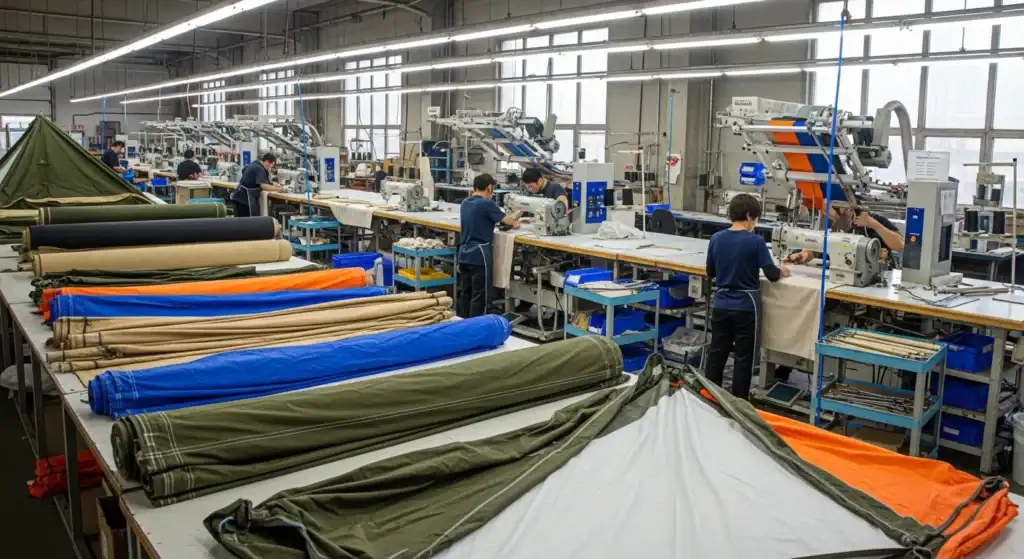
The ESPR shifts the compliance burden from simple material declarations to verifiable proof of recycled content. For a camping tent, that means the fabric supplier must provide chain-of-custody documentation tracing the recycled polyester back to its source — post-industrial waste or post-consumer bottles. Most Chinese mills don’t have this paperwork ready. The ones that do, like the ISO 9001-certified tent factory Kelyland works with in Ningbo, have already invested in certified recycled yarn supply chains.
Mandatory Material Declarations
Every tent sold into the EU after enforcement will require a material breakdown by weight percentage for each component: flysheet, floor, inner mesh, poles, guylines, pegs, and zippers. The regulation doesn’t stop at fabric. The powder-coated aluminum frame on a roof top tent or the fiberglass poles on a trekking model must also be declared with their exact alloy or composite composition.
| Obligation Category | 요구사항 | Compliance Strategy |
|---|---|---|
| Mandatory Material Declarations | Declare fabric composition (e.g., polyester, nylon) and recycled content percentage per EU standards | Source certified recycled polyester (e.g., GRS) from mills; audit supply chain for batch-level traceability |
| Recycled Content Targets | Meet minimum recycled material thresholds in tent fabric and components (targets TBD per delegated act) | Partner with Kelyland to engage early with ISO 9001-certified factories offering recycled yarn options |
| Design for Disassembly | Ensure zippers, poles, and fabric layers can be separated without tools for end-of-life recycling | Specify snap-fit or screw-type pole connectors; avoid glued seams; use separable zipper sliders |
| Life Cycle Assessment (LCA) Data | Provide LCA data covering raw material extraction, manufacturing, and disposal phases | Work with Kelyland’s technical team to compile factory-level energy and waste data for LCA reports |
| Digital Product Passport (DPP) | Link each SKU to a unique identifier containing material, durability, and recyclability data | Implement batch-level tracking systems; Kelyland assists in DPP documentation preparation |
The Digital Product Passport (DPP)
The DPP links every tent SKU to batch-level data — most factories can’t do this yet.
The Digital Product Passport (DPP) is the enforcement mechanism behind ESPR. It’s not a PDF you upload once. It’s a data structure tied to each product’s unique identifier — think of it as a birth certificate that follows every batch through the supply chain. For tent importers, this means every SKU will need traceable records from raw material lot numbers to final assembly date.
The DPP for a camping tent will require at minimum: the recycled content percentage in the fabric, the tear strength test results (N/m), seam slippage values, frame fatigue cycle count, and a complete bill of materials with chemical substance declarations. You also need the manufacturer’s facility location, production date range per batch, and instructions for disassembly at end-of-life.
-
- Material declaration: Fabric type (e.g., 210D Oxford polyester), coating chemistry (PU vs silicone), frame alloy grade — all must be declared with mass percentages.
- Recycled content proof: Certified recycled polyester requires chain-of-custody documentation from the yarn supplier. Most Chinese mills don’t have this; early engagement with GRS-certified suppliers is critical.
- Durability metrics: Minimum setup/teardown cycles without failure — expected threshold around 50 cycles for family camping tents. Test reports must be third-party or factory-qualified.
How Kelyland helps factories prepare DPP-compliant documentation

Timeline and Enforcement
Delegated acts for tents expected Q3 2026.
The ESPR framework is law, but the specific rules for camping tents still sit in delegated acts. The European Commission is expected to publish the first product-specific delegated act covering tents in Q3 2026. That document will define exact durability thresholds, recyclability targets, and Digital Product Passport (DPP) data fields. Until it drops, importers operate on draft signals — not final compliance lines.
Grace Period Reality
Once the delegated act publishes, a grace period of roughly 12 to 18 months kicks in before enforcement begins. That puts mandatory compliance somewhere between late 2027 and early 2028. The grace window is not a pause button. It is the only time you have to redesign products, requalify materials, and build batch-level traceability systems into your supply chain.
Many importers assume they can start preparing after the delegated act publishes. That assumption will cost them. The factories that move now — locking certified recycled polyester sources, upgrading pole and seam construction to withstand mandated setup/teardown cycles, and setting up DPP-compatible data collection — will be the ones ready when enforcement hits.
Steps to Take Now
결론
The EU ESPR will change how tents are designed, sourced, and documented for the European market. The durability and recyclability rules aren’t abstract policy goals—they are specific technical requirements that will hit every SKU you import starting in 2026.
-
- Tents must survive a defined number of setup cycles without seam or frame failure.
- Fabric recycled content percentages must be declared and verifiable at batch level.
- Digital Product Passports require traceable data from mill to finished product.
If your current supply chain hasn’t started sourcing certified recycled polyester or building batch-level documentation systems, the compliance window is closing fast. The factories that will meet these standards are the ones already ISO-certified and accustomed to rigorous quality control—like the network Kelyland Outdoors works with across Zhejiang and Jiangsu. Review your tent supplier’s material certifications and ask for their plan on DPP compliance now, not when customs flags your first container.
자주 묻는 질문
What are the EU eco-design rules for tents in 2026?
The EU Eco-Design for Sustainable Products Regulation (ESPR) will require tents to meet new durability, recyclability, and material information standards, shifting focus from energy use to circular economy principles. Tents are expected. Verify your factory can meet these standards before placing orders.
How can I make my tent compliant with EU recyclability rules?
Design for disassembly by using separable zippers, poles, and fabric layers so materials can be easily sorted and recycled at end of life. You must also provide mandatory material declarations and. Work with your supplier to document material sources and separation methods.
What is a Digital Product Passport for tents?
A Digital Product Passport (DPP) is a data set you must provide to EU authorities, detailing the tent’s materials, recycled content, durability test results, and disassembly instructions. Kelyland Outdoors can help factories. Start collecting material and test data now to avoid delays.
When do the EU tent durability rules take effect?
The delegated acts are still under development, but enforcement is expected to begin in 2026 with a grace period for compliance. Importers should take steps now to audit their supply chain and update tent. Contact your supplier to begin compliance planning immediately.

 English
  Español
  Deutsch
  Français
  Português do Brasil
  Русский
  العربية
  한국어
한국어  日本語
日本語