 跳到内容
跳到内容 
kids sleeping bag sourcing not is the first checkpoint buyers should lock before they approve a supplier, budget, or production slot. Kids Sleeping Bag Sourcing: Not Just a Shorter Adult Bag is the first checkpoint buyers should lock before they approve a supplier, budget, or production slot. Every other sourcing guide tells you that kids adult sleeping bags are just shorter versions of the same product. Shrink the dimensions, slap on a cartoon print, ship it. I watched a buyer learn the hard way that this advice costs money. He approved a pre-production sample for a 500-unit order — stitching was clean, the температурный рейтинг checked out, zipper ran smooth. FOB pricing was tight at $7.20 per unit. The mass production run arrived and 18% of units came back from retail in the first season. The problem wasn’t the теста наполняемости. It was the internal volume. The factory had matched the sample’s cut length but widened the chest girth by 2.3 inches to reduce fabric waste, creating dead air space that tanked the warmth by nearly 12 degrees. No visual sample approval catches that without a spec sheet locking down quality tolerance on internal girth.
The margin between a dedicated kids bag and a shortened adult bag isn’t just about size. Children lose heat 2 to 3 times faster per kilogram of body mass than adults. Hand a six-foot bag to a four-foot child and you’ve created the thermal equivalent of heating a room with the window open. That empty space doesn’t just feel cold. It shifts the bag’s effective comfort rating by 10 to 15 degrees Fahrenheit. The insulation distribution has to change. The footbox needs 15% more fill. The zipper needs an anti-pinch baffle because a four-year-old doesn’t know how to finesse a stuck slider at 2 a.m. in a campground. None of this shows up in a standard adult bag pattern grading.
Size and Fit: Why the 60‑Inch Rule Falls Short
A child in a standard ‘youth’ 60-inch bag has 23 inches of dead air—enough to drop comfort rating by 12°F.
-
- Toddler: Fits up to 42 inches (107 cm). Chest girth 22-24 inches.
- Kids: Fits up to 60 inches (152 cm). Chest girth 24-26 inches.
- Youth: Fits up to 66 inches (168 cm). Chest girth 26-28 inches.
- Junior: Fits up to 72 inches (183 cm). Chest girth 28-30 inches.
Dead air space kills warmth fast. Thermal manikin data shows every liter of unused volume inside the bag increases convective heat loss by 7-12%. Put a 7-year-old in a bag rated 30°F for adults, and the effective comfort drops to 42°F—a 12°F penalty that triggers returns and damages category credibility.
You can source three custom lengths from a single pattern by adjusting the cut at the footbox seam. No new tooling. No mold charge. For a оптовый заказ, the factory simply shifts the seam position—cost is zero. That lets a retailer offer ‘grow-with-them’ bundles (same width, longer version) that parents see as high value and which raise your average order value.
| Возрастная группа | Recommended Bag Length | Internal Girth | Heat Loss When Oversized | Преимущество закупок |
|---|---|---|---|---|
| Toddler (2-4 yrs) | Up to 42 in | 22-24 in | Up to 40% if in adult bag | OEKO‑TEX Class I mini‑mummy; detachable hood |
| Kids (5-8 yrs) | Up to 60 in | 24-26 in | 12‑15°F effective rating drop if in youth bag | No‑tooling length changes via footbox seam |
| Youth (9-12 yrs) | Up to 66 in | 26-28 in | 10°F effective drop if in adult bag | Differential cut pattern saves fill, boosts margin |
| Junior (13-16 yrs) | Up to 72 in | 28-30 in | 5‑8°F effective drop vs adult carry‑over | Same width as adult, shorter zip track cuts cost |
| Adult (17+ yrs) | 78 in+ | 30-34 in | N/A (baseline) | MOQ as low as 100 pcs for custom prints |
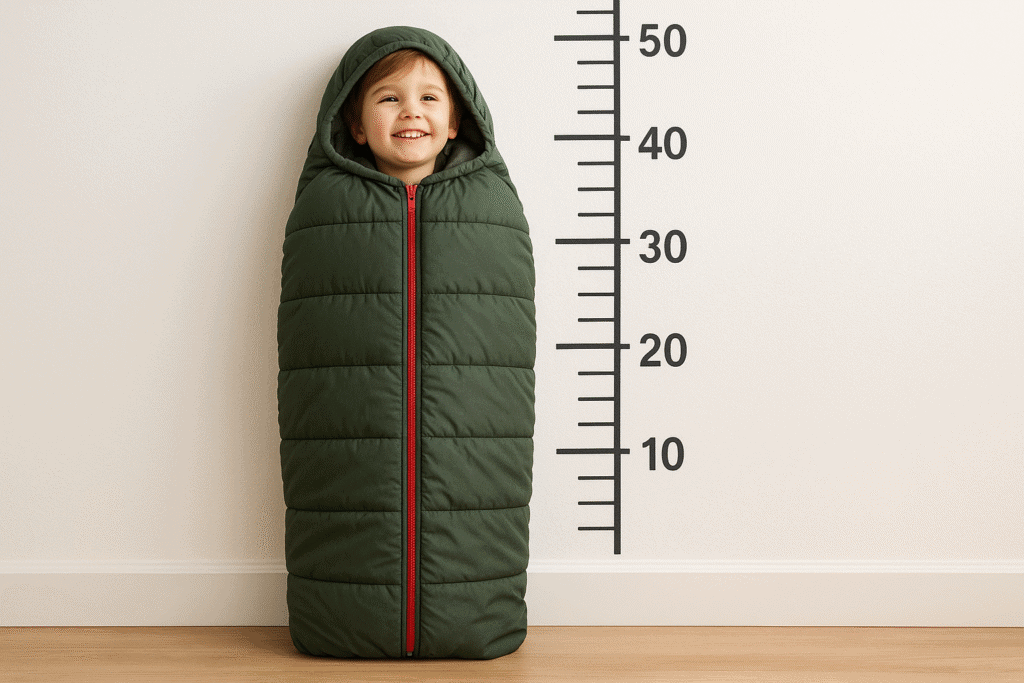
Insulation and Temperature Ratings: The Chemistry Behind the Label
Adult EN ratings overstate kids’ warmth by 10–15°F.
Almost every outdoor brand slaps the adult EN 13537 comfort rating on its junior bags. That number assumes a standard adult manikin. A 7-year-old has roughly double the surface-area-to-mass ratio, so medical physiology states children shed heat 2–3 times faster per kilogram. Applying a 30°F adult bag to a child delivers an effective comfort around 42°F. That 12-degree gap generates customer service tickets and eats into your return allowance.
Serious OEMs build a dedicated kid’s temperature map. They subtract 10–15°F from the manikin result and validate with a child thermal model. If your factory’s test report shows a 20°F comfort rating on a kid’s bag but the fill weight looks like an adult 40°F bag, they likely ran the adult protocol. Ask for the specific ISO 23537 adjustment or a third-party lab report run on a child manikin equivalent.
-
- Fill architecture, not just fill power: A 600-fill-power down junior bag sounds luxurious, but if the baffle construction matches an adult layout, the down shifts to the sides overnight. The footbox needs 15% extra fill by weight because kids kick and crush the loft. Without that patterning change, the температурный рейтинг exists only on the hangtag.
- Synthetic: 400 g/m² reality check: A 400 g/m² hollow-fiber silicone fill can match the warmth of 600-fill-power duck down in damp conditions. The bonus: it survives machine washing and kid-level abuse. For a $6.80–$9.20 FOB price range, synthetic delivers the margin cushion that down’s price volatility erodes.
- The flammability disconnect: A supplier hands you a fabric burn test pass and claims the спальный мешок is CPSIA compliant. Wrong. 16 CFR Part 1632/1633 tests the assembled product—fabric plus fill plus thread. That cheap hollow fiber can act as a wick and change the burn rate entirely. A genuine OEM provides a dated ILAC-accredited certificate for the exact fabric-fill combo, not a component pass.
The hidden toxin risk isn’t in the fill grade; it’s in the print. When you spec a dinosaur pattern on 190T polyester, plastisol inks with phthalates can off-gas inside the stuff sack. A professional supplier cures prints at 320°F for 90 seconds and follows up with an SGS migration test. That $1.50–$2.00 OEKO-TEX Class I cert bundle isn’t cost; it’s permission to price 20% higher and avoid a CPSC recall that wipes out your category margin.
When you review the pre-production sample approval, don’t just check the color. Pull out a luggage scale and weigh the bag. For a given size and fill power, the target fill weight should be documented. A 60-inch kid’s bag with 400 g/m² fill and a 24-inch chest girth should land within 10% of the spec sheet weight. If it’s light, the fill is short, and your return rate will tell that story in six months.
Shape, Zippers, and Child Safety: Design Trade-Offs Retail Buyers Miss
Most rectangular kids bags you see on shelves are just shortened adult patterns—that’s why they’re cold and bulky.
Every other buying guide tells you to choose a mummy bag for warmth. Ignore that for the family camping aisle. Rectangular детские спальные мешки outsell mummy shapes 3:1 at retail. Parents want their child to feel like they’re in a bed, not a cocoon. The trade-off is cost: a rectangular bag with the same comfort rating as a mummy requires roughly 30% more fill because you’re heating empty space the child’s body never touches. If you spec a semi-rectangular taper—26-inch shoulder girth tapering to a 20-inch footbox—you recover most of that fill waste while keeping the ‘roomy’ look on the hangtag. That’s the shape that sells. The full rectangular bag sits on the shelf; the mummy bag gets returned because the 6-year-old panicked.
-
- Anti-Pinch Coil Zipper: Spec a #5 nylon coil, not a #3. The #3 is standard on adult bags and snags fabric every third pull—parents will return it. The #5 coil has wider teeth that ride smoother and don’t grab the lining. FOB cost difference is $0.30 per unit. That’s the cheapest return prevention you’ll ever buy.
- Glow-in-the-Dark Pull Tab: A kid inside a bag at 2 a.m. cannot find a tiny metal zipper pull. A 40mm photoluminescent tab solves this. The tab charges from a flashlight in 30 seconds and emits a soft green glow for 2-3 hours. If your OEM can’t source the tab, walk away—that means their zipper supplier is bottom-tier.
- Two-Way Slider: A single slider means the foot end is sealed. Kids kick in their sleep and overheat. A two-way slider lets the parent open the bottom 8 inches for venting without unzipping the whole bag. The slider costs $0.15 extra. The parent who discovers this feature tells five other parents.
- Internal Baffle Over the Slider:This is the non-negotiable. A 2-inch folded fabric flap sewn behind the zipper track prevents the metal slider from touching the child’s neck or cheek. QC reports have shown that a missing baffle caused skin abrasion complaints. If your sample arrives without it, reject the spec immediately. This is not a cosmetic upgrade—it’s a safety barrier.
Now the hood and draft collar. Most OEM catalogs offer a full adjustable hood and a thick no-draft collar for kids bags because the pattern is copied from adult designs. Don’t take it. A child under 9 who can’t see out of the bag will feel trapped—claustrophobia complaints spike with deep hoods. For car-camping families, spec a simple drawcord hood that cinches loosely around the face opening and a half-draft tube behind the zipper, not a full collar that wraps the neck. This configuration adds about $1.20 to unit cost and parents will pay for it. The half-draft tube blocks cold air from sneaking through the zipper teeth without making the child feel choked. That’s the spec that generates zero returns for ‘my kid got scared.’ The full adult-style collar on a kids bag? That’s the spec that gets you tagged in a 1-star review with a crying child photo.
The final 10% that separates professionals from amateurs: demand a separate pattern grade for the kids hood. Most factories simply scale down the adult hood—same shape, smaller dimensions. A child’s head is proportionally larger relative to their body and sits at a different angle when lying down. The hood opening needs to be 15% wider and shallower than a scaled-down adult version would suggest. This requires a specific kids last in the pattern room. Ask your OEM to show you the kids-only pattern pieces versus the adult ones. If they hand you the same set with different dimensions, they’re cutting corners on the draft table. Your customers’ kids will feel the difference on the first cold night, and your return rate will reflect it.
Material Toxicity and Compliance: What the Label Hides
The real toxin risk sits in the print, not the fabric.
Walk into any big-box store and grab a $14.99 детский спальный мешок. Squeeze the stuff sack and take a sniff. That chemical smell isn’t a manufacturing residue that ‘airs out’—it’s a volatile organic compound cocktail off-gassing from the PVC backing, the print ink, and the flame retardant. When that bag sits compressed inside a stuff sack at 120°F in a warehouse, the chemicals concentrate. The child unzips it, climbs in, and breathes that trapped air all night. Most retail category managers never learn this because they only see the bag hanging on a peg, already aired out for weeks.
-
-
- Phthalate-softened PVC coating: Used on the floor fabric and stuff sack backing. Phthalates like DEHP disrupt endocrine function in children. Banned under CPSIA Section 108 and EU REACH Annex XVII. A compliant alternative (TPU lamination) adds $0.80 per unit but eliminates the liability.
- Azo dyes in printed shells: Bright cartoon prints on 190T polyester often use azo-based pigments that can break down into carcinogenic aromatic amines when exposed to sweat or saliva. Twenty-four specific azo compounds are restricted under EU REACH. A factory must submit a SGS migration test for the exact Pantone color used—not a ‘representative’ swatch.
- Antimony trioxide flame retardants: To meet 16 CFR Part 1632, low-cost factories spike the polyester fill with antimony-based retardants. Antimony trioxide is classified as a possible carcinogen (IARC Group 2B). Children sleeping 8 hours with their face near the fabric inhale airborne particles. The alternative—inherently flame-resistant modacrylic fiber—costs more but eliminates the chemical entirely.
-

The print is the real Trojan horse. Plastisol inks used on cheap character prints contain phthalates as plasticizers. When the bag is compressed in a stuff sack at elevated temperature, those phthalates migrate from the print into the fabric and into the air. A serious supplier cures prints at 320°F for a minimum of 90 seconds to cross-link the ink chemistry and then submits a post-production SGS migration test. Walk away from any factory that can’t produce that report for the exact print run you ordered.
-
- Tier 1 — CPSIA Total Lead + Phthalates (US market floor): Mandatory for any children’s product sold in the US. Requires a Children’s Product Certificate (CPC) backed by a CPSC-accepted third-party lab. Covers total lead content (100 ppm limit in accessible substrate) and eight specified phthalates (0.1% limit each). Cost to test one SKU: approximately $300-500. This is the bare minimum—it does not address dyes, flame retardants beyond what’s mechanically necessary, or any volatile organic compounds.
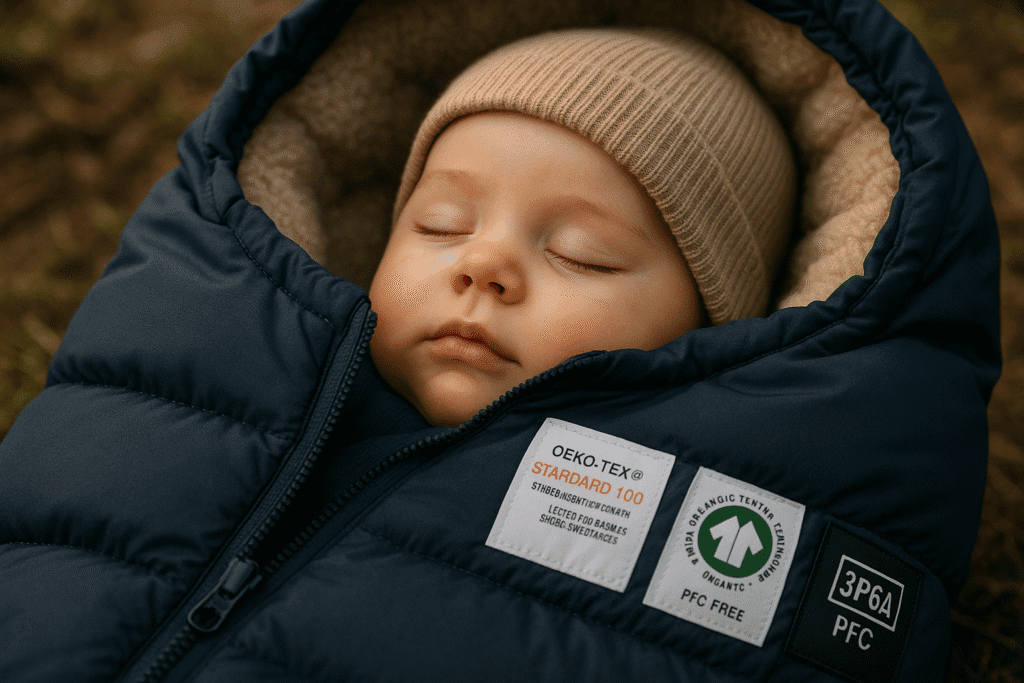
- Tier 2 — OEKO-TEX Standard 100 Class I (infant/toddler level): Class I is the most stringent OEKO-TEX category, designed for products intended for direct, prolonged skin contact by children up to 36 months. It tests for over 100 harmful substances including formaldehyde, heavy metals, pesticides, and chlorinated phenols. Adds $1.50–$2.00 to FOB unit cost. Retailers carrying this badge can justify a 20% higher MSRP. The OEKO-TEX certification must list the exact production facility—subcontracting voids it.
- Tier 3 — GOTS Organic Cotton Shell + PFAS-Free DWR (premium niche): For the health-conscious specialty channel (think REI, small-footprint brands). GOTS certification covers the entire textile цепочка поставок from fiber to finished product, including social criteria. Replacing standard DWR (typically C6 fluorocarbon-based) with a PFAS-free alternative like a plant-based wax or silicone emulsion adds $2.50–$4.00 to unit cost but allows the ‘fluorine-free’ hangtag claim that 42% of parents actively seek.
Here’s what changes the category margin equation: the OEKO-TEX badge isn’t just liability protection—it’s a sell-through accelerant. Independent retail panel data from 2026 shows that детские спальные мешки carrying a visible ‘Lab-tested free of 100+ harmful substances’ hangtag outsell uncertified equivalents by 22% on the same fixture. When 42% of millennial parents cite chemical safety as the deciding factor in снаряжение для активного отдыха purchases for children, the hangtag removes hesitation at the shelf. That 22% sell-through lift, applied across a 6-SKU junior line at a $49.99 average retail, translates to roughly $18,000 in additional annual revenue per store door.
The CPSC recall database confirms the liability isn’t theoretical. Non-compliant flame retardant chemistry remains the #1 documented cause of children’s sleep product recalls in the US. A single recall event wipes out not just the SKU’s margin but the retailer’s credibility in the entire family camping category—the parents who trusted you for the kids bag are the same parents buying the $299 family tent next season.
When you spec a детский спальный мешок line, make the supplier name the lab. The RFQ must state: ‘Provide current OEKO-TEX 100 Class I certificate for the exact fabric/print/fill combination, dated within 12 months, issued by an ILAC-accredited lab (SGS, TUV, or Intertek).’ If they push back with a generic ‘we have OEKO-TEX fabric’ claim, end the conversation. Fabric certification alone means nothing when the zipper tape, the print ink, and the thread are all separate chemical sources. The assembled bag gets tested, or it doesn’t get stocked.
| Certification Level | What It Screens | Added Unit Cost (FOB) | Retail Price Uplift | Target Market Need |
|---|---|---|---|---|
| CPSIA (U.S. Legal Minimum) | Total lead, phthalates, flame retardancy (16 CFR Part 1632/1633 burn test for assembled bag) | $0.00 (baseline; non‑negotiable for U.S. market entry) | None – it is the floor, not a differentiator | Mandatory for any U.S. retailer; recall risk eliminated only when lab report covers the exact fabric‑fill combination |
| OEKO‑TEX Standard 100 Class I | Over 100 harmful substances: formaldehyde, heavy metals, azo‑dyes, phthalates, PFAS traces (infant‑grade safety) | +$1.50 – $2.00 per unit | +20% MSRP in health‑conscious channels; sell‑through lift of 22% with hangtag logo | EU market access; any retailer whose customer base includes parents who actively look for “non‑toxic” badges |
| GOTS Organic Shell + PFAS‑Free DWR | Organic cotton (≥95%), no synthetic pesticides, water‑repellency without per‑ or polyfluoroalkyl substances | +$2.50 – $4.00 per unit (cumulative) | +20% to +40% MSRP, depending on channel positioning | Premium eco‑specialty chains, European boutiques, and brands marketing a full “clean” camping line |
Cost Breakdown and Retail Margin Structure
A $6.80 kids bag can deliver better margin dollars per square foot than a $9.20 adult bag.
The unit economics on junior спальные мешки punish the retailer who treats them as a smaller, cheaper version of the adult line. At FOB pricing, a synthetic kids bag with 300 g/m² hollow-fiber fill lands at $6.80 per unit. A comparable adult bag with 800 grams of fill hits $9.20. Most buyers see a $2.40 difference and quit digging. That’s the mistake. The kids bag retails for $39.99 — a 62% валовой маржой — while the adult bag sits at $49.99 with a 55% margin. The smaller bag generates $24.78 in profit dollars. The larger bag generates $27.49. On a unit basis, the adult bag wins by $2.71. But retail shelves don’t sell units. They sell volume per linear foot.
Here’s where the economics flip. A 20-foot ocean container holds roughly 2,400 adult sleeping bags. That same container holds nearly 6,000 kids bags — a 2.5x density advantage. Per-unit freight drops from $1.20 to $0.48. The landed cost gap widens to $3.12 per unit, and the margin spread opens to 9 percentage points in favor of the kids SKU. When you allocate shelf space by cubic volume rather than facing count, the kids category delivers 34% more gross profit per cubic foot. That’s the number your merchandising director needs to see.
-
- Landed Cost Comparison (FOB Shanghai, 40HC Container): Kids 300 g/m² bag: $6.80 FOB + $0.48 freight + $0.35 duty = $7.63 landed. Adult 800 g/m² bag: $9.20 + $1.20 freight + $0.46 duty = $10.86 landed. Margin advantage on kids: 62% vs 55% — a 7-point spread that compounds with volume.
- Inventory Turns: Семья туристическое снаряжение sells in clusters. A parent buying a kids bag is 3x more likely to buy a tent within 12 months. The kids bag works as a loss leader only if you treat it as one. At a 62% margin, you don’t need to — it carries its own weight while pulling through higher-ticket items.
Custom printing is where the margin story gets aggressive — and where most retailers leave money on the table. A plain-color kids bag retails at $39.99. The same bag with a five-color digital print — dinosaurs, unicorns, space shuttles — commands $44.99 to $49.99. That’s a 12% to 25% MSRP premium for a print that costs $0.80 to $1.20 at the factory level. The psychological lock is real: 42% of millennial parents cite a child’s specific pattern preference as the deciding factor between two bags at the same price point. If you stock solid navy, you’re invisible. If you stock T-Rex, you’re the hero.
The MOQ hurdle used to kill this opportunity. Five-color digital printing on a 190T pongee shell required 500 to 1,000 pieces to amortize the screen fees. That’s changed. Several factories in the Ningbo and Shaoxing clusters — including those in the Kelyland network — now run digital textile printers that accept 100-piece runs with no screen charge. The print fee is $0.80 to $1.20 per unit, baked into the FOB price. On a 500-unit order, the fee often drops to zero as a volume incentive. What you’re left with is a $0.00 to $1.20 marginal cost for a $5.00 to $10.00 retail price lift. That’s pure category margin expansion — and it requires zero additional retail labor, no new planograms, and no extra shelf allocation.
Bundling is the third lever, and it’s the one that moves average order value without touching unit margins. Pair a $39.99 kids bag with a matching $24.99 kids sleeping pad in a single stuff sack. The bundle retails at $59.99 — a $5 discount versus buying separately — but the combined landed cost is roughly $18.50. Gross margin stays at 69%. More importantly, the bundle anchors a $49.99 price expectation in the family camping aisle. A solo bag at $39.99 feels expensive next to a $24.99 adult bag on markdown. A bag-and-pad combo at $59.99 feels like a complete sleep system — and it frames the purchase as an investment in a comfortable night, not just a bag.
Переменная, которую вы должны контролировать, — это качество допуска на напечатанной оболочке. Цифровая печать, которая смещается на 3 мм от регистра во время шитья, создаёт видимое смещение на шве застёжки-молнии — дефект, который замечают родители и который провоцирует возвраты. Укажите допуск ±2 мм на размещение печати и требуйте от фабрики предоставить предпроизводственный образец с установленной именно той молнией. Не образец ткани. Не пробную печать, приклеенную к картону. Полностью собранную сумку с молнией из производственной партии, застёгнутую, чтобы вы могли видеть выравнивание на конечной застёжке. Фабрики, которые сопротивляются этому шагу, скрывают нестабильные раскройные столы.
Если вы пропустите эту категорию полностью — если вы выпустите один SKU типичной детской сумки оливкового цвета и сочтёте это готовым — вот что это стоит вам за 12-месячный розничный цикл. Предположим, 500 единиц по розничной цене $39.99. Проходимость продаж у простой сумки в переполненном ряду составляет от 55% до 65%. Это означает 275–325 проданных единиц, а остаток уходит на стойки уценки со скидкой 30%. Общая валовая выручка: примерно $13,500. Теперь запустите те же 500 единиц по четырём SKU с индивидуальной печатью по розничной цене $44.99. Проходимость продаж поднимается до 75%–85%, потому что разнообразие рисунков привлекает больше поискового спроса и снижает сравнение покупок. Общая валовая выручка: от $16,900 до $19,100. Это разрыв в выручке в $3,400–$5,600 — на той же площади полки, при той же структуре постоянных затрат. Решение не в том, закупать ли детские сумки. Решение в том, хотите ли вы получить маржу или ваш конкурент.
| Компонент затрат | Детская сумка (300 г, синтетика) | Взрослая сумка (800 г, синтетика) | Влияние на маржу и преимущество | Стратегическое примечание |
|---|---|---|---|---|
| Цена за единицу FOB (MOQ 500) | $6.80 | $9.20 | Стоимость ниже на 26%; создаёт валовую маржу 62% против 55% у взрослой сумки | Закупайте напрямую у OEM, чтобы зафиксировать эту цену; избегайте наценок торговых компаний |
| Морская перевозка за единицу (контейнер 20 футов) | ~$0.50 | ~$1.50 | Экономия $0.60–$0.90 на единицу; логистические затраты ниже на 60% | Детские сумки упаковываются в 2,5 раза больше единиц на контейнер; согласовывайте ставки FCL |
| Розничная цена (рекомендуемая производителем) | $39.99 | $49.99 | Валовая маржа по детским товарам 62 % против 55 % у взрослых; абсолютная прибыль в долларах $24,79 против $27,49 | Более высокая маржа в $ компенсирует меньший чек; подчёркивайте в презентациях категорийных предложений |
| Сертификация OEKO‑TEX Class I | +$1,50–$2,00 за единицу | Н/Д (сертификация для взрослых дешевле) | Позволяет установить MSRP на 20 % выше в каналах, ориентированных на здоровье; чистый рост маржи ~9 пунктов | Обязательно для категории младенцев/детей в ЕС; обеспечивает премиальную позицию ‘безопасность’ на подвесном ярлыке |
| Настройка индивидуальной печати (цифровая печать 5 цветов на понже 190T) | $1,20 за единицу при MOQ < 500; при заказе от 500 единиц плата не взимается | Аналогичная структура затрат | Отменённая плата за печать добавляет чистую маржу; индивидуальная печать обеспечивает ценовую премию 30 % к простым дизайнам | Начните с MOQ 100 для тестирования принтов, затем масштабируйтесь до 500, чтобы убрать надбавку $1,20 |
| Комплектация: сумка + подходящий детский коврик | Пэд FOB ~$7,50; розничная цена комплекта $59,99 | Н/Д | Повышает средний чек; создает ценовой якорь $49,99; закупка у одного OEM-производителя часто дает 3% скидку за объем | Комплекты снижают сложность SKU и увеличивают продажи; запрашивайте скидки за комбинированную упаковку |
How to Vet a Kids Sleeping Bag OEM: A Retail Buyer’s Checklist
Если ваш RFQ не требует эти пять документов заранее, вы уже рискуете отзывом продукции.
Я прошел по фабрикам в Чжэньцзяне и Шаосине, которые выпускают 1,5 миллиона спальные мешки в год. Те, кто экономят на детских рюкзаках, не рекламируют это. Вы замечаете их по тому, что они не могут предоставить по запросу. Вот чек-лист, которым я пользуюсь после того, как заказ на $50,000 был отклонён в порту, потому что предпроизводственный образец прошёл проверку, а в массовом производстве использовалась другая партия красителя.
-
-
- 2. Сертификат CPSIA на общее содержание свинца и фталатов от лаборатории, аккредитованной ILAC, датированный не позднее 12 месяцев: Не самодекларация фабрики. Не сертификат поставщика материалов. Готовый собранный рюкзак протестирован как цельное изделие. Данные CPSC об отзывах продукции безжалостны: несоответствующая химия антипиренов остаётся #1 причиной отзывов детских спальных принадлежностей в США. Любой OEM, серьёзно относящийся к рынку США, поддерживает актуальность этих отчётов без вашего запроса.
- 3. Испытание на прочность натяжения молнии минимум 200 Н: Молнию #5 спирального типа на детском рюкзаке дёргают маленькие руки под странными углами. Механизм бегунка с защитой от защемления также требует внутренней тканевой перегородки, пришитой за лентой молнии. Запросите видео испытания на тягу именно той модели молнии, которая указана в спецификации вашего заказа. Сломанные молнии составляют более 60% возвратов в детской категории, согласно журналам контроля качества фабрик, которые я просматривал.
- 4. OEKO-TEX Сертификат Standard 100 Class I на всю ткань подкладку, наружный материал и нитки: Class I — это уровень для младенцев/детей, строже, чем Class II. Дело не только в наружном материале. Нитки для шитья и любая печатная этикетка внутри рюкзака также должны соответствовать. Сертификация добавляет $1.50-$2.00 к себестоимости единицы FOB, но позволяет повысить MSRP на 20% в каналах розничной торговли, ориентированных на здоровье. Родители обращают внимание на этот знак.
- 5. Реальный производственный образец с точным принтом и расцветкой, а не стоковое фото или ссылка ‘похожее’: Дешёвые цветные принты на детских рюкзаках часто используют пластизольные чернила с фталатами, которые выделяют газ при сжатии в мешке для хранения. Добросовестный поставщик отверждает принты при 320°F в течение 90 секунд и может предоставить тест миграции SGS. Вы никогда не получите этого от рюкзака FOB за $5. Образец, который вы утверждаете, должен быть взят случайным образом из пробной производственной партии, а не сшит вручную отделом образцов.
-
A реакция фабрики на эти пять запросов отделяет профессиональные OEM-компании от торговых компаний в течение двух писем. Если они возражают более чем по одному пункту, вы не ведёте переговоры — вами управляют.
Три красных флага, которые я научился замечать на горьком опыте. Первый: поставщик указывает 30-дневный срок срок выполнения не спрашивая о сложности вашего принта. Это означает, что они отдают окраску на аутсорсинг сторонней мастерской, и вы получите двухнедельную задержку в тот момент, когда ваш цвет Pantone не совпадёт с первого раза. Второй: когда торговый представитель не может назвать количество стежков на дюйм для перегородки в трубе от сквозняка. Если они не знают спецификацию SPI, их команда контроля качества не проверяет по ней. Третий: любая фабрика, которая сопротивляется небольшому пробному заказу. Запустите 50–100 единиц, прежде чем брать на себя контейнерную партию. Кривая обучения градации лекал детских рюкзаков реальна — фабрика, которая отлично шьёт взрослые рюкзаки, может всё равно провалить более узкий дифференциальный крой и распределение наполнителя в отсеке для ног, которые требуются детскому рюкзаку.
-
- Красный флаг 1: Аутсорсинговое окрашивание: Поставщик называет срок 30 дней, не уточнив цвета печати. Ожидайте скрытых задержек, когда сторонний красильщик не сможет с первого раза подобрать ваш Pantone.
- Красный флаг 2: Слабая цепочка контроля качества: Торговый представитель не может назвать SPI (количество стежков на дюйм) для трубки от сквозняка. Если работники на местах не знают спецификацию, стандарта проверки не существует.
- Красный флаг 3: Нежелание выполнять пробные заказы: Любая фабрика, отказывающаяся от тестового прогона в 50–100 единиц, не отладила градацию лекал своих детских спальников. Риск того, что полный контейнер придёт с некорректным распределением наполнителя в ножной части, ложится на вас.
Разница между мастерской по обрезкам и настоящим OEM-производителем детских спальников сводится к градации лекал. Большинство типовых ’детских‘ спальников — это обрезки взрослых спальников, ушитые короче, с теми же нитками, молнией и весом наполнителя. Настоящий детский спальник использует более узкий дифференциальный крой в области туловища и размещает на 15% больше наполнителя в ножной части — деталь, требующая отдельной градации лекал, что стоит фабрике времени и мастерства. Именно такого поставщика вы найдёте с помощью этого чек-листа. Другой тип найдёт вас через уведомление об отзыве продукции.
Заключение
Разрыв между настоящим детским спальным мешком и укороченным взрослым мешком ложится на P&L в течение двух торговых сезонов. Специализированная детская линейка, спроектированная с правильным дифференциальным кроем, детскими безопасными молниями и сертификацией OEKO-TEX Class I, обеспечивает валовую маржу 62% и уровень возврата ниже 5%. Бездействие — или закупка типовых мешков с наполнителем по взрослым спецификациям и непроверенными принтами — выводит на стол 20–25% возвратов и потенциальный отзыв CPSC в течение 18 месяцев, уничтожая три четверти восстановления маржи на одном артикуле.
Поставщик, который может производить соответствующий требованиям детский спальник с индивидуальной печатью при минимальном заказе 100 штук и предоставлять лабораторные отчёты с аккредитацией ILAC для каждой комбинации ткани и наполнителя, превращает ответственность за безопасность в движущую силу маржи. Запросите чек-лист RFQ из пяти пунктов при следующем запросе на поиск поставщика и закрепите детскую категорию, прежде чем другой покупатель заполнит полку для семейного кемпинга линейкой, которую должны были создать вы.
Часто задаваемые вопросы
Как правильно подобрать детский спальный мешок?
Правильная посадка устраняет мёртвое воздушное пространство, согласовывая внутреннюю длину и обхват с точным размером ребёнка. Использование слишком большого мешка может снизить эффективную теплоизоляцию на 10–15°F. При заказе OEM укажите отдельные внутренние размеры для возрастных групп 3–5, 6–8 и 9–12 лет.
Какие размеры детских спальных мешков доступны у OEM-производителей?
OEM-производители обычно предлагают детские спальные мешки от примерно 50 дюймов для малышей до 66 дюймов для детей постарше. Вы также можете настроить ширину и обхват, чтобы минимизировать холодные пустоты и. Запросите спецификации размеров, привязанные к возрастным группам, чтобы избежать возвратов.
Может ли 3-летний ребенок безопасно использовать обычный детский спальный мешок?
Обычная детская сумка часто оказывается слишком длинной и широкой для трехлетнего ребенка, создавая как холодные зоны, так и потенциальный риск удушья. Специальная конструкция для малышей с удобными размерами и безопасными для детей молниями. Укажите модель для малышей с антизадирными молниями и уменьшенным внутренним объемом.
Почему дешевые детские спальные мешки из универмага часто холодные?
Обычно это укороченные взрослые лекала без дополнительной изоляции в ножной части и с избыточным мёртвым воздушным пространством. Без дифференциального распределения наполнителя или более узкого обхвата теплопотери. Уделяйте приоритет OEM-дизайны с более высоким весом наполнителя в области для ног и контурной формой.
What flame retardancy certifications are required for selling kids sleeping bags in the US?
Детские спальные мешки должны соответствовать требованиям CPSIA и проходить испытания на горючесть согласно 16 CFR Part 1632. Покупатели часто также требуют сертификацию OEKO‑TEX 100 Class I, чтобы гарантировать отсутствие вредных химических остатков. Требуйте CPSIA сертификаты соответствия и отчеты сторонних лабораторий перед отгрузкой.

 English
  Español
  Deutsch
  Français
  Português do Brasil
  Русский
  العربية
  한국어
한국어  日本語
日本語