 跳到内容
跳到内容 
The Air Tent vs Pole Tent debate directly impacts a rental fleet’s operational costs and a retailer’s warranty claims. Traditional pole tents often fail under wind load, leading to costly replacements, while air tents introduce the risk of punctures and higher capital investment. The wrong inventory choice directly erodes profit margins through labor and returns.
This analysis benchmarks the durability of TPU Air Beams against 7001 Aluminum Alloy frames under simulated field conditions. We evaluate models based on seam-sealing integrity and fabric tear strength to provide a clear sourcing recommendation for a reliable and profitable 2026 продукт line.
Как на самом деле работает технология Air Beam?
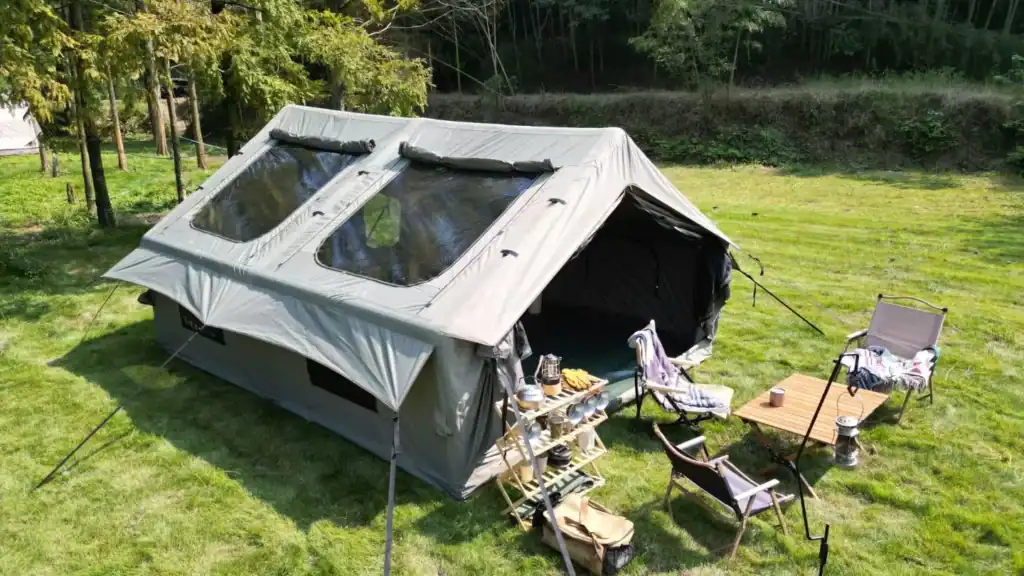
Air beam tech swaps poles for high-pressure inflatable tubes. Pumping air into these TPU or PVC beams creates a rigid yet flexible frame that bends, not breaks.
The Principle of Inflatable Arches
Instead of assembling fiberglass or aluminum poles, you just pump high-pressure air into flexible tubes. These tubes become rigid arches and form the tent’s entire structural frame. The setup is simple: lay the tent flat, connect a pump to the inflation valves, and inflate the beams until they reach the correct pressure.
The main advantage appears in bad weather. The inflatable frame is designed to flex under heavy wind load and then return to its original shape. Rigid poles under the same stress can permanently bend or snap, often damaging the tent fabric in the process.

TPU and PVC: The Materials Behind the Frame
The reliability of an air beam comes down to its material. The tubes are made from either Thermoplastic Polyurethane (TPU) or PVC, both selected for high durability and abrasion resistance. This creates a robust framework that withstands challenging weather by bending instead of snapping.
The material composition also includes essential water-repellent and UV-resistant properties. These treatments protect the inflatable structure from breaking down after long-term exposure to sun and rain, ensuring the beams maintain their integrity over time.
Плюсы и минусы: реальна ли шумиха?
Air tents deliver on setup speed for families, but traditional pole tents win on weight, pack size, and cost, making them better for backpacking or budget camping.
The Genuine Advantage: Speed and Simplicity
The real appeal is speed. A single person can pitch a massive family tent without help, a major practical advantage over pole tents that often need coordination. The structure relies on inflatable Air Beams, made of tough TPU or PVC, that become rigid when pumped up. This creates a no-pole setup that deflates just as fast.
The Trade-Offs: Weight, Bulk, and Cost
The trade-offs are practical: weight, bulk, and cost. Air tents are almost always heavier and pack larger than their pole-based counterparts, making them a poor choice for trekking where lightweight Aluminum Alloy poles are standard. The inflatable technology and required pump also drive up the price, putting them at a premium over tents using common Fiberglass or Aluminum frames.
Обзор рынка: 10 лучших мировых брендов, определяющих 2026 год
The inflatable tent market is split between value leaders, premium innovators, and established brands. Quick-setup tech is now standard, with material quality as the key differentiator.
| Бренд | Home Market | Market Position / Key Strength |
|---|---|---|
| Декатлон (кечуа) | Франция | Value-for-money leader. Offers premium features like blackout pods at budget prices through a strong in-house design and direct retail model. |
| Berghaus | ВЕЛИКОБРИТАНИЯ | Premium quality with a focus on weather-resistance and innovative features like darkened bedrooms (Nightfall technology). |
| Dometic | Глобальная | Global player expanding through acquisition (bought Kampa in 2018). Focuses on a broad outdoor and mobile living portfolio. |
| Vango | ВЕЛИКОБРИТАНИЯ | Mid-to-premium segment. Known for comfort-focused designs and innovative fabrics like their breathable Sentinel TC poly-cotton blend. |
| Kampa | ВЕЛИКОБРИТАНИЯ | Established UK brand now under Dometic ownership. Retains a strong reputation for quality, especially in drive-away awnings. |
| Coleman | США | Mainstream brand with wide distribution. Known for accessible family camping gear, leveraging its massive retail network. |
| Геймпланета | Германия | Niche premium brand with a focus on unique geodesic airframe designs and high-end materials for technical performance. |
| Zempire | Австралия | Specializes in modular and highly configurable tent designs, offering flexibility for different family or group sizes. |
| Fantik | Глобальная | Disruptor focused on speed. Its instant-tent technology targets convenience-first campers, competing on setup time. |
| REI Co-op / The North Face | США | Represents the specialty outdoor retail channel. Their endorsement and testing standards influence premium market trends. |
Key Market Dynamics
The market is defined by three clear strategies. Budget-conscious options are dominated by vertically integrated retailers like Decathlon. The mid-range is held by established European brands like Kampa, Berghaus, and Vango. Premium innovation comes from specialized manufacturers like Heimplanet that focus on unique designs and technical fabrics.
Fast setup is no longer a premium feature; it’s the expected standard. The new battleground for differentiation is fabric technology. Brands are competing on temperature-regulating blends (like poly-cotton), enhanced water resistance ratings, and blackout coatings that reduce heat and light inside the tent.
Понимание долговечности: Что делает палатку долговечной?
A tent’s durability comes from its materials and build. Heavy-duty fabrics, strong frames like aluminum, and reinforced, seam-sealed stitching create a shelter that withstands years of use.
The Role of Fabric and Stitching Quality
A tent’s lifespan is directly tied to its fabric. The material is the first line of defense against UV rays, abrasion, and tearing. We source specific fabrics for different applications, matching the material to the expected field conditions.
- Oxford (150D/600D): Our choice for heavy-duty applications. Its abrasion resistance is ideal for glamping shelters and overlanding tents that see frequent, rough use.
- Ripstop Nylon (20D/40D): Delivers a high strength-to-weight ratio, making it the standard for lightweight trekking and backpacking tents where every gram matters.
- Polyester (190T/210T): A reliable, UV-resistant, and cost-effective option perfect for entry-level and family кемпинговые палатки.
But fabric is only half the story. Poor construction can make even the best materials fail. We use double-needle stitching for strength and apply heat-sealed tape over every seam to ensure it’s fully waterproof. All key stress points, like the corners and guy-out loops, get bar-tack reinforcement to prevent tearing under tension.
Frame Systems and Protective Coatings
The frame provides the tent’s structural integrity. The right material choice is a balance between weight, flexibility, and load-bearing strength, dictated entirely by the tent’s intended use.
- Aluminum Alloy (7001/7075): Lightweight, strong, and corrosion-resistant. This is the professional standard for trekking and mountaineering tents.
- Steel: Delivers maximum strength, essential for supporting the vertical walls of large family cabin tents and long-term glamping setups.
- Fiberglass: A flexible and budget-friendly option well-suited for casual, recreational camping.
Final weatherproofing is achieved with specialized coatings. A standard Polyurethane (PU) coating offers reliable waterproofing up to 5000mm. For high-performance tents, a silicone coating applied to nylon fabric (Silnylon) dramatically increases tear strength and water repellency without adding significant weight.
Внутри фабрики: Информация о производственных процессах
We inspect raw fabrics, use automated cutting for precision, reinforce stress points, and apply heat-sealed tape to every seam before a final waterproof test confirms quality.
From Fabric Rolls to Structural Panels
The integrity of a tent starts with the quality of its components. Each step in our process is designed to ensure durability and a perfect fit before the main assembly even begins.
- Fabric Inspection: All incoming materials are checked for tensile strength and color fastness to meet our standards.
- Precision Cutting: We use automated cutting systems to ensure every fabric panel has exact dimensions for a symmetrical and structurally sound fit.
- Stress Point Reinforcement: Key load-bearing areas, like guy-out points and corners, receive bar-tack stitching for superior strength.
Achieving Waterproofing with Seam Sealing
A tent that isn’t waterproof fails at its primary job. Our process focuses on making every seam a permanent barrier against water entry, not just a point where two panels meet.
- Double-Needle Stitching: All primary seams are sewn with a double-needle technique to create a strong physical bond between panels.
- Heat Sealing Tape: After stitching, we apply a specialized heat sealing tape over every single seam. This process permanently blocks any potential water entry points.
- Hydrostatic Head Testing: We verify the waterproof rating of our fabric batches with a hydrostatic head test to confirm they meet performance specifications.
Основные аспекты поиска поставщиков для розничной торговли
Retailers must prioritize partners with supply chain diversification, verified quality control like ISO 9001, and flexible MOQs to manage inventory risk and ensure resilience.
Balancing Supply Chain Resilience and Cost
Relying on a single manufacturing hub is no longer a viable strategy. Geopolitical shifts and climate disruptions create too much risk. Smart sourcing now involves building a multi-hub network, spreading production across different regions to buffer against potential shutdowns or shipping delays. This isn’t about abandoning global partners, but about building redundancy into your supply chain.
Evaluating a supplier’s ability to perform under pressure is critical. This means going beyond price and verifying their operational stability. A factory’s certifications are a direct indicator of its quality management processes. For instance, an ISO 9001:2015 certification demonstrates a commitment to consistent quality and process control, which is essential for reliable long-term partnerships.
Leveraging Flexible MOQs for Inventory Management
Minimum order quantities directly impact cash flow and your ability to test new products. A rigid, high MOQ locks up capital in unproven inventory. Finding a manufacturing partner willing to support smaller initial runs is a significant competitive advantage. This allows you to validate market demand before committing to a large production order.
Look for suppliers that offer a tiered MOQ structure. A startup-friendly MOQ of 50-100 pieces for specific items can get a new product off the ground with minimal financial exposure. Once sales data confirms a winner, you can confidently scale up to standard production MOQs, which typically range from 300 to 1,000 pieces.
Source High-Quality, Custom Camping Tents

Заключительные размышления
While entry-level tents look similar, the real difference is in the manufacturing details. Skipping heat-sealed seams saves a few dollars but guarantees costly returns and negative reviews when the first rain hits. Investing in properly waterproofed inventory is the only way to protect your brand’s reputation.
The only way to verify quality is to test it. We recommend starting with a sample to inspect our seam taping and fabric finish firsthand. Contact our team to discuss your private label needs and arrange a small trial order.
Часто задаваемые вопросы
What are the main benefits of an air tent over a traditional pole tent?
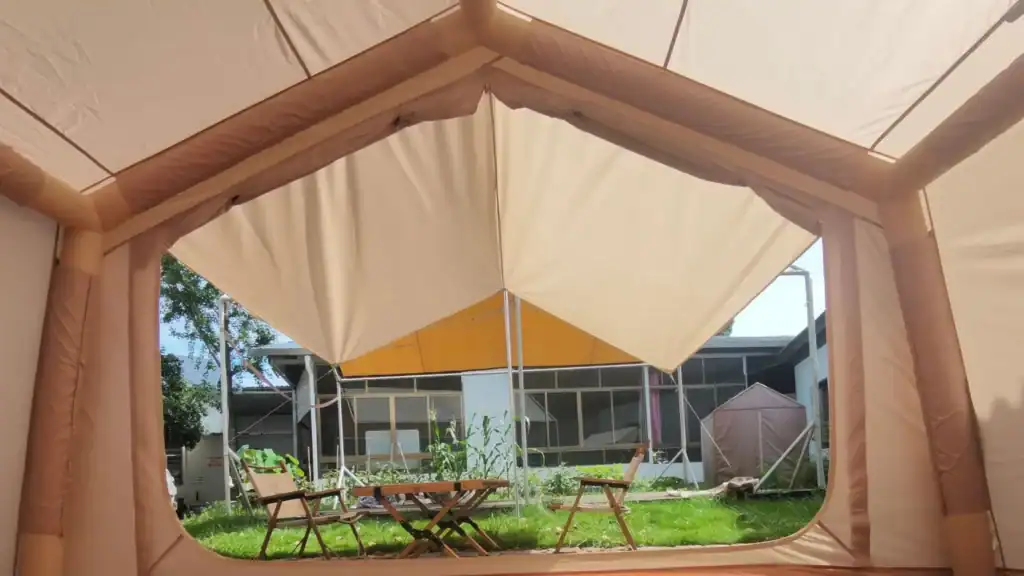
Air tents offer faster setup times and often better durability than tents with rigid poles. Their inflatable beam system makes them easier for one person to pitch and creates more usable internal space.
Are air tents more expensive than pole tents?
Yes, air tents generally have a premium price, costing about 20% more than an equivalent pole tent. This reflects the advanced inflatable beam technology.
What are the disadvantages of choosing an air tent?
The main trade-offs for air tents are their weight and packed volume. They are usually heavier and take up more space when stored, which is a key factor for portability.
Is the technology for air tents improving?
Yes, the technology is advancing. New pump systems and beam materials are improving the portability and overall performance of air tents, closing the gap with traditional models.
Do inflatable tents lose air in cold weather?
Inflatable tents may lose some air pressure in cold weather due to the natural contraction of air, but they will not completely deflate. This pressure loss is usually minor, and the tent remains structurally sound. To minimize this effect, you can inflate the tent to the higher end of its recommended pressure range or add a small amount of air if it appears less rigid.
Можно ли отремонтировать пробитую воздушную балку в полевых условиях?
Yes, repairing a punctured air beam in the field is designed to be straightforward. Most air tents include a repair kit with patches specifically for this purpose. Unlike a snapped pole, which can be difficult to fix without replacement parts, a puncture can be sealed quickly to restore the tent’s structure.
Are air tents better than pole tents in high winds?
Air tents generally perform better in high winds. Their inflatable beams are designed to flex under pressure and bounce back, absorbing wind gusts without breaking. Rigid poles, on the other hand, can bend permanently or snap under the same force, potentially leading to catastrophic tent failure.
Сколько лет служит воздушная балка?
An air beam’s lifespan is typically 5 to 10 years with proper care, though this varies by quality. Premium models can last over 10 years, while basic versions may last 2-5 years. Longevity depends on material quality, frequency of use, and proper storage.
Do I need an electric pump for an air tent?
An electric pump is not required, as air tents come with a manual pump. But, electric pumps offer convenience by inflating the tent much faster and with less physical effort. While a manual pump is reliable anywhere, an electric pump is a useful upgrade if you have access to power and value a quick setup.

 English
  Español
  Deutsch
  Français
  Português do Brasil
  Русский
  العربية
  한국어
한국어  日本語
日本語