 跳到内容
跳到内容 
命中章节 1/6。
问题示例:Vent Engineering: The Five Physical Fixes(Degradation Mode)
请先修复模型链路或重跑生成,再继续发布。
A glamping tent condensation fix rarely makes it onto the sample approval checklist before a buyer signs a $50,000 order for 40 bell tents. The pre-production sample looked flawless under showroom lights: taut canvas, clean seams, ready for the catalog. The production run behaved differently after three nights on a damp riverside meadow. Warm sleeping breath hit cold fabric, water beaded along the interior seams, and then it dripped onto the duvets.
Condensation inside a bell tent is not a stitching failure. It is a physics problem. Humid interior air reaches its dew point the moment it touches a cold single-wall surface. So the fix has to be engineered into the canvas specification, the ventilation layout, and the quality tolerance before production starts. Buyers who chase the lowest FOB price often discover the factory downgraded the vent mesh to save eighty cents per tent. Those eighty cents are what turn a quiet night into a refund request.
Take this benchmark into your next supplier call. A glamping tent needs roughly 2 percent of its floor area in openable vent space to manage condensation in humid night conditions. Below that, moisture collects no matter how breathable the canvas claims to be. If the factory cannot confirm that number in the tech pack, the glamping tent condensation fix is just weather luck.

Why the Water on Your Ceiling Is Not a Leak
A 3,000 mm PU fly stops rain.
On a clear, cold night, a glamping operator walks into a bell tent and finds water beading on the ceiling. The first call is always the same: “The fly leaked.” But pull the coating back and check the hydrostatic head, and the spec is usually sound. The fabric did not leak. The air inside the tent did.
Dew Point Physics: The Hidden Cause
Warm air holds more moisture than cold air. Every occupant exhales humid air all night long, and a tent sealed against rain gives that vapor nowhere to go. When the warm, humid air reaches the cold fly, it cools below the dew point and turns to liquid. On an 8°C night, an unvented single-wall glamping tent interior can hit that condensation point in under 20 minutes.
The Coating Trap
At the Shaoxing glamping tent plant inside Kelyland’s core factory network, a facility producing roughly 300,000 tents per year under ISO 9001:2015, the sample approval sheet records the PU coating’s hydrostatic head. It does not usually record moisture vapor transmission. That gap in the paperwork is why condensation complaints survive the sampling stage and reach paying guests. An OEM condensation fix for bell tents needs that second number on the spec sheet.
Rental Business Impact
- Drying burden: Stop condensation in a glamping tent before it kills your turnaround. A single-wall tent that condenses overnight needs a full day of airing before the next booking. Skip it, and back-to-back rentals leave you with damp interiors, musty bedding, and mold growth that accelerates.
- Review risk: “Water dripped from the ceiling onto the bed.” Guests read that as a leak. They don’t know or care what the dew point is. That review follows the property, not the fabric spec.
- Warranty disputes: Tent makers classify condensation as environmental, not a manufacturing defect. Don’t expect the factory to cover it. Without a written condensation-management spec, the rental operator absorbs the cost of re-airing, cleaning, and early replacement.
For a glamping tent, the condensation fix is never a higher hydrostatic head. That number measures how well the fabric sheds rain, but condensation pushes moisture from the inside out. The real controls are vent placement, inner-tent design, and a fly fabric chosen for vapor transmission in the climate where the tent actually sleeps. Buyers who run a fabric breathability comparison and lock the vent layout into the sample approval, instead of just the rain spec, get guests who wake up dry. That’s the spec that matters on the next order.
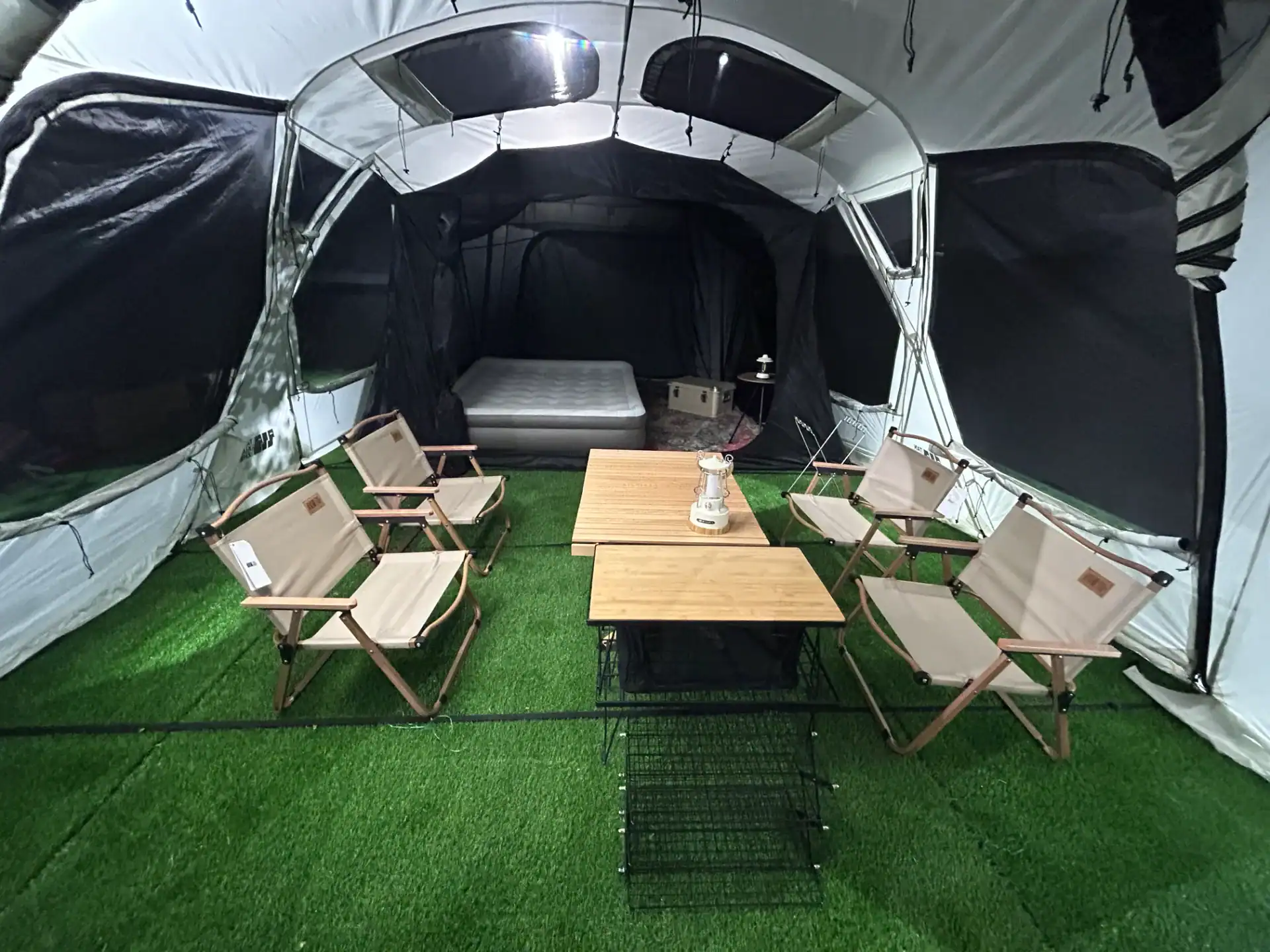
Fabric Fix: Poly-Cotton vs Coated Polyester
In a single-wall tent, the breathability number matters more than the waterproof rating — but most suppliers never volunteer it.
Two bell tents sit side by side. Same silhouette, same zipper track, similar FOB pricing. The difference only shows on a cool, humid night with two people inside. One wall stays dry. The other collects condensation on the ceiling and drips onto the sleeping bags by dawn.
That outcome was sealed at the fabric selection stage, long before the tent reached the sewing line. For an OEM bell tent, the condensation fix belongs in the written spec, not in the first guest review.
The Breathability Gap You Can Feel
Uncoated poly-cotton TC fabric breathes at 500-800 g/m²/24h. PU-coated polyester drops to 100-300 g/m²/24h. In a single-wall tent, that difference determines whether condensation beads on the ceiling or soaks into the sleeping bag.
A coated polyester wall pushes moisture onto the coldest internal surface — usually the ceiling above the sleeper’s head. TC fabric lets vapor escape through the weave, keeping the interior drier without a single vent open.
Why Factory Coating Choices Matter
Coating is a manufacturing choice, not a material upgrade. Factories apply PU to meet a гидростатический напор spec — 1500mm, 3000mm, or 5000mm. Each layer cuts moisture transfer. A supplier quoting “waterproof polyester” without listing the waterhead or MVTR hasn’t solved the condensation problem.
- Ask for both numbers: MVTR in g/m²/24h and гидростатический напор in mm, tested on the same swatch. No breathability test report on coated fabric? Treat that as a red flag.
- The tradeoff: A 5000mm PU-coated flysheet keeps rain out but traps moisture inside. In a glamping tent with two people and a wood stove, the trapped vapor condenses the moment the stove cools.
Single-Wall vs Double-Wall Tradeoffs
Double-wall tents use coated polyester because the inner breathable lining keeps the sleeper away from the condensation zone. The flysheet drips, the inner tent stays dry. Single-wall designs — bell tents, yurts, hot tents — have no buffer. The fabric itself must do the breathing.
For a single-wall bell tent, the practical specification is 210gsm. Put that number on every sample request.
Vent Engineering: The Five Physical Fixes
With the vents shut, condensation comes down to fabric breathability. Coated polyester blocks rain but traps vapor inside. Cotton and TC blends let moisture pass through the weave, so they stay drier overnight. Nylon packs light, yet you have to coat it for weather, and that coating puts the vapor problem right back. Settle the fabric before you design the vents.
Factory Ventiilation Fixtures
Forget more mesh — five production modifications create the controlled airflow path that actually works.
Most buyers ask for more mesh when a tent feels stuffy. Mesh is not the fix. Extra vent panels still trap humid air if the design has no defined entrance and exit path. Directional ventilation comes down to five production changes: a roof opening, a lower mesh kick screen, a suspended inner mesh layer, TPU film patching, and sealed perforations at the seam lines. Sample approval locks those five into the written sewing instructions.
The Five Modifications That Redirect Airflow
- Roof opening: Cut at the highest point of the tent body so hot, humid air exits at the peak. The edge gets a rolled hem and a reinforcing stitch. A raw cut fails after repeated pack-and-unpack cycles.
- Mesh kick screen: Install it on the lower door or foot wall. It pulls cool air in at floor level without putting a draft across the sleeping zone. Standard production runs of 300-1,000 pieces handle this height change without a new pattern.
- Suspended mesh layer: Hang an inner panel below the roof opening so it catches condensation drips before they reach the sleeping bag. Heat still escapes through the top. This layer adds one internal seam line, so it goes into the written sewing instructions, not just the design sketch.
- TPU film patching works where mesh gets removed but the fabric panel stays. The film seals the stitch rows and keeps the waterproof rating intact. Tolerance here is tight. The patch has to sit flat, with zero lifting at the edges.
- Taping perforations: every needle hole around the roof opening and kick screen gets лента для швов. A single hole is nearly invisible. The combined leak path shows up in the first rain. The tape must cover the full stitch row, clean, no bubbles, no wrinkles.
None of these five modifications happen on a standard assembly line. If the sample approval doesn’t carry a revised sewing instruction, the production team defaults to the existing vent pattern. Kelyland’s Camping Tent & Tarp factory in Ningbo, Zhejiang, handles this through an ISO 9001:2015 workflow. The change gets documented in the work instructions, a mid-production inspection verifies the stitch placement, and the 30-45 day production lead time stays intact. Small custom runs, some starting at 50-100 pieces, get the same treatment as bulk orders.
The Benchmark for Your Next Supplier Call
Ask the supplier for a smoke-pen test video at sample approval. The clip should show air entering through the lower kick screen and exiting through the roof opening in one visible path. No video, no proof. The ventilation spec stays unverified, no matter how many square meters of mesh the quote lists. The test takes five minutes and beats any material spec sheet.
Заключение
Condensation control is a system of airflow, seam sealing, and pitch tension, not a single fabric spec. A tent that can’t breathe will drip on bedding, no matter how good the FOB pricing looked at the quote stage. In a 12-week rental season, skipping these checks means guest-facing failures by week three. The replacement bill never appears in the original quote.
- Specify a vented peak and a seam-taped canopy in the sample approval, not just the floor material.
- Before you release the first production run, lock down the stitching tolerance and seam tape spec in writing. If you don’t, the line will drift by 3–5 mm by day three — and that’s where condensation paths start forming inside the tent. A 0.5 mm gap in the seam tape is enough to create a moisture bridge.
- Pitch the tent under full tension for the pre-shipment inspection. A sagging panel traps still air, and still air breeds condensation. That’s the quickest way to know if your factory actually tensioned the canvas or just stuffed it in a bag.
Before you sign the next bell tent PO, sit down with your supplier and run through the condensation checklist — not over email, face-to-face. Ask for the fabric’s MVTR (moisture vapor transmission rate) in writing, not just a “breathable cotton” label. Then compare FOB pricing from two factories that build the same vented canvas construction. Last step: inspect your existing rental tents at the seams and peak vent. That one hour of field work tells you which supplier actually controls moisture, and which one just cuts canvas.

 English
  Español
  Deutsch
  Français
  Português do Brasil
  Русский
  العربية
  한국어
한국어  日本語
日本語