 跳到内容
跳到内容 
verify inflatable tent factory is the first checkpoint buyers should lock before they approve a supplier, budget, or production slot. The gap between a successful sample and a $50,000 production batch often comes down to a weld strength number few buyers ask for—and that gap is exactly why you need to verify an inflatable tent factory before committing. It’s not about FOB pricing or chasing the lowest quote. It’s about whether the supplier can actually deliver a tent that holds air after a full season of UV exposure and repeated folding.
A legitimate manufacturer will have a dedicated TPU high-frequency welding machine on the floor. If a video call only shows sewing stations, the air-tube assembly is being outsourced, and that’s where quality control gets dangerously loose. Ask to see a finished tent’s batch code, then request the corresponding QC report. A trading company can’t produce that traceability because they don’t control the process. The ISO 9001 certificate should also list inflatable tents or TPU welding in its scope, not just generic outdoor goods.
Skipping this verification step means a batch of leaky tents can land on your retail shelves by month five, triggering chargebacks, customer returns, and a burned seasonal slot that takes a full year to recover.
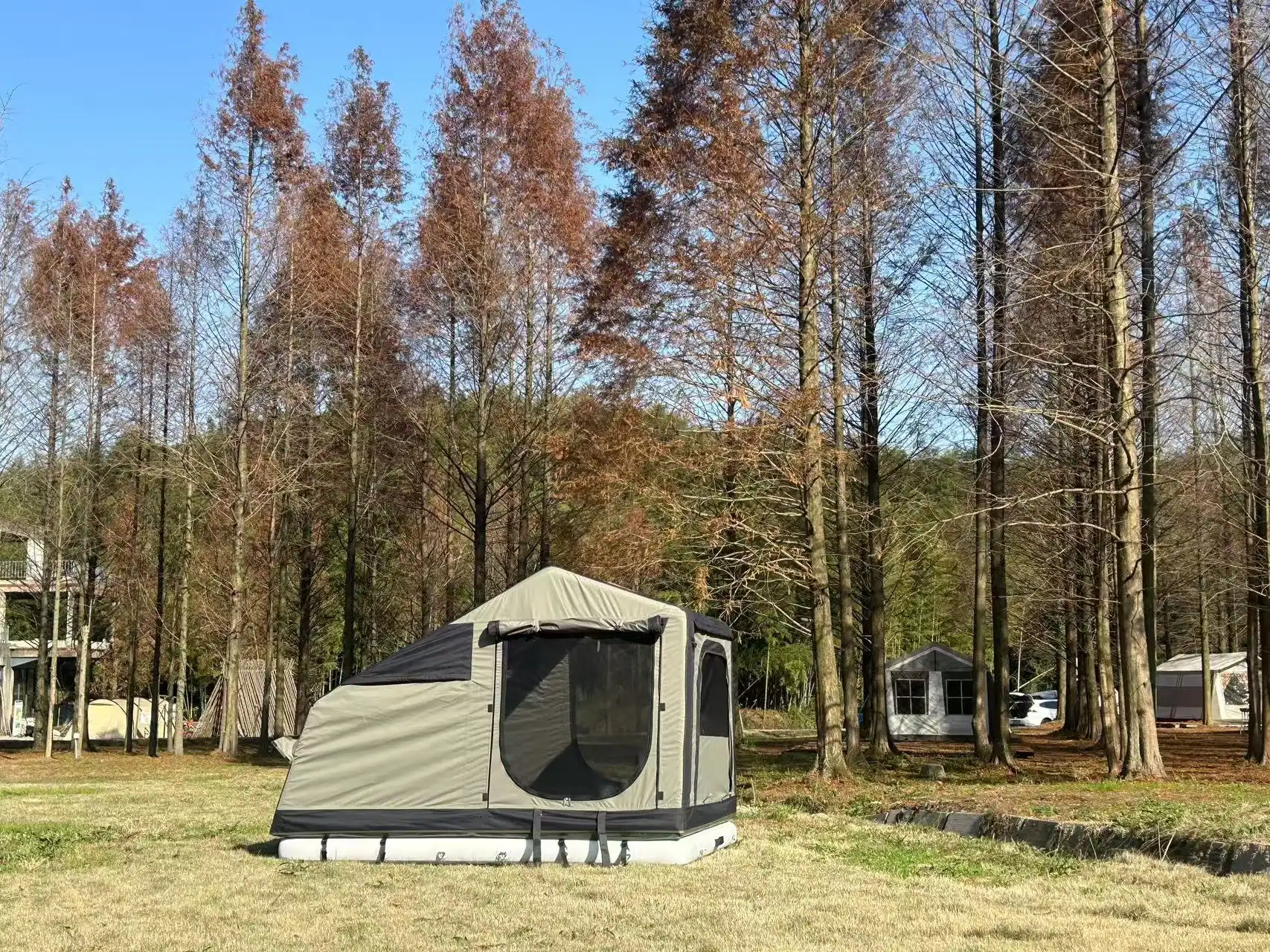
Why Factory Verification Matters More Now
A fake factory doesn’t cost you the deposit.
The invoice gets paid. The container arrives. Then the first chargeback lands months later, after a tent’s airbeam seam fails on the retail floor. The painful way to find out is when the seasonal sell-through report comes back and the markdown budget is already gone.
The Hidden Cost of a Fake Factory
That sequence is the hidden cost of a trading company. A supplier can quote attractive FOB pricing because it bids your order to whichever workshop has open capacity that week. Capacity shifts during peak season, and your order moves to a line that has never welded TPU in that pattern. The sample photos stay perfect; the mass production run does not.
Trading companies also control quality differently. The factory they use today is not the factory they use next month. So the pre-production sample approval means little. There is no fixed team, no fixed line, and no continuous improvement loop between the factory floor and your buyer account.
Trading Company vs. Manufacturer: Quick Tell-Tale Signs
In 2026, verifying a Chinese inflatable tent manufacturer doesn’t require a plane ticket. A 30-minute live video call, structured around the right details, separates a real inflatable tent production line from a trading office. Focus on four signs.
-
- TPU high-frequency welding machine: A legitimate inflatable tent factory keeps at least one dedicated TPU welding machine visible on the production floor. If the camera shows only sewing stations and fabric panels, the air-tube assembly is outsourced. That outsourced step controls whether the tent holds air.
- ISO 9001 scope wording: Request the certificate and read the scope line. It should name ‘inflatable tents’ or ‘TPU welding.’ Certificates covering only ‘outdoor goods’ are often held by trading offices or general import/export companies, not production facilities.
- Batch code traceability: Pick a finished tent, read the batch code, and ask for the QC sheet for that exact batch. A real factory has this record; a trading company cannot connect a physical product to a production day.
- Floor activity: A working factory shows motion: material trolleys, stacked half-finished tents, and workers with tools. A rented showroom floor with neatly displayed samples is the calling card of a trading company.
Pre-screening matters for this reason. Kelyland Outdoors builds its sourcing service on a network of 17 core factories and more than 200 manufacturing partners, most of them ISO 9001:2015 certified. The selection process uses the same logic as the video checks above: direct welding capability, real batch traceability, and a certificate that matches the actual product category.
If a supplier sends a pre-recorded factory video instead of a live call, treat that as a warning. Real manufacturers let you watch the line as it runs. Trading companies offer scripts, not floor access.
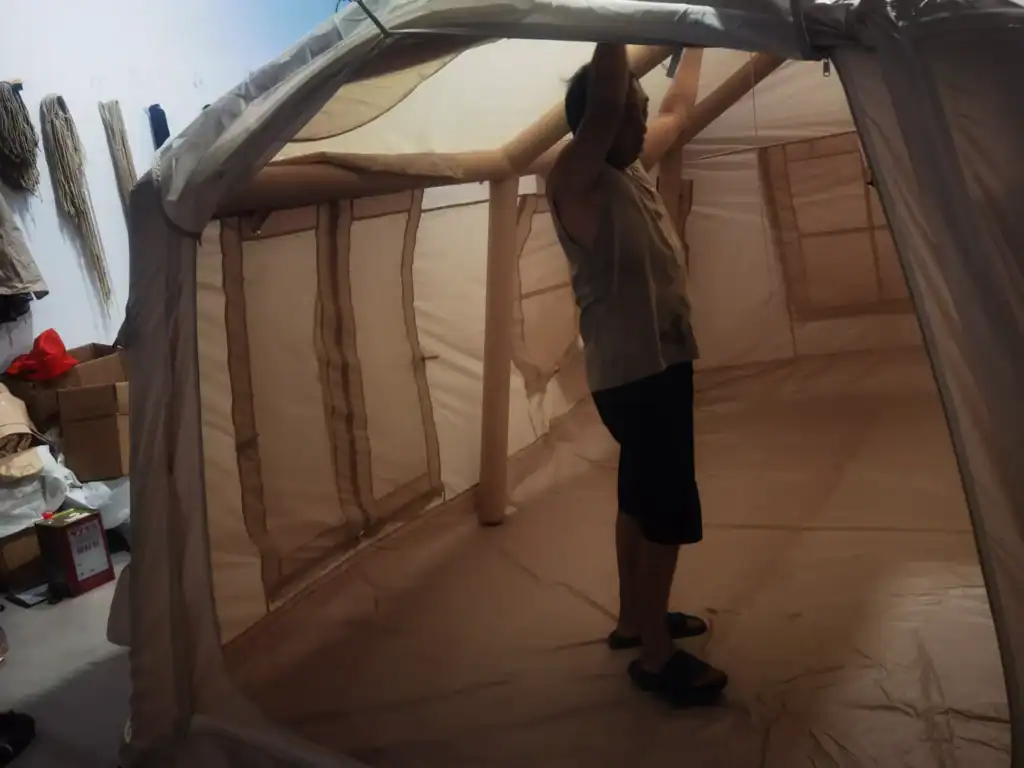
Live Video Call: What to Demand in 2026
One live welding station on video tells you more than a photo gallery ever will.
A sales call follows a script. A live video call does not. When you verify an inflatable tent factory in 2026, the video call is the closest thing to a floor audit without a plane ticket. Run it before sample approval, not after the deposit clears.
Ask for specific shots and watch how the supplier reacts. Real factories move the camera; trading companies move the conversation.
Seven Shots That Expose the Real Operation
-
-
- Raw TPU film rolls: Ask to see the TPU film rolls and their batch labels. A real manufacturer stocks coated fabric in multiple weights. A trading company stalls here.
- TPU high-frequency welding machine: This machine welds the air tubes that give an inflatable tent its structure. A legitimate factory keeps at least one dedicated high-frequency welding unit on the floor. If only sewing machines appear, the air-tube assembly is outsourced.
- Weld seam close-up: Hold the camera on a finished seam. Look for even weld width, no scorch marks, no bubbles. If the seam varies, the quality tolerance is out of control. This is where a $50,000 order fails before the tent reaches a pressure test.
- Airtightness jig: Ask to see a tube inflated to working pressure and held for a timed drop test. A real factory has a jig for this. If no jig appears, ask how leaks are measured. Pauses are answers.
- Full tent inflation: Have the team inflate a complete tent on the production floor. Watch whether every beam holds shape after the pump stops. Soft sections point to weak welds or bad internal valves.
- Batch code plus QC record: Pick a finished tent, read its batch code, and ask for the matching QC report. Inflatable tent batch code traceability is the difference between a manufacturer and an assembler. Fake factories cannot produce this link on demand.
- Packing station checklist: The final shot should show the packing table with a QC checklist pinned beside it. Weld inspection, pressure hold, and zipper function on that list tell you what the factory actually tests.
-
Red Flags: Empty Floors, Sewing-Only Lines, Missing Welding Stations
An empty floor tells you more than any certificate. A factory mid-production has cut fabric, half-finished tents, and workers moving between stations. If the floor is clean and static, you are watching a showroom.
-
- Only sewing machines: Sewing builds the canopy, not the air beams. Without HF welding equipment visible, those tubes come from another workshop, and you lose control of the highest-failure component.
- Empty floors: No material rolls, no work-in-progress, no packed goods. Real production leaves traces. A spotless floor means the operation is being shown from someone else’s building.
- No welding stations: Ask directly where the air tubes are welded. If the answer takes longer than three seconds, the work is outsourced.
The production scale worth trusting matches what Kelyland’s partner network runs today: the roof top tent plant in Jinhua, Zhejiang, holds ISO 9001 certification with an annual production of 500,000 units, and the camping tent and tarp factory in Ningbo produces another 800,000 units a year under CE and BSCI certifications. Those numbers are verifiable on a live call because the machines are already running.
Document Review Checklist
A rubber-stamped ISO certificate proves nothing.
Most buyers ask for three documents: a business license, an export license, and an ISO 9001 certificate. They glance at the first page, file them, and move on. The certificate alone proves nothing about an inflatable tent line. The scope line does.
Business License, Export License, and ISO 9001 Real Scope
Cross-check the registered address on the business license against the factory address shown on your video call. Different city, same building? That’s the classic trading company setup. The license should list manufacturing in the business scope, not just sales or import-export.
The ISO 9001 scope matters more than the logo. A real inflatable tent manufacturer’s certificate should name the process — ‘inflatable tents’ or ‘TPU welding’ — not a vague category like ‘outdoor goods.’ A generic scope suggests the certificate was obtained for a completely different product line.
-
-
- Business License: Confirm the legal entity name matches your supplier’s contract and the scope includes manufacturing, not just trading.
- Export License: Verify the entity can handle customs clearance directly. If a third-party broker handles it, the supplier doesn’t own the process.
- ISO 9001 Scope: Demand the scope line mention inflatable tents or TPU welding. ‘Outdoor goods’ is too generic to prove capability.
-
Traceable Batch Codes on Existing Products
Documents can be staged in an hour. Batch codes cannot. Ask to see a finished tent from a current production run and find its batch code — usually printed on the label near the main valve. Then ask for the QC report for that specific batch.
In the supply chain network used for Kelyland’s tent production, inspections run at every stage and reports are available on request. A legitimate factory can pull the matching report for a batch code within a day. A trading company cannot produce it at all.
-
- Batch code location: Look for a printed code on the sewn-in label near the valve or on the stuff sack. It should match the outer box label.
- QC report trace: The code should correspond to a dated inspection report with pass/fail results and the inspector’s name.
- Order consistency: Tents from the same purchase order should share the same batch range. Mismatched codes mean mixed sourcing from different suppliers.
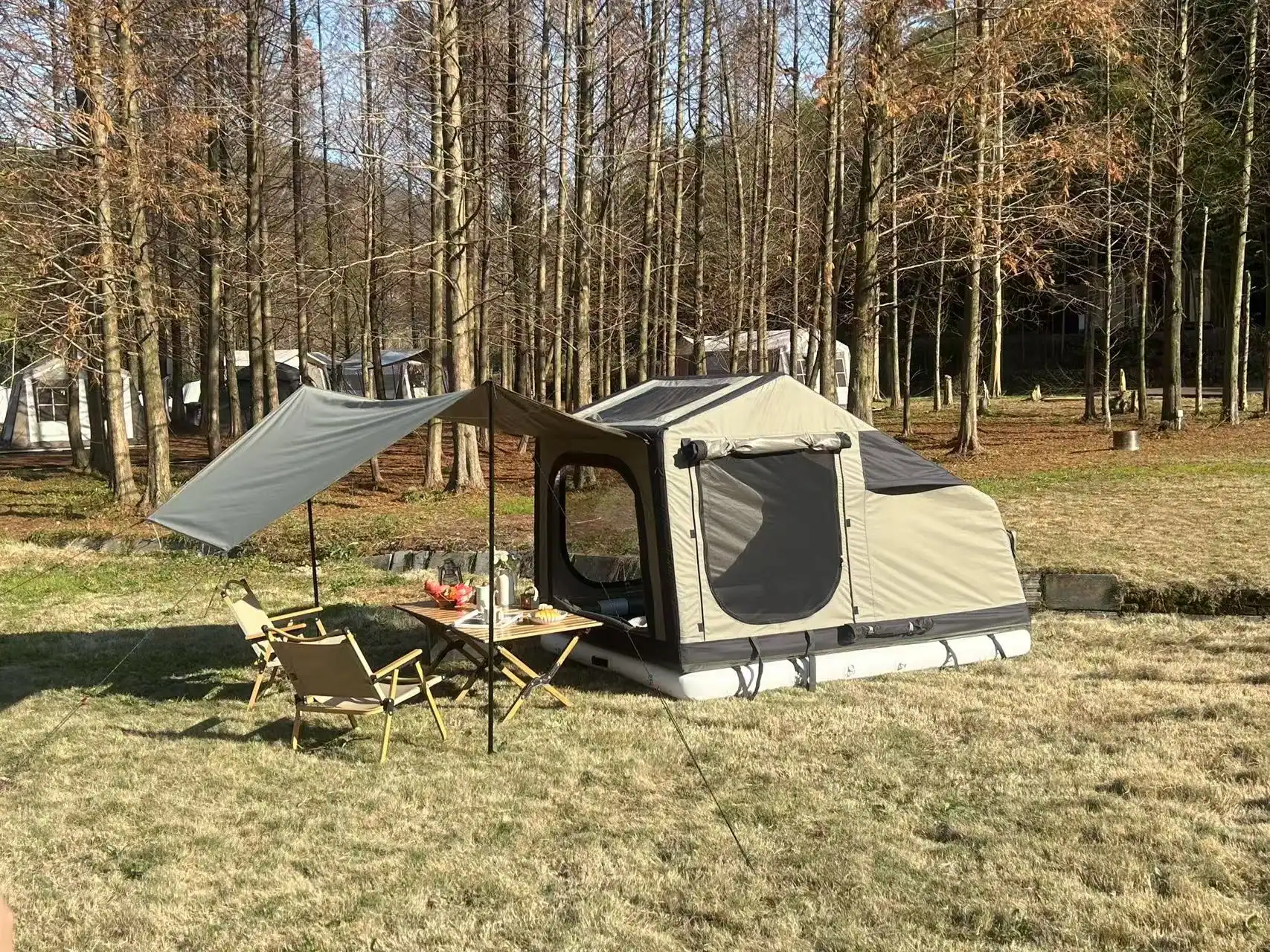
Factory Walkthrough Deep Dive
The welding line tells you more about an inflatable tent factory than any certificate ever will.
The TPU welding area is where an inflatable tent factory proves itself. Air tubes are the structural skeleton of the tent. If the weld fails, the tent collapses at 2 a.m. on a customer’s campsite. A real manufacturer keeps welding in a clean, separate zone because dust or grease on the TPU film creates weak seals.
TPU Welding Area Setup and Cleanliness
On a live video call, demand a close shot of the high-frequency welding machines. A legitimate factory has at least one dedicated TPU high-frequency welder on the floor. If you see sewing stations and finished goods but no welding station, the air-tube assembly is outsourced. That means the supplier doesn’t control weld consistency, pressure tolerance, or seal quality.
Inflatable air products in the Kelyland network use puncture-resistant film in the 0.4mm to 0.6mm thickness range. At that gauge, one dust particle or fingerprint can create a channel in the weld — which turns into a slow leak under sustained air pressure. The layout of the welding area matters: dedicated space, clean tables, no cross-traffic from the cutting floor.
In-House Testing Equipment: Airtightness Jig, UV Chamber
An airtightness jig inflates a finished air tube or tent to operating pressure and monitors pressure decay over a set period. Ask to see a live test, not a photo of the machine. A supplier that outsources welding will usually hesitate here, because they can’t produce a repeatable seal-integrity record for every batch.
Сайт UV chamber accelerates sun exposure on coated fabrics to flag degradation early. Inflatable tents sit in direct sunlight for entire seasons, and a fabric that weakens after a few months becomes your warranty claim, not the factory’s. In-house UV testing shortens the feedback loop on coating and lamination defects before mass production absorbs them.
-
- Batch traceability: Ask to see a batch code on a finished tent and trace it back to a QC report. A factory that outsources welding can’t do this because they have no welding QC records.
- ISO 9001 scope: The certificate should list ‘inflatable tents’ or ‘TPU welding’ in the scope, not just ‘outdoor goods’. Vague scope language is a tell.
For scale reference, Kelyland Outdoors works with an air mattress factory in Xiangyang, Hubei that produces 2.5 million units a year under CE, ETL, and ISO 9001 certifications. Production at that volume only works when airtightness and UV testing happen in-house, batch after batch, with records the buyer can request.
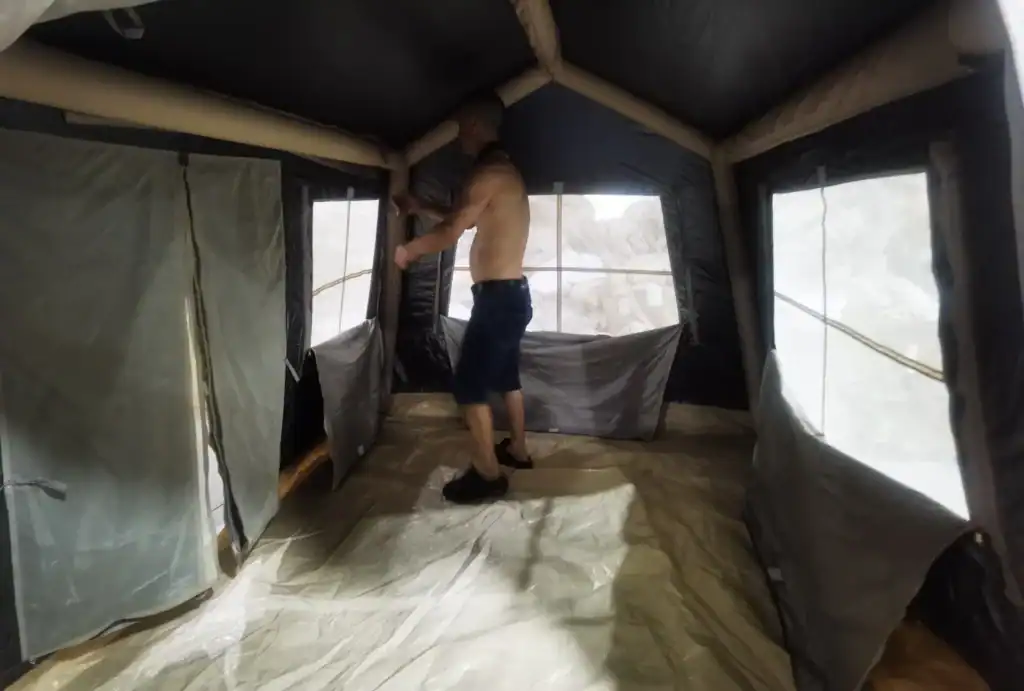
Заключение
Verification matters because a supplier’s real capability is visible long before you sign payment terms — if you ask for the right evidence. A trading company can stage a showroom shot, but it cannot produce a TPU high-frequency welding station, a batch code that traces to a QC report, or an ISO 9001 scope that names inflatable tents. These checks close the gap between the pre-production sample and the mass production run, which is exactly where sourcing teams lose the most money.
-
- Confirm a dedicated TPU high-frequency welding machine appears on the live video call.
- Trace a finished tent’s batch code to a QC report; fake factories cannot complete this loop.
- Check that the ISO 9001 scope names inflatable tents or TPU welding, not just outdoor goods.
- A walkthrough showing only sewing stations means the air-tube assembly is outsourced.
Use this checklist on your next supplier call before you request samples or compare FOB pricing across shortlisted factories. Keep the three non-negotiable criteria — welding station visibility, batch code traceability, and ISO scope — beside your sample approval form. A supplier that passes all three on video is the one worth scheduling for an in-person audit.
Часто задаваемые вопросы
Как проверить, является ли завод производителем надувных палаток?
Подлинные фабрики могут показать работу сварочных станций TPU в реальном времени и проводимое в цеху герметизационное тестирование, тогда как торговые компании обычно ограничиваются офисами или швейными линиями. Запросите видеоэкскурсию от сырья до готовой продукции. Перед принятием решения обязательно используйте видеоудостоверение вместе с проверкой документов.
Что следует увидеть на видеозвонке с заводом?
Запросите семь конкретных ракурсов: рулоны исходного материала, зона ТПУ-сварки, швейная линия, готовые палатки, испытательное оборудование, серийные коды и погрузочный док. Если на полу пусто или видны только швейные машины без движения — настаивайте на LIVE-звонке, а не на заранее записанном ролике.
Какие документы подтверждают надёжность фабрики?
Проверьте лицензию на ведение бизнеса, экспортное разрешение и сертификат ISO 9001 с указанием прямого спектра — производство палаток. Также обращайте внимание на прослеживаемые серийные номера на продукции: сам по себе штампованный сертификат ничего не доказывает. Сопоставляйте документы с реальными производственными данными.
Как отличить торговую компанию?
Торговые компании, как правило, не обладают станциями для сварки ТПУ, внутренними испытательными стендами и отслеживаемыми номерами партий. Если поставщик демонстрирует лишь офисы, склады или швейные цеха без оборудования для воздушной сварки, скорее всего, вы имеете дело с перекупщиком. Запросите отчёты о испытаниях прочности шва ещё до запуска образцов.
Почему стоит выбрать оборудование для термосварки TPU?
TPU-сварка — ключевой процесс производства надувных палаток, а реальная герметичность достигается за счёт ВЧ-сварки или сварки горячим воздухом, а не просто строчкой. Наличие чистого сварочного цеха и герметичного контрольного приспособления — большой плюс. Обязательно проверяйте сварочные мощности фабрики.

 English
  Español
  Deutsch
  Français
  Português do Brasil
  Русский
  العربية
  한국어
한국어  日本語
日本語