 Zum Inhalt springen
Day 1 the purchase order goes out, Day 14 the pre-production sample arrives for approval, and Day 45 the container lands — which is when the real difference between PVC vs TPU inflatable tents starts costing money. The sample that passed inspection and the air beams that actually shipped are frequently two different products.
One $50K order fell apart exactly that way. The buyer approved a sample built with virgin TPU, then received a production run where the factory blended recycled PVC into the air beams to protect its margin. Burst pressure dropped by up to 30%, cold crack performance went from winter-rated to marginal, and the chemical odor triggered return requests for weeks. FOB pricing looked fine, sample approval was documented, and the quality tolerance clause said nothing about material composition.
Material selection for inflatable tents comes down to three questions: does the polymer match the climate your customers camp in, does the compliance documentation survive an EU REACH or US CPSIA review, and does the factory’s quality system guarantee the same material batch after batch? The test data that answers those questions — TPU air beam burst pressure reports, PVC inflatable tent cold crack temperature results, EN 71-3 phthalate screening, ISO 4892 UV weathering hours — belongs in your QC checklist before bulk production, not after the container lands.

How TPU and PVC Air Beams Differ Structurally
PVC and TPU are both thermoplastics.
The thermoset-versus-thermoplastic framing in most comparison articles doesn’t apply here. PVC and TPU are both thermoplastics. The structural difference that matters in the field is how each achieves flexibility. PVC relies on plasticizers — phthalate esters wedged between polymer chains so they can slide past one another. TPU is a segmented block copolymer; its elastic soft segments are part of the molecular chain, so flexibility comes without additives.
Polymer Chemistry: Plasticizer Migration vs. Molecular Elasticity
Plasticizer migration is slow, but it changes the physics of an air beam. Over a hot season, PVC sheds plasticizer at the surface, stiffens, and turns brittle at fold points and weld lines. TPU recovers after deformation because its elastic soft segments pull the structure back. Field failures on PVC tents concentrate where the material folds. TPU failures, when they happen, usually come from puncture rather than material fatigue.
-
- Cold crack temperature: PVC film stiffens and micro-cracks around -10°C. TPU stays flexible down to about -30°C. For a winter camping line, that gap decides the warranty.
- Weichmacherwanderung: PVC’s plasticizers escape over time, leaving weld areas brittle. TPU contains no migrating plasticizers, so its mechanical properties hold up without a stabilizer cocktail.
- Recycled PVC risk: Some factories blend recycled PVC into air beams to cut material cost. Burst pressure can drop by up to 30%. Require a virgin material certificate with each batch.
Welding: High-Frequency Speed vs. Hot-Air Control
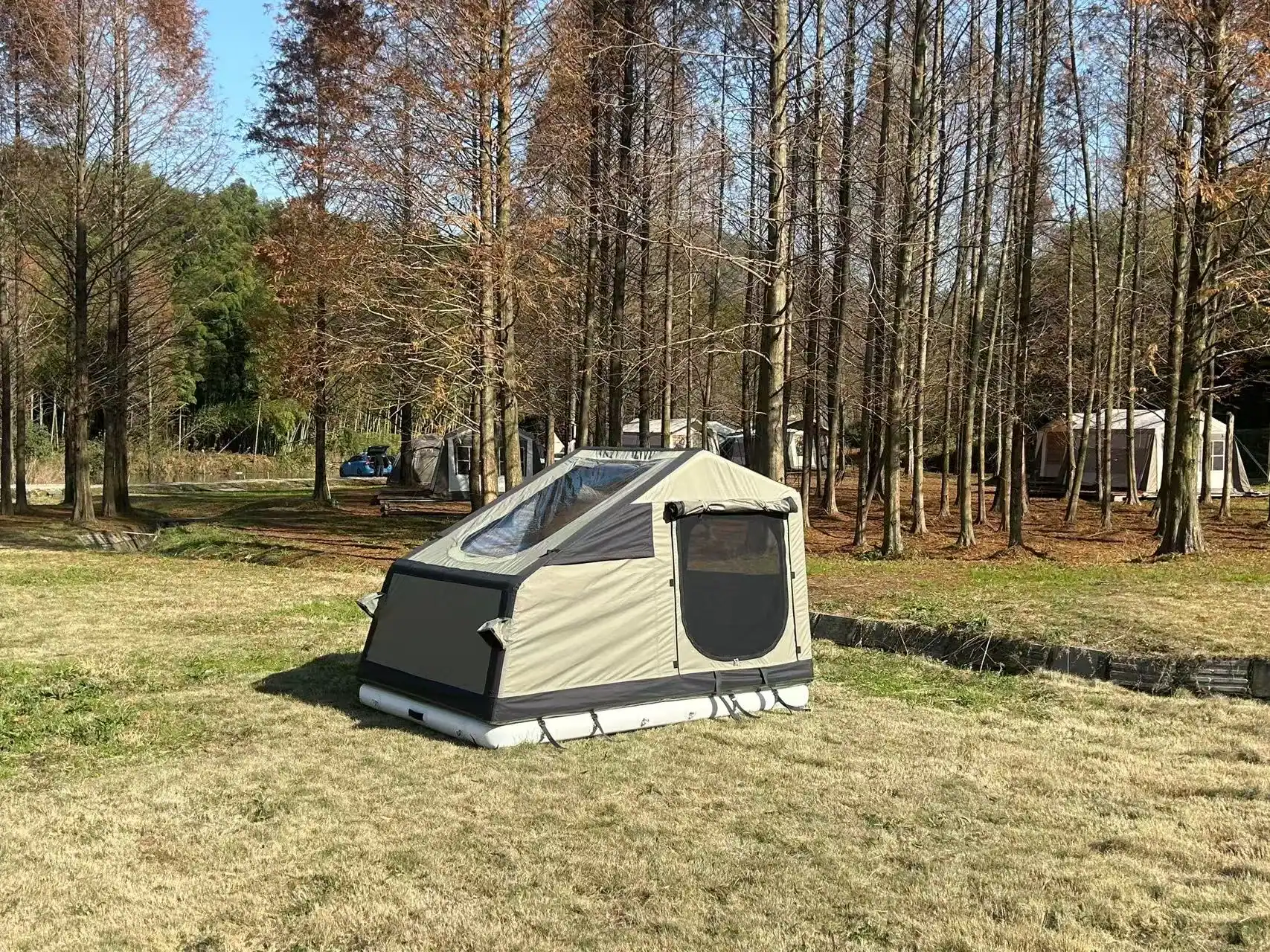
PVC air beams are welded with high-frequency (RF) welding. The machine drives radio-frequency energy through the material, heating it internally until the surfaces fuse. It’s fast, consistent, and produces a clean seam in seconds. That speed is why PVC dominates entry-level inflatable tents: standard RF lines move high volumes without complicating the production schedule.
TPU air beams go through hot-air welding. A continuous seam feeds through a heated nozzle at a steady rate — slower than RF welding, with tighter control over temperature and feed speed. Done correctly, a hot-air weld on TPU creates a molecular bond that flexes with the beam. Done poorly, the seam edge delaminates after a few inflation cycles.
Kelyland’s network of 17 core strategic factories includes a dedicated air mattress plant in Xiangyang, Hubei — ISO 9001:2015 certified, running 2.5 million units annually — where both PVC and TPU lines operate at 0.4mm–0.6mm film thickness. When a brand manager specifies an inflatable tent, the welding method, film supplier, and recycled-content limit belong in the same purchase order. Sample approval checks all three, not just the printed surface.
Head-to-Head Performance Tests
At 0.4–0.6 mm wall thickness, material purity matters more than the polymer name.
Air-beam wall thickness sits at 0.4mm–0.6mm across most PVC and TPU production. That range is the starting point for any performance discussion. The partner factory behind Kelyland Outdoors’ air-beam supply chain in Xiangyang, Hubei, runs this same material range and produces 2.5 million air mattresses a year under CE, ETL, and ISO 9001 certifications.
At this gauge, the polymer choice matters less than the compounding and the seam weld. A virgin TPU film stretches before it tears; a plasticized PVC film tends to fail at the weld or the fold crease.
Burst Pressure and Puncture Resistance
The meaningful burst test for an air beam is not a single pressure spike. It is a fold-and-press cycle followed by an inflated hold test. PVC micro-cracks at the crease after repeated folding, then leaks a week or two later. That failure mode shows up in the field, not on the factory floor.
-
-
- Virgin material: Some factories blend recycled PVC into air beams to cut cost. Burst pressure drops by up to 30%. Insist on virgin-material certificates with each batch.
- Seam integrity: Ask for a 72-hour inflated hold test on the finished beam. High-frequency welding works well on PVC; hot-air welding needs tighter process control for TPU.
-
Cold Crack Temperature
PVC stiffens and becomes brittle around -10°C. TPU remains flexible to about -30°C. For a winter camping tent, that is the deciding factor. The beam will not shatter in the trunk, but at -15°C the PVC fold points develop hairline cracks that only leak once the tent is pressurized at a campsite.
UV Resistance and Lifespan
ISO 4892 accelerated weathering testing separates the two materials over time. TPU retains elongation and elasticity under UV exposure. PVC loses plasticizer to the surface, stiffens, and develops brittle seams. For a tent rated for three seasons, the air beam, not the flysheet, becomes the warranty claim driver.
Off-Gassing and Compliance
The smell test is a legitimate due-diligence step. TPU tents have a sweet smell that fades in about 48 hours. PVC off-gasses a sharp chemical odor that can persist for weeks, and that smell is a leading cause of online returns.
-
- EU-REACH Annex XVII: Flexible PVC loads phthalates as plasticizers. Demand a REACH Annex XVII compliance report for the film and the valves, not just the fabric.
- EN 71-3: European buyers should ask for an EN 71-3 migration of certain elements report. Standard PVC formulations often fail for phthalates unless the compounder builds in an alternative plasticizer.
- California Prop 65: For US distribution, require Prop 65 testing on the air beam material. A failed screening at retail costs more than the test.
Use the sample approval stage to check all four: burst behavior, cold flexibility, UV response, and odor. The spec sheet can say anything. A 72-hour inflated hold test in a freezer tells you what the tent will actually do.
Cost vs. Longevity: 5-Year Total Cost of Ownership
The cheapest air beam is the most expensive one after warranty claims, returns, and chargebacks.
PVC air beams cost less per meter of material at the factory gate. For a compact 2-person tent, the per-unit delta is small. For a 6-person glamping tent with longer beams and more weld points, the upfront savings look attractive. That invoice gap rarely survives contact with warranty logistics.
Claim rates follow material failure modes
Warranty claims reported by European and North American brands cluster in late winter, when tents come out of storage and inflate in cold conditions. PVC beams develop micro-cracks at the weld zones after repeated cold-weather cycling. The failure accelerates when recycled content enters the blend. Some factories blend recycled PVC into air beams to cut costs, which reduces burst pressure by up to 30%. Insist on virgin material certificates with every batch.
Supplier production controls decide how much of that risk reaches your shelf. Kelyland’s partner air mattress factory in Xiangyang, Hubei — 2.5 million units annually, CE, ETL, and ISO 9001 certified — inspects at every production stage, including the 0.4mm–0.6mm wall thickness range used for puncture-resistant inflatable products. If a supplier cannot trace the material batch to a virgin resin source, you own the claims.
Perception is part of the cost structure
Consumer perception shapes resale value more than any spec sheet. TPU tents carry a distinct sweet smell that fades in roughly 48 hours out of the package. PVC off-gasses a sharp chemical odor that can persist for weeks. Customers unbox, smell plastic, file a return, or leave a review mentioning chemical odor. On a marketplace listing, that single review erases the material savings from the entire production run.
Run the 5-year total cost of ownership before locking the spec. The PVC tent costs less to land at your warehouse, but the math shifts when you add return shipping, refurbishment labor, replacement units under warranty, and marketplace fee clawbacks. Brands serving winter climates cycle through PVC replacement beams at a visibly higher rate than TPU, and that replacement cycle lands on your operating budget, not the product margin.
-
- BOM spec: Write ‘virgin TPU film, 0.4mm–0.6mm wall thickness’ into the OEM agreement. Require material certificates per batch, not once per order.
- Lab test: Request EN 71-3 migration of certain elements reports before mass production. Flexible PVC usually fails phthalate limits unless specially formulated.
- Cold crack data: Use the -30°C vs -10°C cold crack difference in your product copy. Buyers pay a premium for ‘stays flexible in deep cold.’.
| Kostenfaktor | PVC | TPU | 5-Year Impact |
|---|---|---|---|
| Initial Unit Cost (4-person tent) | Lower upfront cost, approximately $18-$28 per unit at 500+ MOQ | 20%-35% higher, approximately $24-$38 per unit at 500+ MOQ | Higher initial inventory investment for TPU, but offset by fewer replacements |
| Air Beam Replacement Cycle | Typically 2-3 seasons before beam creep or weld failure occurs | Consistently holds shape for 5+ seasons under regular use | PVC often requires 1-2 replacement cycles; TPU usually avoids replacement entirely |
| Warranty Claim Rate (EU & North America) | Reported 4%-6% of units filed against beam failure or seam separation | Reported under 1.5% using 0.4mm-0.6mm wall thickness | Lower warranty reserve needed for TPU reduces total cost per unit sold |
| Cold Weather Failure Risk | Cold crack temperature around -10°C; beam fractures when flexed at or below this point | Passes -30°C cold crack tests without cracking or delamination | PVC winter-season claims spike; TPU supports 4-season product positioning |
| UV Lifespan (ISO 4892 Accelerated Weathering) | Visible surface degradation and plasticizer migration after 500-800 hours | Maintains structural integrity and color stability beyond 2,000 hours | TPU holds up in alpine and desert sun exposure, extending usable product life |
| Off-Gassing & Return Rate | Sharp chemical odor persists for weeks; linked to 2%-3% Amazon return rates | Distinct ‘sweet’ smell fades within 48 hours; negligible odor-related returns | Fewer returns improve net margin and reduce logistics and restocking costs |
| Compliance Testing (REACH Annex XVII / CPSIA) | Flexible PVC often fails EN 71-3 phthalate migration unless specially formulated | Readily passes EN 71-3 and REACH without reformulation | Avoiding failed test batches saves $2,000-$5,000 per inspection event and prevents shipment delays |
| Material Purity Risk | Some factories blend recycled PVC into Luftbalken, cutting burst pressure by up to 30% | Premium-grade virgin TPU provides consistent burst pressure performance | Require virgin material certificate with each batch; TPU eliminates hidden substitution risk |
| Consumer Perception & Resale Value | Perceived as budget-oriented; limited resale demand | ‘TPU’ label signals premium quality; strengthens resale value and brand equity | TPU supports premium price positioning and improves brand reputation over time |
| 5-Year Total Cost of Ownership | Lower sticker price, but replacements, returns, and compliance overhead add 35%-50% over 5 years | Higher upfront cost, yet fewer recalls and returns deliver lower lifetime cost per usable season | Long-term margin favors TPU for serious camping brands targeting repeat customers |
Making the Final Call for Your Brand
Specify virgin material in the contract or expect recycled PVC and a 30% lower burst pressure.
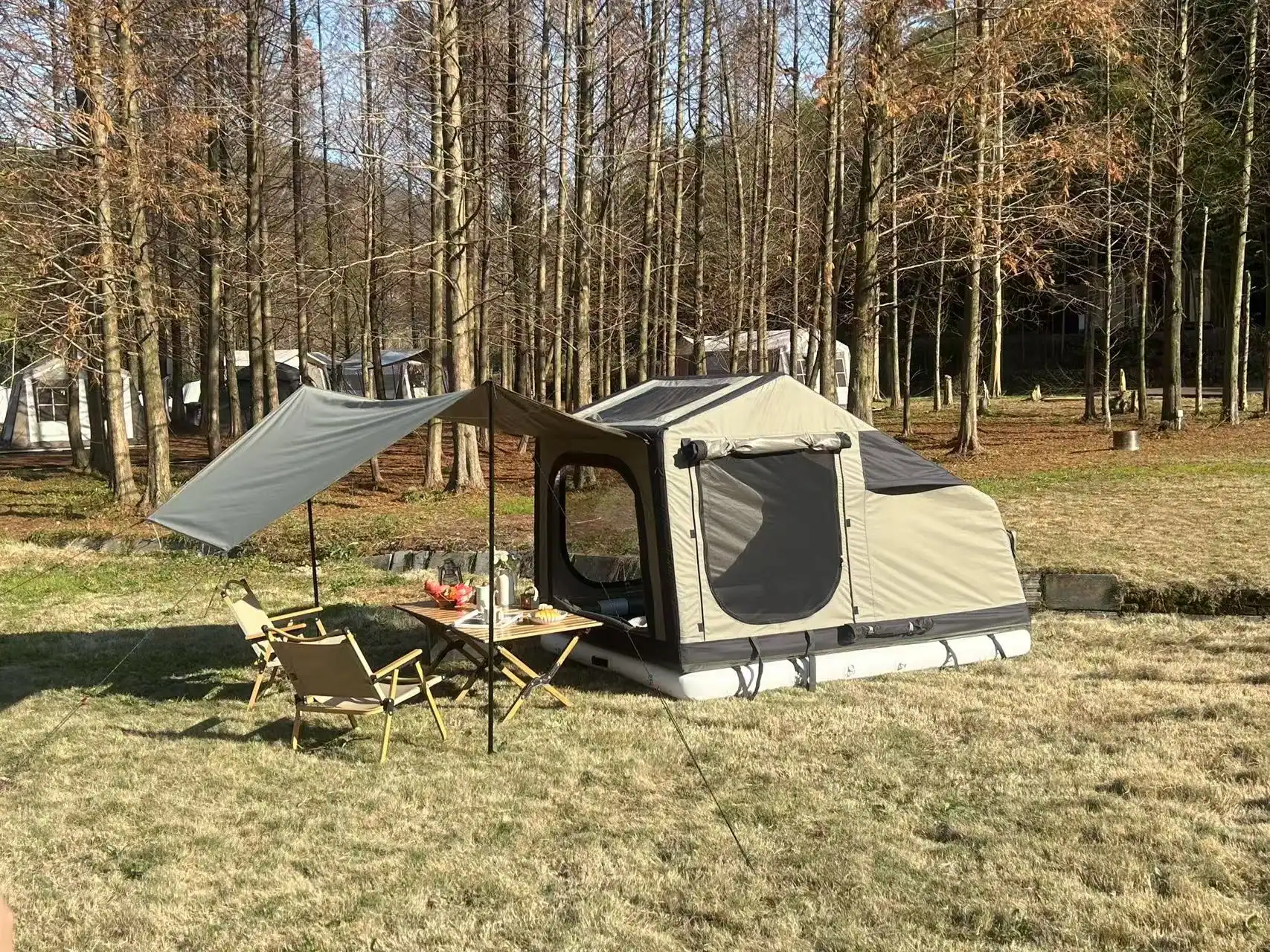
A glamping line aimed at European rental platforms can carry a TPU price premium, because the buyer is paying for a silent night at -5°C. A family tent sold through big-box retail lives on margin, so PVC remains the volume default. The deciding factor isn’t what feels premium in a sample room; it’s whether the customer’s first deployment happens in a snowy field or a sunny backyard.
Match the material to your customer’s first night
TPU air beams hold flexibility at -30°C, which matters for winter camping and cold-weather storage. PVC gets stiff around -10°C and can crack when packed frozen. If your line includes 4-season tents, TPU is the only defensible choice. If the range is strictly summer fair-weather camping, PVC’s cost advantage wins on price per unit — just don’t market it for cold conditions.
Put the material spec in the production contract
A vague Bill of Materials is a loophole. Kelyland’s tent and air-mattress lines run through ISO 9001:2015 partner factories in Ningbo and Xiangyang, with inspection reports issued at every production stage — but that discipline only applies when the contract names the material. If the BOM says only ‘PVC air beam,’ a factory can blend recycled PVC to cut costs. Burst pressure testing shows recycled content can reduce it by up to 30%.
-
-
- Film grade: Name the exact polymer: TPU or PVC, with a virgin material certificate required per batch.
- Wandstärke: Lock 0.4mm–0.6mm for air beams, matching what was approved in the sample.
- Weld type: High-frequency welding for PVC seams; hot-air welding for TPU. Specify which one the pattern uses.
- Plasticizer formulation: For PVC, name the phthalate-free system. Flexible PVC often fails EN 71-3 unless explicitly formulated.
-
Testing protocols to lock before bulk production
The sample approval stage is where material problems get caught. Add these checks to your quality checklist and require the report with every batch, not just the pre-production sample.
-
- Burst pressure: Run a TPU air beam burst pressure test on finished beams at 0.4mm–0.6mm wall thickness. Compare the result to the approved sample, not the catalog.
- Cold crack: Condition beams at -30°C for TPU and -10°C for PVC, then fold and inflate. Any crack or tear means the batch fails.
- UV-Beständigkeit: Use ISO 4892 accelerated weathering to compare the coating’s lifespan. Ask for the hour count, and make sure it matches the promised outdoor life.
- Off-gassing: TPU has a sweet smell that fades in about 48 hours. PVC off-gasses a sharp chemical odor that can persist for weeks and drive Amazon returns. Test both at 25°C.
- EN 71-3: For EU distribution, demand a migration of certain elements test report on every colored component, especially flexible PVC.

Schlussfolgerung
The material decision for an inflatable tent line comes down to two questions: how cold your customers will pitch it, and which compliance reports the factory can produce on demand. TPU holds burst pressure and flexes at -30°C, while PVC remains workable to about -10°C and needs stricter phthalate scrutiny under EN 71-3. The 0.4mm–0.6mm wall thickness matters less than the certificate proving no recycled resin entered the beam.
-
- Geben Sie an: virgin TPU film and request a material certificate with each batch; recycled blends cut burst pressure up to 30%.
- TPU passes cold crack tests near -30°C; PVC typically fails near -10°C, so pick TPU for winter SKUs.
- Ask for ISO 4892 accelerated weathering data and EN 71-3 migration reports before approving air beam specs.
- Weigh 5-year warranty claim rates against unit cost; the cheapest air beam rarely survives full ownership math.
Before you finalize an OEM production agreement, put the air beam material, wall thickness, and test-report requirements directly into the Bill of Materials. Then use the pre-shipment inspection to verify virgin film certificates and welding quality on finished beams. If you’re still weighing options, review Kelyland’s inflatable tent lineup and compare how the factory documents TPU and PVC construction.
Häufig gestellte Fragen
Welches ist besser, PVC- oder TPU-Luftzelte?
TPU ist das stärkere Material für Premium- und Winterzeltlinien, während PVC eine preisgünstige Option für Camping bei mildem Wetter bleibt. Bei einer Wandstärke von 0,4–0,6 mm kommt es mehr auf Materialreinheit und Rezeptur an als. Passen Sie das Material an Ihren Zielmarkt und die saisonalen Bedingungen an.
How do PVC and TPU compare in cold weather?
TPU air beams typically hold up to -30°C, while PVC becomes brittle around -10°C, so TPU is the safe winter-camping choice. PVC can work in mild climates but needs explicit. Require cold-crack data in the spec sheet before committing to winter SKUs.
Why choose TPU over PVC for inflatable tents?
TPU gives better cold-weather durability, lower off-gassing, and fewer long-term warranty claims, which is why premium brands use it. PVC is cheaper upfront but requires tighter formulation control to meet. Put compliance testing in the purchase agreement, not just the marketing claim.
How does material choice affect 5-year total cost?
PVC has the lower initial unit cost, but TPU often wins on 5-year total cost of ownership because claims and returns are lower. European and North American warranty data consistently pushes multi-year. Evaluate cost on expected claim rate, not first purchase price.
How should I specify air beam material in OEM specs?
Specify polymer type, wall thickness, and performance test limits instead of just writing PVC or TPU on the Bill of Materials. Add cold-crack, burst-pressure, and VOC limits to your QC. Lock the material spec into the OEM contract and inspect against it.

 English
  Español
  Deutsch
  Français
  Português do Brasil
  Русский
  العربية
  한국어
한국어  日本語
日本語