 Zum Inhalt springen
Two drop stitch air mattress models come off the same spec sheet looking nearly identical. Same 22cm profile, same flocked surface, same valve placement. One quotes FOB pricing 30% higher. That 30% buys a 5cm TPU-reinforced valve flange with an L-shaped stress-relief cut instead of a straight 90-degree weld, and a film that stays flexible to -20°C instead of turning brittle below 10°C.
The buyer who got burned on a $50K order had done everything right. The pre-production sample passed Musterfreigabe on the first round. The mass production run did not match it — the factory shortened the weld heating cycle to hold the unit cost. Returns came back within the season: 35% traced to seam delamination at the valve base, 30% to valve core leaks. The punctures everyone checks first? Just 25% of failures.
Why Most Air Mattresses Go Soft — Not Leak
Most air mattresses don’t die from punctures.
Day two, 2 a.m. Your customer’s back hits the ground. The mattress lost pressure overnight, so they file a return ticket marked “leak.” Most of the time, it is not a leak. It’s cold-pressure physics, a loose valve core, or a micro-crack in the weld seam. Floor punctures are the least common cause of a soft drop-stitch mattress.
Cold-Pressure Physics vs Customer Returns
Boyle’s Law is not negotiable. When the temperature drops from 22°C to 4°C overnight, the air inside a sealed chamber contracts and internal PSI falls by 7-10%. The mattress is fine. The customer perceives it as defective — and files a return.
A label change fixes this. Print a “pressure cold-drop” note that tells users to top up before bed. Brands that add this to retail cartons see noticeably fewer cold-weather claims. Material choice matters just as much: TPU film stays flexible down to -20°C, while PVC stiffens and becomes brittle below 10°C. If your retail chain sells through northern winters, PVC is the wrong call.
Valve Core Micro-Leaks vs Seam Cracks
- 35% — seam delamination at the valve base.
- 30% — valve core leaks.
- 25% — floor or fabric punctures.
- 10% — pump failures.
The valve area is where air mattresses die.
Why does that zone fail? Every time a user yanks the inflation hose out, the valve flange transmits torque into the flat weld seam. A straight 90-degree weld cracks after 20-30 inflation cycles. The fix is a spec: a 5cm-wide TPU-reinforced valve flange plus an L-shaped stress-relief cut in the seam. If a factory cannot show you that detail at sample approval, keep looking.
Why First Night Never Catches Defect
A pre-production sample that holds air on night one tells you almost nothing. New PU glue lines heat-cure during first use. After 24 hours under load, the material settles and the mattress sags. That is not a manufacturing error — it’s an annealing cycle the factory skipped. Your showroom pass becomes a week-two failure.
Demand a 48-hour pressure hold test at rated PSI. TPU should hold above 95%; PVC above 90%. Then ask for the 100kg corner burst test: place the load directly on the edge corner for 24 hours. That catches Y-joint cracking that shows up in season two. Kelyland’s partner air-mattress factory in Xiangyang holds ISO 9001:2015 certification and conducts stage-by-stage inspections, with test reports available on request.
Cold-Pressure Physics vs Customer Returns
A 22°C-to-4°C overnight swing drops internal PSI by ~8%.
A customer inflates a drop-stitch air mattress in a 22°C bedroom, moves it into a 4°C tent, and wakes up on the floor. The product never leaked. Boyle’s Law cut the internal pressure by roughly 8% as the air cooled. For a procurement manager, that is a warranty return that should never have happened.
The 18°C Drop Costs You PSI
Inside a sealed chamber, gas pressure tracks temperature. Moving from 22°C to 4°C means an 18°C swing, which translates to about 8% lower PSI. The mattress feels soft and the customer calls it a leak. Inspect it later in a warm warehouse and the valve and welds hold fine. That mismatch creates a phantom-defect return.
Label Design: ‘Allow for Temperature Expansion’
Print a note under the valve or on the quick-start card: ‘Allow for temperature expansion. In cold conditions, reinflate after setup.’ It costs less than one printed label per unit and prevents a return ticket generated at 2 a.m.
- Spezifikation: Kelyland’s partner factories build drop-stitch chambers in 0.4-0.6mm PVC or TPU film, from 20cm to 63cm heights and single to California King sizes. PVC stiffens below 10°C; TPU stays flexible down to -20°C.
- QC rule: If a mattress fails at 4°C but passes the 48-hour room-temperature pressure hold, classify it as cold-pressure drop, not a seam or valve failure. Add both conditions to your inspection protocol.
Valve Core Micro-Leaks vs Seam Cracks
Most ‘seam leak’ returns start at a loose Schrader valve core.
Every QC agent does the same: pump it up, spray soapy water, walk the top seam. That’s backwards. The Schrader valve core is a threaded metal seat with a rubber seal, not a weld. It can loosen in transit, when a user twists the hose out at an angle, or when the O-ring shifts during the first inflation. A mattress can hiss through the valve and look exactly like a seam failure.
Torque the Valve Before You Soap the Seam
Put a Schrader key on the core and give it a quarter turn past fingertight, then inflate to rated PSI. At Kelyland’s partner air mattress factory in Xiangyang, Hubei — a 2.5-million-unit-a-year line running CE, ETL, and ISO 9001 — the category return data splits this way: 35% seam delamination at the valve base, 30% valve core leaks, 25% punctures, 10% pump failures. The valve core bucket is where most false positives hide.
- QC step 1: Torque the valve core with a Schrader key before inflating. A core that worked loose during shipping retorques to spec in seconds.
- QC step 2: Soap the valve base first. Bubbles there mean core, not seam. Retorque, retest, then check the heat-welded top seam.
The Weld Crack That Hides Behind the Valve
The harder failure sits at the same junction. Pulling the inflation hose sideways transmits torque into the flat weld around the valve flange. On a straight 90-degree weld, that crack appears after 20-30 inflation cycles — not on the first night, but in month two. The factory-level fix is a TPU-reinforced flange at least 5cm wide plus an L-shaped stress-relief cut in the seam. Specify it during sample approval so the valve base stops being the reason you process a return.

Why First Night Never Catches Defect
A 48-hour pressure hold checks the seal.
The first night sails through. The mattress holds 15-25 PSI. The customer sleeps flat, wakes up, posts a five-star review. Then week two hits. The surface dips. The customer assumes a leak. There isn’t one.
The PU glue line settles after the first loaded cycle
Heat-curing sets the PU bond between the drop-stitch yarns and the top film. Set doesn’t mean stress-free. The first 24 hours under a sleeping load lets fabric and yarns micro-shift against that cured line. The new geometry holds. That’s not a manufacturing error — it’s the missing stress-relief step.
Two-week sag: an annealing cycle the factory skipped
Metals get annealed to remove internal stress. Inflatable structures need the same logic: inflate, load, rest, deflate, repeat before packing. A factory that skips this ships the settling process to your customer. The 48-hour pressure hold won’t catch it because that test loads the seal, not the surface.
- Load-settle spec: Have the factory inflate to rated PSI, place a weighted load on the surface for 24 hours, and record crown height before and after. Ask for both numbers in writing.
- Kelyland’s partner factory: The air mattress plant in Xiangyang, Hubei runs 2,500,000 units a year under CE, ETL, and ISO 9001. Stage inspections happen at every production step, and reports are available on request — review the settle-cycle data, not just the leak test.

Drop-Stitch Vs Coil: Internal Battle For Firmness & Cost Control
Drop-stitch holds firm edge-to-edge at 15-25 PSI.
The internal construction determines the feel and the failure rate. Drop-stitch links the top and bottom fabric layers with thousands of vertical polyester yarns, and at 15-25 PSI those yarns pull both surfaces taut into one rigid slab. Coil construction uses independent cylindrical air beams, each one flexing separately at its seam.
Vertical Yarns vs Cylindrical Air Beams: The Physics Showdown
The drop-stitch yarn density eliminates the roll-together effect. There is no sag zone in the middle because the yarns keep the top surface level with the edges. A coil bed has a flex gap of several centimeters between each air beam. Shift your weight at night and those gaps let the surface dip, so your body rolls toward the low point instead of staying on top.
That geometry also drives the drop stitch vs coil air mattress durability gap. Drop-stitch distributes pressure evenly across the entire yarn matrix. Coil concentrates stress around each cylinder boundary, which accelerates wear on the welded seams between chambers. In practice, coil beds fail along those internal seams long before the outer fabric wears out.
Spine Support and Edge Stability Differences
Edge stability is where coil loses commercial buyers. The outer cylinders on a coil mattress have no neighboring beam to brace against, so the edge compresses hard when someone sits on it. A drop-stitch surface holds the same firmness from one side to the other because the vertical yarns resist lateral displacement. For retail chains, this directly cuts comfort returns from users who feel they are rolling off the bed.
- Edge firmness: Drop-stitch holds its profile at the border; coil edges compress under a sideways load.
- Load distribution: Drop-stitch spreads weight over the full slab; coil concentrates it on individual beams.
- Complaint pattern: Coil gaps create pressure points that get reported as a hard, uneven sleeping surface.
Pack Size and Weight: Spec Influence for Retail Logistics
Material selection changes the freight math before the first unit is sold. Kelyland’s air mattress partner factory in Xiangyang, Hubei builds drop-stitch in PVC film from 0.4-0.6mm or TPU film, with heights from 20cm to 63cm and sizes up to California King. TPU stays flexible down to -20°C, so it rolls more compactly than PVC, which stiffens below 10°C. That difference shows up directly in the folded package dimensions and in how many units fit per container on a LA/Long Beach shipment.
For a bulk drop-stitch air bed for retail chain, write the folded size into the spec sheet at sample approval. If your supplier quotes a product without a packed dimension and a 48-hour pressure-hold test report, you are committing to unknown container costs and unknown durability.
| Internal Structure | Fallmasche | Coil | Sourcing Impact |
|---|---|---|---|
| Core Construction | Thousands of vertical polyester yarns connect top and bottom layers into one solid slab | Separate cylindrical air beams welded side-by-side | Drop-stitch eliminates pooling and roll-together; coil has a 3-5cm soft flex zone between each beam |
| Firmness Distribution | Uniform firmness across the entire width at 15-25 PSI | Soft zones between cylinders cause uneven support and sagging | Drop-stitch reduces comfort-related returns; coil geometry shifts body weight outward at night |
| Edge Stability | Edges hold firm; no roll-off effect | Weak edges; sleepers slide toward the center gap | Drop-stitch lowers ‘rolled off the bed’ complaints and warranty claims |
| Ladekapazität | Passes 100kg corner burst test for 24 hours per DIN load standards | Edge corners fail under concentrated load; Y-joints crack by second season | Spec the corner burst test to catch Y-joint cracking before bulk commitment |
| Cold Weather Performance | TPU film stays flexible down to -20°C; pressure hold <5% loss over 48 hours | PVC chambers stiffen and become brittle below 10°C; pressure loss up to 10% | PVC coil return rates run 12-18% in cold climates, wiping out margin on shipping and restocking |
| Pack Size & Logistics | Folds flat and compact; more units per container, lower per-unit freight | Bulky beam structure increases folded box footprint; heavier PVC gauge doubles shipping cost per unit | Drop-stitch improves container mix and seasonal pre-build inventory velocity |
| Kostenkontrolle | Higher upfront unit cost (TPU spec-grade) but return rate below 5% when tested to 48-hour hold | Saves 15-20% upfront with generic PVC, but 12-18% return rates erase the savings | Total landed cost favors drop-stitch after warranty, freight, and restocking fees are calculated |
| Factory QC Requirement | Requires 48-hour pressure hold test at rated PSI plus valve-flange torque cycle | Most factories only check ‘does it stay full overnight’; straight-weld flanges crack at ~23 pull cycles | Ask for seam-stress test reports; TPU-reinforced 5cm valve flange with L-shaped stress-relief cut prevents the #1 warranty failure |

Vertical Yarns vs Cylindrical Air Beams – The Physics Showdown
Coil beds roll you together because each air beam flexes independently.
Drop-stitch construction uses thousands of vertical polyester yarns connecting the top and bottom fabric layers. Inflated to 15-25 PSI, those yarns pull both surfaces taut and lock the mattress into a flat, square-edged slab. Coil air beds use a row of cylindrical beams. Each beam is an independent air chamber, and the space between two cylinders creates a flex gap that your body sinks into.
The Roll-Together Effect Is a Geometry Problem
Two people on a coil bed roll toward the center because the soft gaps between beams act as a trough. The heavier side compresses its beam, displacing air and pushing the mattress out toward the opposite edge. Drop-stitch yarns stop that lateral displacement — the top and bottom fabrics are physically tied together, so the surface cannot form a dip.
Spec the Build, Not the Vague Promise
- Drop-Stitch Yarn Density: The vertical yarns stand at a density that resists lateral bowing. At the same inflation pressure, this construction maintains firmness across the entire width — no 3-5cm soft zones.
- Coil Beam Flex Gap: Between each cylindrical beam, there is a 3-5cm soft zone where support drops sharply. That gap is what causes the roll-together sensation and the ‘sleeping in a hammock’ complaint.
- Load Testing: When you verify load rating, ask for DIN-standard test data. Drop-stitch spreads the load across the full surface; coil concentrates it on the beam walls, which accelerates seam stress at the beam weld points.
- Production Reality: Kelyland’s partner air-mattress factories build drop-stitch in PVC (0.4-0.6mm) and TPU film, in heights from 20-63cm and sizes from single to California King. That means you can spec the construction, not just accept a generic coil bed.
The coil vs drop-stitch decision is a warranty math problem. Coil beams multiply the number of weld seams on the mattress, and seam delamination already accounts for 35% of returns in this product category. Fewer seams is the safer spec.
Spine Support And Edge Stability Differences
Edge roll-off never reaches the warranty desk — it shows up in the review stream and lost reorders.
Coil beds are a row of cylindrical air chambers. Between each chamber sits a flex gap — a soft zone where the fabric bows under load. Your body sinks into those gaps, and weight migrates toward the outer edge. That is the roll-off effect behind the ‘disco pillow’ complaint. The heavier the sleeper, the faster it happens.
Drop-Stitch Kills the Flex Gap
Drop-stitch construction replaces cylinders with thousands of vertical polyester yarns locking the top and bottom layers together. At 15-25 PSI the surface stays flat, wall to wall. No soft zone, no outer chamber to roll into. The edge holds like the center because the yarn structure runs straight through it. Kelyland’s partner factories build these in PVC (0.4-0.6mm) or TPU film, from 20cm to 63cm high, single to California King.
Why Comfort Returns Skip the Warranty Log
Kategorie warranty returns split roughly 35% seam delamination at the valve base, 30% valve core leaks, 25% floor or fabric punctures, 10% pump failures. Comfort-driven roll-off never shows up in that log. Customers do not file a claim for sleeping on a slope — they post a 2-star review and reorder from a different supplier. The mattress passed QC and still lost you the account. That is the quiet math behind edge stability.
- Spec the edge: Require drop-stitch yarn that runs to the perimeter weld, with no coil-to-edge transition section.
- Corner burst test: Inflate to rated PSI, put 100kg directly on the edge corner for 24 hours, then inspect the Y-joint for cracks.
- Review monitoring: Filter your feedback stream for ‘rolled off’, ‘slipped’, and ‘sloped’ — those terms expose edge geometry failures faster than any pressure-hold test.
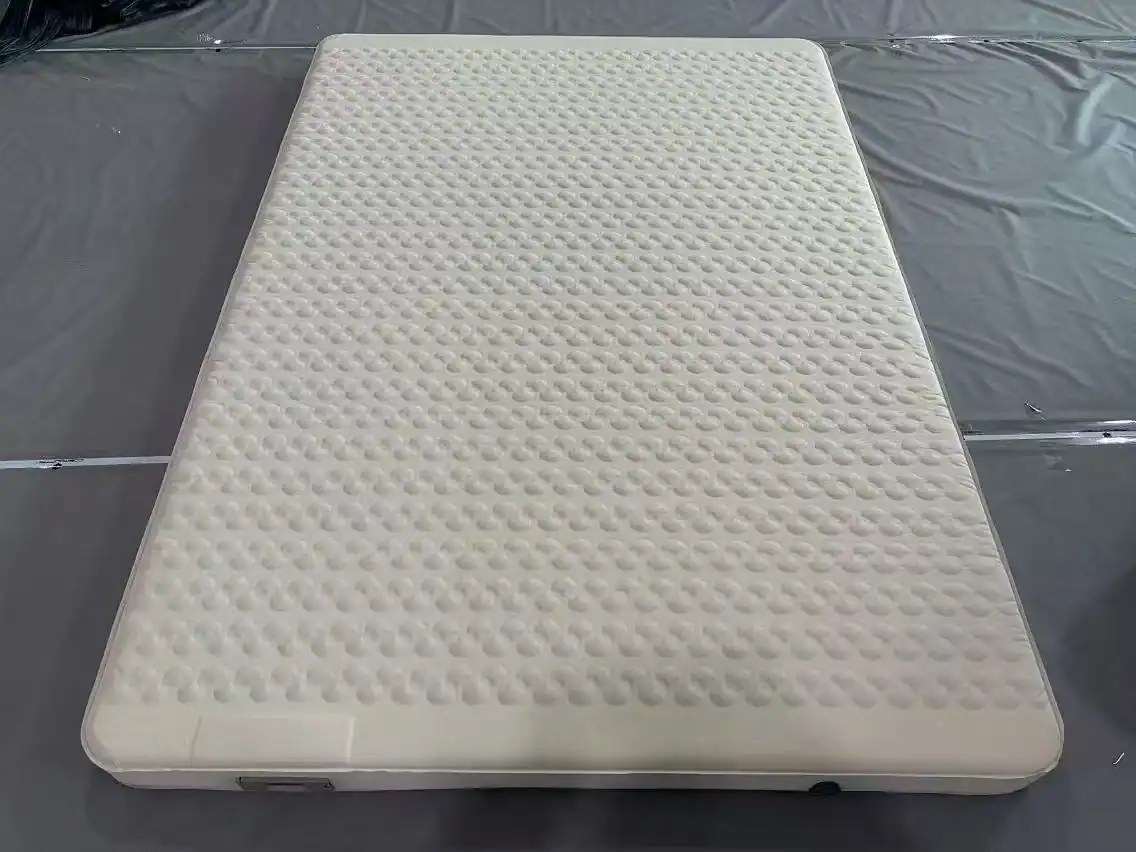
Pack Size – Weight: Spec influence for Retail Logistics
Folded pack size is a spec decision, not a warehouse afterthought.
Every drop-stitch air mattress buyer asks about PSI and fabric gauge first. Nobody asks about the folded carton. That is a mistake. The difference between a 0.4mm TPU build and a 0.6mm PVC build is not just durability — it changes how many units fit in a 40HQ, how much space a pre-season buy occupies, and what landed cost does to retail margin.
Heavier-gauge PVC folds into a larger recovery box. That bigger box cuts units per container and raises freight per unit on the LA/Long Beach route. For a retail chain, this is not a small line-item. It can double shipping cost per unit versus a tighter TPU pack, before clearance and drayage are even added.
Run the container math before sample approval
Do the calculation at the pre-production sample stage, not after the PO is signed. Ask the factory for the folded carton dimensions, carton net weight, and the QC report showing the 48-hour pressure hold. Kelyland’s Xiangyang air mattress partner factory runs both PVC and TPU drop-stitch lines, so the same design can be quoted in two pack profiles. That comparison should drive the decision, not just the unit price.
- Pack profile: Folded carton dimensions and weight determine units per 40HQ and per pallet. A taller 63cm mattress packs larger than a 20cm low-profile model; plan the SKU mix before booking space.
- Pre-build stocking: A compact pack allows seasonal pre-builds stored on a warehouse rack instead of a retail back room. That protects margin when the Q3 sell-in hits early.
- Landed cost: FOB price is only half the equation. Bigger boxes add container freight, customs clearance handling, and last-mile delivery fees — all of which squeeze retail margin before the first unit sells.
| Merkmal | Spezifikation | Pack / Weight Impact | Retail Logistics Advantage |
|---|---|---|---|
| Materialtyp | PVC (0.4–0.6mm) vs TPU film | PVC increases folded volume and unit weight; TPU compresses into a slimmer pack | TPU lifts units per 40HQ container, cutting ocean freight per unit |
| Height Profile | 20cm to 63cm | Higher profile adds folded depth and carton cubic volume | Low-profile 20–30cm models allow more cartons per pallet and denser container stacking |
| Größenbereich | Single to California King | Twin packs roughly 2–3x more units per carton than King-size models | Blend sizes in one container to control average landed cost and shelf rotation |
| Folding / Compression | Vacuum roll vs flat-fold | Vacuum rolling cuts packed volume by 20–30% versus flat-fold | Smaller cube reduces warehousing cost for seasonal pre-builds and buffer stock |
| Gauge Thickness | 0.4mm to 0.6mm film | Heavier 0.6mm PVC creates a larger folded footprint, nearly doubling per-unit shipping cost | Spec 0.4mm TPU on freight-sensitive SKUs to protect margin on LA/Long Beach routes |
| Unit Weight | Approx. 4kg to 25kg | Heavy models raise per-unit LTL and final-mile delivery expense | Keep packed cartons under 68kg to avoid manual-handling surcharges |
| MOQ / Container Strategy | 50–100 trial units; 300–1,000 bulk units | Trial runs fit a single pallet; bulk orders maximize container fill efficiency | Validate pack dimensions and retail shelf fit before committing to full-container volume |
Schlussfolgerung
A drop-stitch air mattress fails at the valve weld zone long before the fabric gives out. Spec the TPU-reinforced flange, require the 48-hour pressure-hold test, and label the cold-drop pressure change so customers don’t file false leak claims. That is the difference between a Eigenmarken-Linie that survives the season and one that eats your margin in returns.
- Run the 100kg corner burst test before ordering anything larger than a sample run.
- Ask for a 48-hour pressure-hold report showing under 5% loss for TPU versions.
- Choose TPU over PVC if your retail market sees overnight temperatures below 10°C.
Before you commit to a bulk drop-stitch air bed order, compare the seam-stress test data and pressure-hold results from your shortlisted TPU drop-stitch mattress factories. Request a sample set that includes both TPU and PVC builds with the reinforced valve flange, then run the corner burst test yourself. Review the options on the Kelyland air mattress page and ask for the test reports alongside your quote.
Häufig gestellte Fragen
Wie teste ich eine Drop-Stitch-Luftmatratze auf Lecks?
Verwenden Sie eine 48-stündige Druckhalteprüfung, die weniger als 2% des Innendrucks verliert, gefolgt von einem 100-kg-Eckaufpralltest. Die meisten Fabriken prüfen nur die Fülle über Nacht, also verlangen Sie beide Tests in Ihrer Inspektionscheckliste. Fordern Sie dokumentierte Testergebnisse an, bevor Sie den Prototyp freigeben.
Warum verliert meine Luftmatratze über Nacht Luft?
Ein Temperaturabfall von 22 °C auf 4 °C senkt den Innendruck um etwa 81 %, was sich wie ein Plattwerden anfühlt. Prüfen Sie den Schrader-Ventilkern auf Dichtheit, bevor Sie der Naht die Schuld geben. Fügen Sie ein Etikett hinzu, das auf die Temperaturexpansion hinweist, um unnötige Retouren zu vermeiden.
PVC or TPU for a drop stitch mattress?
PVC coil construction can save 15-20% per unit upfront, but cold-climate return rates of 12-18% can erase that margin. TPU drop-stitch holds pressure better across temperature swings and supports premium positioning. Run the cost math on cold-weather returns before choosing PVC.
What valve defect should buyers watch for?
Straight-weld valve flanges crack around cycle 23 when the inflation hose is side-loaded 30 times. Specify a TPU-reinforced valve flange and require the torque-cycle pull test in QC. Add valve torque cycling to your pre-shipment checklist.
Why do new mattresses sag after two weeks?
PU glue lines shrink during the first 24 hours under load, so the mattress sags after a couple of weeks. That is an annealing cycle the factory skipped, not a manufacturing defect. Confirm the factory heat-cures glued panels before packing.

 English
  Español
  Deutsch
  Français
  Português do Brasil
  Русский
  العربية
  한국어
한국어  日本語
日本語