 Zum Inhalt springen
Die Spezifikationen der Luftstäbe von aufblasbaren Zelten sind der erste Anhaltspunkt, den Käufer absichern sollte, bevor er einen Lieferanten, ein Budget oder einen Produktionsplatz freigibt. Am Tag 1 geben Sie die Bestellung für Ihre neue Serie aufblasbarer Zelte auf. Am Tag 14 trifft die vorproduzierte Probe ein und sieht richtig aus. Der Stoff fühlt sich gut an, die Nähte sind sauber, und die Luftstäbe blasen sich gleichmäßig auf. Sie geben die Musterfreigabe, die Fabrik läuft mit der Massenproduktion, und am Tag 45 kommt der Container in Ihrer Vertriebszentrale an. Dann stellt Ihr Team eines im Hof auf und bemerkt, dass etwas nicht stimmt — eine durchhängende Seite am luftzugewandten Ende, die beim Prototypen nicht da war. Das Problem ist nicht das Design. Es ist, dass niemand die Inflatable Zelt Luftstreben-Spezifikationen gegen das tatsächlich gelieferte Produkt überprüft hat.
Dieses $50K-Szenario tritt häufiger auf, als die meisten Marktleiter eingestehen möchten. Die Kluft zwischen einer Marketing-Spezifikation und der technischen Realität liegt gewöhnlich an drei Stellen: dem Grundgewebe-Denier unter einer schwarzen Beschichtung, der Flexzyklen-Bewertung des TPU- oder PVC-Stabes sowie der Frage, ob der hydrostatische Presswassertest auf beschichtetem oder unbeschichtetem Material durchgeführt wurde. Die meisten Fabriken testen Stäbe mit 1.000 Zyklen als Basis — akzeptabel für ein Wochenend-Zelt, aber unzureichend für den groß angelegten Familien-Camping-Einsatz.
Der Wechsel zu Verbund-Stabstrukturen in Produktskizzen von Anfang 2026 spiegelt diese Spannung zwischen Kostenzielen und Alltagshaltbarkeit wider. Marken, die sich auf alpine Saisons oder Frühsommer-Launches konzentrieren, setzen gezielt auf TPU statt PVC, weil Kälteflexibilität entscheidend ist, wenn Sie bei Gefriertemperaturen werben. Die Preisdifferenz ist real — etwa 15–20% pro Stab mehr —, aber genauso groß ist der Unterschied in der Druckhaltung unter null Grad Celsius.
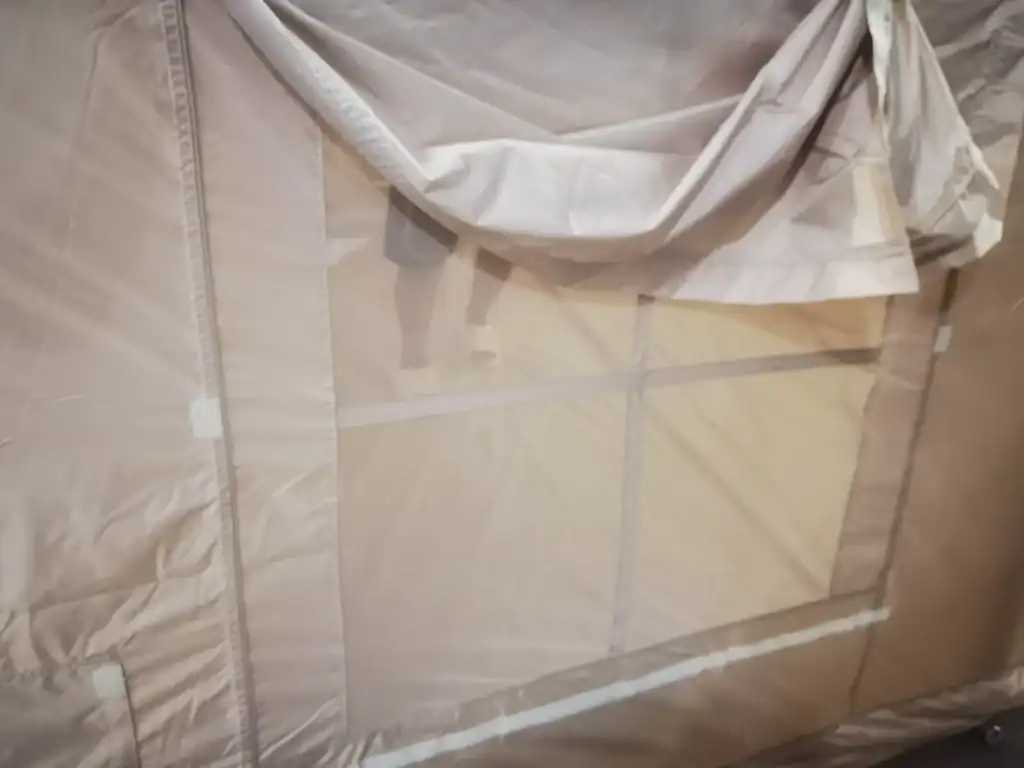
Warum Gewebespezifikationen wichtiger sind als Marketing-Bezeichnungen
Every inflatable tent on the market claims “heavy-duty fabric” or “premium-grade shell.” Those phrases tell you nothing about how the tent will perform after 40 nights of use. The difference between a tent that survives a season and one that lasts five years comes down to three measurable things: fabric denier, coating type, and the hydrostatic head rating. Marketing names are designed to sell. These specs are designed to predict real-world durability.
Retail Claims vs Engineering Reality
“Ripstop polyester” sounds tough until you learn the base fabric is 150D with a thin PU coating that degrades under UV in 18 months. A 600D Oxford-Stoff with a double-sided PU coating will outlast it by years, but most retail listings don’t distinguish between the two. Black coating is a common trick here — it hides the actual denier count and can mask lower-grade polyester underneath. Always verify the denier and hydrostatic head on the uncoated side of the fabric before approving any sample.
How to Brief a Factory With Exact Specs
A vague RFQ like “we need waterproof fabric” invites the factory to quote their cheapest option. A brief that says “600D Oxford polyester, double-sided PU coating, minimum 3000mm hydrostatic head, black coating on outer face only” forces them to quote a specific material grade. Include your target air beam flex cycle count as well — most factories test to 1,000 cycles by default, but for family camping tents meant for repeated seasonal use, you should specify 3,000 cycles minimum.
Shell-Gewebe-Optionen für aufblasbare Zelte
Black coating on polyester can hide low-grade base fabric.
A glamping tent shell that looks premium in marketing photos can fail after 20 nights if the wrong fabric weight was selected. The difference between a tent that lasts three seasons and one that fails mid-season often comes down to a single number: the denier count. For inflatable tents, the shell fabric does more than keep rain out — it protects the air beam structure from abrasion, UV degradation, and puncture. Pick the wrong spec, and your warranty claims spike before year two.
Polyester 300D vs 600D vs 150D
Polyester ist der gebräuchlichste Außenstoff für aufblasbare Zelte, da es den Kostenfaktor besser mit UV-Beständigkeit ausbalanciert als Nylon. Doch innerhalb des Polymers sagt die Denier-Kennzahl alles über Haltbarkeit und Gewicht.
-
- 150D Polyester: Leichtgewichtig – etwa 110–130 g/m². Verwendet für Ultraleicht-Rucksackwander-Zelte, bei denen jedes Gramm zählt. Die Rissfestigkeit ist geringer; rechnen Sie mit einerhydrostatischen Säule von 2000–3000 mm mit Beschichtung. Nicht geeignet für Familienzelte oder Vermietflotten.
- 300D Polyester-Oxford: Der Industriestandard für aufblasbare Familienzelte für 2–4 Personen. Wiegt nach der Beschichtung etwa 180–220 g/m². Bietet gute Durchstoßfestigkeit und eine typische Rissfestigkeit von 30–40 N (ASTM D2261). Die meisten Fabriken verwenden dies als Standard-Spezifikation.
- 600D Polyester Oxford: Hochbelastbar bei 250–320 g/m². Wird bei Glampingzelten, Dachzelt-Anbauten und Vermietungs-Qualitäts-Aufblaszelten eingesetzt, die ständigen Aufbau-/Abbauzyklen standhalten müssen. Die Rissfestigkeit übertrifft 60 N. Der Kompromiss ist das Packgewicht – ein 600D-Zeltbahnmantel fügt im Vergleich zu einer ähnlichen 300D-Version etwa 1,5 kg hinzu.
Luftstab-Materialien: TPU vs. PVC
Für alpines Camping oder saisonale Frühjahrsaktivitäten hält TPU den Druck bei Temperaturen unter -10°C besser als PVC.
Der Luftbalken ist das Skelett eines aufblasbaren Zeltes. Wählen Sie das falsche Material, verliert Ihre Konstruktion zur ungünstigsten Minute ihre Steifigkeit – in einer kalten Nacht, bei einem Böenfront oder nach drei Saisons UV-Belastung. Zwei Materialien dominieren diese Kategorie: TPU und PVC. Jedes hat einen klaren Anwendungsfall, und die Lücke zwischen ihnen ist größer, als die meisten Käufer annehmen.
TPU-Vorteile: Gewicht und Kälteflexibilität
TPU (thermoplastisches Polyurethan) wiegt bei gleichem Balkendurchmesser und gleicher Wandstärke etwa 30% weniger als PVC. Dieser Unterschied ist relevant, wenn Sie Paletten mit familiengeeigneten Zelten zu Einzelhandelslagern versenden. Noch kritischer ist, dass TPU auch bei -20°C flexibel bleibt, während PVC bereits ab etwa -5°C merklich steif wird. Ein steifer Balken reißt bei wiederholten Falt- und Packzyklen. Der interne Produktionsstandard für TPU-Balken in der Aufblaszeltlinie von Kelyland Outdoors umfasst einen Flexzyklustest mit Ziel von 3.000 Zyklen – das Dreifache dessen, was viele Fabriken als他们的 Pass-Schwelle verwenden.
TPU also welds cleanly with RF (radio frequency) sealing, producing seam bonds that hold pressure longer than solvent-welded PVC joints. For brands positioning tents as premium or alpine-ready, TPU is the defensible choice.
PVC Benefits: Cost and Weld Strength
PVC costs 40-60% less per linear meter of beam material than TPU at equivalent diameters. That delta drives most entry-level and mass-market tent pricing. PVC welds are strong at room temperature — properly made seams exceed the burst strength of the base film in most cases — but the material loses that advantage below freezing.
“Most factories test 1,000 flex cycles on PVC beams,” notes one sourcing manager who has audited over a dozen inflatable tent lines across Zhejiang province. “That’s fine for a beach shelter used six weekends a year. It’s not enough for a family camping tent expected to last three seasons.” If your target price point forces PVC, specify a minimum wall thickness of 0.6mm and request the flex cycle report before sample approval.
Composite Beam Structures
Some suppliers now offer composite beams that wrap a TPU inner bladder inside a woven polyester sleeve. The sleeve takes abrasion load; the bladder handles air retention and cold flexibility. This hybrid construction adds roughly 15% to material cost over pure PVC but delivers cold-weather reliability close to all-TPU while improving puncture resistance by about 40% in lab drop tests.
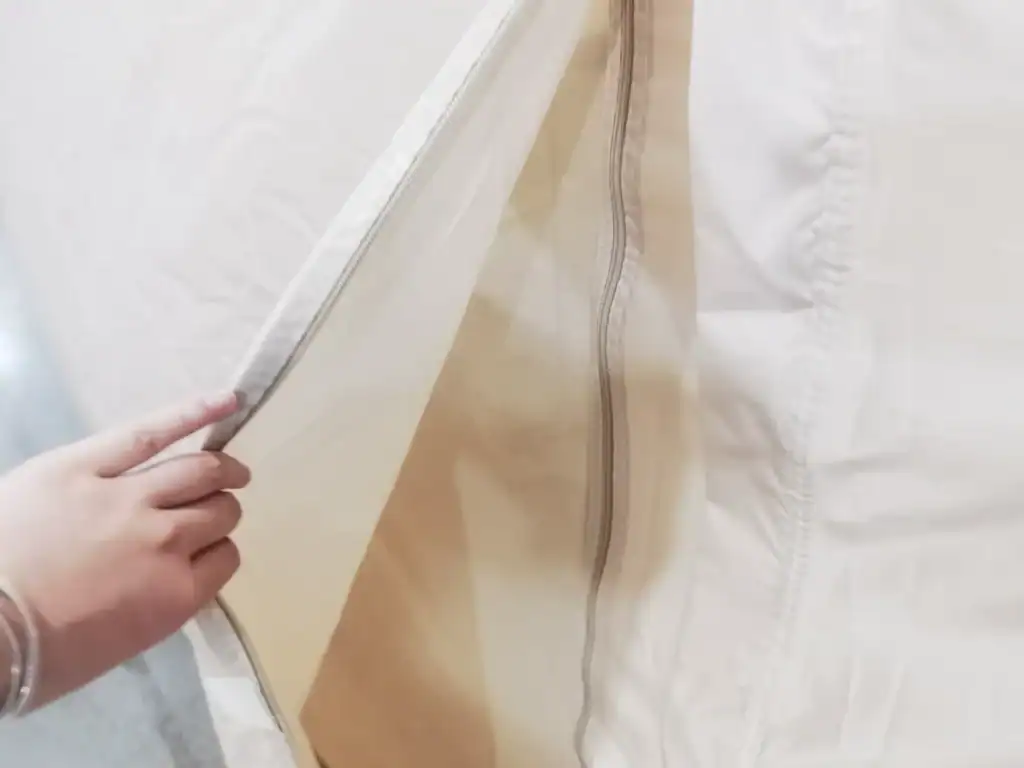
Beschichtungen und Wasserschutz
A 3000mm hydrostatic head is the minimum for reliable inflatable tent waterproofing in sustained rain.
The coating layer is where the real waterproofing happens, but not all coatings perform the same under extended exposure. PU (polyurethane) coating is the most common option for inflatable tents because it bonds well with polyester and nylon, holds up to repeated folding, and delivers consistent hydrostatische Druckkopfs between 2000mm and 5000mm depending on the application layer count. Silicone coating is lighter and more flexible than PU, which makes it the preferred choice for ultralight backpacking inflatables where every gram matters. The trade-off: silicone costs more per linear meter and requires different factory equipment to apply cleanly.
Schwarze Beschichtung zum Schutz vor UV-Strahlung und Hitze
Die schwarze Beschichtung erfüllt einen spezifischen technischen Zweck: Sie blockiert UV-Strahlung, die das Gewebe und den internen Luftstrahl-Material mit der Zeit schädigt. Bei direkter Sonneneinstrahlung kann ein unbeschichtetes Polyestergewebe innerhalb von zwei Saisons 30–40% seiner Reißfestigkeit verlieren. schwarzes Pigment absorbiert UV-Strahlung, bevor sie das Grundgewebe erreicht, was die Nutzungsdauer des Zeltes in sonnenintensiven Umgebungen wie Wüsten oder alpinen Waldgrenzen deutlich verlängert. Zudem wird die Wärmeentwicklung im Inneren reduziert, da ein Teil der Solarstrahlung reflektiert wird — ein messbarer Vorteil für Glamping-Konzepte, bei denen Gäste angenehme Tagestemperaturen im Zelt erwarten.
Der wichtigste Prüfschritt hier: Fordern Sie vor der Freigabe der Produktion einen Hydrostatischen-Druck-Wert (Hydrostatic Head) von der unbeschichteten Seite einer Gewebeprobe an. Ein seriöses Werk liefert diese Daten bereitwillig, da es zertifizierte Rohgewebe mit bekannten Denier-Werten und Webdichten bezieht. Die Partnerfabriken im Netzwerk von Kelyland Outdoors — darunter ISO 9001-zertifizierte Hersteller in Ningbo — führen lückenlose Materialprotokolle, die eine solche Verifikation bereits in der Mustergenehmigungsphase ermöglichen.
Hydrostatische Druckwerte verstehen
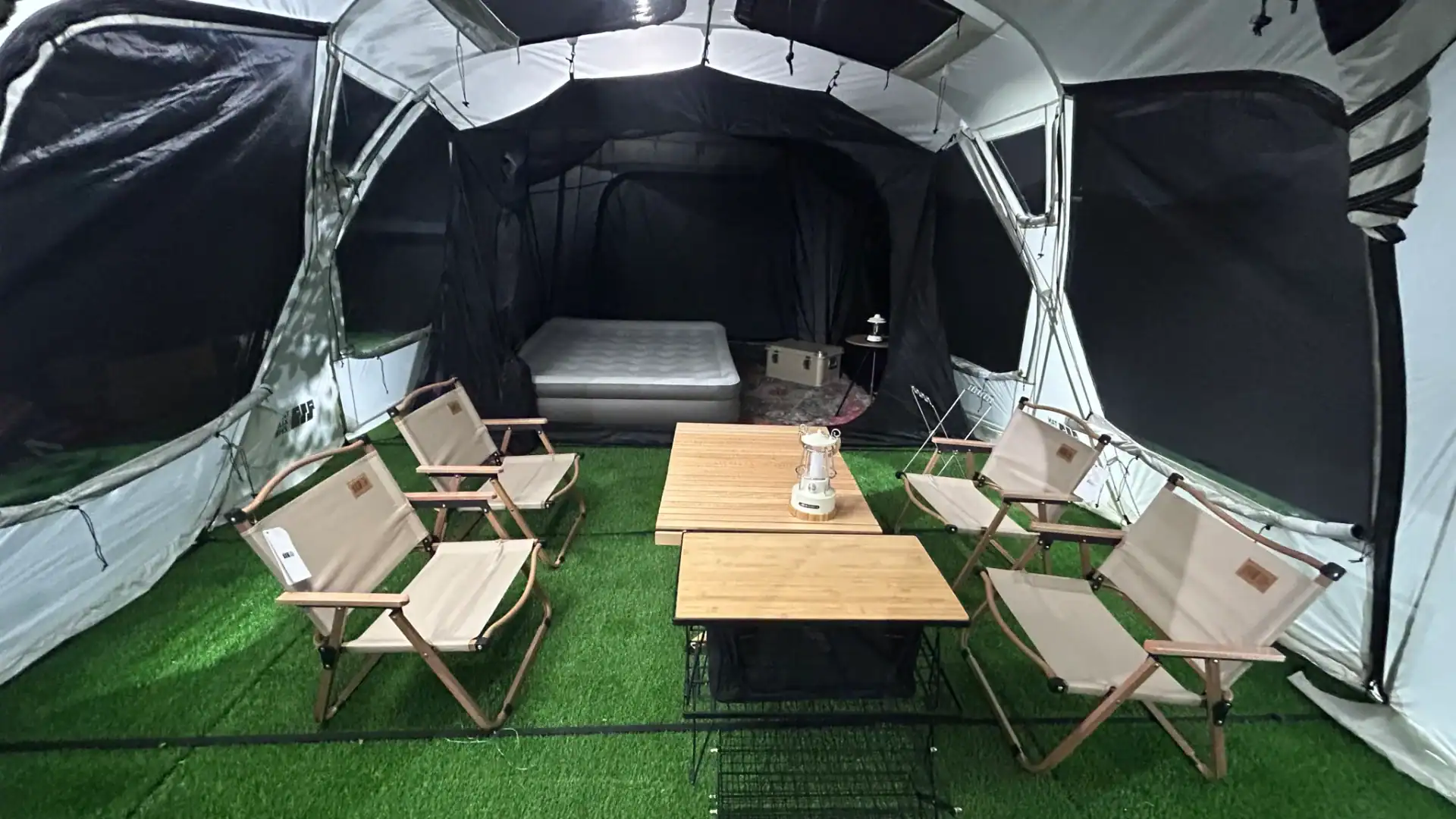
Zertifizierung und Compliance-Anforderungen
Die CE-Kennzeichnung für integrierte Pumpen ist in der EU eine gesetzliche Verpflichtung, keine optionale Aufrüstung.
Wenn Ihr Inflatable-Zelt-Design eine integrierte Elektropumpe umfasst, CE-Kennzeichnung ist dies für den Marktzugang in Europa zwingend erforderlich. Dies umfasst die Niederspannungsrichtlinie (2014/35/EU) und die elektromagnetische Verträglichkeit (2014/30/EU). Eine Pumpe ohne CE-Kennzeichnung wird am Zoll zurückgehalten — und wenn sie dennoch durchkommt, droht Ihnen Haftung für nicht konforme Elektrogeräte. Die Luftpumpen-Fabrik in Kelylands Netzwerk, die jährlich 2,5 Millionen Einheiten produziert, verfügt über CE- und ETL-Zertifizierungen für integrierte Pumpen, wodurch die Konformitätsdokumentation bereits in deren Produktionslinie integriert ist.
REACH-Verordnung und Verordnung über die allgemeine Produktsicherheit
Neben der elektrischen Sicherheit muss auch das Zeltgewebe selbst die REACH-Verordnung (Registrierung, Bewertung, Zulassung und Beschränkung chemischer Stoffe) erfüllen. Diese regelt Substanzen wie Phthalate in PVC-Beschichtungen und bestimmte Flammschutzmittel. Die Verordnung über die allgemeine Produktsicherheit (GPSR) gilt für alle in der EU verkauften Konsumerzeugnisse — sie verlangt Rückverfolgbarkeitsdokumentation vom Werk bis zum Regal. Wenn Ihr Lieferant keine REACH-Erklärung für das Außenmaterial oder das TPU/PVC-Strahlmaterial vorlegen kann, dürfen Sie die Ware nicht versenden.
ISO 9001 and Factory Audit Reports
ISO 9001:2015 certification tells you the factory has documented quality management procedures — raw material incoming inspection, process control, corrective action systems. Kelyland’s core tent factory in Ningbo holds ISO 9001 alongside CE and BSCI certifications. When requesting audit reports, ask specifically for the most recent surveillance audit findings, not just the certificate. A clean report shows zero major non-conformities; a pattern of minor NCs on calibration or supplier control indicates gaps that will surface during mass production.
Sourcing Specs to Put in Your RFQ
The RFQ is your first and best chance to set the standard.
Start with the base fabric denier. For a family camping inflatable tent, 600D polyester is the minimum for the flysheet. Drop to 300D and you risk punctures from branches or ground debris within two seasons. Go up to 150D nylon ripstop if weight matters more than abrasion resistance — that’s for backpacking models where every gram counts.
Coating Specs That Actually Matter
Black coating blocks UV and hides dirt, but it also masks fabric quality. Always ask for a hydrostatic head test on the uncoated side of the fabric sample. A reading below 3000mm means water will push through under sustained rain, regardless of what the coating promises on paper. PU coatings are standard; silicone coatings cost more but last longer and pack smaller.
Beam Material, Diameter, and Pressure Requirements
TPU beams hold pressure better in cold weather than PVC and are easier to recycle, but they add roughly 15-20% to the unit cost. PVC welds stronger at room temperature and keeps pricing competitive for volume orders. For beam diameter: a 4-person tent needs at least 10cm main beams; anything smaller risks sag in moderate wind.
Pressure specs should be stated clearly in your RFQ: most family inflatables run at 7-9 PSI with an automatic shut-off valve at 12 PSI. Without that valve spec in writing, a factory might ship a pump that over-pressurizes the beams on a hot day.
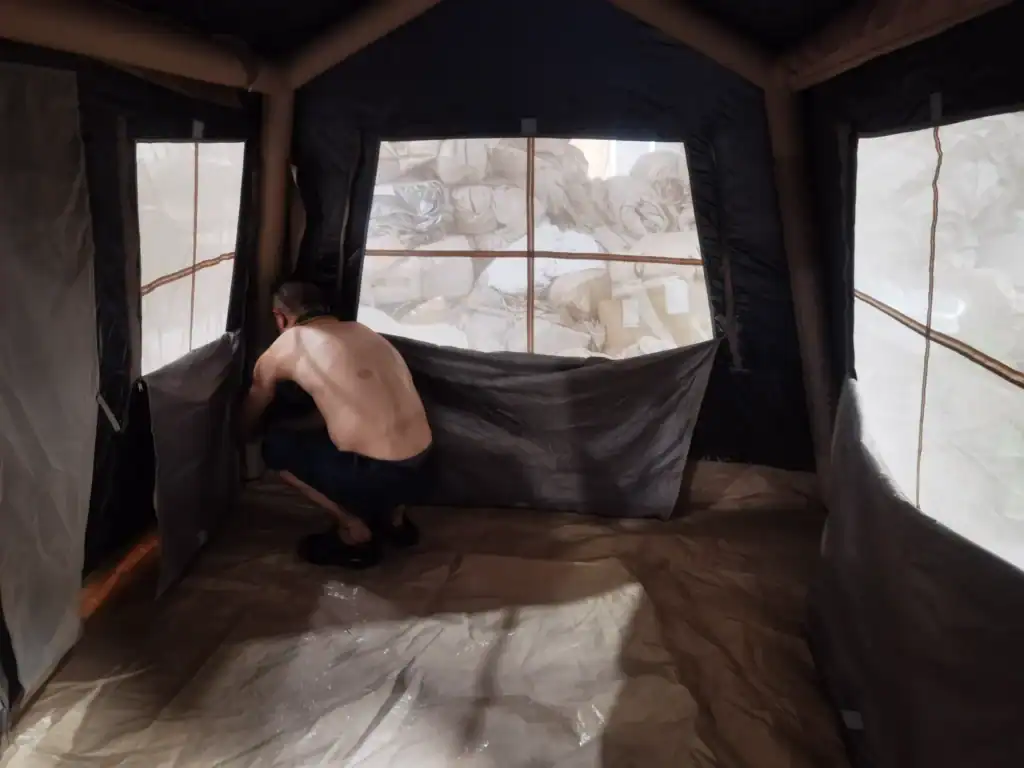
Sample Testing and Flex Cycle Report
This is where most RFQs fall short. Ask specifically for the air beam flex cycle test data. Many factories test to 1,000 cycles as a pass threshold — that’s fine for occasional weekend use. For a product aimed at family camping or rental fleets, specify 3,000 cycles minimum. The difference is one extra layer of reinforcing weld tape inside the beam sleeve.
– If you skip this spec line, a supplier can deliver beams that fail after two seasons of regular setup-and-takedown. – Include it, and you force them to build durability into the seam construction from day one. – Pair this with a request for ISO 9001 documentation from their production line — many factories hold it but only share on request.
Schlussfolgerung
The difference between a tent that survives its first season and one that lasts three often comes down to specs you can’t see in a product photo. Denier counts, coating chemistry, beam flex cycles, and hydrostatische Druckkopfs separate engineered products from marketing-driven ones. Get these details into your RFQ template now, and you remove the guesswork from supplier evaluation.
-
- Specify polyester 600D minimum for family camping shells.
- Require TPU beams for cold-weather or alpine models.
- Demand a hydrostatic head of at least 3000mm on coated fabric.
- Ask for the air beam flex cycle test report at 3,000 cycles.
Your next step is to build an inflatable tent RFQ specification template using the benchmarks above—fabric denier, coating type, beam material, and pressure requirements—before approaching any factory. Review the product specifications on our air mattress page to see how similar material standards apply across inflatable product categories we manufacture under ISO-certified processes.
Häufig gestellte Fragen
What fabric denier is best for inflatable tents?
For most inflatable tents, 300D to 600D polyester Oxford fabric offers the best balance of tear strength and weight. Use 150D for ultralight backpacking models or 600D for heavy-duty glamping tents where. Match denier to your target market’s weight and durability needs.
TPU vs PVC air beams: which is better?
TPU beams are lighter and stay flexible below -10°C, making them ideal for alpine or winter use. PVC beams cost less and have stronger welds, but they stiffen in cold weather. Choose TPU for cold-weather performance or PVC for budget-friendly bulk orders.
What PSI rating do inflatable tent beams need?
Most inflatable tent beams operate safely between 8 and 15 PSI, depending on beam diameter and material. Always specify a pressure relief valve in your RFQ to prevent over-inflation damage. Include a safety valve spec in your RFQ to avoid field failures.
What certifications are required for inflatable tents?
For EU markets you need CE marking on electrical pumps and REACH compliance for fabric and beam materials. ISO 9001 certification from your factory is also expected by major retailers like Ace. Request factory audit reports and certificate copies before sample approval.

 English
  Español
  Deutsch
  Français
  Português do Brasil
  Русский
  العربية
  한국어
한국어  日本語
日本語