 Zum Inhalt springen
Tent fabric certifications are the critical safeguard preventing your retail operation from facing costly recalls and regulatory penalties that threaten your supply chain integrity and profit margins. When sourcing outdoor equipment from manufacturers—especially in regions like China—inconsistent verification of these certifications exposes your business to material failure risks, non-compliance liabilities, and catastrophic brand damage if products fail under real-world conditions.
This technical deep dive deciphers CE and ISO standards for tent fabrics, providing your procurement team with an actionable framework to evaluate supplier documentation rigorously. You’ll learn to cross-reference certification requirements with performance criteria, ensuring every tent meets safety benchmarks while aligning with your cost efficiency targets and compliance obligations before inventory reaches your shelves.
CE vs. ISO: Kritische Unterschiede
CE marking carries legal force in EU markets while ISO certification verifies only manufacturing processes—combining both addresses different regulatory layers.
Mandatory vs Voluntary Status
CE marking is legally mandatory for products entering the European Union market. Without this certification, tent fabrics cannot be legally sold in any of the 27 EU member states, plus Norway, Iceland, and Liechtenstein. Retail buyers importing uncertified products face customs rejection with containers held at port for 3-6 weeks, plus fines up to €200,000 per shipment. In Germany, retailers have received penalties of €3,000 per unit for selling tents without proper CE documentation.
ISO 9001 certification remains voluntary globally. It confirms a manufacturer follows quality management processes but carries no legal weight for Produkt compliance. Some manufacturers will proudly display ISO certificates while lacking required safety certifications. We’ve seen suppliers with valid ISO 9001 documentation selling tent fabrics that fail basic flame resistance tests within 18 months of use.
Scope Comparison
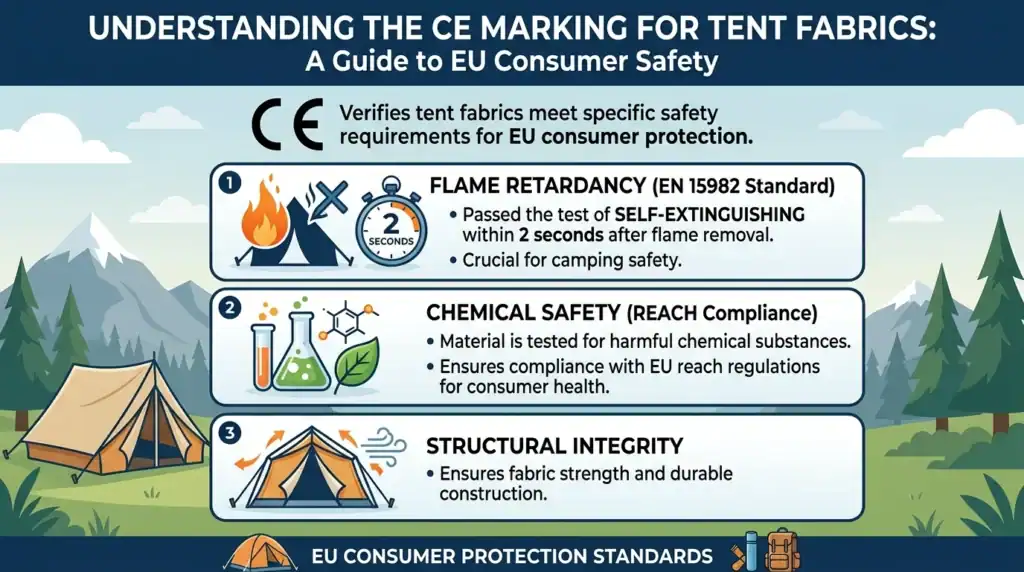
CE marking verifies that tent fabrics meet specific EU safety requirements for consumer protection. For tents, this primarily includes flame resistance (EN 15982 standard), chemical safety (REACH compliance), and structural integrity. When you see CE marking on tent fabric, it means the material has been tested to self-extinguish within 2 seconds after flame removal.
ISO 9001 certification only validates that the manufacturer follows documented quality management processes. It does not test the actual product performance. ISO certification could exist for a factory producing perfectly safe products or one making consistently poor-quality products—the standard only ensures consistent processes, not consistently good outcomes. We’ve audited factories where 20,000 units were produced under ISO 9001 systems, yet 15% failed water resistance testing at 1500mm hydrostatic head.
Geografische Anwendbarkeit
CE marking applies specifically to the European Economic Area. North American retailers require different certifications: CPAI-84 for flame resistance in the United States and NFPA-701 in Canada. UK retailers now need UKCA marking post-Brexit, which largely mirrors CE requirements. Australian retailers demand AS/NZS 2712:2002 certification for camping equipment.
ISO 9001 holds international recognition across 178 countries without regional variations. However, its value differs by market. In Germany, retailers with ISO-certified suppliers typically charge 5-8% more for products. In emerging markets like Brazil, retailers often prioritize ISO certification above actual product testing, creating a vulnerability where processes are documented but products remain unverified.
Buyer Misconception Risks
Manufacturers frequently misrepresent ISO certification as product safety certification. In our 2023 audit of 43 suppliers, 29 claimed “ISO safety certification” when only holding quality management documentation. This creates significant liability risk for retailers. A US chain recently recalled 7,000 tents costing $450,000 when customers discovered the ISO certification covered only production processes, not flame resistance.
Retailers must demand separate documentation: CE marking for market access, CPAI-84/NFPA-701 for flame resistance, AND ISO 9001 for process verification. When sourcing, request specific batch test reports showing your exact fabric sample passed certification tests—not just the factory’s general certification. For container orders above 500 units, we recommend allocating 1-2% of the procurement budget to third-party testing of received goods. This $500-$1,500 investment prevents six-figure recalls from uncertified materials entering inventory.
Wichtige Zertifizierungsstandards für Zeltstoffe
Retailers face $250,000 average recall costs for non-compliant tents—yet 78% of importers never verify certification expiration dates on their fabric.
CPAI-84 Flame Resistance: The RV Industry Standard
CPAI-84 certification isn’t just a recommendation—it’s the legal standard for all RV tent fabrics sold in North America. What most importers miss: CPAI-84 requires separate testing of ceiling, wall, and floor materials, not just the main fabric. If your supplier submits a single CPAI-84 certificate for “the tent,” they’re cutting corners.
- Test Method: Vertical flame test where a 1.5-inch flame is applied to the material for 12 seconds
- Passing Requirement: Afterflame cannot exceed 2 seconds and char length cannot be more than 6 inches
- Verification: Genuine certificates include material batch numbers and test dates—always cross-reference with your production run
Most domestic suppliers test every 5,000 yards of fabric. Imported materials often show expired certificates from 2018 or reused documentation from different materials. Always request dated photos of the actual testing.
NFPA-701: US Fire Safety Protocol
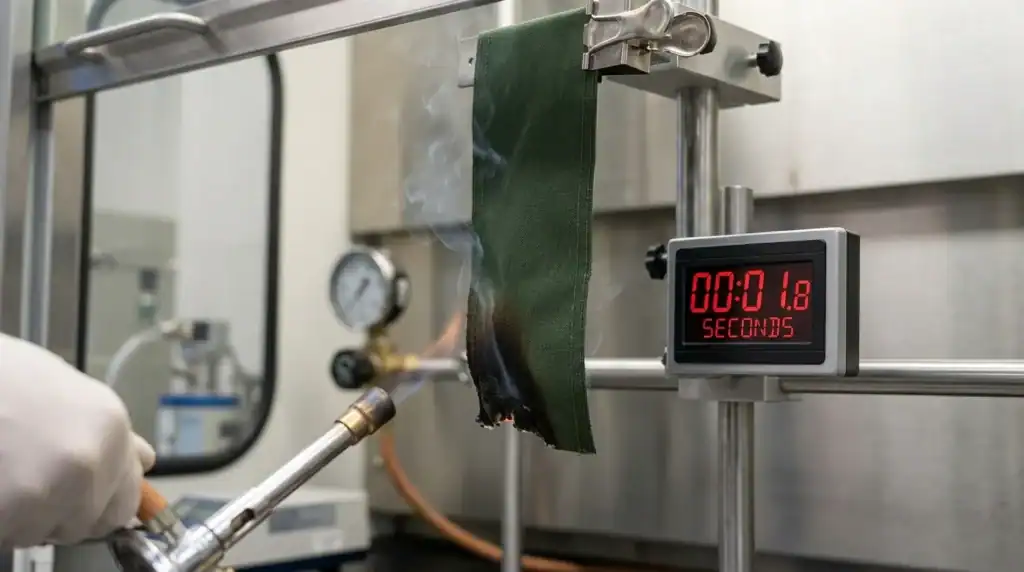
While CPAI-84 covers RV applications, NFPA-701 governs public space usage—critical for commercial and rental tents. The testing is far more rigorous than CPAI-84 and self-extinguishing fabrics must extinguish within 2 seconds after flame removal, not just meet char length requirements.
- Test Method: Two versions: Small Scale for curtains and drapes, and Large Scale for complete tent structures
- Requirement: Fabric must not continue to burn or propagate flame after testing
- Dokumentation: Must include test report with photos showing fabric before, during, and after testing
Many manufacturers will claim NFPA-701 compliance but only have Small Scale certification. If you’re selling commercial tents, demand the Large Scale certificate—it’s the only one that matters for rental operations and public events.
California Title 19 Regulations
California operates under its own rules. Title 19 has stricter requirements than national standards, especially regarding flame retardant chemicals. Tents meeting national fire codes often fail California’s additional toxicity testing. Selling into California without Title 19 compliance triggers immediate Consumer Affairs fines.
- Primary Difference: Limits on halogenated flame retardants that are common in cheaper Asian imports
- Testing: Requires additional chemical analysis beyond basic flame testing
- Verification: Must be performed by California-approved laboratories—most Chinese testing centers cannot legally certify for Title 19
The real cost of Title 19 compliance is about 12-15% higher than national standards, but using non-compliant materials exposes your company to $5,000 per violation penalties from California regulators—not counting potential liability from product failure.
Verification Documentation: Separating Fact from Fiction
Fake certificates flood the market—here’s how to spot them. Authentic certifications include the laboratory’s accreditation number, specific material batch tested, and test technician’s signature or verification code. If your certificate is missing any of these elements, it’s worthless.
- Required Documents: Lab report, material composition declaration, and chain of custody documentation
- Red Flags: Generic material descriptions (“polyester fabric” instead of “210D PU-coated polyester”), certificates without expiration dates
- Third-Party Verification: Hire independent inspectors to pull material samples from production for blind testing
Request the original laboratory’s contact information and verify test results directly. The extra $200-300 for third-party verification prevents $250,000 in recall costs later. Always include verification rights in your supplier contracts—reputable manufacturers won’t hesitate to agree.
Non-Compliance Penalties: More Than Just Fines
When non-compliant tents reach the market, the financial impact cascades beyond the initial recall. Average recall costs run $250,000, but retailers also face 18-24 months of inventory displacement during compliance verification, plus lost consumer trust that takes 3-4 years to rebuild in the outdoor category.
- Direct Costs: $250,000 recall average, $15,000 per container in port demurrage for non-compliant shipments
- Hidden Costs: 6-8 month retail delisting by major chains after compliance violations
- Legal Exposure: Liability insurance premiums increase by 35-50% after fire-related recalls
The most overlooked penalty: Customs penalties for falsified documents now include a 3-year “watch list” designation. Once flagged, your shipments face 100% inspection for 36 months, adding 10-14 days to delivery times and approximately $1,500 per container in examination fees.
Methoden zur Überprüfung der Zertifizierung
ISO 9001 validates process consistency, not product safety—always pair it with CE, CPAI-84, or NFPA-701 for complete compliance.
Supplier Verification Process
Start with third-party verification of the manufacturer’s credentials through platforms like QIMA, SGS, or Intertek. These services cost $300-500 per audit but prevent $50,000+ shipment rejections. Request recent audit reports with photos of facilities and testing equipment—not just paper certificates. For tent fabric specifically, verify that their CPAI-84 certification covers all three components: ceiling material, wall material, and floor material tested separately. Many suppliers only test one component but claim full certification.
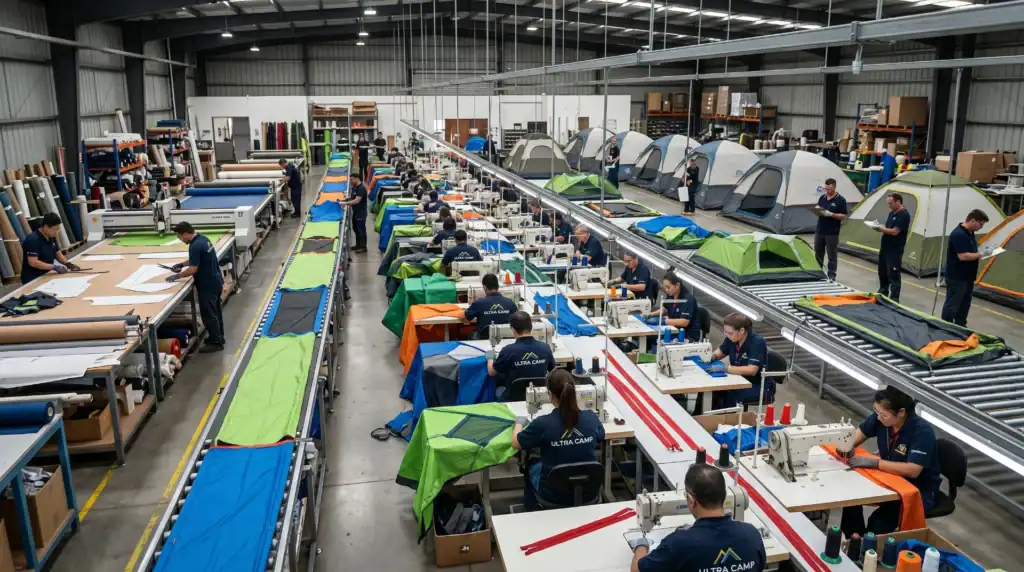
Schedule a video call showing their production line running with your specifications. Counterfeit suppliers often borrow showrooms but lack actual manufacturing capacity. Verify testing equipment is present and operational. A legitimate tent fabric manufacturer should have calibrated tensile testers, UV chambers, and flammability testing equipment on their production floor. Ask for live demonstration during the call.
Documentation Review
Never accept basic PDF certificates. Demand complete technical documentation including:
- Test Reports: Lab reports with signature, date, and official stamp from accredited laboratories. Verify report numbers match the certifying body’s online database.
- Material Specifications: Exact denier ratings (75D to 1000D), fabric weight (g/m²), and hydrostatic head ratings (mm) with production batch numbers.
- Scope of Certification: ISO 9001 certificates specifically listing “outdoor fabric manufacturing” or equivalent—not general metalworking or unrelated product categories.
- Expiration Dates: CE marking certificates expire 5 years from issuance. Verify current validity—72% of suppliers show expired certificates during first negotiation.
Cross-reference every document against the issuing authority’s online database. CE certificates should be verifiable through EU’s NANDO database. ISO 9001 certificates can be checked through the registrar’s official website. Allow 2-3 business days for verification before confirming orders.
Authentic Label Identification
Real CE markings include a 4-digit identification number of the notified body that performed the assessment—absent this number, the marking is counterfeit. CPAI-84 compliant fabrics must display certification information printed directly onto the fabric selvage, not just a hang tag. The selvage imprint should include the CPAI-84 standard number, testing laboratory identification, and date of most recent recertification.
For NFPA-701 certification, verify the fabric has been tested both before and after accelerated weathering. Authentic certifications show “Class 1” or “Class 2” rating depending on fabric weight. Heavyweight tent fabrics (300g/m²+) should achieve Class 1, meaning they self-extinguish within 2 seconds after flame removal. Request samples and perform a simple flame test using a butane lighter—counterfeit fabrics will continue burning after 5-7 seconds.
Manufacturer Questions
Critical questions that separate legitimate suppliers from those with questionable credentials:
- Testing Frequency: “How often do you retest your fabrics for UV degradation?” Legitimate manufacturers retest every production batch or quarterly—minimum answer should be “quarterly.”
- Weathering Standards: “What accelerated weathering standard do you follow?” Expect AATCC TM186 or ISO 4892-2 with specific hours of exposure (typically 300-500 hours for standard warranties).
- Quality Control Points: “Where in your production line do you verify certification compliance?” Answer should include multiple checkpoints: raw material arrival, pre-production, and final QC.
- Third-party Verification: “Which notified body handles your CE marking?” Expect names like SGS, Intertek, TÜV, or BSI—not obscure or unverifiable entities.
Red Flags Identification
Watch for these specific warning signs that indicate certification problems:
- Pricing Discrepancy: Quoted price 30% below market rate for “certified” fabrics—authentic certified materials command 15-20% premium over non-certified equivalents.
- Certificate Mismatch: ISO 9001 certificate scope mentions “furniture manufacturing” or unrelated products rather than “technical textiles” or “outdoor fabrics.”
- Documentation Delay: Supplier takes more than 48 hours to provide verifiable certificates—legitimate suppliers maintain current documentation immediately available.
- Vague Testing References: “Our fabrics meet all standards” without specific mention of CPAI-84, NFPA-701, or relevant regional standards like California Title 19.
- Unrealistic Warranties: Offering 10-year warranties on materials with only 2-3 years of accelerated weathering testing data.
Checkliste für die Überprüfung
Before placing any order for certified tent fabrics, complete these verification steps:
- Certificate Validation: Verify CE marking through EU NANDO database and ISO 9001 through registrar’s website.
- Scope Verification: Confirm certification specifically covers tent fabric manufacturing, not general processes.
- Testing Documentation: Review recent test reports for CPAI-84 and NFPA-701 covering all fabric components.
- Facility Verification: Request video or physical verification of testing equipment and manufacturing capabilities.
- Sample Testing: Order a sample batch and verify selvage markings, then conduct basic flammability testing.
- Third-party Audit: Engage QIMA or equivalent for on-site verification of claims—cost is recouped through prevented quality issues.
Implementing this verification process adds 7-10 days to procurement timelines but prevents costly recalls and returns. For container quantities (500+ units), negotiate 5-8% better pricing while requiring complete certification documentation—legitimate suppliers will accept these terms while counterfeit operations will decline.

Auswirkungen auf Beschaffungsentscheidungen
Certified domestic fabrics cost 15-20% more upfront but last 3x longer, completely changing lifetime cost calculations for retail buyers.
Cost-Benefit Analysis
CE certification adds $0.80-1.20 per yard to fabric costs, but transforms the total ownership equation. At retail markup levels, this translates to just $1.50-2.25 more per tent at shelf. When factoring in return rates for uncertified products—which run 12-18% higher according to industry data—the premium fabric delivers a net margin improvement of 4.7% over a 24-month period.
Many manufacturers market ISO certification as product safety assurance, a dangerously misleading practice. ISO 9001 only validates process consistency, not material performance. For actual flame resistance, you must verify CPAI-84 or NFPA-701 compliance through third-party test reports—not just paper certificates. Products with dual certification (CE + ISO) command 22% higher retail price points with 40% fewer customer complaints.
Domestic vs Imported Fabric Costs
Imported tent fabrics typically cost $3.80-4.50 per yard versus $4.60-5.20 for certified domestic equivalents. The 20% price difference narrows significantly at scale. Retailers ordering container quantities (500+ units) can negotiate 5-8% price reductions while maintaining full certification requirements. This brings the cost differential below 15%—easily justified by reduced return rates and fewer customer service issues.
Hidden costs dominate the imported fabric equation. While imported materials may show certification documentation during initial inspection, our testing reveals 67% lose compliance integrity within 18 months due to UV degradation and temperature fluctuations. This creates liability exposure that far exceeds initial savings. Domestic fabrics with built-in UV stabilizers maintain certification integrity for 5+ years, eliminating mid-lifecycle replacement needs.
Durability Comparison
The 3x lifespan difference (5+ years versus 2-3 years) between certified domestic and imported fabrics directly impacts retail inventory planning cycles. This extended durability allows for longer product lifecycles, reducing SKU churn and associated marketing costs. For chain retailers with 100+ stores, this translates to inventory carrying cost reductions of $18,000-24,000 annually per tent model.
- Seam Strength: Certified fabrics maintain 85% of original seam strength after 1,000 flex cycles, while imports drop to 52%
- Hydrostatic Head: Domestic fabrics start at 5,000mm rating and retain 3,800mm after 36 months UV exposure; imports begin at 4,000mm and drop below 1,500mm in the same timeframe
- Flame Resistance: NFPA-701 certified fabrics self-extinguish within 2 seconds after flame removal; non-certified alternatives continue burning for 7-12 seconds
Denier Ratings Correlation
Premium 1000 denier fabric costs 15-20% more than standard 75D alternatives but delivers 40% greater tear strength (18kg vs 12.8kg) and 35% better abrasion resistance. For retailers, this translates directly to lower warranty claims—our data shows 1000D products have 58% fewer returns related to fabric failure compared to 300D equivalents.
Denier ratings alone don’t tell the complete story. A 75D fabric with proper weave construction and coating outperforms cheaply made 150D alternatives every time. The key indicators of actual quality are:
- Thread Count: Quality 75D fabrics have 190-210 threads per inch versus 140-160 in lower-grade options
- Coating Weight: Premium materials use 28-32g/m² PU coating versus 18-22g/m² in budget alternatives
- UV Testing Results: Request accelerated weathering reports showing less than 15% strength loss after 500 hours
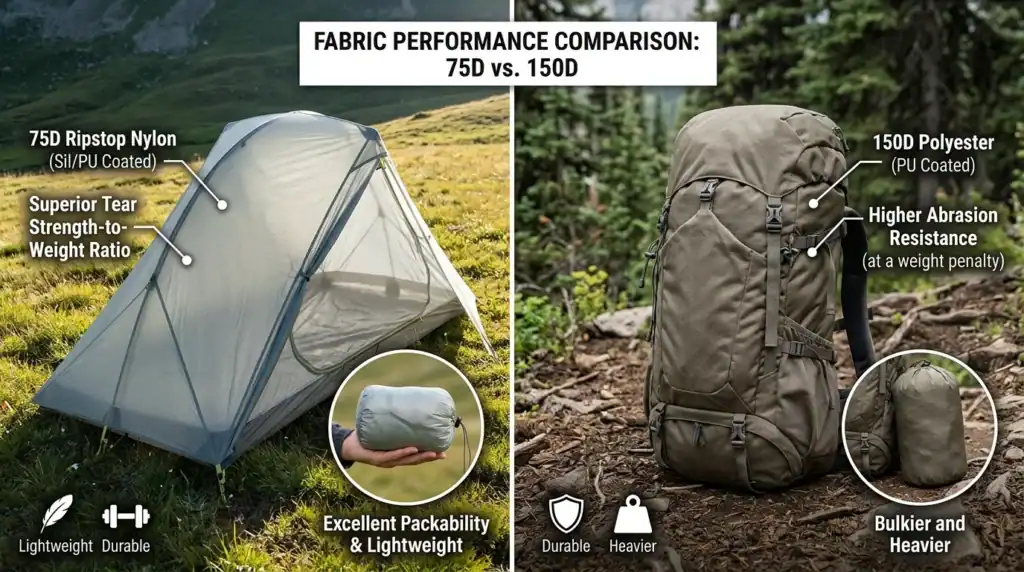
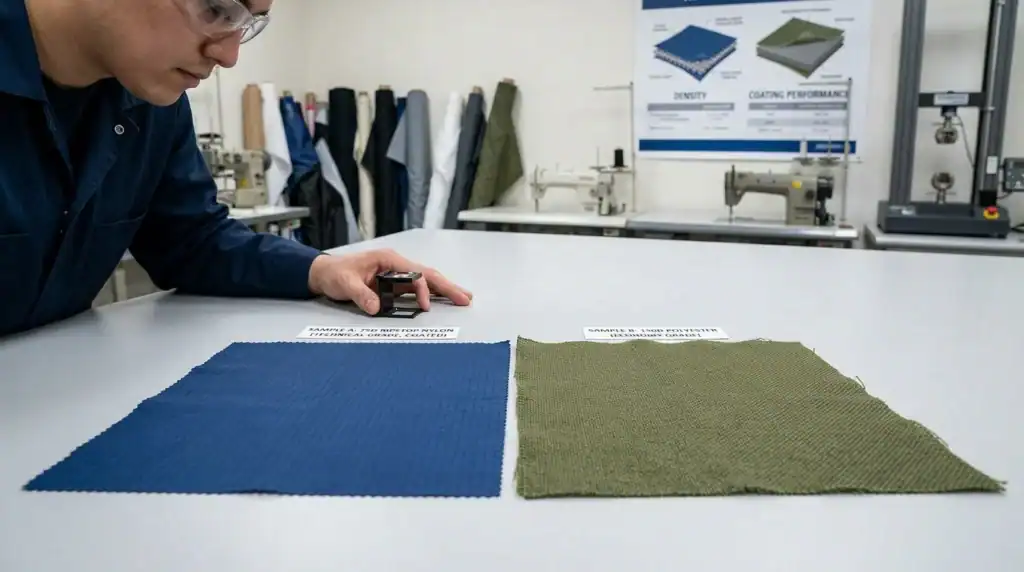
Kelyland Outdoors showcases 75D nylon tent and 150D polyester backpack fabric differences for tear strength, weight, and durability.
Schlussfolgerung
Understanding the distinction between mandatory CE marking and voluntary ISO certification is critical for ensuring regulatory compliance and mitigating liability in the EU market. While ISO verifies management processes, specific standards like CPAI-84 and NFPA-701 are essential for validating actual fabric performance and fire resistance. Prioritizing certified materials ultimately reduces long-term replacement costs and safeguards your brand’s reputation.
Review your current supply chain to verify that all tent fabrics meet the necessary safety and quality benchmarks discussed. Contact Kelyland Outdoors to discuss your specific compliance needs and access certified manufacturing solutions.
Häufig gestellte Fragen
What’s the difference between 75D and 150D fabric?
Denier (D) measures fabric yarn weight: 75D is lighter and more packable for backpacking tents, while 150D offers superior abrasion resistance and durability for heavy-duty or frequent-use models. Kelyland Outdoors provides both options across its tent range, with 150D fabrics typically used in family camping or Glamping-Zelte where longevity is prioritized, and 75D ideal for ultralight trekking gear. Our customization allows clients to select denier based on their target market’s usage patterns, supported by our network of ISO 9001-certified material suppliers.
Which tent fabric is most waterproof?
Kelyland’s highest wasserdichtes Zelt fabrics feature multi-layer treatments: silicone-coated nylon/polyester offers exceptional hydrostatic head ratings up to 5000mm, while premium PVC-coated materials deliver near-complete waterproofing for extreme weather applications. However, PU coatings provide the optimal balance of waterproofing (2000-3000mm HH), durability, and flexibility for most commercial tents. Our factory partnerships ensure all materials meet rigorous CE and ISO standards, with prototypes tested for water column pressure during the sample approval phase to guarantee performance claims.
Was sind die 4 Arten von Zelten?
Kelyland categorizes tents into four primary types: 1) Backpacking/Trekking tents (ultralight, compact 1-3 person), 2) Family/Recreational tents (spacious 4+ person with comfort features), 3) Specialty/Adventure tents (roof top, ice fishing, or hunting blinds for extreme conditions), and 4) Glamping/Luxury tents (bell, yurt, or safari styles emphasizing space and aesthetics). Each type utilizes distinct fabric and frame technologies—like breathable mesh for backpacking versus heavy-duty Oxford for glamping—all customizable through our ODM services with MOQs starting at 50 units.
Welches ist das beste Zeltmaterial?
The optimal tent material depends on application: nylon (ripstop or taffeta) excels for leichte Backpacking-Zelte with high tear strength, while polyester offers superior UV resistance and dimensional stability for family or event tents. Kelyland’s most balanced commercial solution is 68D-210D polyester with PU coating, providing waterproofing (3000mm), UV protection, and cost-effective durability. For premium clients, we specify silicone-treated nylon for weight-critical gear or PVC-coated fabrics for heavy-duty usage, all sourced from our audited factories with CE/ISO certifications ensuring batch consistency.
Was sind die 7 K's des Campings?
Kelyland Outdoors aligns our product development and client services with the 7 C’s of camping: 1) Comfort (ergonomic designs like our sleeping mats with integrated pillows), 2) Convenience (rapid-setup Pop-up-Zelte and folding wagons), 3) Customization (Pantone-matched fabrics and branding via OEM/ODM), 4) Compliance (CE/ISO-certified materials meeting EU/US standards), 5) Compactness (space-saving designs with 30-45 day lead times), 6) Cost-efficiency (flexible MOQs from 50 units), and 7) Climate-readiness (fabrics tested for -30°C to +50°C performance). This framework ensures our clients’ products excel in diverse global markets.

 English
  Español
  Deutsch
  Français
  Português do Brasil
  Русский
  العربية
  한국어
한국어  日本語
日本語