 跳到内容
跳到内容 
camping cot load failure is the first checkpoint buyers should lock before they approve a supplier, budget, or production slot. You get the photos from the échantillon de pré-production. The frame looks straight, the fabric is taut, and the rivets are seated flush. You approve it, the container ships, and eight weeks later your first batch of camping cots lands at distribution centers. Then the emails start coming in — not from your QC team, but from retail buyers attaching photos of a leg tube that sheared clean through at the hinge point on a $50K order. That moment is when you realize the pre-production sample didn’t match what rolled off the line during mass production.
The gap between a sample approval and a load failure isn’t always about material grade or weld quality. More often it’s about cyclic stress on components that never get tested together as an assembly — the hinge rivet, the crossbar wall thickness, and how the leg cup distributes force onto uneven ground. A static load test with dead weight tells you nothing about what happens after night three when a user shifts their weight to one side getting out of bed. That’s where frame cracks start and legs begin sinking into soft campsite soil.
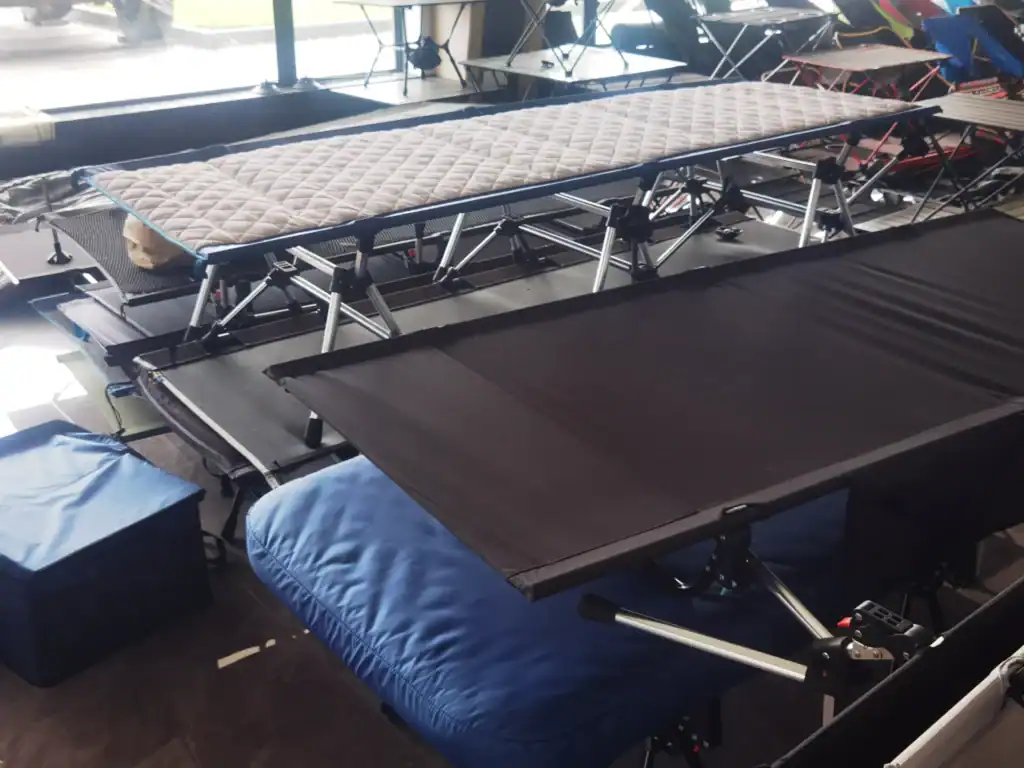
The real failure behind the max load label
A static load test tells you nothing about what happens on night 47.
Every camping cot sold with a max-load label passes a static test: place a dead weight in the center, hold for sixty seconds, record pass. That test is the bare minimum for regulatory compliance — and it misses how cots actually break. Real-world failure happens under dynamic conditions. A 90 kg user doesn’t lie perfectly still. They shift weight when turning over, sit down hard on the edge after a midnight bathroom trip, and rock side to side while adjusting a pillow. Each movement applies uneven, repetitive stress that no static test captures.
Why static ratings fail in dynamic conditions
The problem is fundamental: static testing measures peak strength at one point in time; dynamic use measures cumulative damage over hundreds of cycles. A cot frame that holds 150 kg stationary may develop micro-cracks at the hinge rivet after 200 ingress-egress cycles at just 80 kg. The rivet hole elongates by fractions of a millimeter each time. Eventually the hole wall thins beyond its shear limit, and the rivet pops out — usually at 2 AM with the user’s full weight on one edge.
This is why Kelyland’s partner factories specify double-rivet seating at every hinge joint and require cyclic fatigue data before approving production tooling. The internal standard calls for a minimum tube wall thickness of 1.2 mm on 6061 aluminum frames and 1.0 mm on carbon steel — measured at the drawdown limit, not the nominal spec sheet value. A single-rivet design with thinner walls might pass static certification but will generate warranty claims within one season.
The role of cumulative strain on critical joints
Four points absorb nearly all repetitive load on an X-frame cot: the hinge rivet holes where legs pivot, the crossbar weld junctions near mid-span, the leg-floor contact points (especially on uneven ground), and the fabric-to-side-rail stitching along both long edges. Every time a user sits or shifts, these four zones experience micro-deformation.
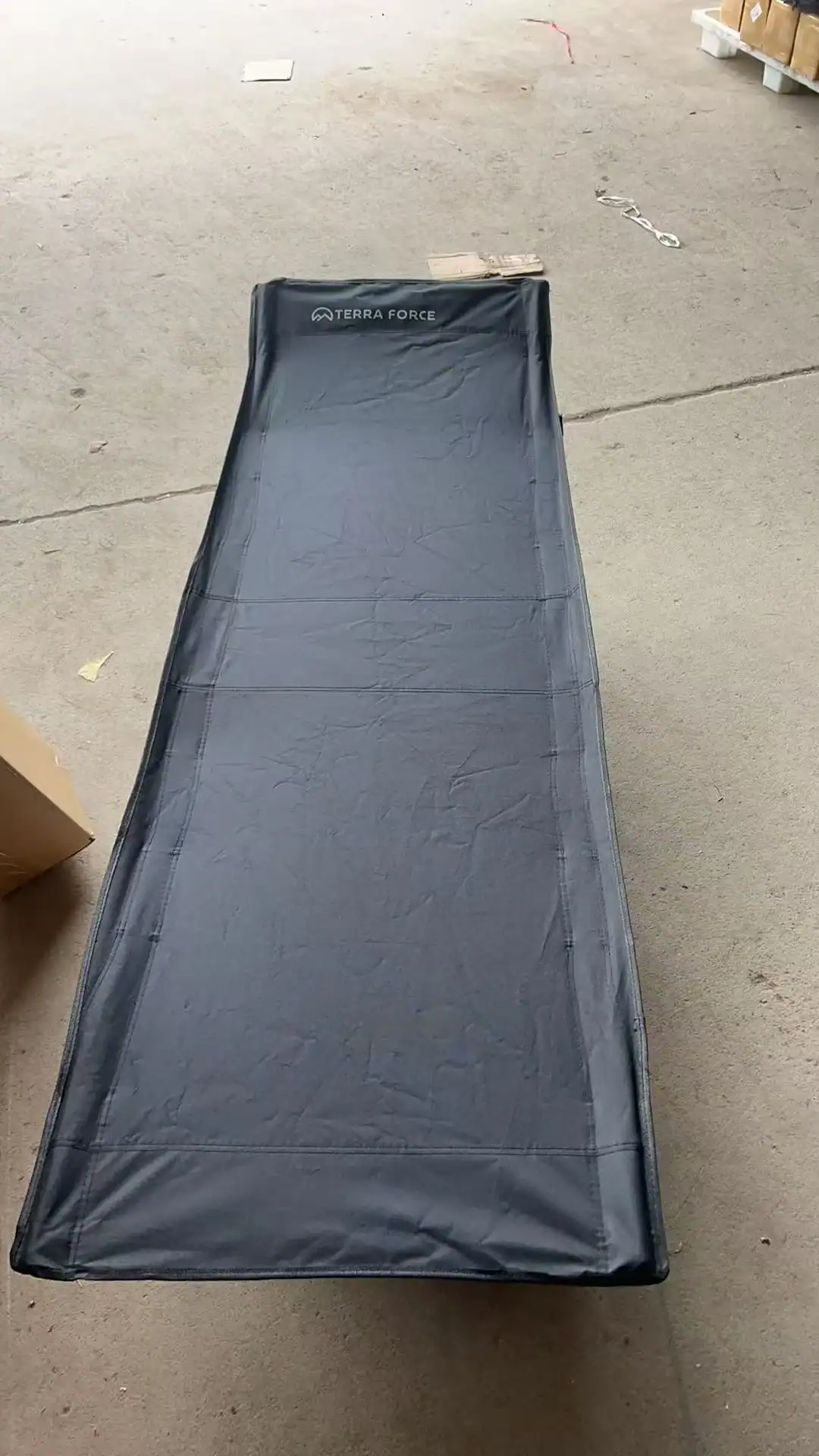
Failure 1: Frame cracks and crossbar collapse
A crossbar rated for 150 kg static load can fail at 80 kg after 500 cycles of real use.
The crossbar is the single highest-stress component on an X-frame cot. It spans the full width, supports the occupant’s center of mass, and transfers load to the hinge joints at both ends. When a buyer sees a “max load” number on a carton, that number almost always comes from a static dead-weight test — place a mass in the center, hold for 60 seconds, pass. That test does not simulate what happens when a user sits down hard on the edge, rolls over at night, or gets in and out repeatedly over a season.
Crossbar material selection thresholds
Budget cots often use pure-series aluminum extrusions (alloy series starting below medium-strength thresholds) with yield strength around 100 MPa. Under cyclic bending stress, those tubes develop micro-cracks at the mid-span within weeks. The minimum spec for any cot intended for commercial or heavy-adult use is alloy series starting at medium-strength threshold under mill production conditions. Steel crossbars face a similar trap: many factories quote “heavy-duty steel tube” but source Q195 grade — wall thickness measures right at drawdown limit. A slight manufacturing variance across a production run of thousands accumulates quickly; what starts as acceptable rocking movement becomes dangerous clearance by month three.
-
- Aluminum threshold: Specify alloy series starting at medium-strength threshold (not pure-series). Wall thickness minimum must hold tolerance within industrial standard drawdown limit.
- Steel threshold: “Heavy duty” steel tube must be ≥Q215 galvanized or better. Budget Q195 fails faster under cyclic loading because its lower yield strength accelerates plastic deformation at weld zones.
Weld vs seamless tube performance
Welded crossbars concentrate failure risk at the heat-affected zone (HAZ) — the area adjacent to the weld bead where material hardness degrades by up to 30%. Powder coating hides these zones visually; they become visible only under chemical etch during factory inspection loops. Kelyland’s strategic partners apply this inspection step during pre-shipment checks to catch HAZ cracks before units leave the factory floor. Seamless drawn tubes eliminate the weld line entirely, removing that failure point but adding cost — roughly 15–20% more per meter depending on alloy and gauge.
Failure 2: Sinking legs on soft campsites
A 90kg camper sitting on the edge of a cot generates over 200kg of momentary force per leg on soft ground.
Here is where most camping cots fail in a way that surprises buyers. The frame holds. The fabric stays tight. But the legs sink into the ground, tilting the entire structure until the user rolls off or the crossbar bends from uneven loading. This failure mode is not about material strength — it is about surface area and soil mechanics.
Why standard plastic foot cups are not enough
Most budget cots ship with small-diameter plastic foot cups, roughly 30–40mm across. On packed gravel or a cabin floor, those work fine. On turf, loam, or damp grass — which is where most campers actually set up — that small contact area concentrates the load into a pressure that exceeds the ground bearing capacity of soft soil. The result: each leg sinks 2–5cm per night. By night three, the cot sits tilted, and the occupant’s weight shifts to one side, overloading that leg’s hinge and accelerating frame fatigue.
The engineering fix: foot pressure distribution
The solution is straightforward but rarely implemented at scale: increase the footprint of each leg contact point so that ground pressure stays below approximately 0.15 kg/cm² for typical campsite soil. That means foot cups or base plates with diameters of at least 60mm for standard cots and 80mm+ for heavy-duty models rated above 150kg.
Conclusion
The gap between a passing static load test and a cot that survives a season of field use is measured in millimeters of tube wall and the number of rivets at the hinge. A label that says “300 lbs” tells you nothing about how the frame behaves on night 47 when the crossbar weld zone hits its fatigue limit.
-
- Exiger cyclic fatigue data, not just static load certification.
- Specify minimum tube wall thickness of 1.2 mm for aluminum or 1.0 mm for steel.
- Require double-rivet seating at every hinge point to prevent shear failure.
Benchmark your supplier against these thresholds before you commit to a production run. Send Kelyland your target weight rating, height, and order quantity — they will return a private-label cot spec with frame material, load-test data, and a firm lead time from their ISO-certified factory network.
Questions fréquemment posées
Quelles sont les causes des fissures dans le cadre d'un lit de camp ?
Frame cracks are typically caused by cyclic stress on a single rivet hinge or thin tube walls under 1.0 mm. A static load test won’t reveal this failure mode, but. Specify double-rivet seating with a minimum 1.2 mm wall for aluminum frames.
Why do camping cot legs sink into soft ground?
Legs sink because the small footpad area concentrates over 200 kg of momentary force per leg on soft campsites. This happens regardless of the cot’s static load rating. Request wider foot cups or integrated ground pads for soft-terrain use.
How can I verify a cot’s real load capacity?
Demand cyclical fatigue test data, not just a static load certification. A crossbar rated for 150 kg static can fail at 80 kg after 500 ingress/egress cycles. Ask your supplier for cycle-count results before approving samples.
What is the minimum tube wall thickness for a durable cot?
Kelyland’s strategic factories specify a minimum tube wall of 1.2 mm for 6061 aluminum or 1.0 mm for carbon steel to prevent shear fatigue. Anything thinner risks hinge-jam failure under repeated use. Confirm wall thickness in your product spec sheet before production.

 English
  Español
  Deutsch
  Français
  Português do Brasil
  Русский
  العربية
  한국어
한국어  日本語
日本語