 跳到内容

If your inflatable tent return rate has climbed past what your margin can absorb, there’s one question worth asking behind closed doors: why did the pre-production sample hold air all weekend while the $50,000 production run leaked by the second campout? The standard supplier answer — handling damage or user error — is usually wrong. The real gap sits between sample approval and the quality tolerance of the mass production line.
For inflatable tents, roughly 67% of sourcing complaints trace back to material and welding defects. When those two areas fail, the seams delaminate under pressure, the coating peels, and the valve seat leaks. That’s why the fix isn’t a cheaper bill of materials — it’s a QC protocol that catches those specific failures before a container leaves the factory. The supplier who cuts your return rate offers the lowest total cost, not necessarily the lowest FOB pricing.
The process change that moves the needle is simple: run a 24-hour pressure-drop test on every air beam, not just one pre-production sample. That single step caught leak failures before shipping and cut one retail line’s return rate from 8.6% to 2.1% — a 75% reduction. The case below shows the material upgrade that made it stick, and the supplier QC checklist that keeps it repeatable.
Background: Retailer Facing Rising Returns on Inflatable Tents
A 75% return-rate cut started with the exact same problem every retailer hits: inflated product promises meeting an under-spec supply chain.
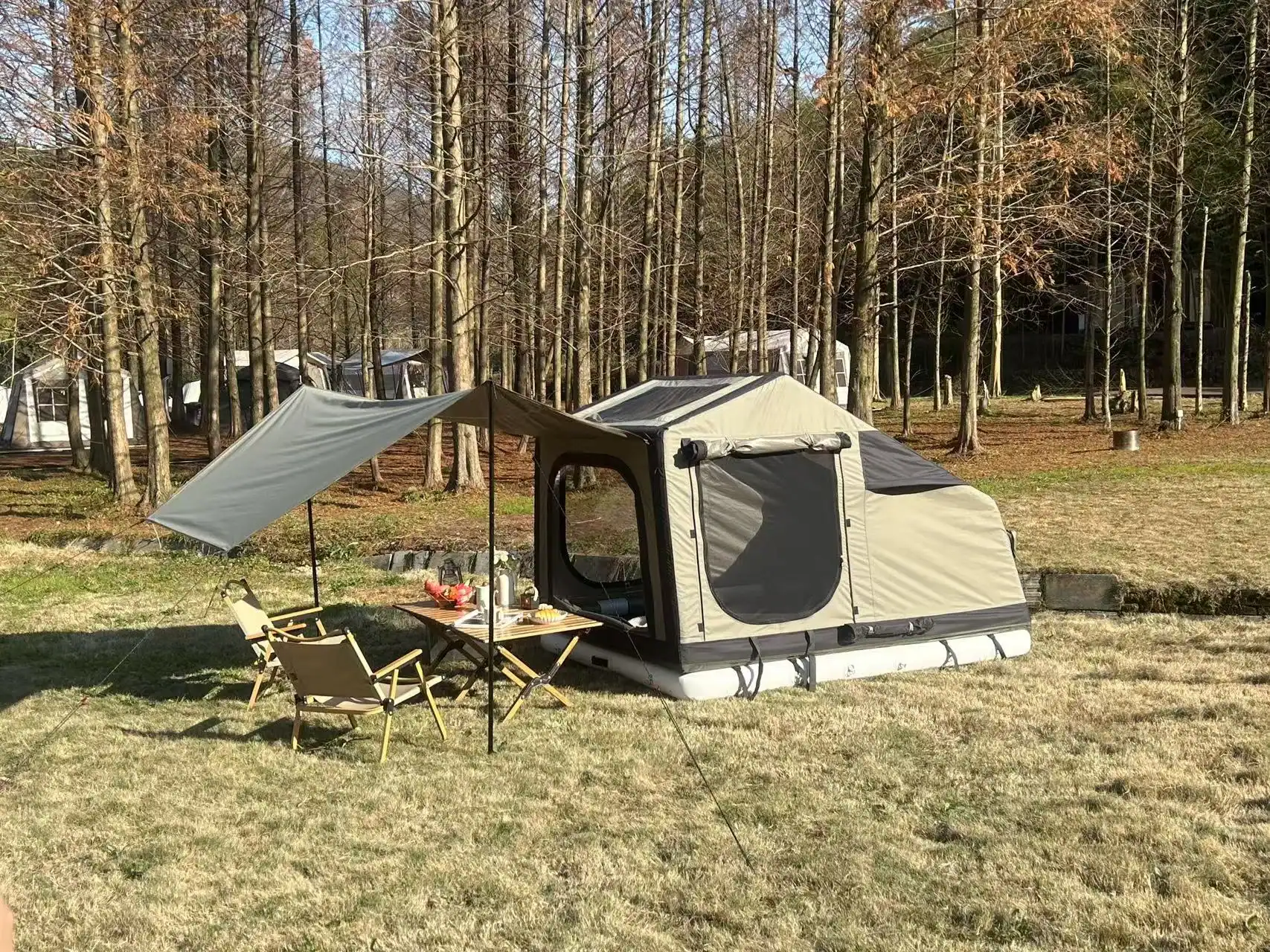
A mid-sized outdoor retailer had been selling inflatable tents for two seasons. The line covered family dome tents and glamping-style shelters priced for weekend campers in North America and Europe. Target users were families with children, which meant the tent had to be simple to inflate, hold air overnight, and survive a stray branch or a dropped chair without collapsing.
The concept was right. Sales volume grew steadily as inflatable tents became a practical alternative to pole-based models. The problem was operational. The retailer was absorbing return costs, shipping damage claims, and negative reviews that started to drag down the category’s overall margin.
Return rate before changes
The return rate for the inflatable tent line ran at 8.6% across the first season. That is well above the typical outdoor gear single-digit threshold and roughly double what most retailers consider acceptable for large seasonal items. Most returned units were not buyers changing their minds. The tents came back with leaks, failed air beams, or coating damage that appeared after a handful of uses.
For a supply chain manager, the 8.6% number was only part of the cost. Each return triggered freight, inspection, restocking, and a refurbishment decision. On a tent with a seasonal shelf life, many of those units ended up written off rather than resold. The category was still growing, but the return rate was quietly eroding the margin that made the growth worthwhile.
Problem: What Was Actually Failing
67% of inflatable tent sourcing complaints trace back to material or welding defects, not design.
When the retailer’s quality team broke down the 8.6% return rate into defect categories, three failure modes dominated. None were random malfunctions. All three traced back to production variables that should have been caught during factory inspection. The failure wasn’t in the tent design — it was the gap between the approved sample and the mass production run.
Air Beam Seam Failures
Air beams are the structural skeleton of an inflatable tent, usually formed by RF-welding or hot-air welding TPU or PVC tube material into shape. If welding temperature or pressure drifts during a long production run, the molecular bond forms incompletely. The beam holds air during the factory test but starts leaking after repeated inflation cycles. Production lines certified under ISO 9001:2015 document welding parameters for every batch precisely because weld repeatability controls the seam failure rate.
Délamination du revêtement du tissu
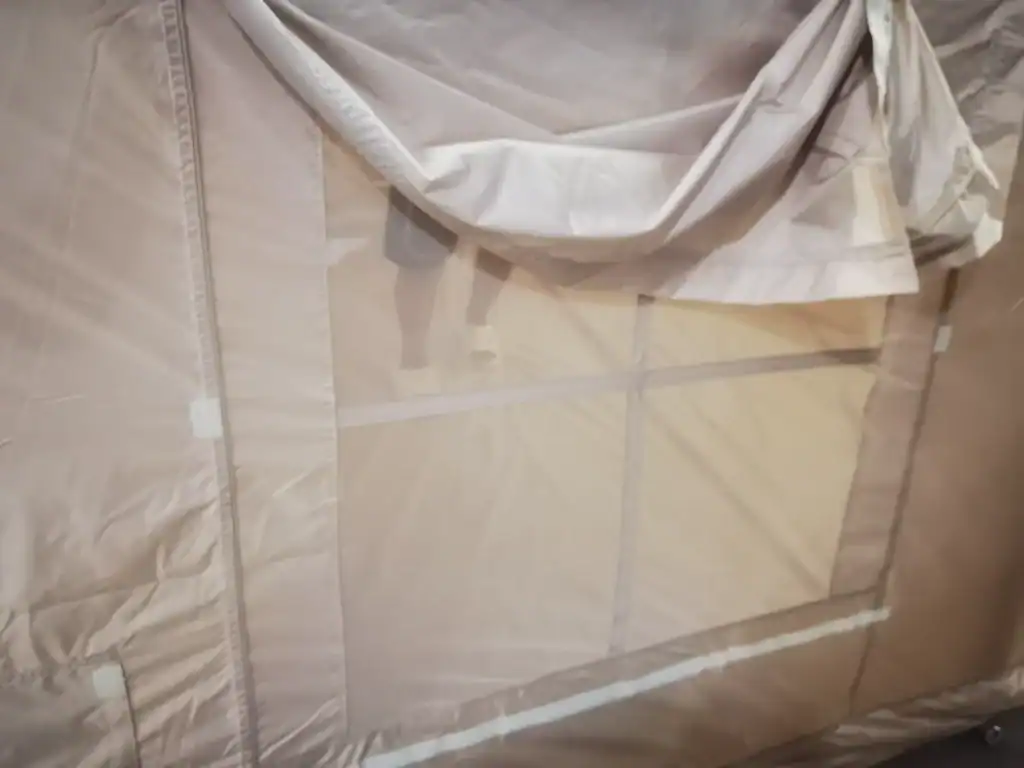
The second failure cluster hit the canopy and floor. The original spec used 150 g/m² Oxford polyester with a Revêtement PU. Under UV exposure and humidity, the coating separated from the base fabric, producing visible peeling and water penetration through the tent walls. Customers read delamination as a clear manufacturing defect. The root cause sat in the lamination process at the fabric mill, not in the tent assembly line.
Valve Leaks at the Inflation Point
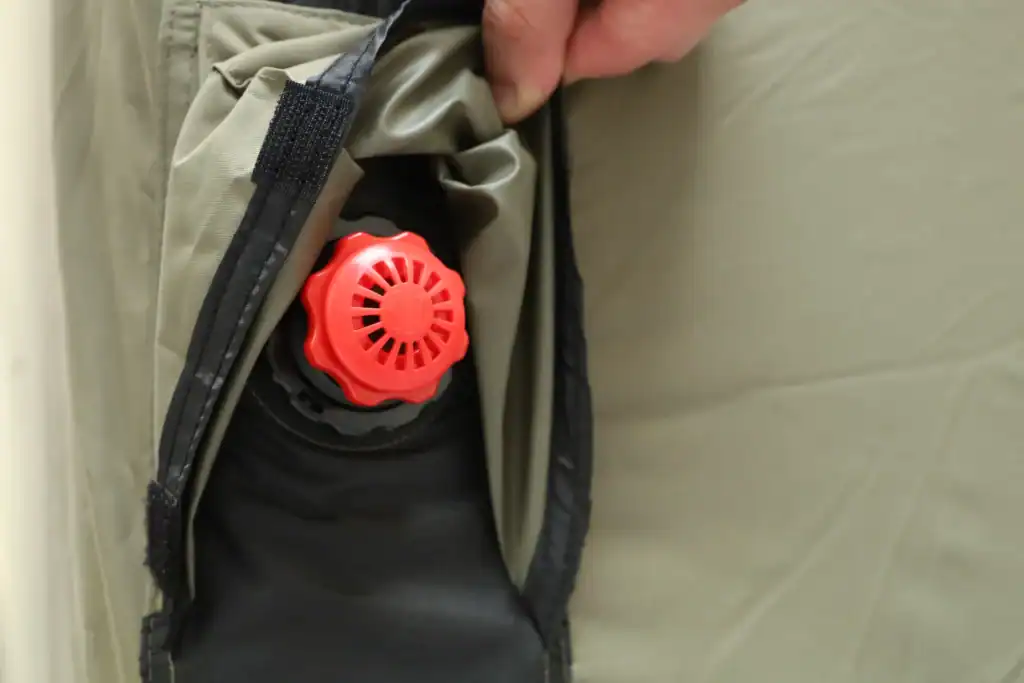
The third failure mode was slow air loss around the inflation valve. The valve flange bonds into the beam wall, making it the highest-stress joint on the tent. A poorly seated flange leaks gradually — enough that a tent sags overnight. A customer who wakes up at 2 a.m. in a collapsing tent doesn’t wait for the trip to end. The return lands within days, and that buyer doesn’t reorder.
All three failure modes shared one root cause: they were invisible at the sample approval stage and surfaced only after repeated field use. Leak detection requires a 24-hour pressure-drop test, not a quick inflation check. Coating bond strength requires a peel test, not a visual scan. Closing that gap demands a material upgrade and a different QC protocol on every production batch.
Solution: Material Upgrade and Supplier Process Changes
The 24-hour pressure-drop test caught leak failures before customers ever inflated a tent.
The fix started with a material reality: 150 g/m² Oxford is a cost-saving compromise, not a durability standard. It abrades on the floor after repeated setups, and its coating breaks down under UV pooling. The upgraded build uses 650 g/m² PVC tarpaulin for both floor and canopy. That is roughly four times the material weight, with a plasticized surface that handles ground friction and rain far better.
PVC Tarpaulin Floor and Canopy
The floor takes the most abuse in a family tent sold at retail. Sharp ground debris, gravel, repeated folding — lightweight Oxford chews through all of it. PVC tarpaulin resists that wear and stays waterproof longer. The canopy benefits too: heavy PVC sheds water instead of letting it soak through the coating. Kelyland’s core tent factory in Ningbo, Zhejiang runs this material spec under ISO 9001 production controls.
0.7mm TPU Air Beams with Reinforced Welds
Air beam seam failures rarely start as punctures. The weld line gives way after repeated inflation cycles, especially when the material is too thin. 0.7mm TPU gives the weld more material to grip, and the reinforced weld pass increases the bonding surface. That combination prevents the slow leaks customers report after a season of weekend use.
24-Hour Air Retention Test on Every Beam
The most effective change was also the simplest to miss. The supplier added a 24-hour pressure-drop test to 100% of the air beams. Each beam inflates to working pressure, sits for 24 hours, and gets checked for pressure loss. Anything that fails the tolerance is pulled before final assembly. Leak failures get caught at the factory gate instead of in a customer’s yard.
-
- Matériau : 150 g/m² Oxford replaced with 650 g/m² PVC tarpaulin for floor and canopy.
- Air beams: Switched to 0.7mm TPU with reinforced welds to extend seam fatigue life.
- QC protocol: 24-hour pressure-drop test added to 100% of production beams.
The sourcing lesson: 67% of inflatable tent complaints trace back to material or welding defects. That matches the failure pattern here. Fabric and welds were the problem, so material and QC upgrades delivered the largest return. Spending on accessories or packaging would not have moved the return rate.
| Change Area | Before | Après | Principaux avantages |
|---|---|---|---|
| Floor & Canopy Fabric | 150 g/m² Oxford fabric | 650 g/m² PVC tarpaulin | Eliminates coating delamination and floor punctures; far higher tear and weather resistance |
| Air Beam Construction | Standard thin-wall TPU/PVC beams with basic welds | 0.7mm TPU with reinforced welds | Prevents air beam seam failures; maintains structural integrity under repeated inflation cycles |
| Quality Control Protocol | Visual inspection and random sample testing | 24-hour air retention pressure-drop test on every batch | Catches valve and weld leaks before shipping, reducing consumer-facing failures at the source |
Résultats
From 8.6% returns to 2.1% — the category went from a margin leak to a profit driver in one season.
The headline result — 8.6% returns down to 2.1% — is a 75% reduction in inflatable tent returns. That shift moved the line from a margin drag to a growth product. The mechanism was simple: the supplier added a 24-hour pressure-drop test on every air beam, catching leak failures before shipping rather than after the end consumer inflated the tent at a campsite.
Return Rate: 8.6% → 2.1%
-
- Return rate: Dropped from 8.6% to 2.1% — a 75% reduction in claims within one sales season.
- Primary failure source: Material and welding defects account for roughly two-thirds of inflatable tent sourcing complaints. The 24-hour retention test targets both.
- Cost shift: Leak detection moved from the end consumer to pre-shipment, eliminating the most expensive failure moment in the supply chain.
The same QC structure that produced these results is standard practice at Kelyland Outdoors’ partner factories — a network that includes dedicated tent production in Ningbo with 800,000 units of annual capacity and ISO 9001:2015 certification. Inspections run at every production stage, with reports available on request.
Net Promoter Score Improvement
NPS followed the return rate down. When air retention issues stop dominating the complaint mix, the customer conversation changes — from demand for refunds after a deflated night to questions about setup and storage. That is a lighter support burden, and it shows up in both NPS and post-purchase review scores.
Reorder Volume Impact
The margin math drove the reorder. At 8.6%, returns diluted category contribution enough to make the line look marginal to the buying committee. At 2.1%, the buyer committed to a larger order for the next season and locked in the upgraded specification. A return rate below 3% changes the internal conversation from risk management to scale planning.
Lessons for Importers and Supply Chain Teams
A 24-hour pressure-drop test on every beam cut inflatable tent returns from 8.6% to 2.1%.
The cost structure of an inflatable tent shows exactly where return risk lives. In a typical bill of materials, 45% goes to material, 30% to welding, and 25% to accessories. When a quote lands noticeably below market, the corner-cutting almost always happens in the first two lines.
Cheaper film or lower-denier fabric saves pennies per unit but creates coating delamination and seam failures. Accessories like valves and zippers are visible and easy to test. Material quality and weld integrity remain invisible until the buyer inflates the tent — which is precisely when they fail.
Sample approval is not production approval
A échantillon de pré-production is hand-assembled by a senior technician, usually over the course of a day. Production-line units come off a high-speed welding machine with a daily output target. The gap between those two realities is what generated the original 8.6% return rate. Sample approval confirms design intent; it does not confirm production consistency.
The fix that closed this gap was a 24-hour air retention test on every beam produced. Each beam gets pressurized, held for 24 hours, and checked for pressure drop. Leaks that would have been found in a customer’s garden were caught at the factory instead.
Spend inspection budget where the risk sits
Across inflatable tent sourcing complaints, 67% trace back to material or welding defects. That makes the allocation obvious: inspect material at intake and beams after welding, rather than spreading the same budget thinly across every station.
-
- Material intake: Verify fabric weight and coating thickness against the spec sheet before cutting. Batch certificates only matter if someone physically checks them.
- Post-weld: Run the 24-hour pressure-drop test on a sample from every beam batch. Random sampling misses intermittent failures.
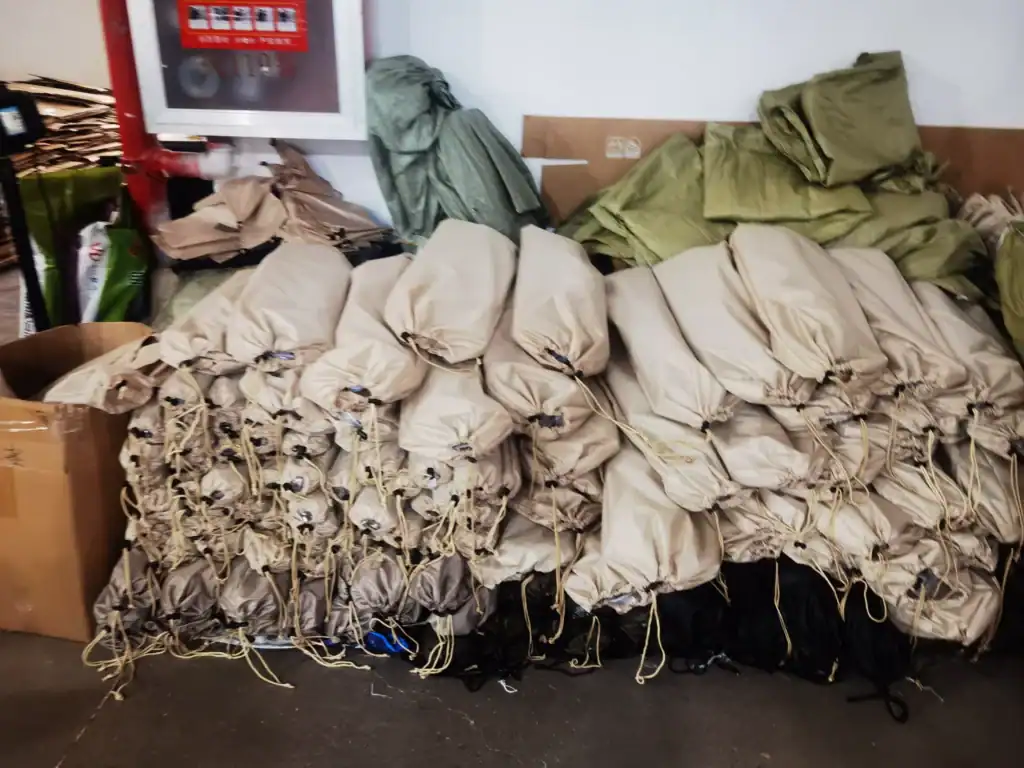
- Audit final : Inspect one unit per carton, not one per container, when the order exceeds 1,000 pieces.
ISO 9001:2015 partner factories run inspections at every production stage and provide reports on request. Use that reporting layer to confirm the 24-hour test was actually performed for each batch. If the supplier cannot produce the pressure-drop log, treat the test as not done.
How to Run a Similar Material Upgrade Project
A material upgrade alone won’t lower the inflatable tent return rate.
Step 1: Baseline your current return reasons
Pull return data from the last 12-18 months and sort by failure mode. For inflatable tents, 67% of sourcing complaints trace back to material or welding defects, so valve leaks and packaging damage rarely justify a full material change. That baseline split decides whether you spend the budget on heavier fabric or on weld process controls.
Set a threshold: if seam or coating failures account for most returns, proceed to the upgrade. If not, fix the actual cause first.
Step 2: Define material and test specifications
Write exact material specs before contacting suppliers. Using 150 g/m² Oxford fabric for a floor that gets packed wet is a common mistake; 650 g/m² PVC tarpaulin offers far better abrasion and water resistance. For the air beams, switch to 0.7mm TPU with reinforced welds, and specify a maximum pressure drop over 24 hours.
-
- Floor/canopy: 650 g/m² PVC tarpaulin with coated finish.
- Air beam: 0.7mm TPU, reinforced weld seams.
- QC gate: 24-hour air retention test on every beam before packing.
Step 3: Run a pilot batch before full production
A single sample tent can hide production variables. Run a pilot batch of at least 50-100 pieces, the MOQ threshold some Kelyland Outdoors lines use, and have the partner factory follow the same welding temperature and QC steps as mass production. ISO 9001:2015 certified plants will document those settings and provide inspection reports at each stage.
Step 4: Track after-sales data for one season
Compare return rates after the season. The 24-hour pressure-drop test catches leak failures before shipping, so the first noticeable drop should appear in seam and leak returns. Track three months after the last shipment, not immediately after delivery, to give users time to set the tent up in the field.
| Étape | Core Actions | Quality Control Focus | Success Metric |
|---|---|---|---|
| Step 1: Baseline Your Current Return Reasons | Audit return data, warranty claims, and customer feedback; categorize failures by seam, coating, and valve defects. | Prioritize material and welding defects, which drive 67% of inflatable tent sourcing complaints. | Accurate baseline return rate and ranked root-cause list |
| Step 2: Define Material & Test Specifications | Upgrade to 650 g/m² PVC tarpaulin for floor and canopy; switch air beams to 0.7mm TPU with reinforced welds. | Add a 24-hour air retention pressure-drop test on every beam before shipping. | Finalized spec sheet; production line matches approved samples |
| Step 3: Run a Pilot Batch Before Full Production | Produce a pilot lot on the exact production line and tooling; compare output against approved samples. | Inspect weld seams, valve seating, and fabric coating adhesion at each production stage. | Pilot defect rate below 2%; sample-to-production consistency confirmed |
| Step 4: Track After-Sales Data for One Season | Monitor return rate, Net Promoter Score, and reorder volume across a full retail season. | Require monthly supplier reporting and corrective-action follow-ups for any defect trend. | Return rate reduced from 8.6% to 2.1%; higher NPS and repeat order volume |
Conclusion
An 8.6% return rate on inflatable tents was draining margin long before complaints reached the category desk. The fix required upgrading to 650 g/m² PVC tarpaulin for the floor and canopy, switching air beams to 0.7mm TPU, and running a 24-hour pressure-drop test on every batch. That combination treated the two root causes — material and welding defects — and cut the return rate to 2.1%.
- Return rate dropped from 8.6% to 2.1% after the material and QC upgrade.
Questions fréquemment posées
What causes high inflatable tent return rates?
Most returns trace to air beam seam failures, fabric coating delamination, and valve leaks at the inflation point. Material and welding defects account for 67% of sourcing complaints, so fix those before redesigning the. Start by logging return reasons per failure mode.
How did Kelyland cut inflatable tent returns?
The case study cut returns from 8.6% to 2.1% by moving to 650 g/m² PVC tarpaulin, 0.7mm TPU air beams, and 24-hour air retention QC on every batch. The key was making. Apply the same material and QC upgrades to your line.
What QC should be added for inflatable tents?
Add a 24-hour air retention test to every batch and inspect welds at each production stage. That catches valve and seam leaks before customers inflate the tent, which is where most returns start. Hold the pilot batch to the same test standard.
What materials reduce inflatable tent returns?
Switching to 650 g/m² PVC tarpaulin for floor and canopy and 0.7mm TPU air beams with reinforced welds directly reduces returns. Budget about 45% of cost to materials and 30% to welding to. Confirm material spec matches production, not just the sample.
How can a retailer start a material upgrade project?
Start by baselining your return reasons, then define material and test specs, run a pilot batch, and track after-sales data for one season. Inspection frequency matters, so sample quality must match production-line quality before. Start with a pilot batch before full production.

 English
 Español
 Deutsch
 Français
 Português do Brasil
 Русский
 العربية
 한국어
 日本語