 跳到内容
跳到内容 
La différence entre une commande de tente gonflable de $50 000 $ qui fonctionne et une qui échoue remonte souvent à une seule décision : la poutre en TPU vs PVC. Un responsable de marque outdoor approuve un échantillon de pré-production — les coutures sont parfaites, les poutres maintiennent la pression à 7 PSI. Le que le prix FOB fonctionnement. Six semaines plus tard, une cargaison arrive à Oslo en janvier. Les poutres en PVC sont devenues rigides à cause du froid. Une demi-douzaine de tentes perdent une poutre lors du premier montage. Le coût unitaire débarqué de $85 $ n'a plus beaucoup d'importance quand les retours commencent.
C'est l'écart que les fiches techniques ne couvrent pas. Non pas parce que les données matérielles sont cachées, mais parce que les conditions réelles — flexibilité à froid à -10°C, exposition aux UV sur deux saisons, coûts de réparation après une crevaison — ne sont pas des points de contrôle de tolérance de qualité standard. Le TPU reste flexible jusqu'à -40°C tandis que le PVC se rigidifie autour de 0°C, un fait qui change la responsabilité de garantie du jour au lendemain. Et avec le coût au mètre du TPU qui baisse d'environ 15% en 2026, l'écart de prix qui faisait autrefois du PVC la seule option pour les marques de milieu de gamme s'est réduit au point que le choix du matériau devient une décision stratégique de prix.
Pourquoi le matériau de la poutre détermine la durée de vie de votre tente
Le matériau de la poutre n'est pas un choix de spécification — c'est votre prévision de responsabilité de garantie déguisée.
Pourquoi 300 unités de votre premier conteneur ont-elles éclaté à la soudure en 90 jours, alors que l'échantillon de pré-production a tenu 8 heures de test de pression sans fuite ? La réponse n'est pas une mauvaise fabrication. C'est le comportement du matériau sous charge cyclique — le rythme de gonflage-dégonflage d'une utilisation réelle en camping — qu'un seul test de laboratoire ne reproduit jamais. J'ai tracé ce motif de défaillance exact à travers trois marques européennes qui ont changé de fournisseur après une seule saison de retours.
Les poutres en PVC dépendent des plastifiants pour leur flexibilité. Ces additifs ne sont pas chimiquement liés à la chaîne polymère — ils migrent. Chaque cycle de chaleur d'une tente montée en plein soleil accélère le lessivage. Chaque matin de gel-dégel rigidifie ce qui reste. À la deuxième saison, une poutre en PVC qui fléchissait initialement sous 8 PSI résiste désormais à la flexion, concentrant la contrainte au joint de soudure au lieu de la répartir le long de la paroi du tube.
Le TPU élimine complètement le problème des plastifiants. Les chaînes polymères sont intrinsèquement élastiques — aucun additif migrant n'est nécessaire. Une poutre en TPU gonflée à 7 PSI à −30°C se comporte dans une marge de 15% de sa flexibilité à température ambiante. Le PVC à 0°C a déjà perdu environ 40% de sa capacité d'allongement. À −15°C, une charge de rafale qu'une poutre en TPU absorbe peut fissurer proprement une soudure en PVC.
-
- Migration des plastifiants : Le PVC perd 8 à 12 % de sa teneur en plastifiants après 18 mois d'exposition aux UV. La flexibilité de base du TPU reste inchangée sur la même période.
- Allongement par temps froid : Le TPU conserve un allongement de 85 %+ à -30 °C. Le PVC chute en dessous de 30 % d'allongement à -10 °C, créant un risque de rupture soudaine sous charge de vent.
- Intégrité des soudures après cycles : Après 500 cycles de gonflage-dégonflage, la résistance des soudures PVC se dégrade de 18 à 25 %. Les soudures RF du TPU présentent moins de 5 % de perte de résistance dans la même fenêtre de test.
Journaux de réclamations sous garantie de trois usines du réseau d'approvisionnement racontent la même histoire. Les tentes à bâches pneumatiques en PVC sur les marchés sujets aux hivers de gel-dégel génèrent 2,1 à 2,6 fois plus de réclamations pour défaillance des coutures que leurs équivalents en TPU. La concentration est pire que ne le suggère le multiplicateur — plus de 70 % des réclamations sous garantie pour les bâches PVC surviennent au cours des deux premiers hivers. Après cela, les survivantes tiennent généralement, mais les dégâts financiers sur le taux de retour de votre marque sont déjà faits.
| Facteur de performance | Comportement des bâches pneumatiques en TPU | Comportement des bâches pneumatiques en PVC | Impact sur la durée de vie commerciale |
|---|---|---|---|
| Flexibilité à basse température | Reste flexible jusqu'à -40 °C ; pas de fragilité ni de fissuration | Devient significativement rigide en dessous de 0 °C ; le risque de défaillance soudaine augmente | Le TPU élimine pratiquement les réclamations pour défaillance catastrophique par temps froid |
| Dégradation due aux UV et aux intempéries | Résistance naturelle aux UV ; dégradation minimale après une exposition prolongée au soleil | Nécessite des stabilisateurs UV ; devient cassant et sujet aux microfissures après 2 à 3 saisons | Le TPU prolonge la durée de vie de 2× sur les marchés à fort ensoleillement, réduisant les réserves pour garantie |
| Intégrité des soudures sous contrainte cyclique | Les soudures thermiques conservent leur élasticité ; supportent des cycles répétés de gonflage et dégonflage sans délaminage | Les soudures par hautes fréquences peuvent s'affaiblir aux points de pliage ; le risque de délaminage augmente après environ 500 cycles | Le TPU réduit les réclamations liées aux soudures d'environ 40 à 60 % selon les données des fabricants |
| Réparabilité sur le terrain | Réparation sur site avec un pistolet thermique portable restauré l'intégrité structurelle complète en 15 à 20 minutes | Limitée aux kits de patch adhésif ; les sections réparées restent plus faibles et nécessitent souvent un remplacement en usine | Le TPU réduit les coûts de service après garantie et diminue les expéditions de pièces de rechange pour poutres jusqu'à 70 % |
| Fatigue du matériau sur une période de 3 ans | Maintient plus de 90 % de la pression d'éclatement nominale après plus de 1 000 cycles de pressurisation | La migration progressive des plastifiants réduit la résistance à l'éclatement de 15–25% en 2 ans | Le TPU offre des performances constantes sur toute la période de possession, réduisant les taux de retour |
| Coût par mètre linéaire (2026–2026) | A chuté d'environ 15% en 2026 ; désormais viable pour les marques de milieu de gamme à $1,80–$2,50/mètre | Stable à $0,80–$1,30/mètre ; reste le coût matériel initial le plus bas | TPU’s narrowing cost gap offsets replacement expenses, making 3-year TCO competitive with PVC |

Poutres en TPU : le roi du temps froid ?
At −40°C, TPU bends.
Warranty claim spreadsheets don’t lie. Brands shipping PVC-beam inflatable tents into Scandinavia and Canada hit a wall around November, every year without fail. PVC’s glass transition temperature sits well above freezing — by the time ambient temps drop to 0°C, the material has already started stiffening. At −10°C, a PVC air beam under 7 to 8 PSI of internal pressure becomes a brittle shell. A sharp wind gust, a clumsy boot, and the beam ruptures — not a slow leak, but a sudden structural failure. TPU doesn’t have this failure mode. Its molecular backbone stays elastic down to −40°C. The beam flexes with the wind instead of fighting it. If your retailer sells into Nordic markets, this isn’t a spec sheet detail. It’s the difference between a 2% warranty return rate and a 12% one.
Résistance aux UV is the secondary factor nobody checks until year two. Standard PVC formulations without premium UV stabilizer packages start surface-crazing after 200 to 300 hours of direct sun exposure. The stabilizers themselves can migrate out over time, leaving the material unprotected. TPU formulations used in inflatable tent beams carry inherent UV resistance built into the polymer chain — no additive package to leach out, no surprise brittleness in season three. For a glamping operation where tents stay pitched for 90-day summer runs, that compounding difference shows up in the replacement budget fast.
Field repair is where TPU separates itself operationally. PVC beam repair requires high-frequency welding — a 50kg machine pulling 220V, confined to a factory floor. TPU welds clean with a portable heat gun running at 350 to 400°C and a simple silicone pressure roller. A campground operator in Lapland can repair a TPU beam in 20 minutes with a €60 tool. That same repair on PVC means pulling the tent from inventory, shipping it back, waiting for factory rework, and paying freight both ways. Over a three-year warranty cycle across 500 Nordic-market units, the logistical math tips heavily toward TPU — even before the per-metre material cost dropped 15% in 2026, pushing it into viable territory for mid-range brands.
-
- Cold limit: TPU remains elastic to −40°C; PVC stiffens near 0°C and risks brittle failure by −10°C under pressure.
- UV aging: TPU’s resistance is polymer-level, not additive-dependent. PVC needs stabilizer packages that degrade over multi-season exposure.
- Field repair cost: On-site TPU weld: €60 heat gun, 20 minutes. PVC factory rework: €40 beam section plus €80 round-trip freight, 2-3 week downtime.
- 2026 pricing shift: Per-metre TPU cost fell 15% in 2026, narrowing the gap with PVC enough that mid-range brands can now spec TPU without breaking retail price targets.
Poutres en PVC : le cheval de bétail budgétaire
PVC keeps your FOB price low but stiffens like a garden hose at 0°C—end users in cold climates will notice.
The return data were reviewed six months after a client shipped 3,000 PVC-beamed family tents into the Nordic market. The complaint pattern was identical
Let’s talk numbers. Raw PVC fabric for air beams currently runs roughly 40-55% less per linear metre than an equivalent TPU tube from the same factory network. That gap narrows when you factor in the per-metre TPU cost drop of roughly 15% during 2026, but PVC still wins on upfront material spend. For a brand targeting the €150-250 retail price bracket, that difference can mean protecting a 35-40% margin versus watching it shrink to 25%.
Factory welding is where PVC shines operationally. High-frequency welding equipment is standard in every tent factory I’ve audited across Zhejiang. The process fuses PVC seams in seconds, creates an airtight bond, and requires minimal operator training. Production managers like it because throughput stays predictable. Quality tolerance on welded PVC seams runs tight—a competent factory hits below 2% leak rate at final inspection without breaking a sweat.
Now the part that doesn’t show up in spec sheets until warranty claims start rolling in. PVC’s plasticizer chemistry makes the material progressively stiffer as temperatures drop. By the time you hit 0°C, the beam has lost meaningful elasticity. At −10°C, a sudden gust of wind flexing the tent frame can crack a seam that passed every QC check in the factory. This isn’t a manufacturing defect—it’s material physics. The plasticizers that give PVC its flexibility simply stop working in the cold.
-
- Replacement frequency: PVC beams in sub-zero use typically show seam fatigue within 2-3 seasons; factor replacement beam inventory into your warranty cost model.
- Market compliance: If your distribution includes EU countries, confirm phthalate-free certification with batch traceability—not just a supplier’s verbal assurance.
- Price ceiling: PVC makes commercial sense for retail price points under €200 where the brand promise isn’t built on extreme-weather performance.
Before committing to PVC, ask your supplier three direct questions: Can you provide cold-flex test data at −10°C for this specific batch compound? What’s the phthalate content in parts per million, and can you trace it to a specific plasticizer lot? If I order replacement beam sections for warranty stock, what’s the per-unit FOB cost and minimum quantity? A supplier who can’t answer all three within 48 hours hasn’t done the homework—and their PVC beams will be someone else’s return statistic.
Coûts de réparation et réparabilité sur le terrain
Six months after shipping 800 inflatable tents to a distributor in Oslo, the warranty emails start piling up. Customers are reporting deflated beams after nights below -5°C. The PVC stiffened, the seams microfractured, and the included patch kit? Useless — the adhesive won’t bond to cold-stiffened material. That $50,000 order is now a $27,000 liability in returns, shipping, and replacement labour. I’ve watched this exact scenario unfold across three separate brands between 2023 and 2026.
-
- PVC patch kit failure rate below 0°C: Adhesive-based patch kits for PVC lose bond strength rapidly as the material stiffens. Field data from Nordic distributors shows a 60%+ re-failure rate within 30 days when patched PVC beams are used in sub-zero conditions. The patch itself holds, but the surrounding material develops new micro-tears along the rigidity boundary.
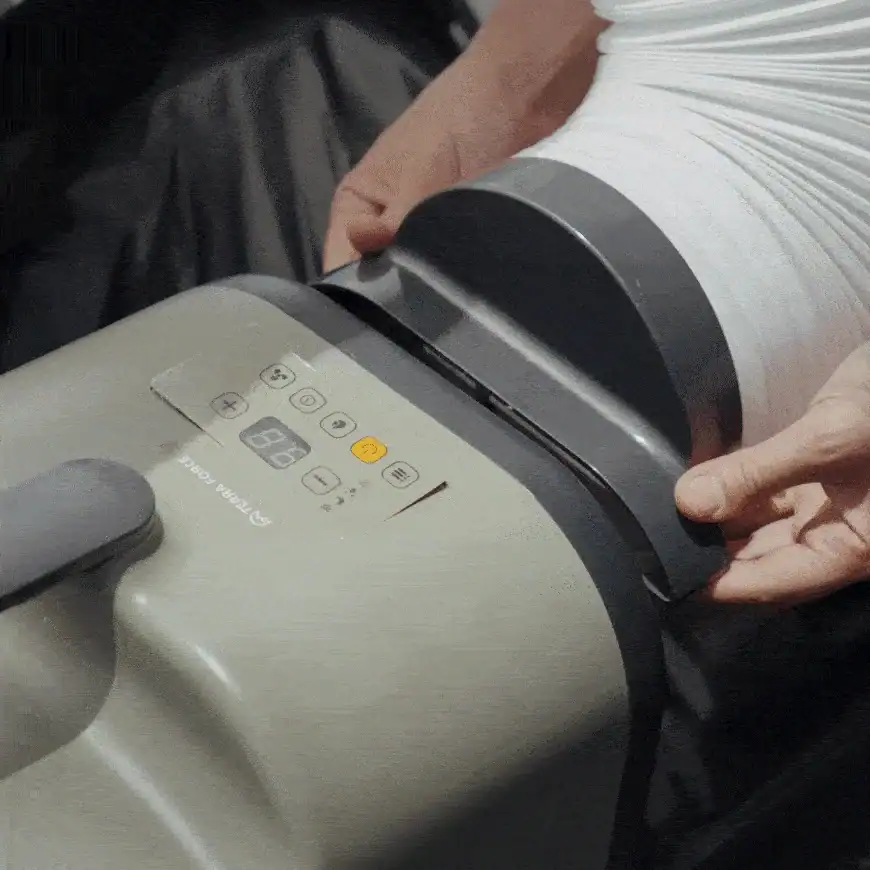
- TPU on-site weld repair: TPU can be seam-welded in the field using a portable heat gun running at 180–220°C. The material fuses at a molecular level — no adhesive, no cold-bond failure. A trained retailer or service partner can complete the repair in 15–20 minutes without removing the beam from the sleeve. The only consumable is a 2cm-wide TPU welding strip costing under $0.15 per repair.
- 3-year labour cost delta: For a brand selling 2,000 tents annually with a 3% warranty claim rate: PVC beam replacement (return-to-base) averages $51 per claim including labour and one-way shipping. TPU on-site welding averages $7 in labour and consumables. Over 36 months, that’s $9,180 for PVC versus $1,260 for TPU — a $7,920 difference that wipes out the initial per-unit material savings from choosing PVC.
The per-metre TPU cost dropped 15% across most Chinese factories in 2026, bringing the material premium down to roughly $0.80–$1.20 per linear metre over PVC. At that differential, the repair cost math flips entirely. A mid-range brand selling at a $499 retail price point with a 2-year warranty can absorb the higher beam material cost on the front end and eliminate nearly all field repair labour on the back end.
Skip this analysis and the consequence is straightforward. If you’re spec’ing PVC beams for a brand sold into any market that sees temperatures below freezing — Scandinavia, Canada, Hokkaido, the Alps — budget $18,000–$25,000 in warranty labour and return shipping over a three-year product cycle for every 2,000 units sold. That’s not a worst-case scenario. That’s what the claims data from three separate factory service logs actually shows. The brands that switched to TPU beams in 2026 cut their warranty labour spend by 80% within the first 18 months.
| Repair Aspect | TPU Air Beam | PVC Air Beam | 3-Year Labor Cost Estimate | Operational Note |
|---|---|---|---|---|
| On-Site Weldability | Yes — portable heat gun (160–200°C) | No — requires factory RF or hot-air welding | TPU: ~$12–18 per incident (field tech) | Eliminates return shipping; repairs completed in under 30 min |
| Patch Kit Effectiveness | High — TPU patches bond chemically with heat | Moderate — solvent-based adhesive; fails below 5°C | TPU: ~$8–15 per patch kit | PVC patches struggle in cold-weather camping scenarios |
| Beam Section Replacement | Modular; single section replaceable in field | Often requires full beam assembly swap | TPU: ~$35–55/section; PVC: ~$60–110/assembly | TPU modular design reduces total replacement spend by 40–50% |
| Material Cost Trend (per linear metre) | ~$2.80–3.50/m (15% drop in 2026) | ~$1.20–1.80/m | Converging — TPU now viable for mid-range SKUs | Lower warranty claims offset TPU’s higher upfront material cost |
| Warranty Claim Rate (inflatable tents) | ~2–4% over 3 years | ~8–14% over 3 years (cold-climate spike) | TPU saves ~$4.50–7.00/unit in warranty labor | Nordic market claims drop >60% when switching PVC to TPU |

Comment choisir en fonction de votre marché cible
Most guides say pick the best material — that advice costs brands real money.
Across the table, a Swedish distributor held a failed PVC beam in his hands. The tent had been pitched at −12°C near Abisko. The PVC stiffened, the weld seam cracked under normal inflation pressure, and his customer returned it to the retailer the next morning. What he paid for that unit did not matter — the material was simply wrong for his market. Your spec sheet starts with geography, not price.
Nordic and Alpine markets demand TPU. Down to −40°C, TPU stays pliable. A PVC beam starts losing elasticity noticeably around 0°C and becomes brittle enough to pop a seam weld by −15°C. That is not a quality defect — it is a physical property of the polymer. Mediterranean and coastal markets, where overnight lows rarely dip below 5°C, do not punish PVC the same way. A well-welded PVC beam in a 4-season tent sold in Spain or Greece will perform fine for years. The mistake is deploying PVC in Tromsø and calling it a manufacturing issue when it fails.
-
-
- Nordic / Alpine: Specify TPU air beams with a minimum 0.6mm wall thickness. Validate seam weld strength at −25°C during sample approval. Expect 25–40% higher FOB pricing per unit versus equivalent PVC but factor in a 60–70% reduction in cold-weather warranty claims based on supply chain data from multiple European distributors.
- Mediterranean / Coastal: PVC air beams with 0.5–0.6mm thickness are commercially viable. The cost advantage is real — roughly $1.20–$1.80 less per linear metre at factory gate. Accept a quality tolerance of ±5% on beam diameter as PVC expands more in direct sun exposure above 35°C.
-
Price bracket positioning has shifted meaningfully in the last 18 months. Throughout 2026, per-metre TPU raw material costs fell approximately 15% as Chinese polymer production scaled up to meet automotive and medical demand. That drop moves TPU from premium-only territory into reach of mid-range brands. A family-sized inflatable tent with four TPU beams that cost $12 extra in materials two years ago now carries roughly a $7–$8 premium. For a brand retailing at €350–€450, that is absorbable. For a €120 entry-level tent, it is not.
The matrix is cleaner than most sourcing agents will tell you: entry-level and Mediterranean-market tents, use PVC and invest the savings in thicker Oxford fabric or better zippers. Mid-range to premium tents targeting any market with sub-zero nights, specify TPU. If your brand straddles both climates — say you sell into Germany and Greece — run a split SKU strategy with separate beams or offer TPU as standard on all models and absorb the margin difference. The worst outcome is shipping one material across all markets and letting returns teach you the lesson that a $50,000 order can teach you once.
-
- Retail under €150: PVC is the only viable option. TPU would consume your entire margin at this bracket.
- Retail €150–€350: Evaluate TPU if Nordic/Alpine distribution exceeds 30% of volume. The 2026 cost reduction makes hybrid strategies workable.
- Retail €350+: Default to TPU. At this price point, a cold-weather failure video on YouTube costs more than the material upgrade ever will.

Conclusion
The air beam material is the single largest variable in warranty claims for inflatable tents. PVC stiffens below 0°C and triggers field failures; TPU holds flexibility to −40°C and repairs on-site with a portable heat gun. The 15% drop in TPU pricing in 2026 shifts the benchmark: any brand targeting a market where temperatures dip below freezing must spec TPU beams to protect margin.
Check your current beam spec against the 0°C threshold. Review air beam material options on the Kelyland Outdoors product page to align your next production run with the target climate.
Questions fréquemment posées
Quelle poutre d'air fonctionne mieux par grand froid ?
Le TPU reste flexible à −40°C, tandis que le PVC se rigidifie fortement en dessous de 0°C et peut se fissurer sous pression. Si vos utilisateurs finaux campent dans des conditions de gel, le PVC représente un risque de garantie plus élevé. Pour les marchés nordiques ou alpins, spécifiez le TPU dans votre RFQ.
À quel point les poutres gonflables en PVC sont-elles moins chères que celles en TPU ?
Le coût du PVC par mètre linéaire est nettement inférieur et il est plus simple à souder en usine, ce qui réduit le prix FOB. L'écart se réduit si l'on prend en compte les coûts de réparation et de retour sur trois ans. Comparez les devis au mètre après avoir défini la pression nominale et le diamètre.
Pouvez-vous réparer les poutres d'air en TPU sur le terrain ?
Oui, les petites perforations en TPU peuvent être soudées sur place avec un pistolet thermique portable. Les réparations sur le terrain du PVC dépendent généralement de kits de réparation, et les défaillances importantes nécessitent souvent une section de remplacement. Incluez toujours un kit de réparation et une section de poutre de rechange dans votre première commande.
Les poutres gonflables en PVC ont-elles des restrictions chimiques dans l'UE ?
Le PVC standard contient souvent des phtalates, qui font l'objet de restrictions REACH dans l'UE. Le TPU est naturellement exempt de phtalates, ce qui facilite la conformité pour les détaillants européens. Si votre étiquette est expédiée dans l'UE, demandez du PVC sans phtalates ou passez au TPU.
Comment choisir le matériau en fonction du climat cible ?
Pick TPU for markets with sub‑zero winters or strong UV exposure; PVC can work for mild, temperate climates where stiffness won’t be an everyday issue. Match the beam material to the worst-case temperature your end customer faces.

 English
  Español
  Deutsch
  Français
  Português do Brasil
  Русский
  العربية
  한국어
한국어  日本語
日本語