 跳到内容
跳到内容 
tent fly replacement inflatable tent is the first checkpoint buyers should lock before they approve a supplier, budget, or production slot. Two inflatable tent flys can look identical on a flat table. One costs 30% more. The difference is rarely the fabric cost — it is whether the attachment tabs align with the beam sleeve geometry when the tent is inflated. A buyer lost a $50K order because the pre-production sample passed the visual check but shifted by four centimeters under tension during mass production. That gap choked the vent, and condensation turned the inner tent into a drip zone.
This is why tab-to-tab distances and port positions matter more than floor dimensions when sourcing a tent fly replacement for an inflatable tent. A generic cover cut for a straight-pole frame will not hold its shape over an inflated arc. The stress points pull differently, and what looks like a perfect fit on paper becomes a warranty claim after three nights in wind. If you are evaluating replacement suppliers or ordering a custom rainfly for an inflatable camping tent, skip the floor print. Measure around the beam ports instead.
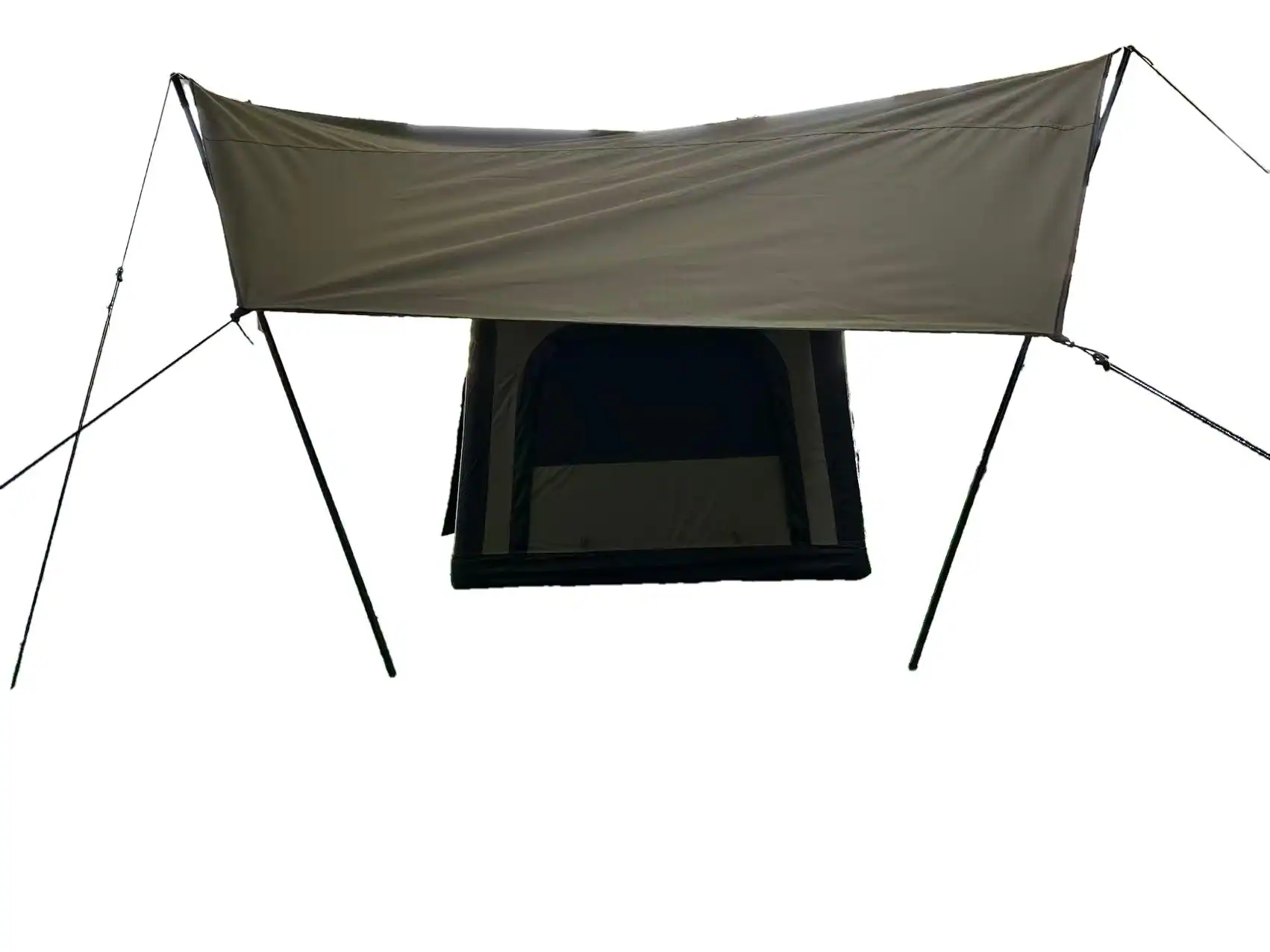
Measure Attachment Points, Not Just Fly Length
Tab-to-tab distance, not fly length, determines fit on inflatable tents.
Most buyers measure the fly length when ordering a replacement. That is the wrong number. On an inflatable tent, the fly pulls against beam arcs, not straight poles. A fly that matches the floor dimensions can still be 8 cm short at the ridge because the inflated beam changes where tension lands.
Tab-to-Tab Distance Drives Fit
Lay your old fly over the inflated tent and measure from hook-and-loop tab to tab. Record every attachment point: around the beam ports, along the ridge line, and across the overhang below the mattress line. These distances in millimeters are what a factory uses to cut a replacement fly that actually tensions correctly.
Skip this step and you risk a fly that looks fine flat but pulls inward when staked out. The result is a choked vent gap and fabric rubbing against the inner tent — two failure modes that generate warranty claims within one season.
Capture Beam Sleeve Geometry
Beam sleeve geometry is the second measurement most buyers miss. You need three numbers: beam sleeve circumference or diameter, port opening width, and distance between ports. Send these with your sample order. They tell the cutter where to place reinforced patches and how much fabric to allocate around each beam port.
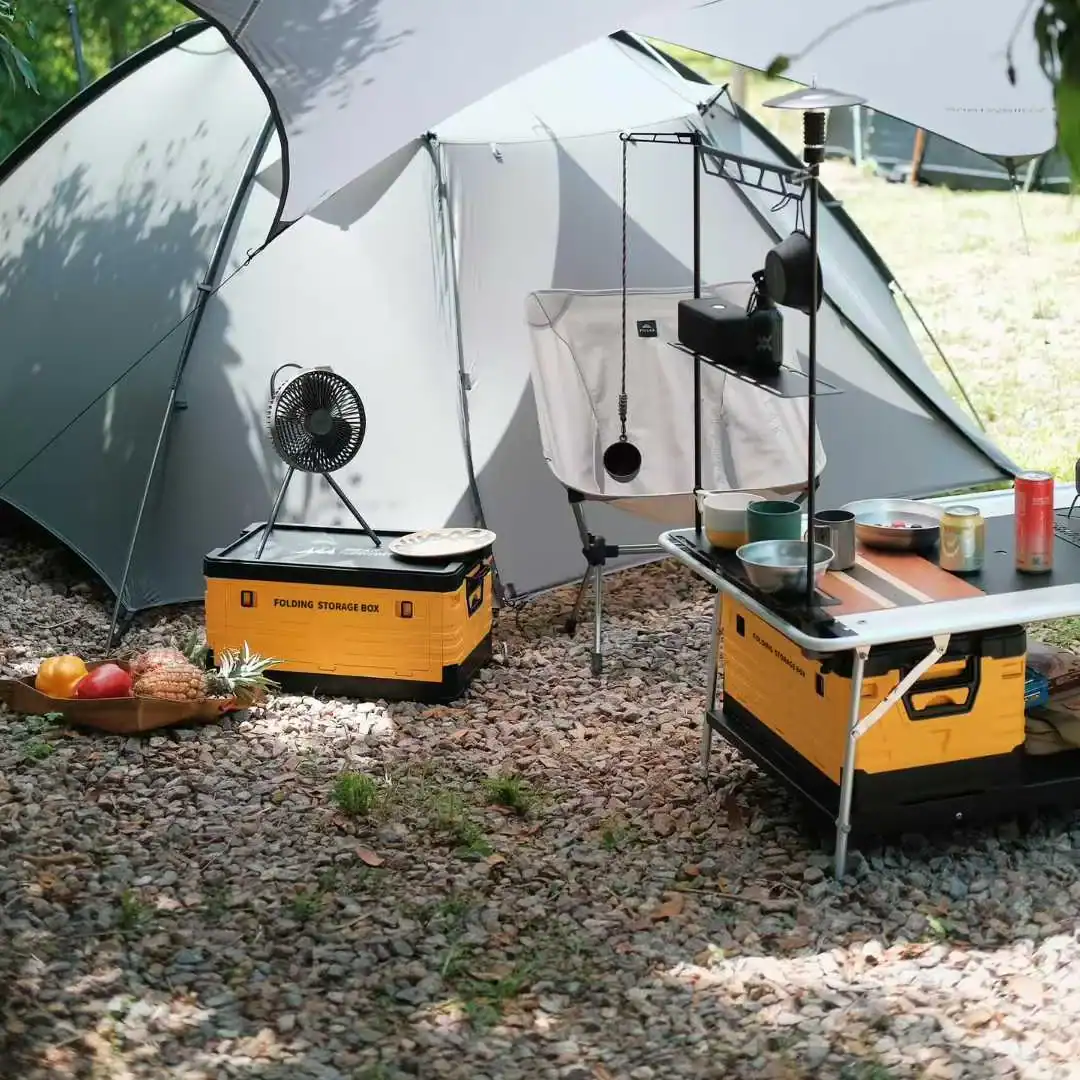
Understand Full-Coverage vs Half Fly Venting
Les demi-toits économisent du poids mais laissent une tente exposée à la pluie poussée par le vent.
Couverture Totale : La Règle de l'Espace d'Air de 5–10 cm
Un toit à couverture totale doit maintenir un espace de 5–10 cm entre le tissu du toit et la tente intérieure en chaque point le long du côté de l'arceau et de la ligne de faîte. Cet espace ne concerne pas uniquement la circulation de l'air — il empêche le toit d'éroder le revêtement imperméable de la tente intérieure. L'abrasion crée des micro-perforations qui apparaissent après 20 à 30 nuits d'utilisation, généralement lors d'un épisode de pluie quand un remplacement est impossible.
Le débord doit également descendre sous la ligne du matelas aux deux extrémités. S'il s'arrête au-dessus du matelas, la pluie poussée par le vent frappe la paroi intérieure et s'accumule à la couture. Un acheteur qui néglige cette vérification se retrouve avec une zone de couchage sèche par temps calme et de l'équipement mouillé par temps venteux.
Demi-Toit : Compromis Poids vs Protection
Les demi-toits ne couvrent que le corps principal ou une extrémité de la tente, laissant la tête ou les pieds exposés. Ils permettent d'économiser environ 25 à 40 % du poids et du coût du matériau, ce qui compte pour les modèles de randonnée où chaque gramme est important. Mais ce sont des solutions pour beau temps uniquement.
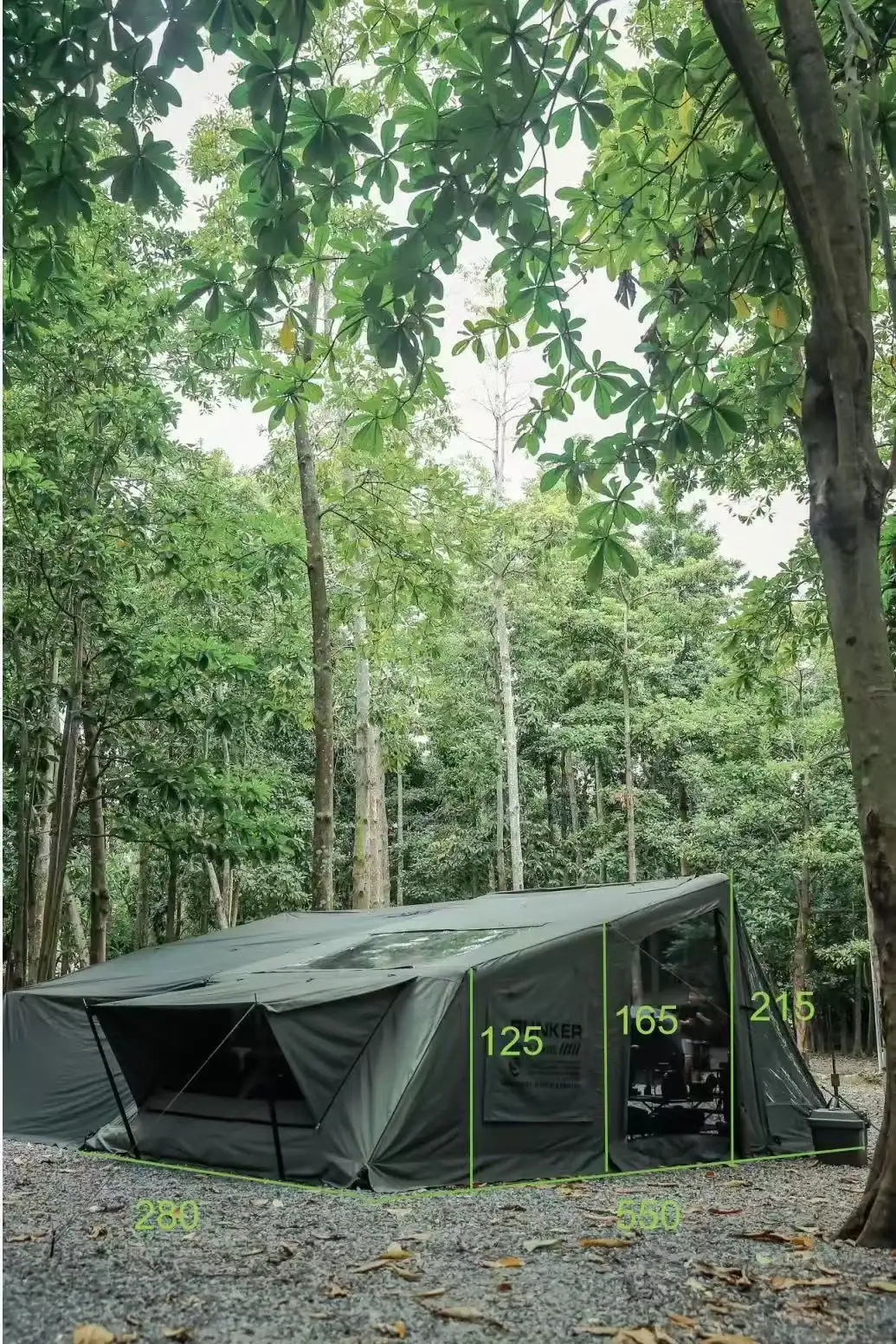
Inspect the Hardware and Strain Points
Les coutures de renfort en bar-tack aux boucles de sangle sont le meilleur indicateur de la durabilité du toit par vent.
Les boutons-pression, attaches velcro, boucles et élastiques à crochet cèdent en premier par vent. Un toit avec un tissu durable mais des accessoires fragiles génère des retours. Évaluez chaque point d'attache comme si le client final montait la tente sous une tempête.
Vérifier les Patchs Renforcés et les Coutures Bar-Tack
Recherchez des patchs renforcés aux coins, des boucles de sangle fixées par couture bar-tack, et des points de tension correspondant aux emplacements des ports d'arceaux. C'est là que les toits économiques se déchirent en premier. Le réseau d'usines derrière Kelyland Outdoors utilise des processus certifiés ISO 9001:2015 qui spécifient la densité des bar-tacks et le nombre de points par pouce — des détails qui séparent un toit qui dure trois saisons de celui qui se fend en pleine saison.
- Spécification : Une couture bar-tack doit apparaître à chaque boucle de sangle, fixation de boucle et patch de renfort d'angle. Minimum 12 points par pouce sur sangle en nylon.
- Risque : Les fixations à couture simple ou uniquement en zigzag cèdent sous charges de vent cycliques. Un coin déchiré sur une tente à 200 € signifie une réclamation sous garantie et un client perdu.
Plan pour la réparabilité sur le terrain
Choisissez des boucles standard et des boucles élastiques qui peuvent être remplacées sur un site pluvieux. Les pièces moulées propriétaires rendent les réparations sur le terrain impossibles et augmentent les coûts de garantie après-vente pour une marque. Une boucle cassée lors d'un voyage un vendredi soir signifie que l'auvent flotte — le campeur se souvient de la marque, pas du fournisseur.

Match Fabric and Coating to the Season
Un auvent avec une colonne d'eau de 3000mm et des passages d'arceaux non scellés échouera avant un auvent de 1500mm avec des coutures scellées.
Dénier du tissu et l'enduction déterminent si l'auvent de remplacement résiste aux empaquetages répétés et aux intempéries. Un auvent en nylon ou polyester 20-40D est un produit pour beau temps — idéal pour les week-ends par temps sec mais pas pour un usage alpin ou les moussons. Le choix pour l'hiver est un tissu 40-75D avec enduction PU, silicone, ou hybride silicone/PU.
Objectifs de colonne d'eau
Utilisez 1500mm+ résistance à la pression hydrostatique comme référence estivale. Cette spécification gère les pluies modérées et les embruns poussés par le vent sans fuir. Pour les tentes gonflables d'hiver ou par temps froid, passez à 3000mm+. La différence n'est pas marginale — elle détermine si l'auvent résiste sous des précipitations soutenues sur des sites exposés.
- Référence estivale : 1500mm+ résistance à la pression hydrostatique; adapté au camping par beau temps et aux pluies occasionnelles.
- Spécification hiver/temps froid : Colonne d'eau 3000mm+ ; requise pour un usage alpin, la charge de neige et une exposition prolongée à l'humidité.
Coutures scellées et passages d'arceaux
Conclusion
Une bâche de remplacement qui échoue à l'espace de ventilation ou à l'alignement des fixations n'est pas un problème d'ajustement — c'est une réclamation de garantie en devenir. Les cinq vérifications ci-dessus vous offrent un cadre de réussite/échec avant de vous engager dans l'outillage ou la production en série. Mesurez de patte à patte autour des orifices de poutre, et non sur l'empreinte au sol.
- Les distances de patte à patte et la géométrie du manchon de poutre contrôlent l'ajustement, pas les dimensions au sol.
- Les bâches de couverture complète nécessitent un espace d'air de 5 à 10 cm pour éviter la condensation et l'abrasion du revêtement.
- Use 1500mm+ hydrostatic head for summer and 3000mm+ for winter-grade flys.
The benchmark for a well-sourced inflatable tent fly is a first-pass fit approval rate above 90% on the initial sample. If your current supplier can’t hit that, send your tab measurements and beam sleeve geometry to Kelyland’s team for a custom OEM quote. They build from your numbers, not generic patterns, and can start production at MOQs as low as 50-100 pieces with a standard lead time of 30-45 days through ISO-certified factories.
Questions fréquemment posées
Quelle est la différence entre un double toit et un rainfly ? Ce sont la même couche. Le double toit est le terme général pour désigner la couverture extérieure imperméable ; rainfly met l'accent sur... ?
La réponse exacte dépend de la spécification du produit, de la quantité et de la configuration de la commande. L'approche la plus sûre est de confirmer les conditions commerciales uniquement après le verrouillage de la fiche d'exigences finale. Les conditions finales doivent être confirmées en fonction de la spécification exacte du produit et des conditions de commande.
Comment mesurer une tente gonflable pour remplacer le double toit ? Mesurer de bande auto-agrippante à bande auto-agrippante autour des orifices des arceaux, le long de l'arête, et à travers le débord ?
La réponse exacte dépend de la spécification du produit, de la quantité et de la configuration de la commande. L'approche la plus sûre est de confirmer les conditions commerciales uniquement après le verrouillage de la fiche d'exigences finale. Les conditions finales doivent être confirmées en fonction de la spécification exacte du produit et des conditions de commande.

 English
  Español
  Deutsch
  Français
  Português do Brasil
  Русский
  العربية
  한국어
한국어  日本語
日本語