 跳到内容
跳到内容 
La pression PSI de la tente gonflable est le premier point de contrôle que les acheteurs doivent verrouiller avant d'approuver un fournisseur, un budget ou un créneau de production. Une commande de $50 000 tentes gonflables est arrivée à l'entrepôt en septembre. En octobre, la responsable de catégorie retail avait enregistré 12 réclamations d'affaissement. L'usine a blâmé une erreur de l'utilisateur. Les clients finaux ont blâmé le produit. Le vrai problème ? Un échantillon de pré-production qui tenait sa forme à 22°C dans une salle d'exposition à Guangzhou a cédé à 8°C sur un terrain de camping en Bavière. La différence était d'environ 1,4 PSI — bien dans la plage normale de perte de pression à froid, mais suffisante pour transformer un beam rigide en un passif affaissé.
Cet écart entre l'approbation de l'échantillon et la performance en production de masse est là où se trouvent la plupart des erreurs d'approvisionnement. Il ne s'agit pas de mauvais matériaux ou de coutures de qualité inférieure — ceux-là sont faciles à détecter lors des inspections de contrôle qualité. Le risque caché est le comportement de la pression selon les plages de température, et la plupart des acheteurs ne le testent jamais avant de s'engager sur une cargaison complète.

Pourquoi votre tente gonflable s'affaisse la nuit
9 réclamations sur 10 pour ‘ fuite ’ sont une perte de pression nocturne à cause du froid, pas des perforations.
Vous montez une tente gonflable au coucher du soleil, gonflez les beams à la pression PSI recommandée, et fermez la fermeture éclair pour la nuit. À 3 h du matin, un beam s'est ramolli. La paroi latérale s'affaisse vers l'intérieur. Votre premier réflexe est une perforation. Dans la plupart des cas, ce réflexe est faux.
Perte de pression à froid vs. véritables fuites
L'air se contracte lorsque la température baisse. Une variation typique de 10°C pendant la nuit réduit la pression interne du beam d'environ 1 PSI. Cette simple chute d'un PSI transforme un beam en TPU correctement gonflé à 10 PSI en un beam affaissé à 9 PSI — suffisant pour donner à la structure une apparence compromise.
Une véritable fuite se comporte différemment. Elle perd de la pression en continu, quelle que soit la température. Si vous marquez le beam au coucher du soleil et vérifiez à nouveau au lever du jour, une fuite montrera une diminution régulière au-delà de ce que la température seule explique. Une perte de pression nocturne à cause du froid se stabilise lorsque les températures s'égalisent tôt le matin.
Calcul pression-température, simplifié
La relation suit la loi des gaz parfaits en termes pratiques : pour chaque baisse de 10°C de la température ambiante, attendez-vous à une baisse de 1 PSI de la pression du beam. Une tente gonflée à 12 PSI dans l'air du soir à 25°C lira environ 11 PSI lorsque la température atteindra 15°C à l'aube.
Ce calcul est important pour les réclamations de garantie. Si votre client signale un beam affaissé et que vous vérifiez uniquement la lecture finale de pression sans enregistrer la variation de température, vous ne pouvez pas faire la différence entre une physique normale et une couture défectueuse.
Comportement à basse température TPU/PVC
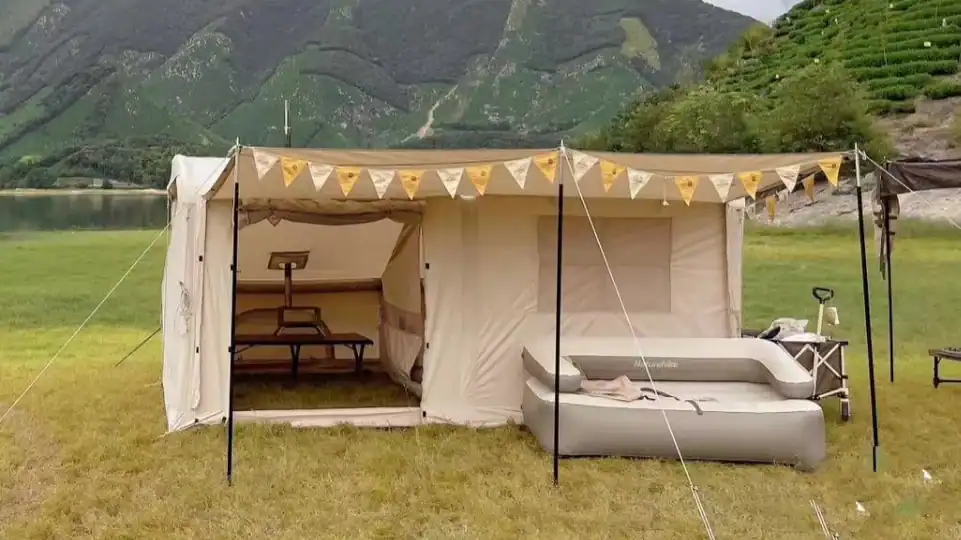
Spécifications PSI de la tente gonflable par type de beam
Les spécifications PSI varient selon le matériau de la poutre — ne devinez pas.
Le matériau de la poutre détermine la plage de pression de fonctionnement. Les poutres en TPU sont plus légères et fonctionnent à 8–12 PSI. Les poutres revêtues de PVC sont plus lourdes et fonctionnent à 15–18 PSI. Elles ne sont pas interchangeables — gonfler une poutre en TPU à 18 PSI risque de provoquer une défaillance des coutures, tandis qu'une poutre en PVC à 8 PSI s'affaisse sous la charge.
Comparaison du PSI selon le matériau de poutre
-
- TPU 250g (léger) : Plage de fonctionnement : 8–10 PSI. Test d'éclatement : 1,5x la pression nominale (12–15 PSI). Idéal pour les tentes de randonnée pour 1 à 2 personnes où le poids prime sur la durabilité.
- TPU 400g (standard) : Plage de fonctionnement : 10–12 PSI. Test d'éclatement : 1,5x la pression nominale (15–18 PSI). Courant dans les tentes familiales 4 personnes. La gamme de tentes gonflables de Kelyland utilise cette spécification pour la plupart des modèles de milieu de gamme.
- PVC revêtu 650g (usage intensif) : Plage de fonctionnement : 15–18 PSI. Test d'éclatement : 1,5x la pression nominale (22–27 PSI). Utilisé dans les tentes de glamping et les abris événementiels. L'épaisseur de paroi plus élevée supporte des cycles de gonflage répétés sans fatigue du matériau.
Le risque de mélanger les types de poutres est réel. Un acheteur a approvisionné des poutres en PVC pour une tente familiale 4 personnes mais a spécifié 10 PSI (TPU) sur le formulaire d'approbation des échantillons. L'usine a fabriqué selon les spécifications, mais les poutres se sont affaissées sous une légère charge de pluie. La différence de tolérance à la pression n'est pas théorique — c'est la différence entre une tente debout et une structure effondrée.
Comment le contrôle qualité de l'usine définit le PSI nominal
Le PSI nominal ne provient pas d'un manuel. Il est déterminé par des tests d'éclatement: les usines gonflent une poutre jusqu'à ce qu'elle cède, puis fixent le PSI de fonctionnement à 60–65 % de ce point de rupture. Le réseau de 17 usines principales de Kelyland suit ce protocole pour chaque type de poutre. Chaque lot est testé à 1,5x la pression nominale avant expédition. Si une poutre échoue à 1,5x, tout le lot est signalé et retesté.
Le chiffre PSI imprimé sur la valve n’est pas décoratif. C’est une cible définie en usine qui assure la régularité des boudins sur l’ensemble de la production. Si la valve indique 10 PSI, le boudin a été testé à 15 PSI avant de quitter la chaîne. Un boudin qui s’affaisse sur le terrain signifie que quelqu’un a ignoré ce chiffre — soit un gonflage insuffisant au montage, soit un manomètre de pompe décalé de 2+ PSI.
Rapports de chute de pression par lot pour les importateurs
Les importateurs devraient demander un rapport de chute de pression sur 24 heures avant d’approuver la production en série. Le test est simple : gonfler un boudin d’échantillon au PSI nominal, le laisser reposer 24 heures à 20 °C, puis mesurer la pression restante. Une chute de 0,5 PSI ou moins est normale. Une chute de 1 PSI ou plus indique une fuite de valve ou une porosité du matériau — les deux se traduiront par un affaissement nocturne sur le terrain.
L’usine de tentes gonflables de Kelyland fournit ces rapports sur demande. L’équipe de contrôle qualité enregistre le PSI de départ, le PSI final, la température ambiante et l’humidité de chaque boudin pendant le test. Les rapports sont associés aux numéros de lot afin que vous puissiez retracer une réclamation spécifique jusqu’à la semaine de production. Cette pratique n’est pas standard chez tous les fournisseurs — la plupart proposent un test sur un seul échantillon et s’en contentent. Pour un achat saisonnier de 500+ unités, les données au niveau du lot sont le seul moyen de confirmer que la cohérence du contrôle qualité se maintient sur toute la production.
Le coût de sauter cette étape est prévisible. Un acheteur qui a approuvé une commande de 1 000 unités sur la base d’un seul test d’échantillon a constaté que 12% des boudins perdaient de la pression pendant la nuit à 5 °C. L’usine a blâmé le froid. L’acheteur a assumé les coûts de retour. Un lot rapport de chute de pression aurait signalé le problème de porosité du matériau avant l’expédition du conteneur.
Comment gonfler correctement les boudins d’air (pompes et valves)
Une pompe sans manomètre est le moyen le plus rapide de faire éclater un boudin de tente gonflable.
La plupart des défaillances sur le terrain des tentes gonflables remontent à une seule chose : la pompe. Pas le boudin, pas le tissu — la pompe. Un acheteur se procure une tente avec boudins en TPU un boudin prévu pour 10 PSI, la remet à un utilisateur final qui attrape une pompe électrique à grand débit sans coupure de pression, et le boudin éclate à 18 PSI. C’est un warranty claim qui n’aurait jamais dû arriver.
Pompes manuelles vs rechargeables vs électriques
Les pompes manuelles (à main ou à pied) offrent un retour tactile — vous sentez la résistance à mesure que la pression augmente. Elles sont lentes, mais sûres. Les pompes rechargeables avec manomètre intégré permettent de régler un PSI cible et de s’arrêter automatiquement. C’est le compromis idéal pour la plupart des tentes glamping et des modèles de camping familial.
Les pompes électriques sans manomètre sont dangereuses. Elles poussent un grand volume rapidement, et si l’opérateur s’éloigne deux minutes, le boudin dépasse la pression nominale. Le seuil de test d’éclatement en usine est de 1,5× le PSI nominal — donc un boudin en TPU prévu pour 10 PSI éclate autour de 15 PSI. Une pompe électrique non régulée atteint ce seuil en quelques secondes.
Vannes à haut débit vs vannes à visser
Le type de vanne détermine la compatibilité avec la pompe. Les vannes à haut débit (souvent appelées style Boston ou militaire) sont courantes sur les poutres enduites de PVC car elles déplacent de grands volumes d'air rapidement — utiles pour les tentes de glamping robustes qui nécessitent 15 à 18 PSI.
Les vannes à visser (comme celles des matelas gonflables en TPU) assurent une étanchéité plus hermétique mais nécessitent un adaptateur correspondant. Les confondre entraîne soit une fuite lente au niveau du raccord, soit aucune étanchéité du tout. Chaque tente gonflable fournie par Kelyland est livrée avec des marquages sur les vannes qui indiquent à la fois le PSI cible et le type de pompe compatible.
Risque de pompage sans manomètre par temps froid
Le temps froid aggrave le risque de gonflage sans manomètre. Vous gonflez jusqu'à ce que la sensation soit ferme à 20 °C, puis les températures chutent à 5 °C pendant la nuit — la pression chute d'environ 1 PSI par baisse de 10 °C.

Dépannage sur le terrain : est-ce une fuite ou simplement le froid ?
9 réclamations sur 10 pour ‘ fuite ’ sont une perte de pression nocturne à cause du froid, pas des perforations.
A retail category manager at a mid-size outdoor chain once flagged a $50K inflatable tent order as defective after three field reports of overnight sagging. The factory QC team asked for photos, a temperature log, and a valve check. Every single complaint traced back to the same cause: the user inflated at 25°C in the afternoon, and by dawn at 8°C the beams had dropped from 10 PSI to under 7 PSI. No leak. No seam failure. Just physics.
4-Step Leak vs. Cold Diagnostic
Before filing a warranty claim or rejecting a batch, run this four-step check on any sagging beam. First, press the beam with your thumb — if it feels soft but holds firm shape, it is under-inflated, not punctured. Second, listen at the valve with the cap off: no hissing means no active leak path. Third, spray a soapy-water solution on all seams and the valve base; bubbles confirm a puncture location. Fourth, subtract the overnight temperature drop from your inflation PSI target using the rule of thumb: roughly 1 PSI lost per 10°C drop.
Conclusion
Cold-night pressure loss causes the majority of collapse complaints, not punctures. A buyer who understands that a 10°C temperature drop costs roughly 1 PSI can stop chasing phantom leaks and start asking the right questions before a bulk order ships.
-
- TPU beams run at 8–12 PSI; PVC-coated beams run at 15–18 PSI.
- A factory burst test at 1.5x rated pressure is the minimum benchmark.
- A printed PSI on the valve is a batch QC target—not decoration.
Next time you evaluate a supplier, ask for two documents before sample approval: a batch burst-test report at the rated pressure and a recorded pressure-drop reading over a controlled temperature cycle. Those two numbers tell you more about field reliability than any glossy catalog page. If the factory hesitates to share them, you already have your answer. Review the beam material specs and QC protocols on Kelyland Outdoors’ inflatable tent sourcing page to see how an ISO-certified supplier documents pressure stability from production through pre-shipment inspection.
Questions fréquemment posées
What PSI should an inflatable tent use?
TPU beams typically run 8–12 PSI; PVC-coated beams run 15–18 PSI. Always follow the valve marking, as it is the factory-set target for batch consistency. Check the valve label before inflating.
Why does my tent lose air overnight?
Cold air contracts, dropping pressure about 1 PSI per 10°C drop. Add valve seepage and you get a 0.5–1 PSI loss that mimics a leak. Top up pressure after a cold night before blaming a puncture.
Can you overinflate an inflatable tent?
Yes. Burst pressure is usually 1.5x rated PSI, and overinflation is a top cause of seam failure. Use a pump with a pressure gauge to stay safe.
Can I use any air pump for my inflatable tent?
No. Match the pump to your valve type and rated PSI, because a gauge-less pump risks overinflation and burst beams. Confirm pump compatibility before buying or shipping.
Should I leave my tent inflated in winter?
Deflate and store indoors with valves open during winter.

 English
  Español
  Deutsch
  Français
  Português do Brasil
  Русский
  العربية
  한국어
한국어  日本語
日本語