 跳到内容

A folding wagon customs hold rarely traces back to a broken weld or a cracked wheel. Two wagons can sit side by side on the same factory floor and look identical; the one that clears the border costs 30% more because the paperwork survives the entry review. That premium buys a CPSIA certificate with the correct age range on the tracking label, a third-party REACH test for the fabric, and an HTS code that matches the invoice.
The buyer who gets burned signs off on the quality tolerance during sample approval, then lets a $50K order ship without auditing the mass production documents. In one 2026 case, the manufacturer’s Children’s Product Certificate showed the wrong age range on the tracking label—a detail that passed pre-production checks and only surfaced when U.S. customs cross-referenced the entry data. The folding wagon shipment sat for 30 days while a corrected certificate was filed, the demurrage clock running the entire time.
The three holds in this article trace to the same root cause: a document that didn’t match the product. Fix that mismatch at the factory gate, and the border crossing becomes a formality. Suppliers who charge that 30% premium catch these discrepancies before you do.

Why Folding Wagons Get Held at U.S. or EU Customs
Most folding wagon customs holds trace to one root cause: paperwork that doesn’t match the physical product.
Folding wagons trigger more customs holds than most camping gear because one product carries two regulatory identities. A wagon with a 150kg load capacity classifies as a utility cart, but the moment the packaging says “ages 3+” or the listing shows children, U.S. Customs treats it as a children’s product under CPSIA. That split causes the documentation failures below.
Missing CPC Documents
A Children’s Product Certificate (CPC) is mandatory for any wagon intended for children 12 and under. The certificate must match the physical shipment — same model, same production date, same age grade that appears on the tracking label. In a 2026 case, a U.S. importer’s folding wagon shipment was held for 30 days because the manufacturer’s CPC listed the wrong age range on the tracking label. CBP now cross-references CPSC data with entry documents, so any discrepancy triggers an automatic hold.
REACH Documents for EU Entry
EU customs holds follow a different path. Folding wagon materials — 600D-900D double-layer Oxford fabric, PP or MDF baseboards, powder-coated steel or aluminum frames — all fall under REACH substance-of-very-high-concern screening. A supplier’s self-declaration often gets rejected; EU customs increasingly demands third-party REACH test reports tied to the actual production batch, not a generic document.
Tracking Labels That Don’t Match
CPSIA requires a permanent tracking label on the product and its packaging: manufacturer name, location, production date, and a cohort code. The age range printed on that label must match the CPC exactly. If the label says “3+” and the CPC lists “6+”, the shipment gets flagged. The cost compounds quickly — demurrage fees on a held container, missed shelf dates, and expedited freight to recover.
Supplier capability matters. Kelyland Outdoors runs its folding wagon production through a Jinhua, Zhejiang factory certified to CE and ISO 9001 with annual output of one million units. Even so, compliance paperwork sits outside the quality certificate — batch-level REACH tests and accurate CPC data must be requested before production, not after the container lands.
-
- Verify the CPC age grade matches the tracking label: One-line mismatch triggers a CPSC referral and a 30-day hold.
- Request third-party REACH tests on the production batch: A supplier declaration alone rarely clears EU customs review.
- Check the HTS code before booking: Folding wagons can classify as non-motorized utility carts or children’s products; the wrong code triggers statistical validation holds.
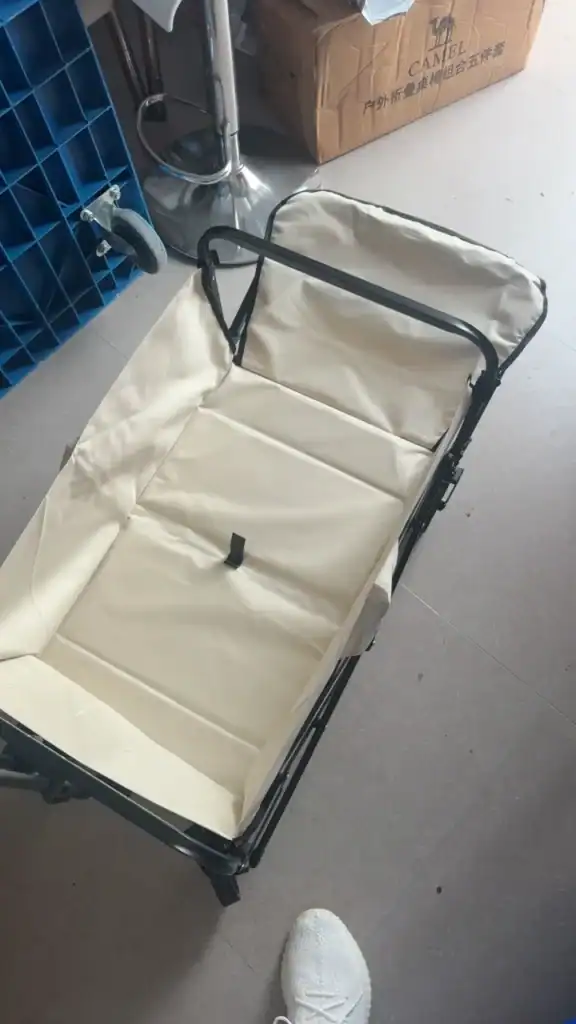
Case 1: Missing CPSIA Children’s Product Certificate
A 30-day CBP hold plus two weeks of document rework delayed one folding wagon order by 45 days.
A U.S. importer’s folding wagon shipment sat under a CBP hold for 30 days in 2026. The cause wasn’t missing safety tests. The factory issued a valid CPC but listed the wrong age range on the tracking label. That mismatch triggered an automatic hold when CBP cross-referenced CPSC data against the entry documents.
The 45-day delivery hit
The importer had planned for a 45-day transit-to-warehouse window. It burned the first 30 days in customs, then spent two more weeks submitting corrected documentation and waiting for CPSC data to sync. Total delivery delay: 45 days. The buyer missed a retail reset date and absorbed demurrage fees on the container.
Why the age range matters
Folding wagons sit in a gray zone. If the product is marketed for family camping but includes a canopy, bright colors, or a child-safe locking mechanism, CPSC can classify it as a children’s product. That triggers CPSIA. The tracking label and the CPC must state the identical age grade. One character difference — “4+” versus “4–12” — is enough to flag the entry.
-
-
- CPC age grade: The certificate must list the same age range as the tracking label. CBP matches these fields against CPSC records.
- Tracking label: Permanent label on the product and carton with manufacturer ID, date of production, and the exact age range.
- テストレポート: A third-party CPSC-accepted lab report for lead and phthalates, with the applicable standard listed on the CPC.
-
The fix that cleared the hold
The manufacturer issued a revised CPC with the corrected age grade and submitted proof that the laboratory test report covered the same product model. The importer filed a statement through ACE, and the hold lifted once CPSC validated the match.
Supplier baseline matters here. Kelyland Outdoors works with a Jinhua-based folding wagon factory that holds ISO 9001 and CE certifications and maintains 1,000,000 units of annual production capacity. Facilities with that compliance baseline still need to be checked on age-grade documentation — certification alone doesn’t prevent CPSIA holds.
What to ask before you book freight
-
- Ask for a PDF of the printed tracking label: If the supplier can’t show it before production, the CPC is likely a template.
- Require the CPC to name your importing entity: Factory-generated CPCs listing the supplier as the manufacturer can complicate the entry.
- Confirm the test report covers the exact model number: A report for a similar wagon won’t pass a CPSC audit.
The 45-day scenario collapses into a preventable documentation error. One spreadsheet check before the container leaves Jinhua beats 30 days of storage fees and a missed launch. For supply chain managers, the fix is a pre-shipment document checklist that treats the CPC with the same rigor as the packing list.

Case 2: EU REACH Non-Compliance at Border
A REACH declaration is a promise.
The second case follows a European importer who received a Notice of Non-Compliance from EU customs on a 2,400-unit folding wagon order. The hold trigger wasn’t the steel frame or the carton. It was the fabric and the wheel treads — the two places where REACH chemical restrictions bite hardest.
Why the supplier’s declaration failed at the border
The exporter provided a signed letter stating that the folding wagons ‘comply with REACH.’ No accredited lab was named. No test method was cited. No batch number was attached. Under Regulation (EC) No 1907/2006, EU customs authorities can demand third-party test evidence at any point, and enforcement agencies in the Netherlands and Germany routinely do this for camping goods.
The declaration was a legal statement, not a proof of compliance. When the inspecting officer requested the underlying test report, the supplier had nothing to produce. The container was moved to a bonded inspection area, and the importer had to find an ISO 17025-accredited laboratory that could test the exact production batch.
What the third-party REACH test covers
For a folding wagon, the laboratory test scope matters as much as the test itself. The dye in the 600D-900D Oxford fabric needs screening for restricted azo amines. Flexible PVC parts — usually wheel treads or handle grips — need phthalate testing. And the polymer wheels and grips need PAH analysis under REACH Annex XVII entry 50.
-
- Lab accreditation: The report must come from an ISO 17025-accredited lab and cite the specific REACH Annex XVII entry for each substance group.
- バッチトレーサビリティ: The report must name the batch number, fabric lot, and production date so the tested goods are provably the shipped goods.
- Material coverage: Fabric, coating, wheel treads, and handle grips all need separate sample preparation. Testing only the frame is a wasted expense.
The importer in this case cleared the goods after weeks of detention, but the bill included port storage charges and a delayed retail placement. The permanent fix was simpler than the paperwork suggests: specify TPE wheels for EU-bound production instead of PVC. The partner factory that builds Kelyland Outdoors’ folding wagon line, in Jinhua, Zhejiang, offers wheel options in PVC, PU, EVA, or TPE. TPE compounds contain no plasticizers, which removes the phthalate question before it reaches customs.
The practical rule for procurement teams: obtain the third-party REACH test report before the order goes into production, not after detention. Ask the supplier for the lab name, the report date, and the batch reference. If the response is another signed letter, the next container may face the same hold.
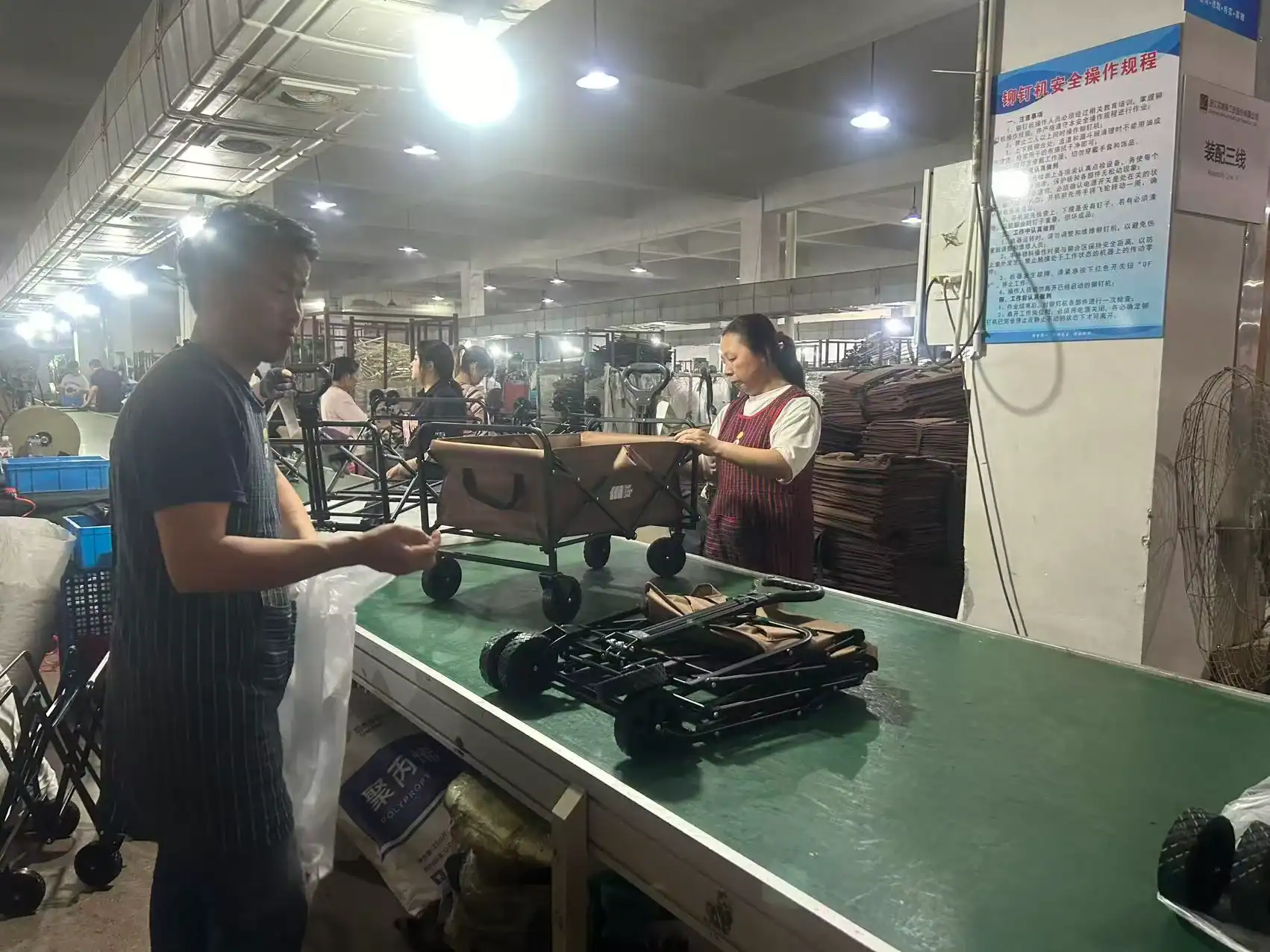
Case 3: Incorrect HTS Code on Shipping Docs
Declaring a folding wagon under a furniture code to reduce duty is the fastest way to trigger a CBP hold.
Most HTS holds on folding wagons are not fraud cases. They are lazy classification calls. A buyer pushes the landed cost down by declaring a wagon under a furniture code like 9403, CBP’s automated statistical validation flags the mismatch, and the container sits in a bonded warehouse until someone fixes the entry.
Folding wagons belong under heading 8716 because they are non-mechanically propelled vehicles used to haul loads. That classification holds up whether you import into the U.S. or the EU. The 9403 route leans on the folding frame, but the General Rules of Interpretation are clear: the wagon’s function controls, not its folded dimensions.
What Triggers the Hold
-
- CBP statistical validation: The ACE entry system compares the declared HTS code against the product description. A product description that says “folding wagon” under a 9403 furniture code creates an automatic flag, and the entry moves to a manual officer review.
- File timing: A correction filed while the shipment sits in a bonded warehouse is handled as an entry amendment. Leave it until after liquidation, and the only option is a prior disclosure, which brings heavier scrutiny and mandated disclosure language.
- Cost exposure: Every added day in a hold adds demurrage and warehouse fees. A missed retail season launch costs far more than the duty difference. Most buyers catch this only after the container misses the truck appointment window.
The fix path depends on where the hold happens. If the shipment is still at the port, your broker can request the entry be revisited. If CBP posts a notice after the goods cleared, a prior disclosure under 19 U.S.C. 1592 is the way back. In both scenarios the duty is recalculated under 8716.80, and the importer pays the difference plus applicable interest.
Where the Correction Happens
The importer holds legal responsibility for the HTS declaration. The supplier controls what appears on the export documents. Kelyland Outdoors handles export paperwork and customs guidance inside its Global Shipping process, which is exactly where a code mismatch should be caught before the container leaves the China port. The folding wagon factory in Jinhua holds CE and ISO 9001 certification with 1,000,000 units of annual production volume, so the manufacturing side already works under documented compliance controls.
Verify the first six digits before production ends. The 2026 HTS and China’s export schedule are harmonized at the 6-digit level. Compare the code your broker files with CBP against the code your supplier declares for export. A mismatch there means someone is paying the wrong duty or holding a container that cannot clear. That is the cheapest discrepancy to fix and the easiest one to prevent.

結論
A folding wagon customs hold rarely starts with a mechanical defect. It starts with a paperwork mismatch — an age range on a tracking label, a REACH declaration without a supporting test report, or an HTS code that contradicts the cargo. Each case cost weeks in storage fees and delayed shelf dates, and every one of them was preventable at the documentation stage.
-
- Confirm the CPC age range exactly matches the tracking label before shipment; CBP cross-checks both.
- Get a third-party REACH test report for folding wagon fabric; a supplier self-declaration alone may not release a hold.
- Verify the 2026 HTS code against the actual wagon construction before entry filing; mismatches trigger statistical validation holds.
- Build compliance review into pre-shipment inspection so a 30- to 45-day hold never starts.
Audit the certification package behind any folding wagon quote before the container leaves the factory. Ask for the CPC, REACH test report, and HTS classification in writing, then reconcile each document against the finished product during sample approval. To see how a sourcing partner structures that handoff, review the folding wagon production and inspection options Kelyland Outdoors makes available to supply chain teams.
よくある質問
Why do folding wagons get held at customs?
Most folding wagon customs holds come from paperwork that doesn’t match the shipment—missing certification, REACH non-compliance, or an incorrect HTS code. The physical product is usually fine; the border stop is driven by documentation gaps. Get the compliance docs reviewed before shipping.
What documents prevent a folding wagon customs hold?
You need the compliance document that matches the product classification: a CPSIA certificate for U.S. children’s products, a REACH declaration for EU, plus the correct HTS code. Confirm the required documents with your supplier before booking shipment.
How long does a customs hold delay a folding wagon order?
A folding wagon customs hold can add roughly 45 days—one documented case involved 30 days with CBP plus two weeks of document rework. Actual timing depends on how fast. Build extra lead time into your schedule if your shipment is at risk.
How do you fix a folding wagon customs hold?
Fix it by identifying the exact reason for the hold, then submitting the missing compliance or customs document—such as a corrected CPSIA certificate or REACH test report. The fastest path is working. Ask your supplier for the corrected document the same day.

 English
 Español
 Deutsch
 Français
 Português do Brasil
 Русский
 العربية
 한국어
 日本語