 콘텐츠로 건너뛰기

disaster relief tent certifications is the first checkpoint buyers should lock before they approve a supplier, budget, or production slot. The buyer signed off on the pre-production sample for a 1,000-unit inflatable shelter order. The fabric felt right, the seams held air, and the flame test report from the supplier looked clean. Three months later, a container arrived at the NGO warehouse in Southeast Asia. The first tent inflated fine. The second one held pressure for six hours before a seam let go. By the time someone checked the certification documents against the actual production batch, the entire shipment was sitting in customs limbo because the fire test certificate referenced a different fabric formulation from a 2022 production run.
That scenario plays out more often than most supply chain managers want to admit. The disaster relief tent certifications landscape in 2026 is fragmented across three major markets — China, Europe, and North America — and each market enforces standards that overlap in name only. A CE mark on an inflatable shelter does not automatically mean the PVC fabric meets REACH material rules or that the electric inflation pump complies with LVD directives. NFPA 701 test results are batch-specific by design: a certificate issued for a fabric run from two years ago carries zero weight for a current order unless the mill can prove zero changes in formulation or production line setup.
Most overseas buyers have never heard of GB/T 44010-2026, yet it is now the most relevant baseline for relief tents manufactured in China. It covers flame resistance, hydrostatic head thresholds, and structural integrity under wind load — all written specifically for disaster response shelters rather than general camping gear. The gap between knowing these standards exist and actually verifying that a factory’s certificates cover your exact product model is where procurement mistakes get expensive.

Why Relief Tent Certifications Confuse Buyers in 2026
A CE mark on tent fabric does not certify the inflation pump or the blower motor.
The certification landscape is fragmented across markets
A supply chain manager sourcing inflatable relief tents for a government tender in 2026 faces a messy reality. The Chinese factory shows you a CE certificate, but your end customer in Germany wants proof of REACH compliance for the PVC fabric. The same tent going to a US aid organization needs NFPA 701 test reports — and those reports must come from the actual production batch, not a generic file from 2022. Each market applies its own set of standards, and very few overlap.
China released GB/T 44010-2026 specifically for disaster relief tents. It covers flame retardancy, hydrostatic head resistance, and structural stability under wind load. Most overseas buyers have never heard of it. But if your tent is manufactured in China — and most inflatable relief tents are — this is now the baseline standard that factories should be testing against. Ask for it explicitly.
Why one CE certificate does not cover all inflatable tents
CE marking is not a single pass-fail test for an entire inflatable shelter system. The fabric must comply with EU REACH regulations on restricted substances — phthalates in PVC, heavy metals in coatings, formaldehyde in adhesives. The electric inflation pump falls under the Low Voltage Directive (LVD) and Electromagnetic Compatibility (EMC) directive separately. A blower motor that passes EMC testing still fails if the fabric contains prohibited plasticizers.
Flame-retardant textiles require per-batch testing because the chemical formulation can shift between production runs. A certificate issued for a 2023 fabric lot means nothing for material woven in 2026 unless the factory can prove identical formulation and unchanged production line conditions. Request batch-specific test reports, not the certificate cover page.
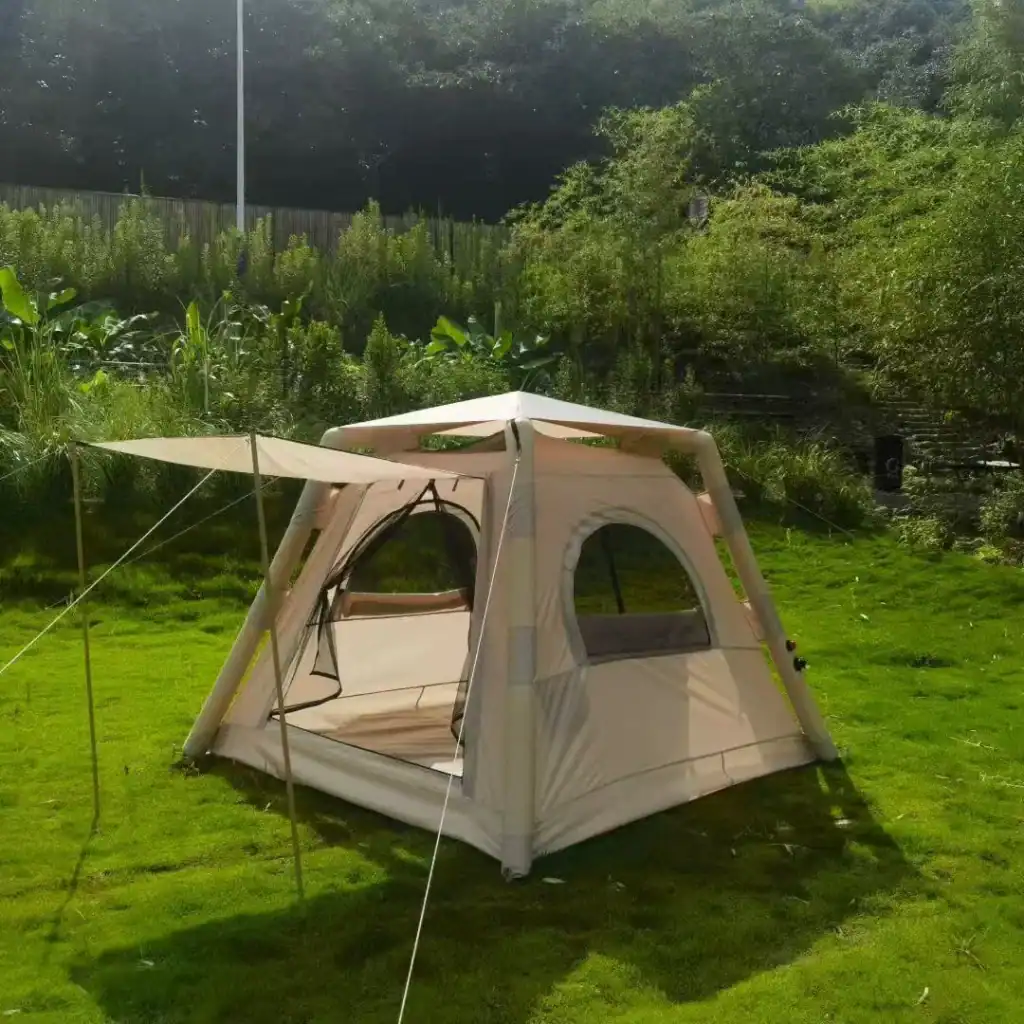
GB/T 44010-2026: The New Chinese Standard for Disaster Relief Tents
GB/T 44010-2026 is the first mandatory Chinese standard written exclusively for disaster relief tents.
Most overseas buyers sourcing disaster relief tents from China have never heard of GB/T 44010-2026. That is a problem. Released in late 2026, this national standard was written specifically for emergency shelters used in flood, earthquake, and pandemic response scenarios. It replaces the patchwork of voluntary industry norms that previously governed this category.
Flame retardancy requirements and test methods
GB/T 44010-2026 mandates that all fabric components pass a vertical flame test with a char length not exceeding 150 mm and after-flame time under 15 seconds. The test protocol follows GB/T 5455, which uses a controlled ignition source applied to vertically suspended fabric samples. This differs from the European EN ISO 6941 standard in both specimen size and flame application angle — so a fabric that passes the Chinese test may not automatically satisfy CE requirements.
The standard applies to the outer shell, inner lining, and groundsheet. If any layer fails, the entire tent model is non-compliant. Some mills in Zhejiang run batch-level flame tests as part of their QC process; Kelyland Outdoors’ partner factories that produce inflatable shelter models typically validate air beam seams at over twice the working pressure during QC checks.
Hydrostatic head and waterproofing specifications
For roof panels, GB/T 44010-2026 sets a minimum hydrostatic head of 2000 mm measured per GB/T 4744. Side walls require at least 1500 mm. These thresholds are lower than what many commercial expedition tents specify (3000 mm or higher), but they reflect the real-world trade-off between weight and deployability for mass-relief logistics.
Floor material must reach a minimum of 3000 mm hydrostatic head — a sensible requirement given that flood-response tents often sit on saturated ground for weeks. Buyers should request third-party test reports for each fabric roll batch, not just a certificate cover page issued two years ago.
Wind load and structural integrity clauses
[Continued below…].
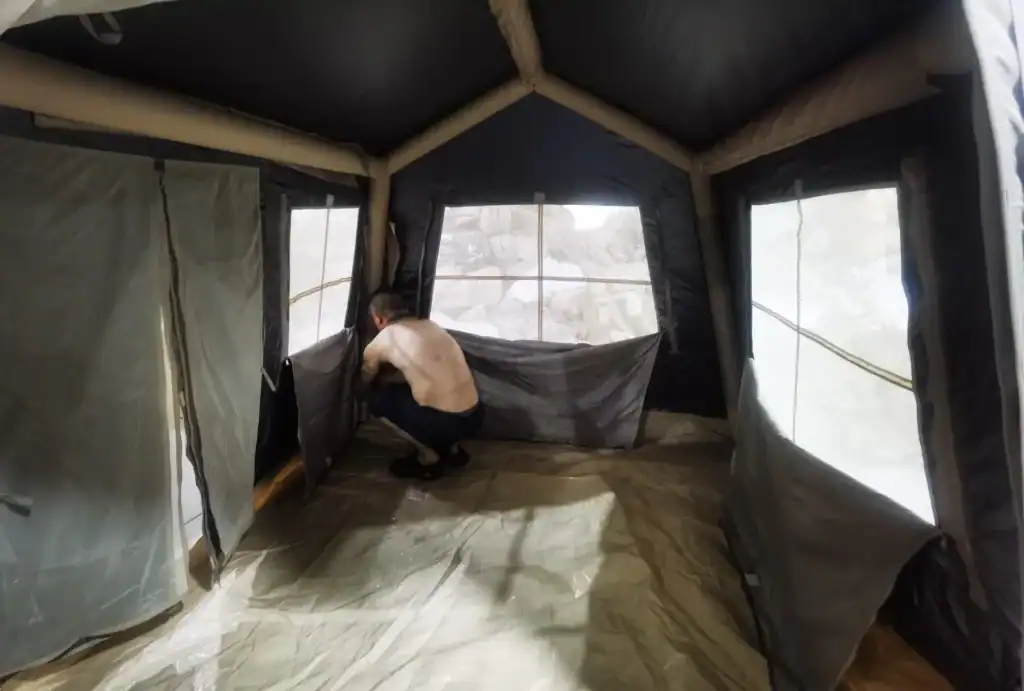
CE Certification for Inflatable Tents Sold in Europe
CE marking on an inflatable tent requires compliance across three separate EU directives — fabric, pump, and flame retardancy are each tested.
Most buyers assume a single CE certificate covers the entire inflatable tent. That assumption fails when customs flags the electric inflation pump for missing Low Voltage Directive (LVD) compliance, or when a lab rejects the fabric because it lacks REACH documentation. CE marking for inflatable shelters is not one document — it is a stack of separate conformity assessments that must each pass before the product can bear the mark.
EU directives that apply to inflatable shelters and pumps
The shelter structure itself falls under the General Product Safety Directive (GPSD, 2001/95/EC), which requires that the tent does not present any risk under normal use. But the two directives that cause most rejections are LVD (2014/35/EU) and EMC (2014/30/EU) for the electric inflation pump. A pump rated above 50V AC or 75V DC must carry LVD certification confirming insulation, creepage distances, and overcurrent protection. The EMC directive ensures the pump motor does not emit electromagnetic interference that disrupts nearby equipment — relevant when relief tents cluster in field hospitals with sensitive devices.
Flame-retardant textiles add another layer: EN 13501-1 classifies building material reaction to fire, but for tents used in public spaces or emergency shelters, local authorities may require EN 14115 (formerly EN ISO 6941) for vertical flame spread on flexible fabrics. A factory producing inflatable relief tents should be able to provide a test report showing burn length and after-flame time per EN 14115, not just a generic CE declaration.
REACH compliance for PVC and TPU fabrics
PVC fabric — common in heavy-duty inflatable tent floors and walls — contains plasticizers that fall under REACH Regulation (EC) No 1907/2006. The restriction on phthalates (Annex XVII, Entry 52) limits DEHP, DBP, BBP, and DIBP to concentrations below 0.1% by weight in articles intended for indoor use or contact with skin. For a relief tent where occupants sleep directly on the floor, this threshold applies. TPU fabrics generally face fewer restrictions because they do not require plasticizers, but any coating additives or flame-retardant chemicals added to TPU must still be registered under REACH.
The practical implication: ask your supplier for a REACH compliance declaration specific to the fabric lot used in your order. A general company-level statement is insufficient — REACH applies per substance batch. Kelyland Outdoors coordinates with its partner factories to maintain REACH-compliant material sourcing records across PVC and TPU fabric runs, which allows buyers to trace compliance back to the raw material mill.
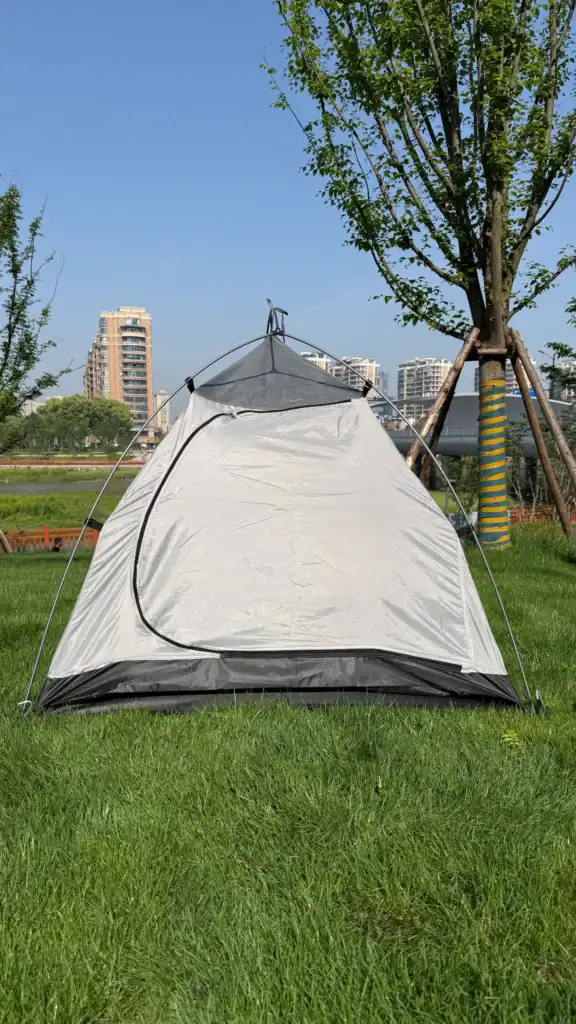
NFPA 701 and the North American Fire Standard
NFPA 701 test reports expire when the fabric batch changes — always request current batch data.
North American buyers often treat NFPA 701 as a single pass-or-fail checkbox. That assumption is dangerous. NFPA 701 is a fire-test-response standard that measures how a fabric ignites, how fast flame spreads, and whether burning material drips off. The test method applies to textile products used in public spaces, shelters, and temporary structures — exactly the category inflatable relief tents fall into.
When buyers need NFPA 701 test reports
If your relief tent will be deployed in a US state or Canadian province that enforces fire codes for temporary shelters, NFPA 701 is almost always required. Municipal fire marshals ask for it during permitting for emergency staging areas, field hospitals, and mass-care shelters. The key detail most buyers miss: NFPA 701 test results are batch-specific. A certificate issued for a fabric run in 2022 has no validity for a 2026 order unless the fabric formulation — base yarn type, coating chemistry, dye lot — and the production line remain unchanged.
A supply chain manager should request the full test report (not just the certificate cover page) from the latest production batch. The report must include the fabric sample identification number, date of test, and the specific NFPA 701 method used — Method 1 (vertical flame) or Method 2 (small-scale). Many factories source coated fabrics from external mills; if your supplier cannot trace the report back to the exact roll used in your order, you have no assurance.
ASTM D751: Tensile and seam strength testing
While NFPA 701 handles fire safety, ASTM D751 addresses mechanical integrity of coated fabrics — which matters just as much for an inflatable shelter that must hold internal pressure under wind load. This standard covers grab tensile strength, trapezoidal tear resistance, and seam strength. For an inflatable relief tent with welded or stitched seams holding air beams at 8-12 psi, seam strength is the critical parameter.
The factory network Kelyland Outdoors works with includes ISO 9001:2015 certified partners who regularly submit coated tent fabrics to third-party labs for ASTM D751 testing alongside NFPA 701. A buyer should ask for both reports on the same fabric specification before signing a production agreement.
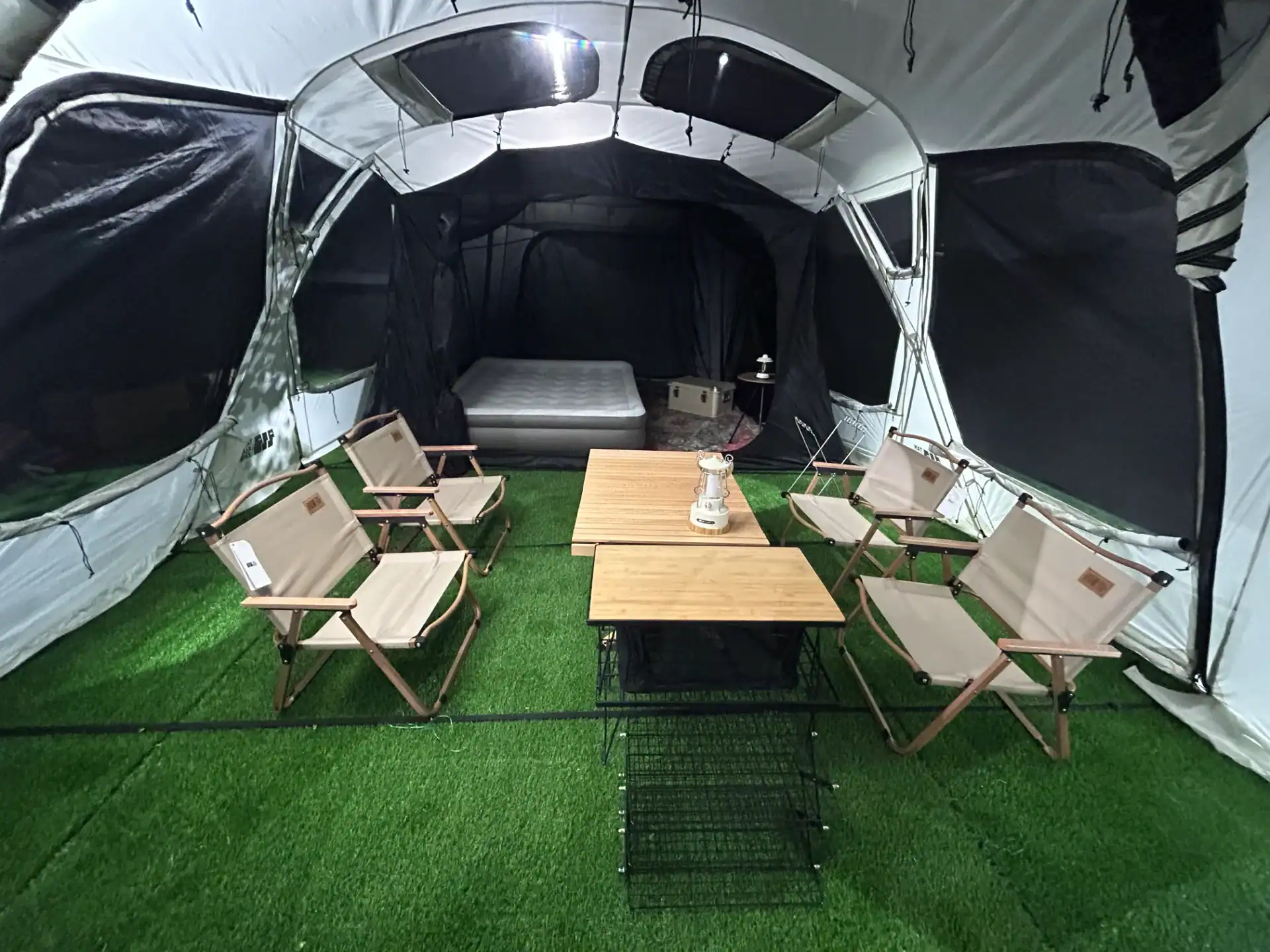
Other Certificates Buyers Should Recognize
EN ISO 5912 tests recreational tents.
Most relief tent buyers focus on GB/T 44010, CE, and NFPA 701 — the big three. But three other certificates appear frequently in supplier documentation, and they are often misunderstood or misapplied. Knowing which ones matter and which ones are irrelevant to a relief shelter order can save weeks of back-and-forth.
EN ISO 5912: The Camping Tent Standard — Not for Relief Work
EN ISO 5912 is the European standard for recreational camping tents. It tests basic weather resistance, seam strength, and pole integrity under a maximum wind load of roughly 28 m/s (about 62 mph). That is fine for a weekend car-camping trip. But for an inflatable relief shelter that needs to stay upright through a typhoon or hold up under heavy rain for weeks straight, EN ISO 5912 is not enough.
The standard does not require 내수압 testing above 300 mm — GB/T 44010-2026 demands at least double that for relief tents. It has no specific clause for flame retardancy on PVC or TPU fabrics used in inflatable structures. If a supplier offers EN ISO 5912 as proof of quality for a disaster relief tent, push back. Ask why they are using a recreational camping standard instead of the relief-specific one.
BSCI: Social Compliance Audit — Not Product Certification
BSCI (Business Social Compliance Initiative) audits factory working conditions — labor rights, health and safety, environmental practices. It does not test fabric flammability, seam burst strength, or inflation system reliability. A factory can pass BSCI with flying colors and still produce tents that fail a flame test.
For supply chain managers evaluating risk: BSCI tells you whether the factory treats workers fairly and maintains basic safety protocols. That matters for ethical sourcing and brand reputation. But do not confuse it with product certification. A BSCI report does not replace an NFPA 701 test report or a GB/T 44010 compliance statement.
ISO 9001: Quality Management System — Process, Not Product
“ISO 9001 certified” appears on nearly every factory profile in China’s outdoor gear sector — including Kelyland Outdoors’ partner factories across air mattresses, sleeping bags, camping furniture, folding wagons, backpacks, trekking poles, camp kitchen gear, outdoor storage units, camping lights, umbrellas, hammocks, charcoal grills (EN1860/LFGB), gas stoves (CE), cookware (304/430 stainless steel), hard coolers (PU/EPS foam), dry bags (TPU/PVC coated), pop-up tents (fiberglass/aluminum frames), automatic tents (polyester/oxford/nylon/TC fabric options with black/silver/PU/silicone/PVC coatings), glamping tents (bell/yurt styles up to 15-person capacity), roof top tents (CCC certified aluminum/fiberglass/carbon fiber frames), beach shelters (UV-block black coating available), ice fishing shelters (PVC/TPU air tube frames), hunting blinds (mesh/oxford fabric blends), tailgate tents (custom dyeing + silk-screen/digital/thermal transfer printing options) — but ISO certifies the management system only.
How to Verify a Factory’s Certification Documents
A certificate cover page proves nothing.
Most buyers stop at the PDF cover page. That is a mistake. A factory can hold a valid ISO 9001:2015 certificate for its management system while the specific tent fabric lot fails NFPA 701 by a wide margin. For disaster relief tents, the certification game changes when you move from system audits to product-specific standards like GB/T 44010-2026, CE marking directives, and NFPA 701 — each with its own verification trap.
Check the certificate number against the issuing body’s database
For GB/T 44010-2026 compliance, ask the factory for the test report number issued by a CNAS-accredited lab in China. Cross-reference it on the China National Accreditation Service portal. If the lab name does not appear in CNAS’s directory, the report has no legal standing for Chinese government procurement contracts. For CE-marked inflatable tents, verify that the notified body number (e.g., NB 0123) matches an EU-recognized entity listed in NANDO — and confirm that body’s scope includes ‘personal protective equipment’ or ‘machinery directive’ depending on whether you are certifying the fabric or the inflation pump.
Confirm the certificate covers your exact product model
A common trick: a supplier shows you an NFPA 701 test report from a 2022 fabric run on a different tent model. The formulation may look similar — same base PVC weight, same plasticizer ratio — but without a direct line-item match to your model number and production batch, that report is worthless. Demand that the certificate or test report explicitly lists: (1) your tent model name or SKU, (2) the fabric roll batch number, and (3) the production date range. GB/T 44010-2026 requires hydrostatic head testing per batch; if your supplier cannot produce a matching batch ID for a relief tent order placed in Q1 2026, flag it immediately.
Request test reports from the latest fabric batch
결론
Certifications for disaster relief tents are not a single checkbox. They are a stack of market-specific requirements, each with its own expiration date tied to the fabric batch. The buyer who treats a CE cover page from 2022 as proof of compliance for a 2026 order is the buyer who will face customs holds or field failures.
-
- GB/T 44010-2026 is now the baseline for relief tents made in China.
- CE marking requires separate compliance for fabric, pump, and flame retardancy.
- NFPA 701 test reports expire when the fabric formulation changes.
- Batch test reports matter more than certificate cover pages.
Before you place your next relief tent order, run that three-point checklist against your supplier’s documentation. If they can produce a GB/T 44010-2026 test report, a current batch NFPA-701 result, and a CE declaration that names your exact model and pump type, you have a verifiable stack of evidence. If they hesitate on any of those three points, it is worth digging deeper into their production records and material sourcing history before committing to volume.
자주 묻는 질문
What is GB/T 44010-2026?
GB/T 44010-2026 is the first mandatory Chinese standard specifically for disaster relief tents. It sets requirements for flame retardancy, hydrostatic head waterproofing, and wind load structural integrity. Verify your factory tests to this exact standard, not a general tent norm.
인플레이터블 구호 천막에 CE 인증만 충분합니까?
아닙니다. 단일 CE 마크는 모든 급식 텐트 시스템을 포괄하지 않습니다. 원단(건설제품규제), 인플레이션 펌프(기계지시령) 및 REACH 각각 별도의 규정이 요구되므로, 각 지침을 커버하는 준수 매트릭스를 요청하시기 바랍니다.
What does NFPA 701 test for?
NFPA 701 tests the flame propagation of fabrics and films used in tents. It measures how quickly fire spreads across the material under controlled conditions. Confirm your supplier provides a report from an accredited lab for your specific fabric batch.
How do I verify a factory’s certification documents?
Check the certificate number directly with the issuing body and confirm it covers your exact product model. Also request test reports from the latest fabric batch, not just a generic. A certificate without a matching batch report is not proof of compliance.

 English
 Español
 Deutsch
 Français
 Português do Brasil
 Русский
 العربية
 한국어
 日本語