 콘텐츠로 건너뛰기
The drop-stitch vs coil air mattress call looks clean when the PO goes out. It still looks clean on Day 14 when the pre-production sample passes approval. Then the container lands on Day 45, and a $50K order starts turning into returns because the mass production run didn’t match the approved sample.
That scenario repeats more often than procurement teams admit. The two constructions fail differently, and not just in how they feel when inflated. Coil mattresses tend to break at welded seams and pump-housing joints, the kind of damage an air mattress seam leak repair kit can’t fix. Drop-stitch air mattress delamination starts inside the fabric-thread bond. The economics of those two failures are completely different.welded seams
For a supply chain manager carrying return-rate and warranty-cost targets, the real drop stitch vs coil air mattress durability question isn’t which model feels more luxurious in the showroom. It’s which one you can afford to replace when it comes back. That shift from unit price to failure economics changes how you read factory specs, how you set quality tolerance, and which questions you ask before committing to a production run.
Inside the Construction: What Actually Holds Air
The pressure gap — 10-15 psi vs 2-5 psi — decides which part fails first.
Set aside the TPU vs PVC air mattress material comparison for a second. Both constructions are welded membranes. The difference is how internal walls transfer load. Drop-stitch runs at 10-15 psi; coil runs at 2-5 psi. That pressure gap determines the first failure point before you ever fill the bed.pressure gap
Drop-Stitch: High-Pressure Fabric Composite
Drop-stitch uses thousands of polyester threads connecting the top and bottom fabric layers, tensioned by high air pressure. It resists point loads, holds a flat sleep surface, and is the default for performance camping and truck-bed sleep systems. Failures start inside that thread-fabric interface when repeated folding breaks the bond.
Coil: Low-Pressure Vertical Air Beams
Coil construction welds vertical loops or beams to the top and bottom sheets, creating a traditional bed feel under low pressure. Most coil-style beds use 30-40 internal coils to spread body weight. Low pressure reduces puncture risk but concentrates stress on every weld. The first split usually shows up at a beam weld or the pump-housing seam.
Film Layer: PVC vs TPU
Compare TPU vs PVC air mattress material and the first spec to check is film thickness. OEM film runs 0.4mm to 0.6mm in either material. PVC costs less and RF-welds easily, which is why budget lines use it. But it turns brittle around -5°C, a real problem for cold-chain logistics or winter storage. TPU is lighter, more puncture-resistant, and survives cold-weather folding without cracking. Flocking changes the surface feel and slip, but it does nothing for structural life.
- Drop-stitch construction is built for high-pressure rigidity. Returns are rare. When one does come back, the failure signature is a smooth delaminated patch, a spot where threads tore loose from the fabric. That is the classic drop stitch air mattress delamination pattern, and it points directly at the stitching process.
- In the drop-stitch vs coil air mattress comparison, coil builds feel soft, around 2-5 psi. They come back more often than drop-stitch units. The typical failure is a split at the beam weld or the pump-housing seam. That seam is the first place to look when durability questions surface.
- Factory check: Kelyland’s partner air-mattress factory in Xiangyang pushes out 2.5 million units a year under ISO 9001:2015, with CE/ETL-certified pump options. That volume means you can test film and weld samples before mass production. If you want proof of claims, ask for those sample reports.
Physical Failure Mode #1: The Middle Bulge (Delamination vs Beam Split)
A bulge in the middle is a diagnostic, not just a defect.
When a middle bulge comes back from a customer, most buyers mark it “defective” and swap the unit without taking a photo. That throws away the cheapest diagnostic in the supply chain. The bulge shape tells you which construction failed and which station in the factory needs an audit. One photo of that bulge is worth more than a blind air mattress seam leak repair kit order.
Reading the return: delamination vs beam split
Two failure signatures tell the whole story. Coil mattresses come back with a split at the welded seam where the pump housing enters the mattress. Drop-stitch units show a smooth delaminated patch where internal threads pulled free from the fabric. Match the signature to the construction, and QC knows exactly which station failed. That is the difference between real drop stitch vs coil air mattress durability analysis and guessing.
- Drop-stitch air mattress delamination signature: a smooth, slightly raised patch with no outer seam rupture. The thread-to-fabric bond failed inside. The panel loses its 10-15 psi rigidity and balloons under load.
- Beam split signature (coil air mattress): a local opening along one vertical weld line. Air dumps into the adjacent chamber, so the bulge sits between two beams. The system runs at only 2-5 psi, but the weld failed first.
Why a bulge kills the bed
A bulge is not a comfort complaint. It means the internal structure no longer holds pressure evenly. That distinction sits at the center of the drop-stitch vs coil air mattress durability question. Drop-stitch delamination keeps stretching at every inflation because the torn threads cannot re-anchor to the fabric. A coil beam split shifts load to the neighboring welds, accelerating the next failure.
Classifying returns this way is standard practice at Kelyland’s air mattress partner factory, which produces 2.5 million units annually under ISO 9001:2015 with CE/ETL certifications. Repeated delamination routes the audit to the lamination station; repeated beam splits pull the RF weld records for review.
Insider rule: photograph every bulge return before disposal. The smooth patch versus split seam distinction is a zero-cost QC tool that most importers never use. It also tells you whether an air mattress seam leak repair kit is worth trying before you write off the unit.
Physical Failure Mode #2: Cold Weather Cracks in PVC Coils
The mattress that passes at 23°C can fail at -5°C.
Cold-weather returns rarely start at the store. They start in an unheated warehouse or a truck sitting overnight in January. The mattress ships folded and loaded. When the customer unfolds it, a crack line runs along the PVC membrane on the fold. The failure looks like a handling issue, but it is a material specification issue. In a TPU vs PVC air mattress material comparison, this is the failure that makes TPU the safer call for cold climates.Cold-weather returns
The -5°C fold test
The test is straightforward. Take a production sample, fold it once, put it in a -5°C environment, unfold it, and check the crease under a light. PVC plasticizers turn brittle around -5°C. Folding at that temperature puts stress on both the weld and the film. The crack shows up exactly where the fold was made. TPU doesn’t fail the same way.
- Film thickness: OEM orders typically use 0.4mm-0.6mm PVC or TPU. A thicker film gives you better puncture resistance but does nothing for cold brittleness.
- Material choice comes down to tradeoffs. PVC costs less and RF-welds easily. TPU weighs less, resists punctures better, and handles cold folding without cracking. For stock that sits in winter warehouses or ships through cold routes, TPU is the safer pick.
- QC gate: Make the -5°C fold test part of your pre-production sample approval and keep the report for every batch that follows. That single test tells you more about winter warehouse returns than any other check.
Winter warehouse impact
A container crossing a northern shipping route or sitting in an unheated warehouse can hit those low temperatures long before a customer opens the box. A PVC coil mattress that passes inspection at room temperature can crack sitting in storage. The result is a wave of warranty claims weeks after delivery — not at the factory where you could catch it.
Kelyland’s partner factory for air mattresses runs 2.5 million units annually under ISO 9001:2015 with CE/ETL certifications. That volume means batch-level inspection reports are standard procedure. If your sourcing team needs winter-proof stock, ask for the cold-fold test report before production starts — it’s available on request.
Repair Reality: What Can Be Glued and What Is Garbage
Coil splits are patchable; drop-stitch delamination is a total loss — budget warranty reserves accordingly.
Coil seam patch: feasible
Most coil air mattresses use a welded PVC shell. A split along the pump-housing seam is repairable when the tear stays in the film and the surrounding weld has not peeled. Clean the area, hit it with an air mattress seam leak repair kit, and let a warehouse worker re-inflate it. The unit goes back into sellable stock. That is why coil failures are the high-frequency, moderate-cost claim: a few dollars in parts, an hour of labor, and you have not lost the unit.
Drop-stitch delamination: total loss
A delaminated drop-stitch panel shows up as a smooth bulge where internal threads have torn loose from the fabric. No glue can re-anchor thousands of individual polyester threads once 10-15 psi of tension is pressing on that bond. At that point, the mattress is functionally dead. This is the drop-stitch vs coil air mattress durability difference in one image: a coil unit gets patched, a delaminated panel gets replaced. The warranty team sees that bulge and knows it is not a repair job.
Warranty planning by failure signature
- Coil construction fails often, but the cost stays moderate. A seam leak repair kit and one warehouse worker keep returns out of the write-off column. You book a service charge, not a total loss.
- Drop-stitch construction fails less often, but when it does, it is a total write-off. One full replacement cost, no parts, no patch. That is the durability math that matters when you plan warranty reserves.
The partner factory behind Kelyland’s air mattresses ships 2.5 million units a year under ISO 9001:2015. Its QC team reads return photos by failure signature: a delamination defect points back to the thread-bond station, a pump-housing split points back to RF welding. Ask to see that failure library before you order. Ask for the TPU vs PVC air mattress material comparison while you are at it. That tells you more about what your warranty reserve should cover than any spec sheet.
Cost vs Return Rate: The B2B Math for Sourcing
Unit price is one line.
The quote you open is not the quote that counts. After the container lands, the numbers add up differently: freight, returns, replacement units, and the staff hours logged on a defect claim. A returned air mattress takes the same shipping cube as a new one, so you pay freight twice on every defective unit. Unit price gets you the first order. Warranty math decides whether you reorder.
Warranty cost profile by construction
Coil construction wins on price. It also fails more often — usually a beam weld cracking or the pump-housing seam splitting. Those failures are often fixable, so you manage them case by case. Drop-stitch rarely fails. But when it does, the unit is gone. That changes the math: small repair claims eat margin differently than sporadic full replacements. Your reserve structure should match whichever failure profile you are stocking.
- Failure frequency: Coil — high. Beam welds and pump-housing seams split. Drop-stitch — low. Failure mode is thread or fabric delamination.
- Repair route: Coil — outer seams can be patched; internal beam welds are not economical to access. Drop-stitch — delamination cannot be re-bonded to usable strength with any glue.
- Warranty profile: Coil — high-frequency claims, moderate cost per claim. Drop-stitch — low-frequency claims, full replacement cost each time.
- Pick the coil route when price is the main lever and your margins can handle a few warranty swaps before the season ends.
- Drop-stitch makes sense if return rate shows up on your quarterly report, you sell into markets where winter actually happens, or the brand lives or dies on “it won’t fail.”
MOQ and lead time levers
Kelyland structures market entry differently. Some customized air mattress items start at 50–100 pieces, so you validate a private-label SKU before committing to a full production run. Standard lead time runs 30–45 days, which lets you align production with seasonal demand instead of paying to warehouse early inventory.
On new orders over US$3,000, terms are 30% deposit and 70% before shipment. That keeps your cash exposure bounded while the order is in production. The air mattress partner factory holds ISO 9001:2015 certification and produces 2.5 million units annually with CE/ETL-certified pump options — the QC baseline is documented, not claimed.
| Metric | 드롭 스티치 | Coil |
|---|---|---|
| Internal pressure | 10-15 psi | 2-5 psi |
| Primary failure | Thread/fabric delamination | Beam weld or pump-housing split |
| Repair route | Usually total loss | Outer seam patchable |
| Failure frequency | 낮음 | 높음 |
| Warranty cost | High severity, low frequency | Low severity, high frequency |
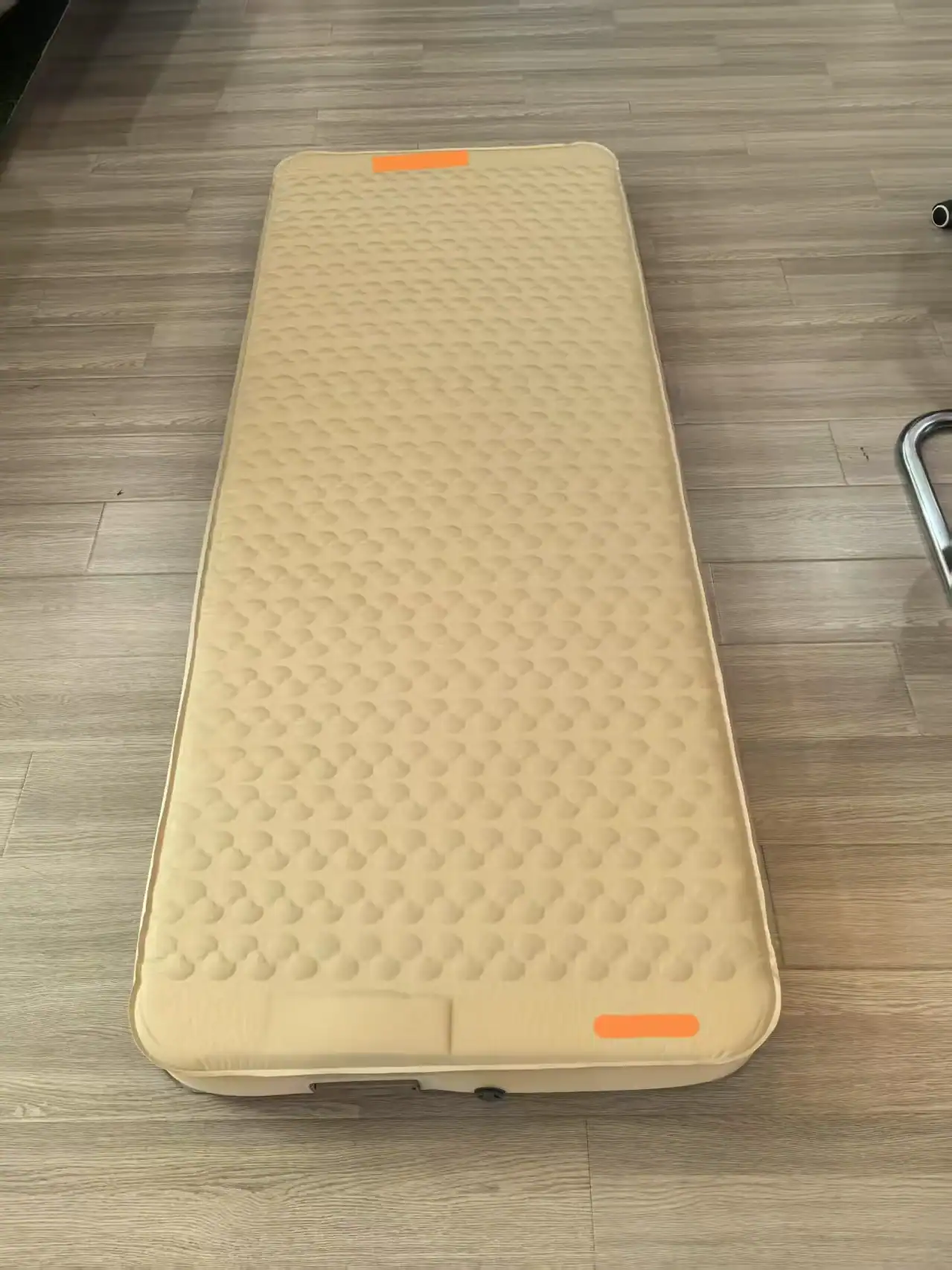
Material Selection for OEM/ODM: TPU Drop-Stitch vs PVC Coil
Film material and internal pressure decide cold tolerance and warranty exposure.
Drop-stitch panels hold 10-15 psi and give you a rigid, flat deck. TPU film in the 0.4-0.6mm range resists punctures and stays flexible when folded in cold weather. PVC stops holding that performance below about -5°C. The higher unit price buys a durability story that holds up in court, which is why premium lines, truck-bed sleep systems, and extended-warranty programs all default to this build.
PVC coil: entry-level value and cold risk
Coil systems run at 2-5 psi with vertical air beams welded to the top and bottom sheets. PVC keeps the bill of materials low and welds fast on RF tooling — fine for value lines or seasonal indoor use. The catch: PVC plasticizers stiffen below -5°C. A mattress folded in an unheated warehouse can crack along the sidewall weld before it ever lands on a shelf.
- Heights from 20 cm to 63 cm work in both constructions; taller profiles push up material cost and packed volume equally.
- Flocked surface adds hand feel and cuts down sheet slip. The flocking adhesion needs separate verification — it behaves differently on PVC versus TPU film, so don’t assume one test covers both.
- Film thickness between 0.4mm and 0.6mm is the OEM standard for both TPU and PVC. A thicker layer boosts puncture resistance but makes the fold line stiffer — an issue when you’re pulling a mattress out at 5°C in a storage closet.
- Built-in pumps come with CE or ETL certification. External pumps lower your per-unit cost and shift the failure point off the mattress, so you aren’t replacing the whole unit when a fan dies.
- Go with TPU drop-stitch if your brand promise is durability, winter camping, or heavy users who won’t baby their gear. It also helps if your warranty reserve is thin and every return eats into margin.
- Go with PVC coil if your target price sits at entry level, the mattress lives indoors or only sees seasonal use, and your return model can absorb a higher replacement rate without killing category P&L.
- Either way, run two QC gates on pre-production samples: the -5°C cold-fold test and a 48-hour pressure hold. Those two tests catch more failures than any showroom demo ever will.
Which construction fits your SKU plan
Most private-label buyers pick construction based on how comfortable it feels during sample approval. That’s exactly how return patterns start. Film material and internal pressure decide who pays for warranty replacements — the factory or your margin.Film material and internal pressure
| 기능 | TPU Drop-Stitch | PVC Coil |
|---|---|---|
| Construction & Internal Pressure | Fabric-core composite with thousands of vertical threads; operates at 10-15 psi | Vertical air beams welded to top/bottom sheets; operates at 2-5 psi |
| Best Positioning | Premium/performance outdoor lines, truck-bed sleep systems, glamping | Entry-level/value indoor lines and hospitality where price drives the SKU |
| Cold-Weather Performance | Survives the -5°C cold-fold test with no crack failure | Membrane becomes brittle near -5°C; fold stress causes cracks and weld failure |
| Primary Failure Mode | Internal thread/fabric delamination — smooth bulged patch | Beam weld split or pump-housing seam tear — visible split |
| Repair Reality | Usually total loss; delaminated threads cannot be re-anchored | Outer seam can be patched; internal beam welds are uneconomical to repair |
| 펑크 방지 | Higher — TPU film is lighter, more puncture-resistant, and cold-tolerant | Lower — PVC film is heavier and more prone to puncture and tear damage |
| Edge Firmness & Load Support | Rigid panel holds edge firmness under 250 lb+ loads | Edge roll and sag risk under heavier users; outer coils deform first |
| Film Thickness Options | 0.4mm-0.6mm TPU film, tuned for puncture and crack resistance | 0.4mm-0.6mm PVC film; easier to RF-weld but cold-brittle |
| Warranty Cost Profile | Low frequency, high severity — full replacement when it fails | High frequency, lower severity — patch-friendly but more claims |
Factory QC Checklist Before Placing Your Air Mattress Order
5°C fold test and a 24-hour pressure hold: the two QC gates that decide winter returns.
Required Pre-Production Tests
- Pressure-hold test, 24 to 48 hours: Inflate to rated pressure and leave it overnight. Any measurable drop points to a weld or valve leak, and that leak only gets worse through shipping and warehouse storage. For a drop-stitch vs coil air mattress durability check, this is the first test that matters.
- Cold-fold test at -5°C: Fold the mattress at freezing warehouse temperature, not in a heated showroom. PVC coil membranes crack at roughly -5°C, while TPU drop-stitch panels survive. This is the TPU vs PVC air mattress material comparison that predicts winter returns better than any other test.
- Film thickness gauge check: Use a caliper to verify 0.4mm to 0.6mm PVC or TPU film. Below-spec film cuts puncture resistance and raises cold-crack risk. Check it before production, not after failures show up.
- Pump-housing seam leak test: Every inflation cycle bends the seam where the pump enters the mattress. A weak RF weld here is the most common coil mattress failure. If you stock an air mattress seam leak repair kit, this is the leak your customers are trying to patch.
Pre-Shipment Inspection Gates
Inspection should use random sampling against your approved sample, not factory-picked units. Check coil beam welds for skips, look at drop-stitch panels for early signs of drop-stitch air mattress delamination, and re-test a percentage of units at rated pressure. Ask to see return-failure photos from previous batches. A factory that tracks its failures knows exactly where to look.factory that tracks its failures
Kelyland’s Partner Factory Certifications
Kelyland’s air mattress partner factory produces 2.5 million units a year under ISO 9001:2015. Built-in pump options carry CE/ETL certification, and inspection reports are available at every production stage. Weld parameters, film thickness, and pressure results are documented and auditable, not improvised per order.
Which Construction Should You Private-Label?
Let failure economics — not showroom comfort — choose your air mattress construction.
For most private-label launches, the drop-stitch vs coil air mattress decision comes down to durability. TPU drop-stitch is the safer default. PVC coil wins on upfront price, but that lead disappears once cold-crack returns and seam splits start hitting the warranty line. You pay more per unit for drop-stitch. Total landed cost still ends up lower because failure frequency drops.
Decision matrix: price, use, warranty appetite
- TPU vs PVC air mattress material comparison starts with unit cost: PVC coil leads. Drop-stitch TPU costs more. Add freight, return shipping, and replacement units, and the gap narrows or flips. At volume, the cheap quote rarely stays cheap.
- Use-case splits by pressure and environment. Drop-stitch holds a rigid 10-15 psi panel, which suits outdoor, heavy-user, and cold-weather use. Coil runs a soft 2-5 psi bed, right for indoor guest rooms and warm-climate value tiers.
- Warranty budgeting follows failure type. Coil fails more often, but an air mattress seam leak repair kit fixes many of those returns. Drop-stitch fails rarely, but delamination writes off the unit. Set your reserve for coil’s frequency or drop-stitch’s severity, not both at the same rate.
- Failure signatures tell you which station to fix. Coil returns split at the pump-housing weld. Drop-stitch returns show a smooth delaminated patch, classic drop stitch air mattress delamination. Photograph every return and classify it by production station.
- Go with TPU drop-stitch when the product promise has to cover durability, outdoor use, cold-weather shipping, or heavy users. You pay more per unit, but you get far fewer returns.
- Choose PVC coil when the target price is entry-level and the sales channel can absorb replacements. Before mass production, require pump-housing reinforcement and a -5°C cold-fold test.
The air-mattress factory behind Kelyland produces 2.5 million units a year under ISO 9001:2015, with CE/ETL-certified built-in pump options. The same production network builds TPU drop-stitch panels or PVC coil beds, so construction choice stays with brand strategy, not supplier capability. Custom orders start at 50-100 pieces with a 30-45 day lead time, which lets new brands test either construction without overcommitting.
Recommended default for new brands
For a new brand, warranty write-offs kill more product lines than unit cost ever will. A higher-priced drop-stitch TPU bed still costs less than replacing a wave of PVC coil units under warranty. Start with drop-stitch TPU on the hero SKU, and keep PVC coil for warm-weather channels where cold-fold stress never applies.
결론
Air mattress failures become predictable once you read the return signature. The real difference between drop-stitch and coil construction is failure economics: coil beds fail often and get patched, while drop-stitch beds fail rarely and get replaced. Do the warranty math before you commit to a unit price, and the right construction becomes obvious.
- Drop-stitch beds run at 10-15 psi and fail by delamination. Coil beds run at 2-5 psi and split at a beam weld.fails by delamination
- A -5°C cold-fold test predicts winter warehouse returns: PVC cracks, TPU survives.
- When a coil seam splits, you patch it. When drop-stitch fabric delaminates — the inner yarn bonds fail and the mattress bulges — there is no repair. It goes in the trash. That distinction defines your warranty risk from day one.
- Before approving any production sample, get two things in writing: a 48-hour pressure-hold test report and a documented film thickness check at 0.4 to 0.6 mm. Suppliers who skip these checks are the ones whose mattresses fail in month eight.
Write down two numbers for your next supplier conversation: the -5°C cold-fold result and the 48-hour pressure-hold record. A factory that cannot produce those reports is passing the warranty risk to you. Browse Kelyland’s air mattress product page to compare TPU drop-stitch and PVC coil constructions side by side, then request samples and internal QC reports before locking in the order.
자주 묻는 질문
드롭 스티치와 코일 에어 매트리스 중 어느 것이 더 내구성이 있나요?
Drop-stitch is generally more durable under repeated use because it is a high-pressure fabric composite rather than a low-pressure welded beam system. Coil mattresses fail more often at beam welds or the pump-housing. Specify drop-stitch if your return data shows mid-bed bulging.
Can a drop-stitch air mattress be repaired?
A puncture in the outer TPU shell can be patched, but delamination where internal threads tear from the fabric cannot be reliably repaired. Coil-style beam splits are repairable with weld patches. Inspect the tear location before deciding whether to scrap or repair.
Is TPU or PVC better for an air mattress?
TPU is better for durability and cold-weather performance because it stays flexible at -5°C, while PVC becomes brittle and cracks. PVC only makes sense for budget runs where cold exposure is. Choose TPU if your shipments cross cold climates or winter warehouses.
Why does my air mattress leak at the seam?
A seam leak usually comes from poor RF weld pressure, stress at the pump-housing flange, or repeated folding along the same crease. This pattern is much more common in coil mattresses because. Request seam burst and fold-cycle QC reports before mass production.
How many coils should an air mattress have?
Most coil-style air mattresses use 30-40 vertical coils for adequate weight distribution. If a design has fewer coils, expect higher pressure on individual beams and earlier weld fatigue. Confirm coil count and beam weld specs on the pre-production sample.

 English
  Español
  Deutsch
  Français
  Português do Brasil
  Русский
  العربية
  한국어
한국어  日本語
日本語