 Ir para o conteúdo
Every inflatable glamping tent design brief that lands on a Chinese factory desk carries the same tidy checklist: base fabric weight, zipper gauge, valve spec, coating layer, logo placement. A buyer can tick every box, approve the pre-production sample, and place the deposit on a $50K order — then watch the first production batch leak air by morning. The item nobody checks is the quality tolerance between the sample room and the mass-production line.
The fix is a tighter brief, not a longer one. Specify air beam diameter, working pressure, and a target inflation time under four minutes, then hold the sample approval to the same test the bulk run must pass. In 2026, also plan for the material bottleneck: TPU-laminated beams still run 45 to 60 days out of Zhejiang, while PVC lamination returns in about 30 days, so your beam choice decides whether you hit the season or chase it.
Why Inflatable Tents Fail in European Weather
Most inflatable glamping tent failures in Europe trace back to two unverified specs: wind load class and beam fabric burst strength.
The wind speed that collapsed the tent was on the local forecast. The spec that could have prevented it never made it into the design brief.
The Core Engineering Specs a Factory Needs From You
If the RFQ only names tent dimensions without beam pressure and fabric gsm, the factory fills in the gaps — not in.
A factory receives design de barraca glamping inflável specifications in two forms: a sales sketch or an engineering document. The sketch gets you a sample. The engineering document gets you a production run that survives a third season. When you learn how to brief a Chinese factory for inflatable glamping tent projects, this is the line that separates smooth launches from costly rework.
Air Beam Diameter, Pressure, and Lamination Layers
The air beam is the skeleton of an inflatable tent, and three numbers define it: diameter, inflation pressure, and lamination layers. Beam diameter controls how wide a span you can hold and how much internal volume you lose to the fabric curve. Pressure controls rigidity, but over-specifying pressure stresses welds and zippers. The lamination layer count sets the puncture threshold and determines whether the beam survives continuous UV exposure and hundreds of inflation cycles. vigas de ar para tendas infláveis de TPU vs PVC is not a material preference — it changes the welding process, the price, and your production calendar. Expect extended lead times with TPU: in 2026, TPU beam production in Zhejiang runs 45–60 day cycles versus roughly 30 days for PVC. That gap alone can push your launch date.
-
- Diameter: Specify the cross-section in millimeters. Deeper spans require larger diameters to avoid sagging in wind.
- Pressão de operação: State the PSI or mbar target and the allowed variance. A beam pumped too hard can burst along the weld line.
- Lamination layers: Define single or double layer in the brief. Double-layer laminated TPU is the standard for premium glamping units.
Base Fabric Weight (g/m²) for Polyester vs. PVC-Coated Options
When evaluating inflatable tent fabric weight in g/m², specify the total finished weight, including coating, not just the base cloth. Polyester shells are lighter and pack smaller, but they typically need a coating to reach the hydrostatic head required for overnight rain. PVC-coated polyester is heavier and more abrasion-resistant, which suits permanent glamping installations. The manufacturer needs both numbers: the base fabric weight and the coating weight, because seam taping and welding parameters change with each. Kelyland’s glamping tent program, run through a dedicated ISO 9001-certified factory in Shaoxing, works with polyester, Oxford, and PVC-coated constructions, so the same project can be engineered either direction depending on your target price point and site conditions.
UV Resistance and Fire Retardancy Standards (EN ISO 5912, EN 15619)
A glamping tent sits in the sun for months, not days. That is why EN ISO 5912 inflatable tent compliance matters more than a waterproof rating. EN ISO 5912 sets the structural and water-tightness expectations for camping tents, while EN 15619 covers flame-retardant behavior for coated fabrics used in temporary structures. For commercial overnight rental use, you need both on the compliance page of your technical pack. If a supplier quotes “waterproof” but cannot produce a flame-retardant test certificate against EN 15619, walk away. Requesting these standards upfront also prevents a failed customs inspection later, especially if the destination country enforces fire-safety labeling for public accommodation.
Writing the Design Brief: From Layout Sketch to Production Drawings
A vague design brief is the most expensive part of an inflatable tent project.
The jump from layout sketch to production drawing is where inflatable glamping tent projects stall. A sketch saying “5m bell tent, two windows” gives the factory nothing to engineer. Without beam diameter, fabric weight, and pressure tolerance, the factory fills the gaps with its cheapest assumptions — and you find out at the sample stage or pre-shipment inspection.
The 10-Point Technical Checklist Before Contacting Suppliers
-
-
- Footprint and peak height: Give interior and exterior floor dimensions plus peak height in meters. A 5m dome and a 5m bell use different beam geometries; the peak height drives the fabric cutting plan.
- Air beam diameter: State the inflated diameter and the beam pocket construction. Beam diameter changes wind-load behavior, and the pocket cut determines how the beam sits when pressurized.
- Beam material and laminate: PVC suits rental fleets. TPU weighs less, but TPU lamination in Zhejiang runs 45-60 days versus roughly 30 for PVC. A fixed launch date favors PVC.
- Working pressure and valve type: Set an operating pressure range and name the valve system: high-flow twist-lock for speed or pin-valve for simplicity. The pump must match the valve spec, or the inflation time target fails on the first test.
- Fabric weight and coating: Specify g/m² for the canopy and the floor separately. A rental fleet unit needs a heavier base cloth with PU or PVC coating; a lightweight shell cuts cost but shortens life under continuous use.
- Compliance standards: Write EN ISO 5912 and EN 15619 into the brief. Ask for the test report with the sample. Verbal assurance is not a compliance document.
- Wind load class: Confirm the weather scenario — seasonal camping or year-round rental — and require the factory to state the wind load class on the production drawing.
- Floor waterproofing and seam finish: Specify the hydrostatic head rating and whether seams are welded or sewn. On wet grass, a sewn seam wicks water into the interior no matter what the fabric claims.
- Ventilation area: Define the total vent opening and mesh coverage. Condensation is the most common glamping complaint in humid climates, and it is solved at the drawing stage, not with a retrofit vent.
- Packed volume and inflation kit: State packed size, packed weight, and who supplies the pump. These numbers decide freight cost per container and whether a single person can set the tent up on site.
-
When all ten points are in writing, the factory moves straight to sample production instead of interpreting your sketch. In Kelyland’s 10-step process, the design brief is locked before material sourcing begins. The glamping tent line runs through a Shaoxing partner factory producing 300,000 units a year, certified to ISO 9001:2015, with inspection reports available at every stage.
Creating a Sample Test Matrix: Tear Strength, Welding Integrity, Inflation Time
A sample without a test protocol is just a photo opportunity. Define the pass/fail thresholds before the sample ships, not after.
-
- Tear strength: Run a tongue-tear test on the canopy and beam sleeve fabric. Compare the production sample against the approved reference sample and record the delta. That gap predicts batch consistency.
- Welding integrity: Inflate beams to working pressure, hold for a defined period, and measure the pressure drop. The brief states the maximum acceptable drop. A slow leak fails on site at the worst possible moment.
- Inflation time: Set the target at under 4 minutes and test with the exact pump that ships in the order. Also inflate to 50% pressure: if the structure twists before full pressure, valve placement or beam pocket geometry is wrong.
Use the sample cycle to set your production benchmark. PVC beam production in Zhejiang returns in about 30 days; TPU runs 45-60 days. If a supplier quotes faster than the material cycle allows, ask whether the sample actually uses the specified laminate — corners get cut at the sample stage all the time.
Design Features That Justify Premium Campground Rates
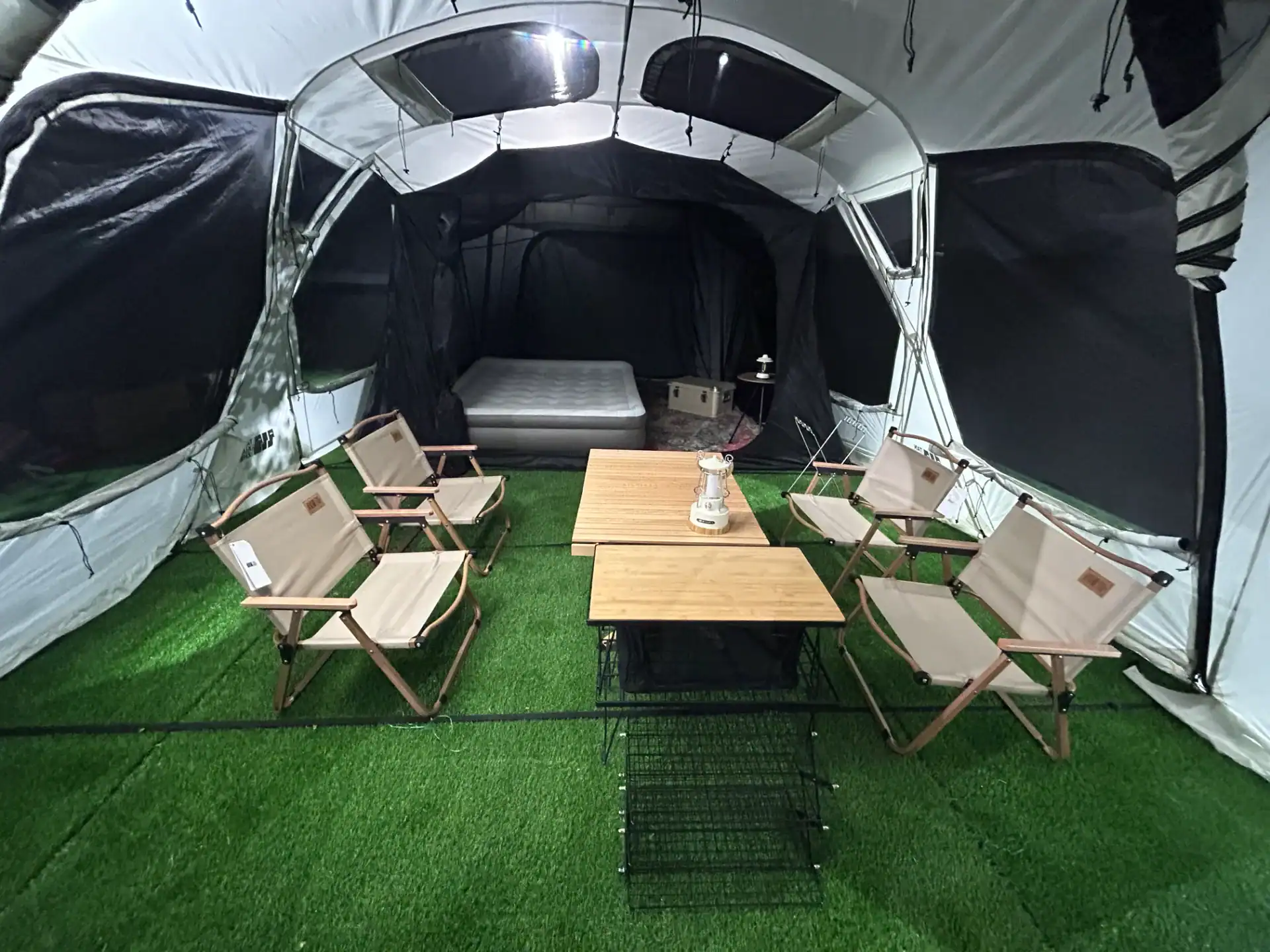
Blackout panels, modular dividers, and controlled airflow turn a tent into a bookable suite.
The difference between a glamping tent and a campground tent is not the brand logo. It’s whether the structure delivers a hotel-level sleep experience. That means controlling light, splitting interior space, and stopping condensation. Operators can charge a premium rate when these three systems work, and they face refund requests when any one fails.
Integrated Blackout Panel Systems
A standard polyester canopy lets light through by 6 a.m. Black-coated fabric blocks that. The factory network applies black coating to polyester and oxford bases for superior UV block, which also drops interior temperature on hot mornings. That single fabric choice converts a 7:30 a.m. checkout complaint into a repeat booking. It is the cheapest upgrade with the most visible guest impact.
-
-
- Coating types: Black, silver, PU, silicone, and PVC are all available in the factory network. Black coating serves the sleeping zone; silver coating reflects heat but doesn’t block light.
- Seam placement: Light leaks through seams before it leaks through fabric. Specify overlapping baffles or coated seam taping in the sample approval round.
-
Blackout panels also require a tight-weave base fabric. Ask the supplier for the base fabric weight in g/m² before approving the sample. A heavier base resists sagging between attachment points and keeps the interior dark for the full lifecycle of the tent. Light bleed between panels, rather than through the fabric, is the failure mode that shows up in online reviews.
Modular Internal Separators
A 5-meter bell tent with no internal divider is one space. Add two zippered separators and the same footprint becomes a bedroom, a living area, and a changing zone. That reconfigurability is what lets operators charge different rates for couples, families, and small groups under the same roof. A family suite at peak season can generate more revenue than a fixed single-room tent.
Air beams make this easier than pole frames. Because the structure curves without a central pole, divider panels can attach directly to the beam sleeves and hang flat. The glamping tent line in Shaoxing produces these configurations with CE and ISO 9001 certification, which matters when the tent will be marketed as a permanent accommodation unit.
-
-
- Divider fabric: Polyester cotton blended (TC fabric) is a practical divider choice—opaque, breathable, and dyeable to match brand colors.
- Prazo de entrega: TPU-laminated dividers run 45–60 days in Zhejiang province; PVC-based panels cycle around 30 days.
-
Ventilation Architecture
Condensation forms when warm, humid air hits a cooler canopy. A single-wall tent with no airflow becomes a rain shower at 3 a.m. The fix is not just a window. It’s a deliberate path for air to enter low and exit high, and the path must be designed into the canopy rather than added as an afterthought.
Mesh panels in the lower canopy, adjustable vents near the peak, and a small gap between the fly and the inner liner create that path. Mesh is a standard fabric option in the glamping tent program, so specifying it in the ventilation panels does not complicate sourcing. Confirm the vent design in the sample test matrix before mass production.
-
- Low entry: Mesh panels at floor level pull cooler air in without letting insects through.
- High exit: Peak vents release warm, moisture-heavy air. Without them, condensation collects at the highest point and drips onto the bed.
These three systems are what separate a shelter from a suite. When the design brief includes blackout fabric, modular dividers, and a real ventilation path, the tent earns a premium rate instead of being compared to a basic campsite. Operators notice the difference in occupancy, and guests notice it in their sleep quality.
| Recurso | Especificação | Benefício | Premium Justification |
|---|---|---|---|
| Integrated Blackout Panel Systems | Twin-wall design with 99% light-blocking PU/silver coating on interior panels | Prevents early-morning light intrusion, extending guest sleep quality and comfort | Enables glamping operators to charge higher nightly rates for ‘hotel-grade’ sleep experience |
| Modular Internal Separators | Zippered, detachable room dividers (300D+ polyester oxford) creating private suites | Convertible layout—one tent becomes 2–3 private sleeping rooms or a living area | Increases unit flexibility for family/suite bookings at premium occupancy rates |
| Ventilation Architecture | Multi-point airflow: low-level intake vents + high-level exhaust windows with insect mesh | Reduces internal condensation in humid climates; lowers mold risk and keeps bedding dry | Maintains premium guest reviews for comfort across humid coastal or forest sites |
| TPU Air Beam Frame | TPU-laminated beams (10–20 cm diameter), 8–12 psi operating pressure | Higher burst strength and air retention vs PVC; stable in high winds | Allows year-round operation in exposed campgrounds, reducing revenue loss from weather closures |
Conclusão
Every specification in this guide—air beam pressure, base fabric weight in g/m², EN ISO 5912 compliance—exists to keep the production run honest to the approved sample. The factory can only build what the brief defines. The final 10% that separates professionals from amateurs is planning for material lead times, not just material specs.
-
- TPU air beams stretch lead time to 45–60 days in Zhejiang; PVC holds at about 30 days.
- Put the sample test matrix in writing: tear strength, welding integrity, and inflation under 4 minutes.
- EN ISO 5912 compliance and wind load class belong in the initial brief, not the follow-up.
- Lock down base fabric weight in g/m² during sample approval; treat later changes as a new quote.
Before you send the next inquiry to a custom inflatable glamping tent supplier, map your launch date against the beam material’s production lead time. Specifying TPU in Zhejiang means 45–60 days versus PVC’s 30-day return, which shifts sample approval and deposit milestones accordingly. Review Kelyland Outdoors’ glamping tent line to benchmark your brief against a factory-tested build.
Perguntas frequentes
Quais especificações são mais importantes para o design de tendas glamping infláveis?
A fábrica precisa do diâmetro da câmara de ar, pressão operacional, número de camadas de laminação e peso do tecido base em g/m² antes de emitir um orçamento. Sem essas informações, o fornecedor utilizará materiais padrão que podem não atender aos seus requisitos de resistência ao vento ou durabilidade. Defina esses parâmetros técnicos antes de solicitar amostras.
Por que as tendas infláveis falham em climas europeus?
A maioria das falhas tem como causa a classe de carga de vento não verificada e a resistência à explosão do tecido. Confirme a conformidade com as normas EN ISO 5912 ou EN 15619 e teste a integridade da solda dos tubos infláveis antes da produção em massa. Solicite os relatórios de teste antes de aprovar o protótipo.
Qual é o MOQ (quantidade mínima de pedido) típico para tendas infláveis personalizadas?
O MOQ varia conforme o produto, mas alguns itens personalizados podem começar com 50-100 peças, enquanto os modelos padrão geralmente ficam entre 300 e 1.000 peças. O número exato depende do tamanho da haste, escolha do tecido, impressão e outros fatores. Solicite um orçamento de MOQ após a finalização do seu brief de design.
Qual o prazo de produção para uma tenda personalizada?
Standard production lead time is 30-45 days depending on order timing, product complexity, quantity, and customization level. Prototyping and sample approval add extra time before mass production starts. Factor in sample rounds when planning your launch date.
What should a design brief include for a factory?
Use a 10-point technical checklist covering layout, beam pressure, fabric weight, coating, zippers, valves, floor materials, UV resistance, fire retardancy, and packaging. A vague brief creates costly revisions and delayed samples. Share the full checklist before requesting a quote.

 English
  Español
  Deutsch
  Français
  Português do Brasil
  Русский
  العربية
  한국어
한국어  日本語
日本語