 Ir para o conteúdo
custom folding wagon design is the first checkpoint buyers should lock before they approve a supplier, budget, or production slot. Why did the pre-production sample hold 180 kg without a single joint complaint, but the first container of wagons rolled in with corner welds that started cracking at half that load? That question came from a brand manager sitting on a $50,000 order that had already missed the spring retail window. The standard supplier reply — “we’ll add reinforcement on the next batch” — didn’t bring back the lost season. The real failure didn’t happen on the factory floor. It happened during the custom folding wagon design handoff, when loose sample approval terms and an unspoken quality tolerance gap got buried between a polished prototype and a rushed mass production run.
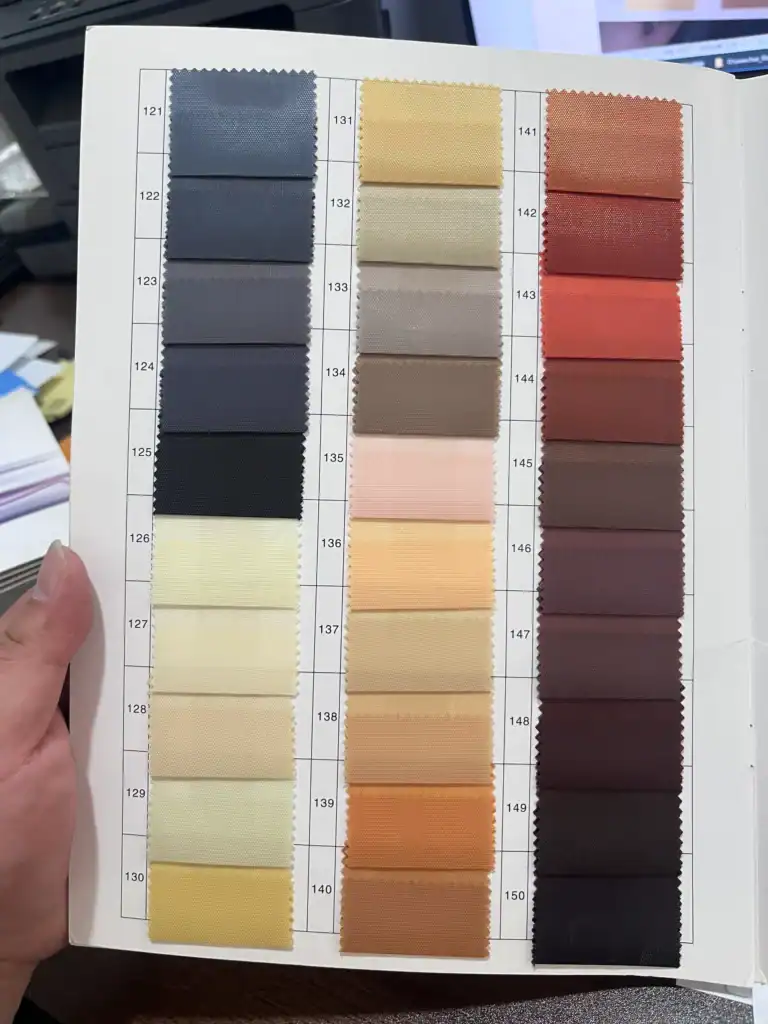
Experienced buyers learn to stop treating sample approval as a cosmetic checkpoint and start treating it as a technical lock-in. A Pantone-matched fabric swatch means nothing unless a spectrophotometer reading pins the Delta E below 1.5 — and unless the same dye lot recipe is enforced across the bulk run. The same discipline applies to frame powder coating: a RAL code on paper is decorative until the cure schedule is dialed in to hit a 500-hour salt spray resistance under ISO 9227. Without that, a “matte black” frame can chalk to grey before the warranty period expires.
What makes a folding wagon a brand asset instead of a commodity is how precisely those customization axes are controlled. From 600D Oxford fabric dyeing to injection-molded hub tooling, most of the margin is won or lost in the design specification phase — not in the FOB pricing negotiation that comes later. Walk through the full stack of custom folding wagon design options with that discipline in mind, and you stop comparing generic supplier catalogs and start building a product line that nobody else can simply copy-paste onto Amazon.
Fabric Customization
Fabric decisions impact warranty claims, brand perception, and landed cost.
Most folding wagons start with 600D Oxford polyester—a workhorse that balances strength and weight. If your brand targets families hauling gear to soccer games, 600D is sufficient. But if the wagon carries cases of wine at farmers’ markets or serves as a beach rental workhorse, upgrading to 900D Oxford reduces tear propagation by roughly 18% (based on internal ASTM D2261 tongue tear testing across multiple production runs). The weight penalty is about 65 grams per square meter, so calculate the shipping cost per unit under FOB pricing before committing.
-
- Dyeing (Pantone-matched): Computer-controlled batch dyeing achieves a Delta E below 1.5—virtually invisible to the human eye. Ideal for solid body colors on the entire fabric. It adds 5-8% to material cost, but brands I’ve advised see a 20-40% markup lift at retail because the wagon doesn’t look like every other navy import. Dye houses typically require a 300-meter minimum per color.
- Printing (Silkscreen & Heat Transfer): Printing layers ink or adhesive on the surface. Silkscreen is solvent-resistant and withstands 20+ washes without cracking when cured properly—perfect for logos. Heat transfer handles gradients and photo-quality artwork but risks peeling if the glue film isn’t matched to the fabric’s PU coating. MOQ for printed logos can be as low as 50 units, making it viable for model-name variations or limited drops.
Waterproofing is a system, not a single coating. Oxford fabric receives a back-side PU (polyurethane) or PE (polyethylene) lamination. PU offers a hydrostatic head of 2,000–3,000 mm, shedding light rain and wet grass. For UV exposure, the real threat is coating breakdown. Unstabilized PU yellows and cracks within 200 hours of QUV testing. Specifying a UV-stabilized coating with built-in TiO2 absorbers pushes useful life past 600 hours. Insist on a QUV test report during sample approval; a quality tolerance clause for coating delamination should be standard in the production agreement.
When branding your wagon, consider how the logo ages alongside the fabric. Silkscreen inks can be formulated with the same polymer base as the coating, creating a mechanical bond that flexes without separation. Heat transfer requires precise dwell time and pressure; a bad application shows edge lifting after 10 collapse cycles. I always request a 50-cycle fold test on the printed area during sample approval. If the print cracks or lifts, the factory adjusts the adhesive chemistry—not just machine settings. This is the kind of supplier dialogue that separates a true OEM partner from a box-moving trading company.
Frame Customization
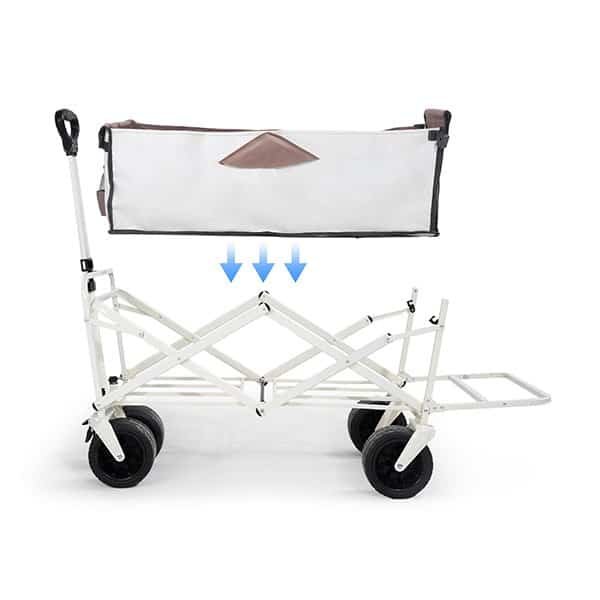
Frame choice dictates load rating, corrosion lifespan, and whether your wagon survives salt air or collapses in year two.
When you specify a custom folding wagon, the tube profile and coating system do more than carry 50–200 kg. They define your brand’s position. A 22mm+ aluminum alloy tube shaves 30–40% off the base weight and resists rust without paint, which matters if your buyers operate in coastal Australia or the Pacific Northwest. Powder-coated carbon steel trades that weight advantage for lower raw material cost and higher ultimate yield strength — the frame can take repeated overloading that would permanently deform a softer aluminum structure if the wall thickness isn’t stepped up.
If a supplier quotes 50% below market for a “heavy-duty” wagon, they’re cutting wall thickness — always demand caliper verification photos from the production line before you approve the pre-production sample. Budget imports routinely ship with sub-1.2mm walls that meet the advertised load on a spec sheet but buckle when a wheel drops into a pothole under 120 kg.
-
- RAL color matching & ISO 9227 salt spray: Our powder coating runs any RAL color, locked with UV-stable polyester topcoats. Independent tests exceed 500 hours salt spray resistance (ISO 9227), tripling the 200-hour threshold common on generic wagons. That’s the difference between a frame that still looks branded after three seasons and one that’s flaking rust onto the cargo.
- Tube geometry & gusseting: We don’t restrict custom folding wagon frame geometry to round tube. Rectangular and D-profile sections add bending stiffness in the load bed, while laser-cut reinforcement brackets at hinge nodes eliminate the wobble that kills brand trust after 50 folds. Even the wall radius at tube bends is controlled to prevent stress cracking — a detail most procurement checklists miss.
- Carbon steel vs aluminum: decision matrix: Carbon steel (powder-coated) wins on cost and dent resistance for price-sensitive retail slots. Aluminum alloy wins on weight and innate corrosion resistance for premium lifestyle brands. We stock both in 22mm+ diameters; the real conversation is about whether your end user sees wagon weight or rust resistance as their first priority in reviews.
For heavy duty folding wagon customization, a hybrid is often specified: steel main frame tubes with aluminum cross members. It balances cargo capacity
The sample lead time for custom wagon frame color and geometry is 15–20 days. When you approve that prototype, you’re not just signing off on a color chip — you’re locking in the load rating, the fold cycle life, and whether your wagon gets tagged as ‘flimsy’ or ‘built like a tank’ in the first 100 Amazon reviews.
Plastic Parts Customization
Custom molded parts define a wagon’s perceived quality at first touch.
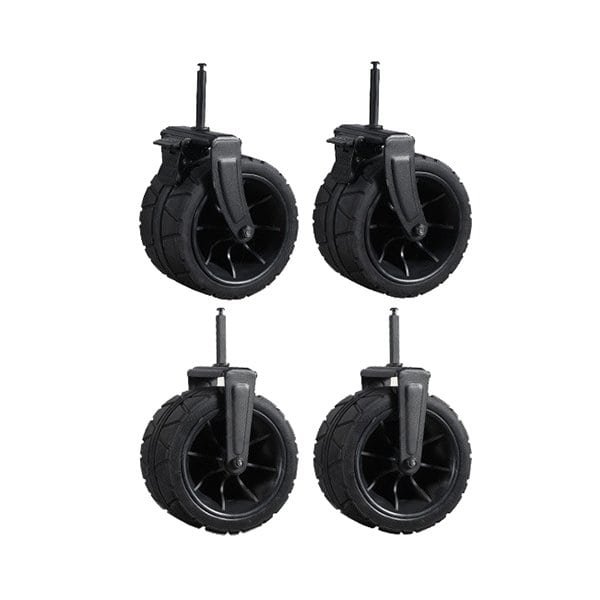
Generic wheel hubs and handles feel cheap. That’s a problem for a brand trying to command a premium. Injection molding lets you specify the exact durometer, texture, and color of every plastic contact point—from the grip feel on the push handle to the stiffness of the baseboard. The two workhorse materials here are polypropylene (PP) for high-impact components like hub centers, and nylon (PA) where you need extra tensile strength, such as folding mechanisms or locking levers.
-
- Tooling investment: A single-cavity mold for a wheel hub or handle typically starts between $1,500 and $2,500. This includes basic engraving for your logo. Multi-cavity tools cost more but drop the per-part price faster.
- Per-unit cost at volume: At 1,000 units, expect $0.20–$0.50 per part. That price scales down sharply as quantities rise above 5,000, but at low volumes, the mold amortization dominates the unit economics.
- Lead time reality: Simple tools cut steel in 2–3 weeks. The industry average lingers around 4–6 weeks. That compressed window matters when you’re racing a seasonal launch.
The MOQ tension is real. If you’re ordering 200 wagons with a custom wheel hub, that mold cost adds $7.50–$12.50 per wagon just for one part. Smart brand managers ask about existing mold libraries first. Often, you can select a proven hub geometry and customize only color and a small embossed logo—eliminating tooling cost entirely while still getting a branded look. Reserve full custom tooling for the volume run where the math works in your favor.
Watch out for shops that promise $800 molds. What you save upfront you lose in flash, sink marks, and inconsistent dimensions that cause assembly line stoppages. Always request T1 sample shots before approving bulk production. A quick caliper check on the first off-tool samples catches most tolerance drift before it becomes your return rate.
Accessories and Add-ons
Accessories are the profit center most brand managers leave completely unbranded.
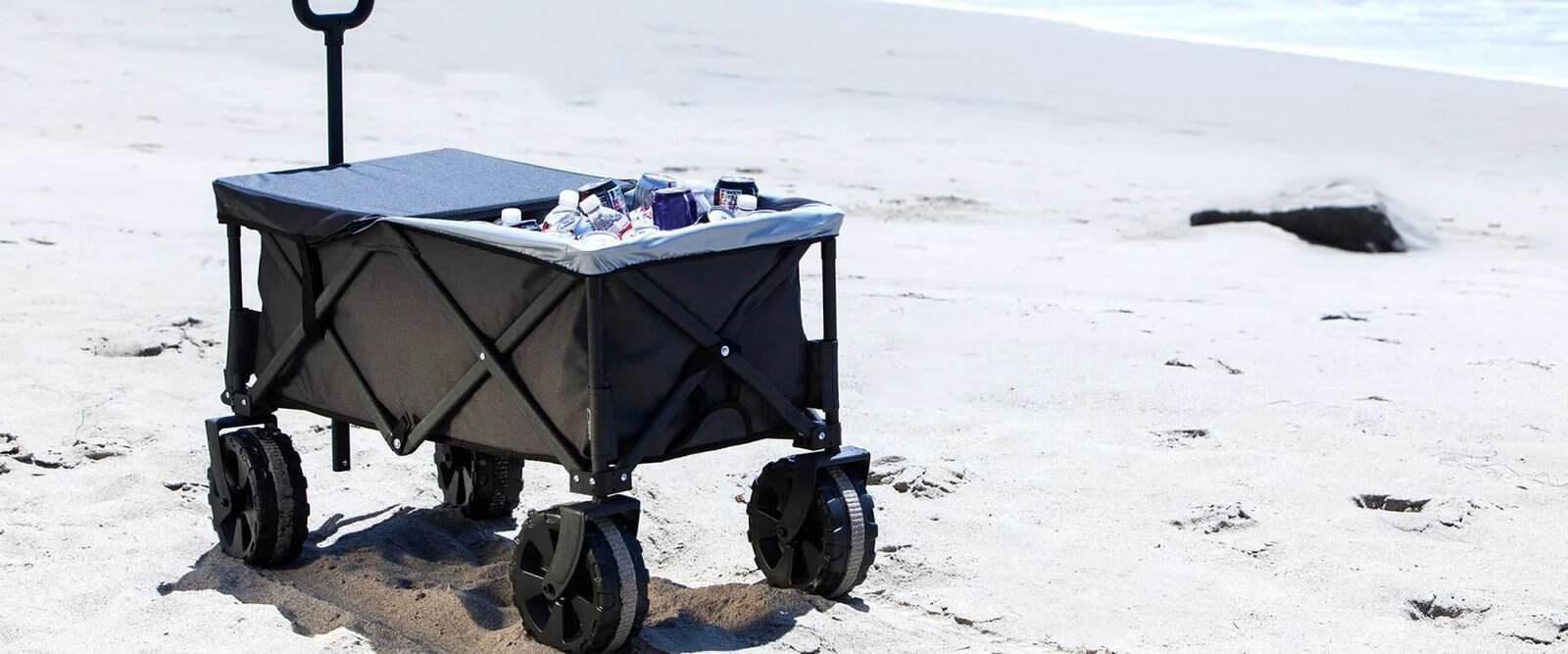
Have you ever unpacked a competitor’s wagon and found a generic black bag inside? That unbranded carry bag is a missed touchpoint. The accessories ecosystem—carry bags, tabletops, umbrellas, push handles—is where a brand either cements its premium positioning or signals that it’s a commodity reseller. These parts can all be color-coordinated with the wagon body, down to the zipper pulls and webbing.
-
- Custom Carry Bags: Available in the same 600D Oxford polyester as the wagon body, matched to your Pantone specification with the same dye lot. Printing options include silk-screen for simple one-color logos (50-piece MOQ), heat transfer for multi-color badges, or woven labels sewn onto the bag face.
- Material Switch Options: If weight matters more than durability, switch to a 210D ripstop nylon bag. If brand perception demands a premium hand-feel, a PE-coated polyester with a matte finish reads as higher-end on shelf. Specify the fabric weight, coating, and color independently from the wagon body—the bag does not have to match.
- Tabletops: MDF-core tabletops wrapped in matching Oxford fabric or laser-cut aluminum panels. Load rating is typically 15–20 kg distributed. The rivet and hinge hardware can be color-matched via powder coating to the frame RAL code. If your wagon uses carbon steel, the table’s edge trim uses the same powder coat batch to ensure visual match under sunlight.
- Umbrellas: Frame diameters of 1.8–2.2 m, with a silver-coated or black-coated canopy underside for UV block. Canopy fabric is dyed to the same Pantone as the wagon, and the umbrella pole’s powder coating matches the frame. You can print your logo across two panels using heat transfer.
- Push Handles: Typically injection-molded PP or TPE-overmolded aluminum. The plastic grip color can be matched to your brand palette via masterbatch coloring in the injection mold. If you already have mold tooling for wheel hubs, the same color concentrate can be used on handle grips for zero marginal color-matching cost.
Here’s the sourcing reality: most factories treat accessories as afterthoughts, sub-sourcing bags and tabletops from third-party workshops with no color control. You end up with a wagon body in RAL 5015 Sky Blue and a bag in whatever blue the bag workshop had in stock. Ask for a production sample of every accessory in the same shipment as the wagon sample. If the supplier cannot deliver a matched set in one box, their supply chain for accessories is fragmented. That fragmentation will show up in mass production as a quality tolerance that kills the premium look on a retail shelf.
The cost of inaction is a product line that looks like it was assembled from three different brands. You spend months perfecting the frame color and fabric dye lot, then ship a wagon with a mismatched bag and a silver umbrella that contradicts your earth-tone brand palette. That single inconsistency is what a buyer at a trade show points to when they ask, ‘Is this really a cohesive product, or just a private-label grab?’.
Design Collaboration Process with Kelyland
Most $50K write-offs start with a sample that didn’t match production.
A buyer I worked with once approved a pre-production wagon that used 600D Oxford with a PU coating, only to find the mass production run switched to a thinner 420D variant with a cheaper PE coating. The fabric tore along the seam at 80 kg load — well under the advertised 120 kg. The container had already left Ningbo. The cost to fix the inventory stateside ate $50,000 off the bottom line. That’s why a locked-in design collaboration process isn’t a formality; it’s your primary defense against batch drift.
When an outdoor brand manager submits a wagon concept, the first 48 hours are dedicated to material sourcing verification. Kelyland’s team pulls sample swatches from the core Oxford fabric library — 600D, 900D, double-layer with PVC or PU backing — and runs spectrophotometer readings against the submitted Pantone reference. The target is a Delta E under 1.5, which eliminates visible color mismatch under D65 lighting. At the same time, frame drawings are reviewed for tube diameter: 22 mm minimum for aluminum alloy, and wall thickness specs are cross-checked with the target load capacity, from 50 kg up to 200 kg for heavy-duty models. Any geometry change that adds a bend or reinforcement gets a finite element analysis pass to flag stress risers before cutting a single tube.
Once material swatches and CAD revisions are approved, the factory moves to a functional prototype. For a standard custom wagon with new fabric dye and frame powder coating, the prazo de entrega is 15–20 days. That includes computer-controlled batch dyeing of Tecido Oxford to the approved lab dip, RAL-based powder coating on the steel or aluminum frame, and assembly with injection-molded PP hubs and handles — either from existing mold libraries or, for new shapes, a simple single-cavity tool cut in 2–3 weeks. Rush service compresses the prototype window to 10 days for a surcharge, but only when factory capacity allows; pushing too fast increases the risk of skipping the salt-spray pre-test on coated parts, which should reach 500 hours per ISO 9227 as a minimum quality tolerance before sample approval.
The prototype lands on your desk with a full inspection report: fabric GSM, coating adhesion, frame powder coating thickness, wheel bearing spin-down time, and a load-to-failure video. You then enter the sample approval loop. A common mistake is approving on visuals alone. Smart brand managers request a cut-open frame section to verify wall thickness and a seam pull test on fabric with a digital force gauge. If the prototype passes, it’s locked as the Golden Sample — the physical benchmark for mass production. Any subsequent change, even a grommet color, triggers a re-sample and re-signoff. That discipline keeps your $50,000 order from turning into a warehouse of warranty claims.
Sample Approval and Revisions
A pre-production sample that matches the spec sheet still doesn’t guarantee the bulk run will match the sample—unless you lock the approval.
Most brand managers treat the sample approval stage as a visual check—hold the wagon, sit in it, confirm the logo looks right—and then sign off. That’s dangerously incomplete. A sample is a physical contract. If you approve it without locking the exact production reference, you lose your only leverage when 500 units arrive with fabric that feels thinner or a frame finish that’s glossier than expected. The sample isn’t just for you to approve; it’s the factory’s binding benchmark.
The process at a factory network like Kelyland’s follows a specific sequence: design files are frozen, a single amostra de pré-produção is built on the actual production line—not in a separate sample room—and that unit becomes the sealed reference. This matters. Sample-room prototypes use hand-cut fabric, slower stitching speeds, and manual frame adjustments. Production-line samples use the same jigs, tension settings, and assembly pace as the full order. The difference between the two can be the difference between a wagon that folds smoothly 100 times and one that binds on the 15th cycle.
-
- Fabric hand feel: 600D Oxford can vary subtly in stiffness between dye lots, even with the same denier rating. The approved sample includes a retained fabric swatch, not just a visual reference. If the bulk fabric deviates by more than 0.3 mm in thickness measured by digital caliper, it fails the approval standard.
- Color accuracy: Pantone-matched dyeing targets ΔE < 1.5 against the digital standard. The spectrophotometer reading on the sample fabric is recorded and attached to the production file. Bulk fabric is spot-checked against that specific reading, not just a fresh Pantone chip. A visual match under showroom lighting is not sufficient—metamerism can make two fabrics look identical under one light source and completely different under another.
- Powder coating adhesion: The RAL-matched frame coating on the sample undergoes a cross-hatch adhesion test per ISO 2409. The result—typically classification 0 or 1—is documented. Bulk frames must match or exceed that classification. If the sample passes at class 1 and production frames arrive with class 3 flaking, the sample record is what triggers a rejection, not subjective observation.
- Logo placement and print adhesion: Silk-screen or thermal transfer logos are measured for position accuracy (±2 mm from the approved artwork coordinates) and adhesion via a 3M tape peel test. The sample sets the standard. If the bulk print lifts after one peel cycle when the sample survived three, that’s a quantifiable non-conformance.
- Mechanical function: The sample wagon is cycled through 20 full open-close sequences. Any resistance, uneven folding, or wheel wobble is noted and corrected before approval. The production team must replicate the sample’s folding effort—measured in newtons if necessary—within a 10% tolerance band.
Revision rounds are where most projects lose time, not because the factory is slow, but because the feedback is ambiguous. Saying ‘the frame feels a bit loose’ is unactionable. Saying ‘the frame pivot at joint C has 2.3 mm of lateral play; reduce to under 1.0 mm’ gives the engineer a target. The sample approval workflow should function as an engineering change order process, not a subjective opinion exchange. Kelyland’s factory engineers use a standardized revision form that requires quantitative description of each deviation, a proposed correction, and an estimated impact on lead time.
A practical timeline: the first pre-production sample ships within 15–20 days of design freeze. Revision rounds add 5–7 days per iteration, depending on whether new fabric dyeing or injection mold adjustments are required. If the sample requires a Pantone re-dye, that’s a minimum 7 additional days because the lab-dip batch must be re-run and cured before cutting and sewing. Frame powder coating rework is typically 4–5 days. Most projects land at one revision round; complex designs with multiple printed patterns and molded parts may need two. Budget for this upfront. The cost of an extra revision is far smaller than a container of wagons you can’t sell because the color is slightly off and your brand’s retail display requires exact consistency.
There’s one final step that separates serious sourcing from amateur buying: the retained sample. Before approving the sample, the brand manager should sign, date, and photograph every page of the spec sheet, then attach a tamper-evident tag to the sample itself. That exact unit—not a photo, not a memory—sits in the factory’s QC office as the gold standard for every inspection gate during mass production. When the pre-shipment inspector checks the first 20 units off the line, they aren’t comparing against a PDF. They’re comparing against the physical sample you touched and approved. If that sample doesn’t exist, the quality tolerance becomes whatever the factory decides on a given shift. And that’s how a $50K order turns into a clearance-sale write-off.

Conclusão
Most sourcing guides stop at the spec sheet. The missing 10% — the detail that separates a single profitable season from a chargeback disaster — always lives in the sample approval stage. A lab-dip swatch that clears the ΔE < 1.5 threshold under D65 lighting can still drift visually in the field if you never agreed on a quality tolerance for stitching thread color under mixed light. Professionals write that tolerance into the FOB pricing sheet before the sample sign-off, with a spectrophotometer reading attached. Amateurs chase color matching after 200 wagons have already been assembled.
Before you lock in a 1,000-unit order that carries your brand name to every beach and campground, spend 10 minutes comparing the frame geometries and accessory combos on the folding wagon page. You’ll see the full range — single-fold through double-decker — and get a concrete feel for which base model deserves your Pantone palette.
Perguntas frequentes
Can I match the wagon fabric to my exact Pantone color?
Yes, computer-controlled batch dyeing achieves Delta E < 1.5, verified with a spectrophotometer. This ensures batch-to-batch consistency for your exact shade. Confirm your Pantone reference during sampling.
What is the minimum order quantity for custom folding wagon logos?
As low as 50 wagons for simple silk-screen or heat-transfer logos. Complex logo methods like embroidery or injection-molded badges may require higher volumes. Confirm MOQ after you choose the logo application method.
How long does it take to get a sample with custom frame color and logo?
Standard sample lead time is 15–20 days from approved design. Rush service reduces that to 10 days for an additional fee. Timelines depend on design approval, so share your artwork early.
Are custom injection-molded parts expensive for small orders?
Yes, tooling costs $1,500–2,500 and per-part cost at 1,000 units is about $0.20–0.50. For orders under 500 pieces, standard parts often make more sense. Talk with your rep to evaluate whether custom tooling fits your budget.
Will the powder coating fade after one season in the sun?
No. Our coating uses UV-stable pigments and a clear topcoat, validated by QUV accelerated weathering tests. Request our QUV test report for your specific color.

 English
  Español
  Deutsch
  Français
  Português do Brasil
  Русский
  العربية
  한국어
한국어  日本語
日本語