 Ir para o conteúdo
Choosing the wrong Pop-Up Throw Tents is the fastest way to turn a promising weekend trip into a frustrating lesson in gear failure. The confusion starts with the marketing terms themselves, where ‘pop-up’ and ‘instant’ are often used to describe two completely different shelter designs. This mix-up leads many to purchase a coiled fiberglass tent meant for casual festivals when what they really needed was a more robust, framed shelter for a family camping trip, risking a collapsed tent at the first sign of wind or rain.
This guide cuts through the noise to provide a clear technical breakdown. We will compare the deployment mechanics of a true ‘throw-and-go’ pop-up against the ‘extend-and-click’ frame of an instant tent. We’ll examine the structural differences between flexible fiberglass coils and telescoping steel poles, explain why one can handle weather and the other can’t, and finally, demystify the process of folding that coiled frame back into its bag without damaging it.
Deployment: Throw-and-Go vs. Extend-and-Click?
A escolha entre instant pop-up tents and traditional pole tents boils down to a fundamental tradeoff: sub-minute deployment convenience versus superior structural integrity for variable weather conditions.
Understanding the deployment mechanism is the first step in sourcing the right tent for a specific market. The two dominant approaches serve entirely different end-users and performance expectations. One system prioritizes speed above all else, while the other prioritizes stability and weather protection.
Instant Pop-Up Systems for Rapid Setup
Instant or “throw-and-go” tents are designed around a single goal: speed. They use pre-attached poles integrated into a spring-hinge or “Instant-Up Mechanism,” allowing the entire structure to expand into its final shape in less than 60 seconds. This design directly serves the needs of festival-goers, beach campers, and any user who values minimal effort and immediate shelter over all-weather resilience.
| Attribute | Instant Pop-Up System | Traditional Pole System |
|---|---|---|
| Deployment Time | Under 60 seconds | 5-15 minutes, manual assembly |
| Frame System | Integrated Fiberglass Coils (Pre-attached) | Separate Aluminum Alloy or Fiberglass Poles |
| Caso de uso principal | Casual Camping, Festivals, Fair Weather | Backpacking, Family Camping, All-Weather |
| Resistência às intempéries | Lower; flexible frame can struggle in high wind | Superior; engineered for wind and rain load |
Traditional Pole Designs for Structural Integrity
Conventional “extend-and-click” tents require a more hands-on setup process. The user must manually connect pole sections—typically made from high-strength aluminum alloy or fiberglass—and thread them through fabric sleeves or attach them with clips. While this takes more time, it creates a much stronger and more rigid frame. Modern designs often incorporate a “fly-first” architecture, allowing the waterproof rainfly to be pitched before the inner tent is clipped in. This keeps the sleeping area completely dry during a rainy setup.
Market Division: Convenience vs. Resilience
The tent market is clearly segmented based on these two deployment philosophies. One segment of buyers prioritizes the effortless, near-instant shelter provided by pop-up models, making them the standard for fair-weather campers and festival attendees. The other segment requires the proven resilience of a traditional pole tent, built for backpackers and family campers who plan for, and expect, variable weather conditions like wind and rain. The decision is not about which is better overall, but which is fit for purpose.
The Struggle: Why is Folding the “Taco” So Hard?
The difficulty in folding a pop-up tent stems from a counterintuitive process that requires the user to simultaneously manage high-tension poles and trapped air through a specific, non-obvious sequence of twists.
The Counterintuitive “Taco” Formation
The primary point of failure for most users is mastering the “taco” shape. This intermediate step requires a specific twisting motion that runs counter to how people naturally fold flexible objects. This friction in user experience is the main learning curve that manufacturers address with detailed instructional videos and diagrams, as the physical instinct is to simply flatten the tent, which doesn’t work.
- This step demands a precise grip and a coordinated twist to bring the poles into the correct alignment for the final coil.
- If you form the taco incorrectly, the high-tension fiberglass or steel poles will spring back open with considerable force.
- This single action represents the steepest learning curve and is a known friction point in pop-up tent design.
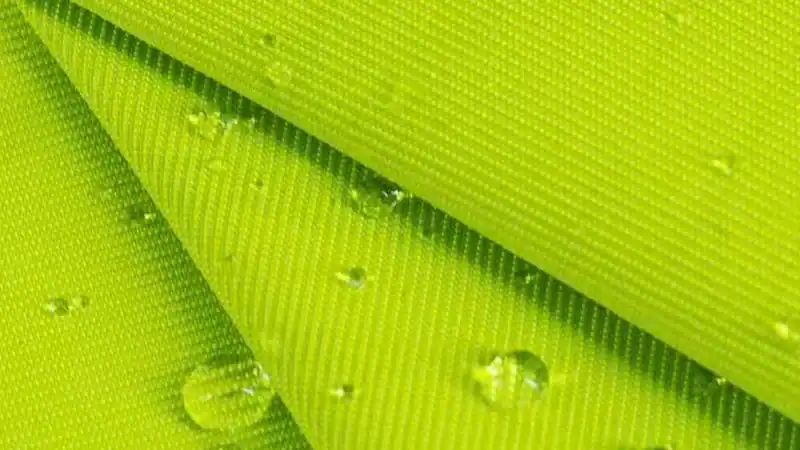
High-quality waterproof tent fabric detail from Kelyland Outdoors, highlighting durability and water resistance
Controlling Pole Tension and Air Management
When folding, users are fighting two physical forces at once: the constant outward pressure from the coiled poles and the resistance from air trapped inside the tent. This dual challenge complicates every step of the folding sequence. The poles are engineered for rapid deployment, which means they are actively trying to uncoil and expand at all times.
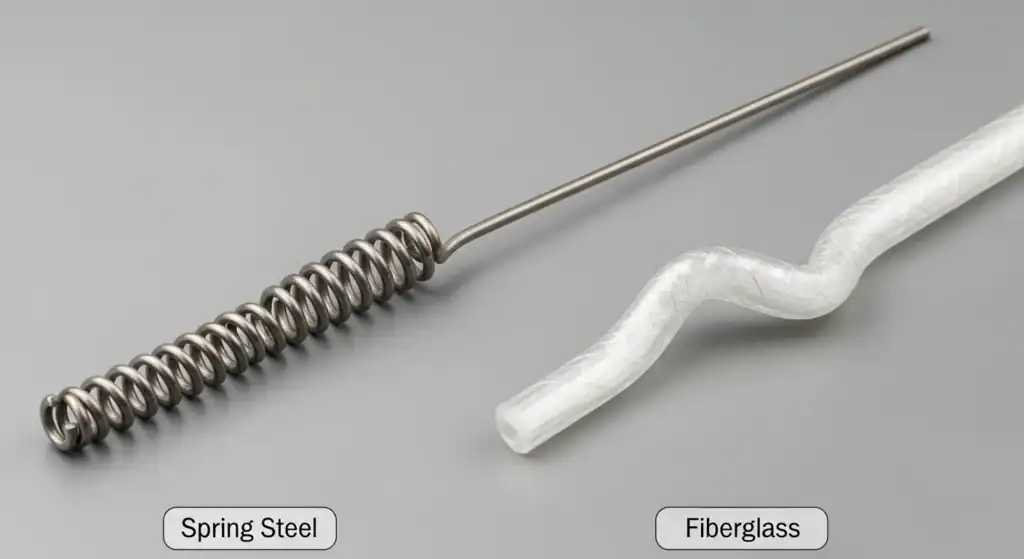
- The frame’s spring steel or fiberglass poles actively resist being coiled, storing potential energy that must be controlled by the user.
- Air trapped within the sealed polyester or nylon fabric acts like a balloon, preventing the tent from compressing easily. Opening all doors and windows is critical.
- A successful fold requires a technique that both controls the pole tension and actively expels air during compression.
The Sequential Folding Process
Folding a pop-up tent is not a simple collapse-and-roll action like a traditional tent. It is a multi-step sequence that must be executed in a specific order. Any deviation from this sequence, like an accidental pole rotation, will prevent the tent from coiling correctly and force the user to start over. This makes the process less forgiving than packing conventional pole-and-sleeve tents.
- Users must coordinate several distinct movements in the correct order, often without clear visual cues on the product itself.
- A common failure point is an unwanted rotation of a pole segment, which disrupts the geometric sequence and forces a restart.
- The process demands an understanding of how each fold builds upon the last to create the final compact, circular shape for bagging.
Seu fornecedor único de barracas de camping personalizadas

Durability: Fiberglass Coils vs. Spring Steel Memory?
The flexible, corrosion-resistant nature of fiberglass makes it the superior material for pop-up tent frames, which must endure repeated coiling and exposure to moisture, while steel’s advantages in stiffness and heat tolerance are irrelevant for this application.
Resistência à corrosão
Fiberglass naturally resists corrosion from saltwater, chemicals, and high humidity, making it a far more reliable material for equipamentos para atividades ao ar livre used in damp conditions. Unlike steel, which requires protective coatings to prevent rust and degradation, fiberglass maintains its structural integrity for decades even with constant exposure to moisture. This inherent resistance makes it the definitive choice for tent frames that will see frequent use in wet or coastal climates, where a typical steel frame would begin to corrode within a few years.
Lifespan and Maintenance
The long-term ownership costs associated with fiberglass are significantly lower due to its extended lifespan and minimal maintenance needs. A fiberglass structure can have a service life of 75 years or more with very little upkeep. Steel structures, by contrast, typically last around 25-30 years and require periodic maintenance to manage and prevent corrosion. For a pop-up tent, the extreme durability of fiberglass translates to less worry about frame failure over the entire life of the product.
| Attribute | Fibra de vidro | Spring Steel |
|---|---|---|
| Tensile Strength | ~1000 MPa (High Flexibility) | ~250 MPa (Rigid) |
| Resistência à corrosão | Inherently resistant | Corrodes without coating |
| Typical Service Life | 75+ Years | 25-30 Years |
| Caso de uso principal | Flexible frames, high-moisture environments | Rigid columns, load-bearing structures |
Mechanical Strength and Flexibility
While steel is stiffer, fiberglass offers four times greater tensile strength—the ability to resist being pulled apart. This flexibility is the critical property for a pop-up tent frame that must coil and uncoil repeatedly without breaking or losing its shape. Steel excels in compressive strength, which makes it better for rigid, load-bearing columns, but it is not engineered for the flexing motion required by instant tent designs. The inherent material memory and high tensile strength of fiberglass are what enable the entire coiled pop-up mechanism to function reliably.
Temperature Limitations
Both materials perform well within the temperature ranges of any normal camping environment. Steel has a technical advantage in extreme high-heat industrial settings, maintaining its integrity up to 400°C, while standard fiberglass can lose strength above 200°C. This difference is purely academic for consumer outdoor equipment, as these temperatures are far beyond any weather conditions a tent would ever face. For all practical purposes, temperature is not a deciding factor between the two materials for this product category.
Use Case: Festival Crash Pad or Family Shelter?
The pop-up tent market has split to serve two distinct users—the festival-goer needing speed and the family camper needing reliability—but material and modular innovations are now bridging this gap.
The Festival Scenario: Speed and Simplicity
For festival attendees, a pop-up tent’s value is measured in seconds. The priority is getting a basic shelter up almost instantly to claim a spot in a crowded field. These designs favor lightweight rip-stop polyester fabrics, making the tent easy to carry from distant parking lots. The focus is purely on convenience and providing a place to sleep, so features like interior space, advanced ventilation, and weatherproofing are often minimal. The core function is rapid deployment, allowing setup in under a minute.
The Family Camping Angle: Weatherproofing and Livability
Family camping shifts the focus from speed to reliability. A shelter for a weekend trip needs to handle unexpected rain and provide enough comfort for multiple people. In response, manufacturers are engineering pop-up tents with features once reserved for traditional models. This includes factory-taped seams for better waterproofing, fabrics with higher hydrostatic head ratings (above 2000mm), and more robust frame designs to improve wind stability. Better ventilation systems are also critical to manage the condensation produced by several occupants overnight.
| Recurso | Festival-Grade Specification | Family-Grade Specification |
|---|---|---|
| Impermeabilização | Basic 1000-1500mm PU coating; seams may not be fully taped. | 2000mm+ PU coating with fully heat-sealed seams and a bathtub floor. |
| Tecido | Lightweight 190T Polyester for maximum portability. | Durable 210T Polyester or Oxford fabric for better abrasion resistance. |
| Frame System | Thin fiberglass poles focused on simple coil-and-release mechanism. | Thicker, more stable fiberglass poles; improved wind stability. |
| Ventilação | Limited to a single door mesh or small roof vent. | Multiple mesh windows, ground vents, and double-layer doors for cross-flow. |
Bridging the Gap with Modular and Material Innovations
The market is no longer strictly divided. Innovations now allow a single pop-up tent to serve both purposes. Modular designs are a key driver, enabling users to add accessories like awnings or vestibules to a basic tent, instantly increasing its livability for family use. The adoption of UV-resistant composite materials and advanced fabric coatings also boosts durability for longer trips without adding significant weight. This dual-use capability gives a product a much wider market appeal, attracting both the casual festival camper and the more serious family looking for a convenient weekend shelter.
Wind Limit: When Should You Not Use a Pop-Up?
A pop-up tent’s wind tolerance is less about its advertised rating and more about proper anchoring and a clear understanding of the 35 mph industry safety limit.
The convenience of a pop-up tent comes with clear structural limitations, especially in windy conditions. Knowing the specific wind speed thresholds is not just about protecting your gear—it’s a critical safety measure. Ignoring these limits can lead to catastrophic frame failure, property damage, or injury.
The 35 MPH Rule: Industry’s Critical Threshold
Across the outdoor and event canopy industry, there’s a recognized consensus: sustained wind speeds exceeding 35 mph create unsafe conditions for nearly all pop-up shelters. This threshold is the accepted point where the risk of structural failure becomes too high, even for a well-anchored tent. Once winds consistently reach this speed, the only safe action is to take the tent down immediately.
Standard vs. Commercial Grade Ratings
Not all pop-up tents are engineered equally. A standard, recreational-use model is typically rated for safe operation in winds of 15–30 mph. These are designed for fair weather and light breezes. For more demanding environments, heavy-duty or commercial-grade models offer enhanced stability with stronger frames and better anchoring points, with some rated to handle conditions up to 40 mph. This extra margin provides a buffer, but it doesn’t override the primary 35 mph safety rule.
Anchoring and Certification Gaps
A wind rating printed on a box is meaningless without proper anchoring. The tent’s ability to resist wind is fundamentally tied to how well it’s secured to the ground. A significant issue in the market is that many manufacturers lack independent, third-party wind certifications, which creates inconsistencies in safety and performance claims. This puts the responsibility on the user to prioritize robust anchoring and exercise caution.
- Effective anchoring with stakes, guy lines, and weights is the most critical factor for maximizing wind resistance.
- Never trust the tent alone; always have a plan to evacuate and dismantle the shelter if weather conditions suddenly worsen.
- Assume the manufacturer’s rating is a best-case scenario achieved under ideal testing conditions, not a guarantee in turbulent, real-world wind.
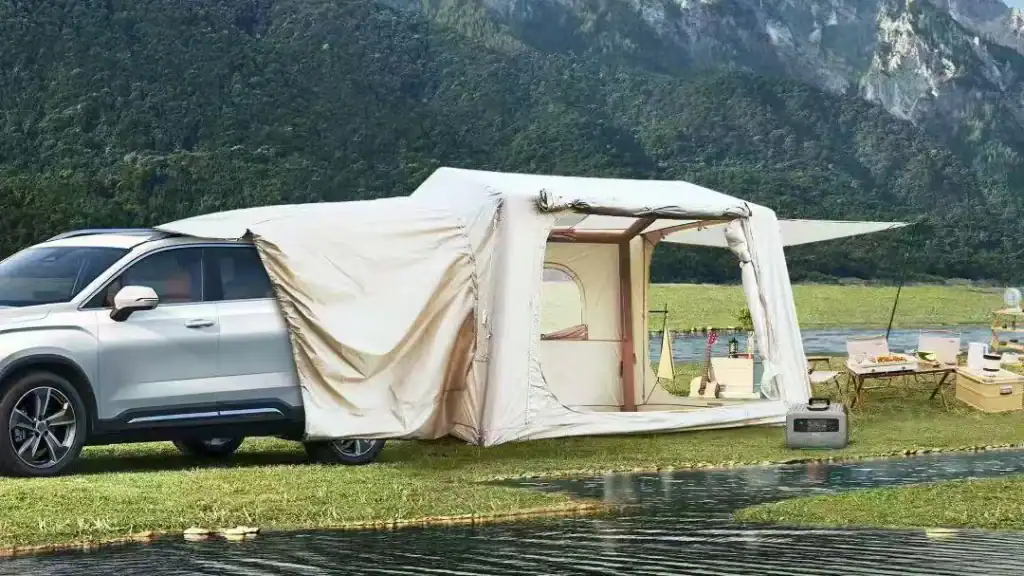
A car is parked beside a lakeside, with a spacious camping tent setup, outdoor furniture, and camping gear for a comfortable outdoor experience.
Conclusão
Choosing between a pop-up and an instant tent comes down to your target market’s priorities. Pop-ups excel in speed for casual events like festivals, while instant tents provide better durability and interior space for family campers. Understanding these trade-offs in pole design and folding mechanisms is key to sourcing a product that matches your customers’ needs.
If you are building a new product line or refining an existing one, we can help you select the right materials and mechanisms. Contact our team to discuss customization options or request a full catalog of our Fast-Pitch series.
Perguntas frequentes
How do i fold up a pop up tent without breaking the poles?
To fold a pop-up tent without damaging the integrated poles, you must work with their natural tension, not against it. First, collapse the tent flat into a large single circle. Stand it on its edge and hold it at the top and bottom. Push the top down towards the bottom, which will cause the frame to form a “figure 8” shape. Finally, overlap these two smaller circles on top of each other and secure the bundle. Never force a bend; if you feel resistance, reset and try the motion again smoothly.
What is the best way to fold a pop up tent back into the circle bag?
The most effective method is the “twist and fold” technique. After collapsing the tent into one large, flat circle, grab opposite sides of the frame. Push one hand forward and pull the other back, twisting the frame into a figure 8. As the two loops form, guide one to fold over the other, creating a smaller, multi-layered circle. Gather any loose fabric, tuck it neatly inside the circular frame, and slide the compact tent into its bag.
Are pop-up tents waterproof enough for serious camping?
While pop-up tents (often called “throw-and-go instant systems”) offer excellent convenience, they generally lack the weather resistance needed for serious camping. Their design prioritizes rapid deployment over structural integrity. They typically have lower waterproof ratings and single-wall designs that are susceptible to leakage in sustained or heavy rain. For multi-day trips or unpredictable weather, a traditional tent with a full-coverage rainfly and higher hydrostatic head rating is the more reliable choice.
Will a pop-up tent blow away easily in windy conditions?
Yes, a pop-up tent’s lightweight design and flexible frame make it highly susceptible to wind. Its structure is optimized for fast setup, not for withstanding strong lateral forces. To mitigate this risk, it is critical to use every stake and guy line point provided by the manufacturer. Anchor the tent securely in a sheltered location if possible. Even when fully staked out, these tents are not recommended for use in exposed, high-wind environments.
Can a standard queen-size air mattress fit inside a pop-up tent?
Whether a queen-size air mattress fits depends on the tent’s specific model and person-rating. A standard queen mattress measures approximately 60 x 80 inches. Many 3-person and most 4-person pop-up tents will have a large enough floor footprint to accommodate it. However, you must always check the manufacturer’s specified floor dimensions. Also, consider that the sloped walls will reduce the usable interior space at the edges, potentially creating a tight fit.
How do you clean a pop-up tent before storing it?
Proper cleaning is essential for longevity. First, fully set up the tent. Use a non-abrasive sponge, cool water, and a mild, non-detergent soap to gently wipe down the interior and exterior surfaces. Avoid harsh chemicals or detergents that can damage the waterproof coating. After cleaning, rinse it thoroughly with clean water. The most critical step is to let the tent air dry completely before packing it away. Storing a damp tent will inevitably lead to mildew and fabric degradation.

 English
  Español
  Deutsch
  Français
  Português do Brasil
  Русский
  العربية
  한국어
한국어  日本語
日本語