 Zum Inhalt springen

A $50,000 folding wagon import china order can die in the gap between the pre-production sample and the mass production run. That’s the story of one buyer who approved a sample with PU tires, watched it fold smoothly, and then received a container where the wheels had quietly been swapped for a cheaper PVC compound. The returns started within the first season.
The lesson isn’t that factories set out to deceive. It’s that sample approval only protects you when the spec sheet names the components that actually fail. Wheel sets are the highest-failure component in folding wagons, so insist that the sample uses the exact wheel material — PVC, PU, EVA, or TPE — that the production run will use. Frame tube thickness, baseboard material, and the Oxford fabric denier deserve the same written commitment.
Keep this benchmark in front of you on your next supplier call: a 40HQ container holds 800 to 1,200 folding wagons depending on collapsed size, and that range moves per-unit freight more than most factory price concessions. Compare FOB pricing with that load range in mind, and ask how mold fees amortize across the first order before accepting a lump-sum charge. Small-batch private label runs are realistic — custom folding wagon MOQs can start at 50 to 100 units.
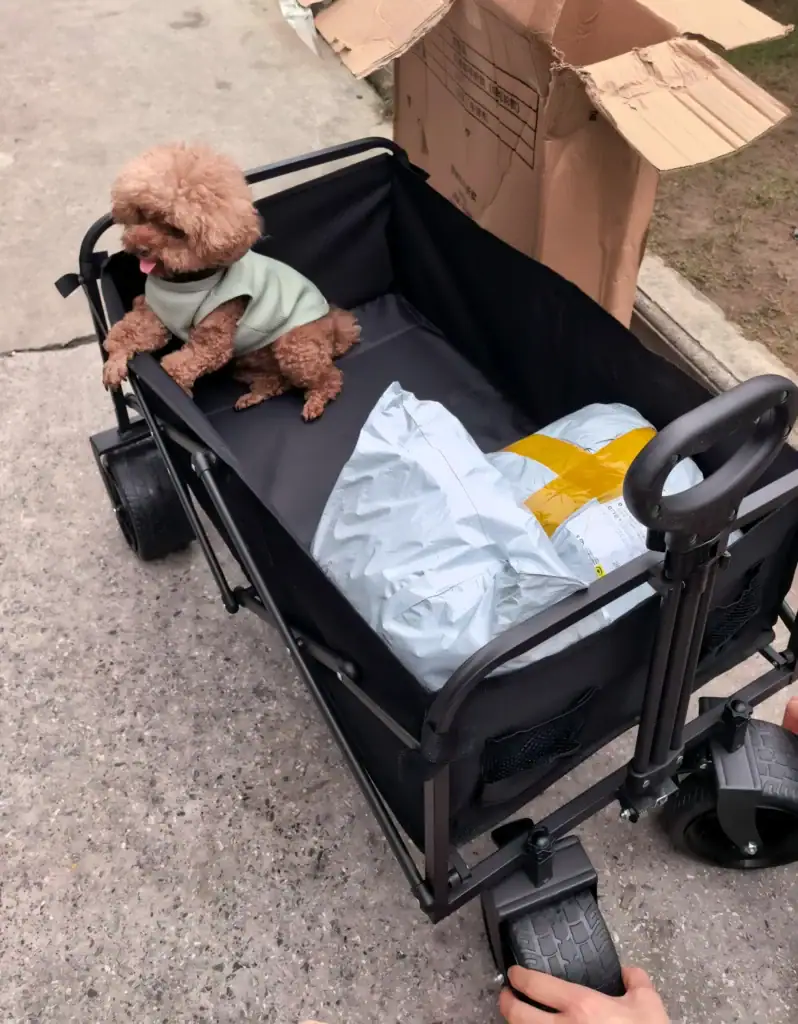
Before You Contact a Folding Wagon Factory
The $50,000 mistake happens before you ever contact a factory, not after.
Buyer: “The pre-production sample held 150 kg on rough ground. The mass production run will match that, right?” Supplier: “Same materials, same spec. No problem.” Then the container lands with hard PVC wheels instead of the PU that passed your field test. That is how a $50,000 order goes sideways.
Lock the spec before you ask for a quote
Folding wagons come in several configurations: single-fold, multi-fold, extended, double-decker, and cot/bench convertible models. Load capacities run 50–200 kg, with heavy-duty variants above that. Fabric is typically 600D–900D double-layer Oxford, and frames are powder-coated carbon steel or aluminum. If you cannot state those three things — style, load capacity, fabric weight — comparable-looking quotes will not actually be comparable.
Factories quote standard models at low prices because the tooling is already paid off. Add a custom-molded part — a branded wheel hub, a unique handle, a custom baseboard — and mold fees appear. Ask for mold amortization over the first order instead of paying full tooling upfront. Some suppliers split the cost across the first three production runs.
OEM vs. ODM: which route for a first order?
OEM means you provide the specification and the factory builds to it. ODM means you take an existing factory design, change the fabric and logo, and sell it under your own brand. For a first order with an MOQ around 50–100 units, ODM on a proven model is faster and safer. Full OEM on a first order means new tooling, longer lead times, and debugging a design that has never run in production.
A sourcing partner with factory connections changes the math. The folding wagon factory in Jinhua, Zhejiang that Kelyland works with produces about one million units per year and holds CE and ISO 9001 certification. That scale means tooling for dozens of standard models already exists, so a private-label buyer can ride existing molds instead of funding new ones.
Landed cost: the number that actually matters
FOB price is just the starting point. Freight, import duties, warehousing, and last-mile delivery stack on top. A 40HQ container typically holds 800–1,200 folding wagons depending on collapsed size and carton dimensions, which swings per-unit freight. Ask for loaded quantity per container before comparing quotes.
-
- FOB-Preis: The factory price at the Chinese port. Compare only after confirming the same fabric, frame, wheel material, and packaging.
- Freight: Sea freight per 40HQ divided by actual loaded units. Collapsed size changes the count, so request carton dimensions in the quote.
- Duties and warehousing: Import duty varies by country and HS code. Add storage costs if your warehouse is not ready when the container arrives.
Skip this homework and the cost shows up later. A buyer who contacts factories without a locked spec spends weeks comparing mismatched quotes. A buyer who discovers a swapped wheel material after the container lands is out far more than a sample fee. Define the spec, settle the mold terms, and know the landed cost before the first inquiry goes out.
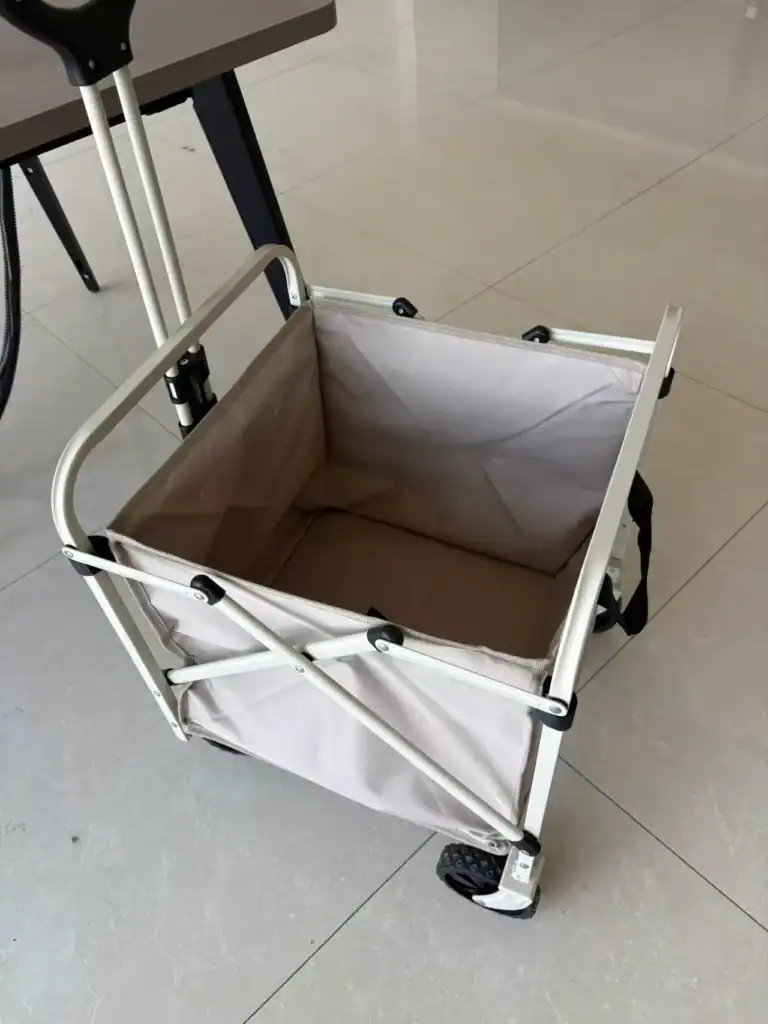
How to Find and Verify Folding Wagon Manufacturers in China
A real factory names its materials, its MOQ, and its production line.
The first inquiry separates a real manufacturer from a front company. A genuine folding wagon factory in Jinhua, Zhejiang — the main production cluster for this category — answers with model numbers, material specs, and a factory name. A middleman answers with a PDF catalog and yes to everything. That difference decides your entire import.
Questions to ask in your first inquiry
Ask what wheel material the quote covers. Wheel sets are the highest-failure component on folding wagons, and the gap between PVC and PU tires shows up in the first 90 days of customer use. If the supplier cannot confirm the wheel compound in writing, the sample will arrive with whatever wheel was cheapest that week.
Ask how custom parts are priced. Many factories quote low on standard wagons, then add mold fees for custom injection-molded components — wheel hubs, handle grips, baseboard clips. Ask for mold amortization over the first order. A factory that refuses is signaling they don’t expect a reorder.
Confirm load capacity and fabric grade in the same email. Production standards here use 600D-900D double-layer Oxford fabric on powder-coated carbon steel or aluminum frames, with load ratings from 50-200 kg. A quote that only says high-quality material leaves room for thinner fabric to appear at inspection.
Red flags that signal a trading company, not a factory
-
- Stock photos as proof: A legitimate factory shows its own welding stations, assembly lines, and finished-goods warehouse. Images scraped from Alibaba or a trade show booth mean a desk, not a production floor.
- Vague MOQ: Real manufacturers quote specific numbers: customized wagons from 50-100 pieces, standard models from 300-1,000. A supplier who says MOQ is flexible after you state your quantity has not costed the order.
- No audit, no video walkthrough: Ask for a live video tour of the assembly line. ISO 9001:2015 certification documents process discipline, but it does not replace seeing the actual line.
Why a one-stop sourcer with multiple factories reduces risk
A single-category factory has a ceiling. The tent facility that makes your camping line cannot give you competitive wagon pricing, and a wagon specialist may lack the fabric dyeing and printing capability a private label needs. Matching wagons to the right line requires a wider view of the supply base.
A one-stop sourcer with 17 core strategic factories and over 200 manufacturing partners routes each order to the right production line. For wagons, that means a Jinhua, Zhejiang facility producing 1,000,000 units annually under CE and ISO 9001. When capacity tightens, the sourcer shifts production rather than pushing your delivery date.
Single-point accountability matters when something fails. If a wagon wheel breaks in month four, you do not want the fabric supplier, frame workshop, and wheel sub-contractor pointing at each other. One sourcing partner owns the full chain — leaving you with a phone call, not a three-way dispute.
Sample Process for Custom Folding Wagons
Treat the pre-production sample as a contract.
The pre-production sample is the last point where a spec change costs hundreds instead of thousands. Most first-time importers treat it as a visual check: unfold the wagon, look at the logo, approve. Then the mass production run comes back with different wheel hubs, thinner fabric, and a fold mechanism that binds on the third use.
What Your Wagon Sample Must Confirm
-
- Stoffgewicht: Verify the exact 600D-900D double-layer Oxford specification, not a visual match. A lighter fabric lowers the load rating and the stitching tears at the baseboard seam.
- Frame tube thickness: Measure the powder-coated carbon steel or aluminum tube walls with calipers. Check the welds at the X-joints — that’s where a wagon fails first.
- Wheel material: Wheel sets are the highest-failure component in folding wagons. Demand samples in the exact tire material you specified (PVC, PU, EVA, or TPE) with brakes that lock on hard ground.
- Fold mechanism: Cycle it 20 times under no load, then 10 more with weight inside. A release that sticks or a frame that wobbles after repeated folds will do the same across the full run.
Sample Fees and Mold Costs
Paid samples are standard, with fees potentially refundable when you confirm a bulk order. Low-cost samples may be free if you cover shipping. Get this in writing before you transfer money. Ask about tooling separately — most factories quote lower prices for standard models but add high mold fees for custom injection-molded parts. Mold amortization over the first order keeps that from ballooning your initial PO.
A 30-Minute Field Test Before Approval
Load the sample to its rated capacity — standard wagons handle 50-200kg; heavy-duty models exceed 200kg — and push it across gravel, grass, and a curb. Check wheel spin afterward. Wobble or drag signals poor axle tolerance. Fold and unfold ten times with weight in the cart, then spray the fabric at the baseboard seams and check for seepage.
Film the whole test. Send the video to your supplier with the approval note so it becomes the reference for pre-shipment inspection. A production facility like the Jinhua, Zhejiang wagon factory — running since 2017 with an annual capacity of 1,000,000 units under ISO 9001 — expects this diligence. A supplier that pushes back on sample verification is telling you how they’ll behave on a full production run.
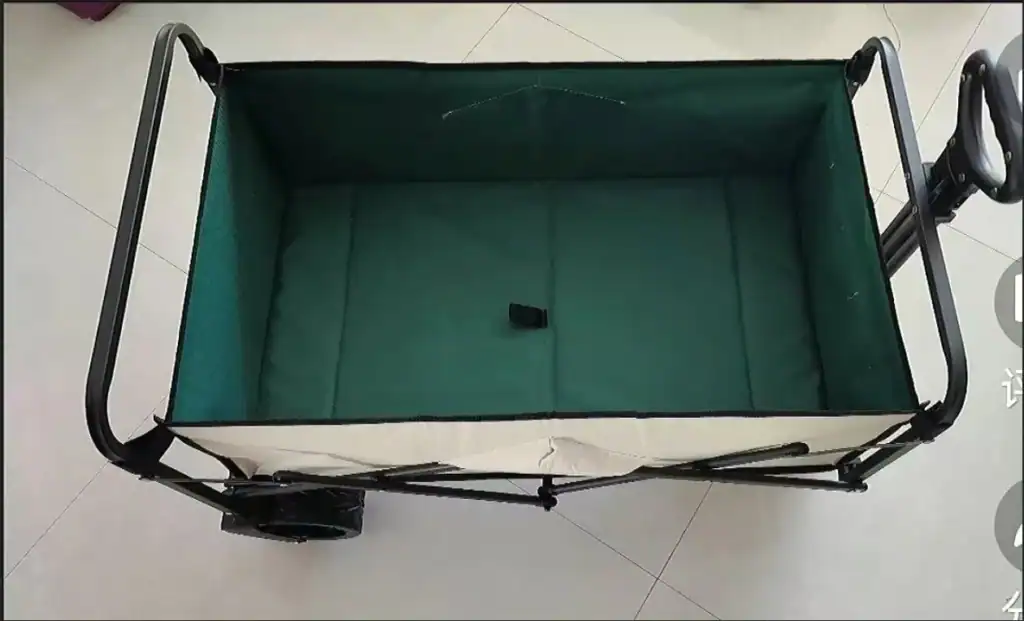
MOQ, Lead Time, and Payment Terms Explained
MOQ is a negotiation starting point, not a fixed wall — understand what moves it and you can plan around it.
A custom folding wagon MOQ of 50-100 units doesn’t mean the factory is being generous. It applies to customizing models they already produce — your fabric color, logo, and packaging on an existing frame. Standard, unmodified wagons run 300-1,000 units. The more you change, the higher your per-unit cost.
Why a 50-unit custom order is possible
The folding wagon factory in Jinhua, Zhejiang, runs standard models continuously — around 1 million units a year — so a 50-unit custom batch slots between larger orders. Custom-molded parts change the calculation. If your design needs a new wheel housing, the factory quotes a mold fee. Ask to amortize that mold cost across the first order instead of a lump sum.
Lead time: 30-45 days, plus the variables
-
- Anpassungstiefe: fabric dyeing and custom printing extend the timeline; sticking with stock fabrics keeps it closer to 30 days.
- Order timing: capacity tightens during peak outdoor season and before Chinese New Year, pushing schedules toward 45 days.
- Sample sign-off: the production clock starts after the pre-production sample is approved. Each revision round pushes your ship date further out.
The lead time starts when the production agreement is signed, not when you send your first inquiry. New buyers commonly lose two weeks just in email lag — quotes, revisions, fabric confirmations — then wonder why the 45-day window didn’t start when they expected. Get the start date written into the agreement.
Deposit and balance for first orders
New clients put down a 30% deposit to lock the production slot, with the 70% balance due before shipment. That balance is your last real checkpoint — it clears after you review the pre-shipment inspection. If a supplier asks for full payment before production, treat it as a red flag.
Repeat clients negotiate more flexible terms, but on a first private label folding wagon order, plan cash flow around the deposit at signing and the balance roughly 45 days later, before loading. That schedule matters more than the unit price when you run your folding wagon landed cost calculator.
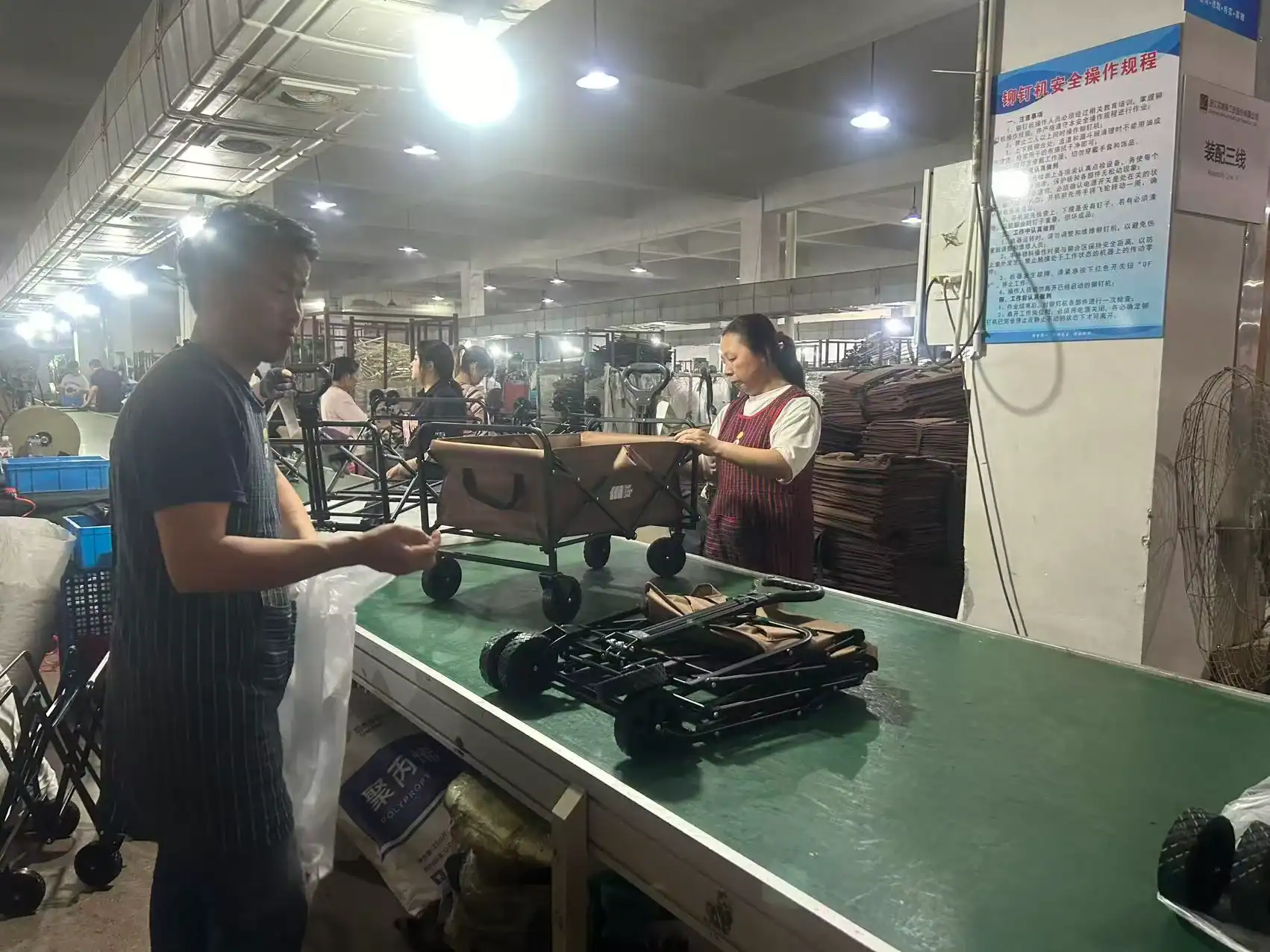
Quality Control and Pre-Shipment Inspections
Wheel sets fail most often.
A pre-production sample sets the baseline. The 40HQ shipment must match it. A structured Vorversandkontrolle is how you catch drift before the container leaves China.
10 Point Wagon Inspection Checklist
-
- Stoffgewicht: Confirm the Oxford fabric is 600D to 900D. A lower denier tears under load.
- Rahmenmaterial: Check for powder-coated carbon steel or aluminum. Look for rust, chips, or exposed metal.
- Welds: Inspect joints for cracks, pinholes, or excess slag. Hinge points show weld failure first.
- Fold mechanism: Fold and unfold several times. The lock should engage firmly with no lateral wobble.
- Wheel material: Confirm PVC, PU, EVA, or TPE against your spec sheet. Unmarked wheels are a red flag.
- Brakes: Press each brake, then rotate the wheel. A working brake stops the wheel within a quarter turn.
- Tragkraft: Load to the model’s rated capacity. The frame should not bend and wheels should spin freely.
- Nähte: Inspect stress points where the tub attaches to the frame. Skip any loose threads or broken stitches.
- Verpackung: Verify carton dimensions and inner packing. A wagon that shifts inside the box gets damaged in transit.
- Printing and labels: Compare logo placement, colors, and label text to the approved artwork. Small errors cause costly returns.
When to Use Third Party Inspection
Supplier QC reports serve a purpose, but they lack the neutrality of an outside check. Book a third party for the first order, after a tooling change, or when you cannot view the factory in person. They should pull random units from finished stock, run load and wheel tests, and photograph defects for your approval.
What ISO 9001 Certification Tells You
ISO 9001:2015 certifies a documented quality management system. It shows the factory follows procedures and keeps records. It does not guarantee a flawless wagon. The folding wagon partner factory in Jinhua holds ISO 9001:2015 and runs inspections at each production stage. Request the reports connected to your batch and make those reports a release condition. A generic certificate is a start. Batch-specific evidence is the real proof.
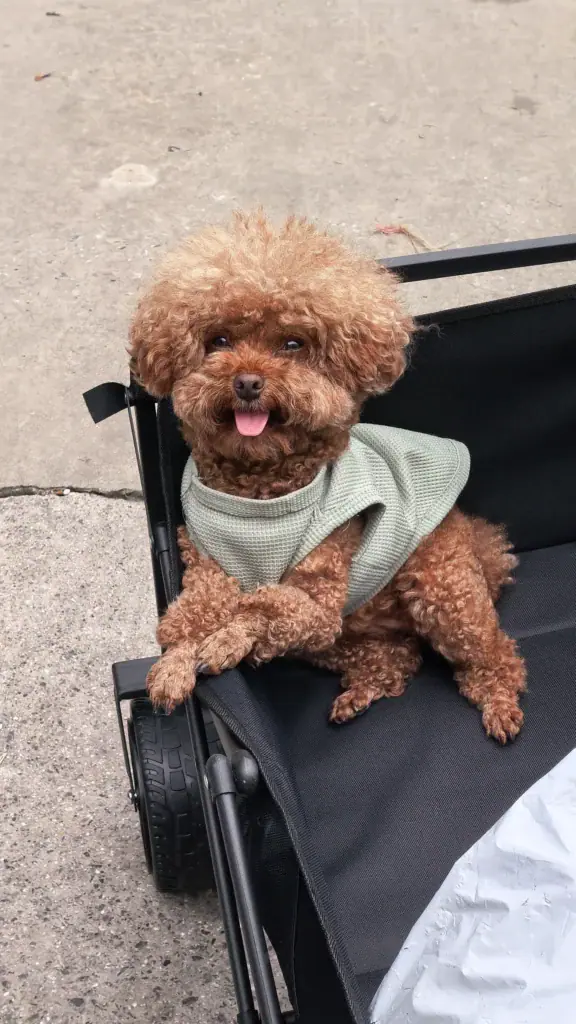
Shipping Folding Wagons Internationally
A 40HQ holds 800–1,200 folding wagons depending on collapsed size.
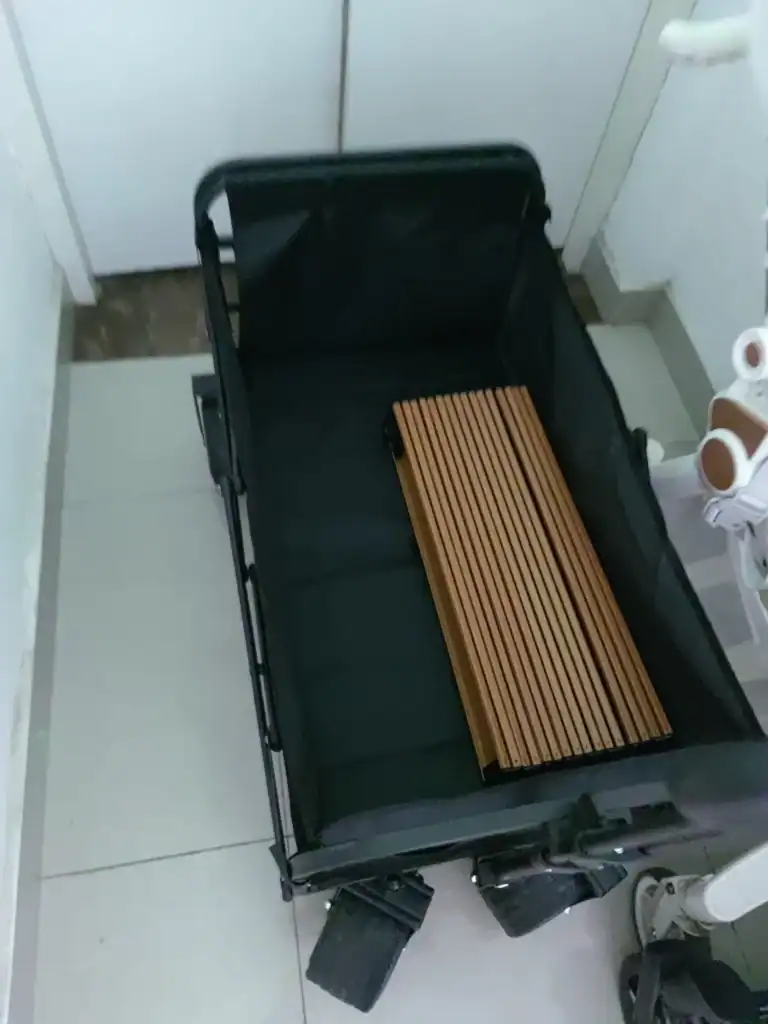
The single biggest freight variable for folding wagons isn’t the unit weight. It’s the collapsed carton size. A standard single-fold wagon with 600D Oxford fabric and a carbon steel frame compresses into a box roughly 28″ x 14″ x 12″. Multi-fold models with double-layer fabric can drop below half that height, which is why the same container can be the difference between 800 units and 1,200 units.
Container Loading Estimate by 40HQ
A 40HQ container has a usable volume of about 67 cubic meters. Factor in palletization and packaging crush resistance, and the practical loading capacity for folding wagons lands between 800 and 1,200 pieces. Heavy-duty wagons with 900D fabric, reinforced corner brackets, and larger wheels eat roughly 30% more space per unit than a compact beach wagon. Even a 2-centimeter difference in carton height changes the per-unit freight cost by several dollars when you’re shipping thousands of units.
-
-
- Single-fold wagon: Collapsed carton around 28″ x 14″ x 12″. Expect 900–1,200 units per 40HQ depending on wheel size and fabric weight.
- Multi-fold wagon: Collapsed carton around 16″ x 12″ x 10″. Fits 1,100–1,500 units per 40HQ, but frame joints add failure risk if not reinforced.
- Heavy-duty wagon: Larger wheels and thicker steel tube increase volume. Plan for 700–900 units per 40HQ. Ask the factory for palletized loading diagrams before you commit to a purchase order.
-
FOB vs EXW vs DDP for Folding Wagon Orders
Most folding wagon factories in China quote FOB Ningbo or Shanghai. That’s the price for the goods loaded onto the vessel at origin, excluding ocean freight, insurance, and import duties. EXW drops the factory’s responsibility right after the goods leave the warehouse door. You coordinate the truck, customs broker, and everything else. DDP puts the factory in charge of delivery to your door, including duties.
For a first-time importer, FOB plus a reliable freight forwarder is the pragmatic middle ground. DDP sounds convenient, but you lose transparency on freight markup. EXW works when you have an existing forwarder network, not when you’re validating a new private label product. If a supplier pushes you toward EXW while quoting vague port charges, that’s a red flag.
Required Export Documents for China Customs
The factory or your sourcing agent handles the export declaration, but you need to know what moves through customs. A commercial invoice, packing list with carton dimensions and gross/net weights, and the bill of lading are the non-negotiables. For folding wagons, no special certifications are typically required at export, though ISO 9001 production oversight matters for consistent quality across the run.
-
- Commercial invoice: States the FOB/EXW value, payment terms, and Incoterm. Used by customs for duty calculation. Keep it consistent with the declared packing list.
- Packing list: Shows carton count, dimensions, weight per carton, and total shipment weight. A mismatch with the actual cargo causes delays.
- Bill of lading: The carrier’s cargo receipt and title document. Confirm the shipper name, port of loading, and container number before it’s issued.
- Export declaration: Filed by the Chinese exporter (or the one-stop sourcing agent). Buyers rarely file this themselves, but you should confirm it’s done before the vessel departs.
Jinhua, Zhejiang is where the folding wagon supply chain is concentrated. Kelyland’s core wagon factory there has produced over a million units annually since 2017 under ISO 9001 and CE production control, which means the export documentation process runs on established procedures rather than improvised paperwork.
Schlussfolgerung
The import decision comes down to three variables: supplier verification, sample discipline, and per-unit landed cost. A 40HQ container holds 800-1,200 folding wagons depending on collapsed size, which changes freight costs more than most first-time buyers expect. Nail those, and a custom folding wagon MOQ of 50-100 units becomes a workable 2026 entry point.
-
- Verify wheel material on the physical sample; wheel sets are the highest-failure component in folding wagons.
- Jinhua, Zhejiang is the main folding wagon factory cluster, with many ISO 9001-certified facilities.
- A 40HQ container holds roughly 800-1,200 wagons, so collapsed size directly drives per-unit freight.
- Use pre-shipment inspection before release, even on audited factories.
Before signing a production agreement, plug your numbers into a folding wagon landed cost calculator that covers der FOB-Preis, freight, and duties. Then request a sample with the exact wheel material, fabric weight, and frame spec you plan to sell. Compare three vetted suppliers from the Jinhua cluster, and review current folding wagon offerings on the Kelyland product page to anchor your quality tolerance before the next supplier call.
Häufig gestellte Fragen
Wie hoch ist die MOQ für Klappwagen?
Custom folding wagon MOQs can start at 50-100 pieces, while standard models typically require 300-1,000 pieces. The exact number depends on customization level, materials, and the factory’s production schedule. Confirm MOQ after you lock your wagon specs.
What is the production lead time?
Standard production lead time for folding wagons is 30-45 days. Order timing, customization depth, and order quantity can shift that window, so plan around sample approval and peak season. Ask for a written schedule before you sign.
How should I verify a folding wagon factory?
Ask for ISO 9001 certification, audit reports, and inspection photos, and confirm the factory names its materials, MOQ, and production line. Be wary of stock photos or vague answers about manufacturing capacity. Book a factory visit or third-party audit before mass production.
How does the folding wagon sample process work?
Samples are usually paid, with fees refundable after bulk order confirmation; low-cost samples may be free if you cover shipping. Use the sample to verify fabric, frame, wheels, and fold mechanism. Run a real field test before approving the sample.
What are typical payment terms for wagon orders?
New clients or orders over $3,000 typically pay a 30% deposit with 70% due before shipment. Repeat clients can negotiate more flexible payment terms, but inspection should always happen before the final payment. Tie payment milestones to pre-shipment inspection.

 English
 Español
 Deutsch
 Français
 Português do Brasil
 Русский
 العربية
 한국어
 日本語