 Zum Inhalt springen

A buyer once approved a $50K order for private label folding wagon packaging based on a perfect pre-production sample. The mass production run showed up with fabric that felt thinner, a frame powder coat that chipped at the weld points, and cartons that collapsed during stacking. That gap between sample approval and bulk delivery is where margins disappear. It happens because the packaging and branding specs—the carton grade, the print plate costs, the Pantone-matched dyeing—get treated as administrative details rather than engineering constraints.
Most sourcing conversations start with FOB pricing per unit. That number tells you almost nothing about landed cost. Packaging costs hide in separate line items: carton print plates, hang tags, polybags, inserts. Fabric dyeing and frame powder-coating are quoted differently than the base wagon. A supplier who itemizes these costs in the RFQ is usually more transparent than one who bundles everything into a single number. Ask for that breakdown before you compare quotes.
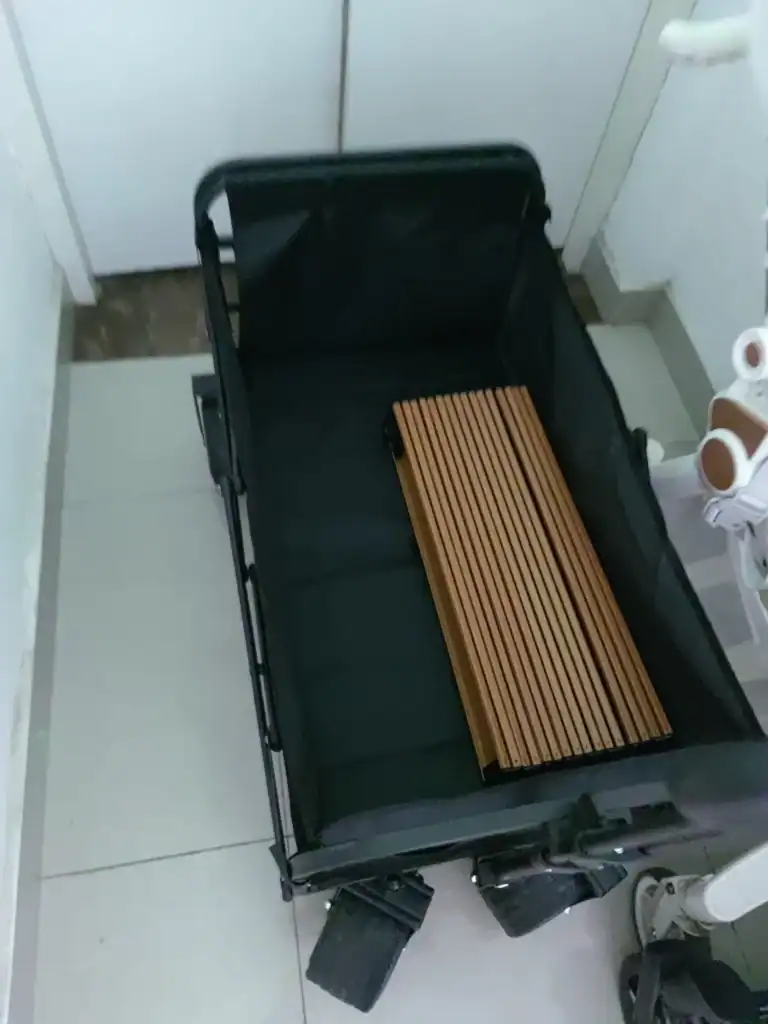
Why Wagons Arrive Damaged Without Proper Packaging
A polybag-only wagon is a damage claim waiting to happen.
Folding wagons are heavy and rigid. A standard single-fold model with a powder-coated carbon steel frame and 600D–900D Oxford fabric weighs between 10 and 18 kg. Stack six of those on a pallet with nothing but polybags between them, and the bottom unit absorbs the full load of the stack above. Frame denting, scuffed powder coating, and torn fabric corners are the predictable result.
What Standard Packaging Misses
Most suppliers default to a single polybag per wagon. That works for shelf display in a retail store after individual handling. It fails completely inside an ocean freight container where pallets shift, straps loosen, and containers stack three high during transit. The collapsed wagon volume creates air gaps that let units slide against each other.
-
- Frame Protection: Powder-coated carbon steel or aluminum frames dent when another wagon’s wheel hub presses against the tube wall during container vibration. Corner-edge cardboard inserts or foam end caps prevent this.
- Fabric Scuffing: Oxford fabric (600D–900D double-layer) abrades against adjacent frames when polybags burst at the seam. A fitted fabric cover or internal divider carton eliminates surface damage.
Carton Specs That Actually Matter
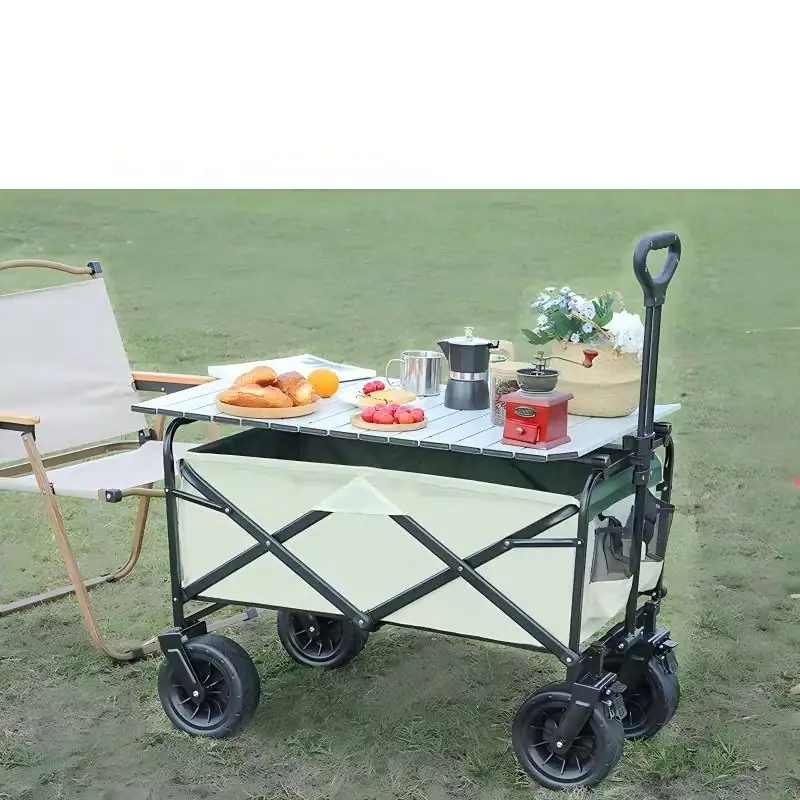
Packaging Cost Breakdown for Folding Wagons
A single FOB quote hides 15-25% of packaging costs that determine your landed margin.
Most buyers ask for an FOB price and assume the packaging cost is baked in. It is — but only at the cheapest tier. The supplier builds a plain brown export carton into the quote. Every branding touch after that adds a line item: print plates, Pantone-matched fabric dyeing, hang tags, polybags, inserts. A buyer who requests an itemized packaging cost breakdown in the RFQ consistently lands a lower landed cost.
Carton Tiers: Export vs Retail-Ready
A 5-layer export carton with single-color printing costs roughly $1.20–$2.00 per unit for a standard folding wagon. An 8-color retail-ready box with UV coating and inside dividers can hit $3.50–$5.50 per unit — before any insert or handle cutout.
-
- Export carton: Brown kraft, one-color print, no inner dividers. Protects during ocean freight but requires repackaging at retail.
- Retail-ready box: Full-bleed CMYK print, coated finish, integrated handle and product window. Saves labor at the retailer but adds 40-60% to packaging cost.
The Hidden Line Items Buyers Miss
| Packaging Component | Spezifikation | Auswirkungen auf die Kosten | Am besten für |
|---|---|---|---|
| Export Carton (5-layer) | Double-wall corrugated, single-color print | Lowest cost; protects for ocean freight | B2B bulk orders, palletized shipping |
| Retail-Ready Carton (8-color) | Full-color print, shelf-ready design | +30-50% vs export carton | Direct retail shelf placement |
| Fabric Dyeing (Pantone Match) | 600D-900D Oxford, lab dip required | $0.50-$1.50 per unit for custom color | Brand identity consistency |
| Logo-Druck (Siebdruck) | Einfarbiger Druck auf Stoffpaneel | 0,20–0,60 USD pro Einheit | Einfache Logo-Anwendung |
| Logo-Druck (Thermotransfer) | Multi-color, high detail on fabric | $0.80-$2.00 per unit | Complex brand graphics |
| Frame Powder Coating | Custom RAL color, anti-corrosion finish | $1.00-$3.00 per unit | Matching frame to brand palette |
| Hang Tags & Inserts | – Printed cardstock, barcode, care label – Polybag for each wagon – Corner protectors / foam inserts inside carton – Stretch wrap and pallet corner boards for consolidated loads. | – $0.10-$0.30 per tag set – $0.15-$0.40 per polybag – $0.50-$1.50 per carton – $2-$5 per pallet. | – Brand presentation at point of sale – Prevents scuffs and dust during transit – Prevents frame denting from stacking forces during container loading and unloading – Stabilizes pallet stack and prevents carton collapse in high-humidity sea freight conditions. |
| Pre-Shipment Inspection Report | Third-party or factory QC check | $200-$500 per batch | Verifying packaging integrity before shipment |
Carton Design vs Collapsed Wagon Volume
Collapsed wagon cube determines freight cost more than weight does.
Most buyers compare FOB price per unit and assume that’s the cost story. It’s not. The collapsed carton dimensions — length, width, height — determine how many units fit in a 20ft or 40ft container. That number directly sets the per-unit sea freight, which often exceeds the packaging material cost.
Single-Fold vs Multi-Fold: The Cube Gap
Single-fold wagons collapse into one flat panel stack. The folded profile is roughly the full wagon length and width, with thickness equal to the frame plus fabric layers. A typical single-fold wagon packs at about 0.12–0.15 CBM per unit. Multi-fold wagons break the frame into two or three segments, reducing the longest dimension by 30–50%. That cuts CBM to roughly 0.08–0.10 per unit — a difference of 30–50% in container utilization for the same product.
What to Request in Every RFQ
OEM vs ODM Branding Choices Compared
ODM shifts the engineering risk from the buyer to the factory floor.
The practical difference between OEM and ODM for a folding wagon comes down to who owns the design risk. An OEM buyer walks into the process with a finished spec sheet: collapsed dimensions, fabric denier, frame tube gauge, Pantone references for fabric and powder coat, and artwork files for screen or thermal-transfer printing. The factory executes against that brief. An ODM buyer walks in with a concept — “I need a 200L wagon that folds flat enough to stack 4 high on a pallet” — and asks the factory to engineer the solution.
OEM: You Control Every Variable
OEM buyers supply artwork and Pantone colors. They specify fabric weave (600D vs 900D double-layer Oxford), frame material (powder-coated carbon steel or aluminum), baseboard type (PP or MDF), and wheel composition (PVC, PU, EVA, or TPE). The factory runs fabric dyeing, screen/digital/thermal-transfer printing, frame powder-coating or anodizing, and custom injection molding for plastic components like handle grips and wheel hubs. You control the bill of materials down to the thread color.
ODM: Factory Validates Before You Commit
ODM reduces development risk because the factory validates load capacity, folding mechanism geometry, and carton fit before sampling. A typical ODM project at Kelyland Outdoors starts with a design brief. The engineering team models the frame fold path in CAD, checks that the collapsed volume fits within standard export carton dimensions (to minimize wasted CBM), and runs load simulations on weld points. Only then does tooling begin. For brand owners without a technical designer on staff, this route eliminates months of back-and-forth on drawings that miss real-world constraints.

Retail Compliance Rules for Wagon Packaging
California SB 343 takes effect October 2026 — verify recyclability claims before printing cartons.
A folding wagon that clears customs but gets rejected at a retailer’s receiving dock costs you the full FOB value plus return freight. US and EU retailers enforce specific labeling and safety standards that private-label buyers must build into their packaging spec from day one.
US Retail Compliance: CPSC, ASTM, and Prop 65
For folding wagons sold in the United States, the Consumer Product Safety Commission (CPSC) requires permanent tracking labels on the product and its packaging. The label must include the manufacturer name, production date, and batch code — this is non-negotiable for any retailer that sells to consumers.
ASTM F2057-19 is the voluntary stability standard for clothing storage units, but some big-box retailers apply similar tip-over logic to folding wagons with tall handlebars. If your wagon has a push handle over 30 inches above ground level when collapsed, ask your supplier whether the frame passes a 50-pound stability test at a 15-degree tilt angle. No certification? Expect a chargeback if units tip in-store.
California Proposition 65 warnings are required if any component — handles, rivets, or powder-coat pigments — contains lead, cadmium, or phthalates above safe harbor levels. A Prop 65 warning on a wagon carton reduces shelf appeal; better to request material compliance certificates from your factory before printing packaging.
EU Retail Compliance: CE Marking and REACH
Folding wagons sold in the European Union require CE marking under the General Product Safety Directive (GPSD). The factory must issue a Declaration of Conformity stating that the wagon meets applicable EN standards for mechanical safety and chemical content. Without this document, EU customs will hold your shipment.
REACH regulation restricts SVHCs (substances of very high concern) in textile fabrics and plastic components. Your supplier should provide a REACH compliance statement covering the Oxford fabric dyeing process and any PVC or PP parts used in wheels or baseboards.
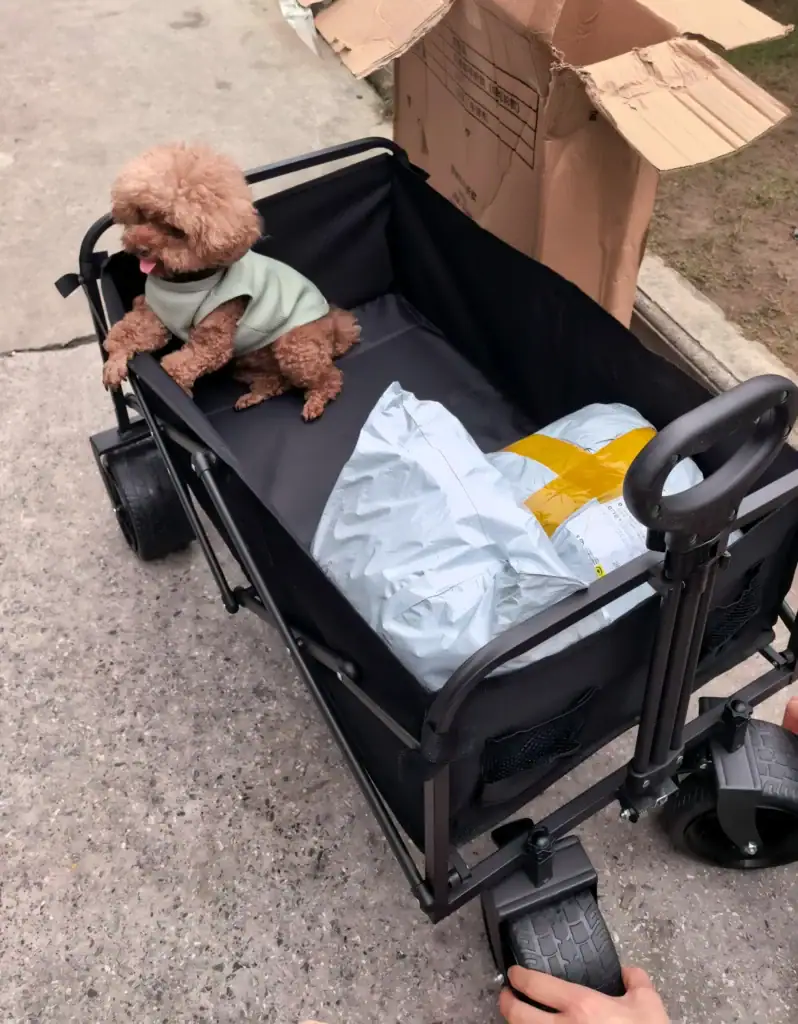
How to Vet a Private-Label Wagon Factory
Three QC checkpoints separate a reliable wagon supplier from a margin-eating one.
A $50,000 folding wagon order went bad because the mass-production units used thinner fabric than the pre-production sample. The supplier swapped 900D Oxford for 600D after sample approval and the buyer didn’t catch it until containers arrived. That gap — between what you approve and what ships — is where quality control failures live.
The Three-Stage Inspection Protocol
A factory that passes ISO 9001:2015 audit has documented procedures for every production stage. But certification alone doesn’t stop a batch from drifting off-spec. You need three specific checkpoints written into your purchase agreement.
-
-
- Pre-Production Sample: Dies ist der Prototyp. Überprüfen Sie die zusammengeschobenen Abmessungen, das Gewebedenier (600D vs. 900D), die Wandstärke der Rahmenschrohre, die Haftung der Pulverbeschichtung und die Schweißqualität. Geben Sie dieses Exemplar schriftlich frei, bevor die Fabrik die Rohstoffe bestellt.
- Serienproduktionsmuster: Nehmen Sie eine Einheit aus dem ersten Produktionslauf – kein handgefertigtes Muster vom erfahrenen Techniker. Vergleichen Sie es stufenweise mit der Einheit vor der Produktion. Messen Sie das Gewichtegewicht mit einer Grammwaage. Prüfen Sie, dass die zweilagigen Nähte den Spezifikationen entsprechen.
- Bericht zur Vorversandkontrolle: Ein Drittanbieter- oder Qualitätskontrollteam der Fabrik prüft mindestens 20 % der fertigen Kartons vor der Containerbefüllung. Der Bericht muss Fotos von zufällig ausgewählten Einheiten, dem Kartonzustand, der Palettensicherung sowie aller als problematisch eingestuften Einheiten (Rahmenbeulen oder abgeplatzte Stoffstellen) enthalten.
-
What to Check During a Factory Audit
If you’re visiting or requesting documentation from a potential partner factory for your private label folding wagon packaging program, focus on four areas that directly affect your landed cost and defect rate.
-
- Material Certifications: Ask for mill certificates on steel tubing and fabric roll specs from the textile supplier. A factory that stocks material certificates can prove they use powder-coated carbon steel or aluminum frames as quoted — not cheaper alternatives.
- In-Line Welding Inspection: Wagon frames fail at weld joints under load. The factory should have a visual inspection station after welding and a spot-check jig test every 50 frames to verify structural integrity against the rated load capacity.
- Rückverfolgbarkeit der Chargen: Does each production batch carry a lot number linked to raw material receipts? If you get a defect claim six months post-shipment, traceability lets you isolate whether it was one bad coil of steel or a systemic process drift.
Kelyland Outdoors’s partner factories are ISO 9001:2015 certified with CE and BSCI where required. They provide inspection reports at every production stage — material sourcing, in-process checks, final assembly, and pre-shipment — so buyers can verify compliance without flying across time zones.
Schlussfolgerung
A private-label folding wagon program lives or dies on three numbers: MOQ, collapsed carton volume, and QC inspection points. FOB price per unit tells you almost nothing about the final margin. The real cost sits in the packaging line items, the freight cube, and the gap between a lab-dip sample and a mass-production run.
-
- Require an itemized packaging cost breakdown in the RFQ.
- Compare collapsed CBM between single-fold and multi-fold wagon models.
- Insist on a mass-production sample before approving bulk production.
- Verify California SB 343 compliance for any US retail packaging.
Skipping these steps costs more than just damaged goods—it erodes trust with your retail partners and buyers. A single rejected shipment of wagons can set your program back by months and thousands in chargebacks. Before you commit to a production run, review Kelyland’s camping furniture and folding gear specifications to see how fabric denier, frame powder-coating, and carton construction standards translate into a sellable product. Compare supplier capabilities side by side before requesting samples.
Häufig gestellte Fragen
Q: What is the minimum order quantity for private label folding wagons? A: Select custom items can start at 50–100 pieces; standard folding wagon models typical?
Die exakte Antwort hängt von Produktspezifikation, Menge und Auftragskonfiguration ab. Der sicherste Ansatz ist es, die Handelsbedingungen erst zu bestätigen, nachdem das finale Anforderungsdokument abgeschlossen ist. Bestätigen Sie die Mindestbestellmenge (MOQ), nachdem Spezifikation und Anpassungsumfang final festgelegt sind.
F: Kann ich vor der Serienproduktion eine Probe eines Faltwagens erhalten? A: Proben werden berechnet, die Gebühr wird jedoch nach Auftragsbestätigung für die Serienproduktion erstattet. Niedrigpreisige Probe?
Die genaue Antwort hängt von der Produktspezifikation, der Menge und der Auftragskonfiguration ab. Der sicherste Ansatz ist, die kommerziellen Konditionen erst zu bestätigen, nachdem das endgültige Anforderungsblatt festgelegt wurde. Die Musterverfügbarkeit sollte anhand des aktuellen Lagerbestands und des Versandplans bestätigt werden.

 English
 Español
 Deutsch
 Français
 Português do Brasil
 Русский
 العربية
 한국어
 日本語