 Zum Inhalt springen
anchor inflatable tent sand is the first checkpoint buyers should lock before they approve a supplier, budget, or production slot. Subject: Vorserienmuster vs mass production run — the $50K gap.
I watched a buyer approve a sample that looked perfect in the showroom. The mass production run came back with anchor loops sewn from a lighter webbing — same color, half the tear strength. That order went to a beach rental fleet, and within three weeks, two tents had pulled their corner loops out during an afternoon gust. The failure wasn’t in the stake choice or the guyline angle. It was in the loop spec that no one put on paper.
When you anchor inflatable tent sand setups for a rental fleet, you are not solving a single problem. You are solving for repeatability across dozens of units, multiple setups per week, and wind conditions that change by the hour. A standard 9-inch stake fails in dry sand before the air beam even transfers its load. That is not opinion — it is physics. Dry sand has almost no shear strength, so narrow stakes slide out and leave the tent rocking at the base. The real fix starts before the tent leaves the factory: reinforced anchor loops, perimeter skirts that stop sand scouring, and guylines spec’d at a 45-degree angle rather than whatever angle feels right on site.
Why Inflatable Tents Lift Differently on Sand
The real failure point isn’t the stake — it’s how the air beam transfers load to the loop.
Most buyers assume an inflatable tent holds against wind because the beam is rigid. That assumption is wrong. An air beam flexes under gust load — that’s its advantage over a pole tent — and in doing so, it transfers the entire lateral force down to the anchor loops at each beam end. The PSI inside the beam matters for shape retention, but it does almost nothing for holding power. The base loops and guyline geometry do that work.
Standard Stakes Fail in Dry Sand
Dry sand has almost no shear strength. A standard 9-inch stake relies on friction against compacted soil, but sand particles shift under load and offer no grip. The stake slides out before the beam can transfer its full load to the fabric. Once one corner lifts, the tent rocks and puts repeated stress on every other anchor point, accelerating tear-outs at the loops.
Anchor Loop Size Is the Hidden Weak Point
Most stock inflatable tents ship with narrow, single-stitched anchor loops rated for light duty. In a rental fleet, those loops see nightly setup and takedown plus gust loads that exceed their design margin by a factor of two or three. The first failure mode is stitch elongation — the thread stretches under load until one bar tack pops, then the rest unzip sequentially.
The 5 Sand Anchor Setups That Actually Hold
Five anchoring methods, not three.
Standard 9-inch stakes rely on friction against the sand grains. Dry sand has almost no shear strength, so the stake slides out before the beam can transfer wind load to the fabric. The tent then rocks at the base, putting repeated stress on the anchor points.
1. Sand Screws: Auger-Style for High-Wind Beach Conditions
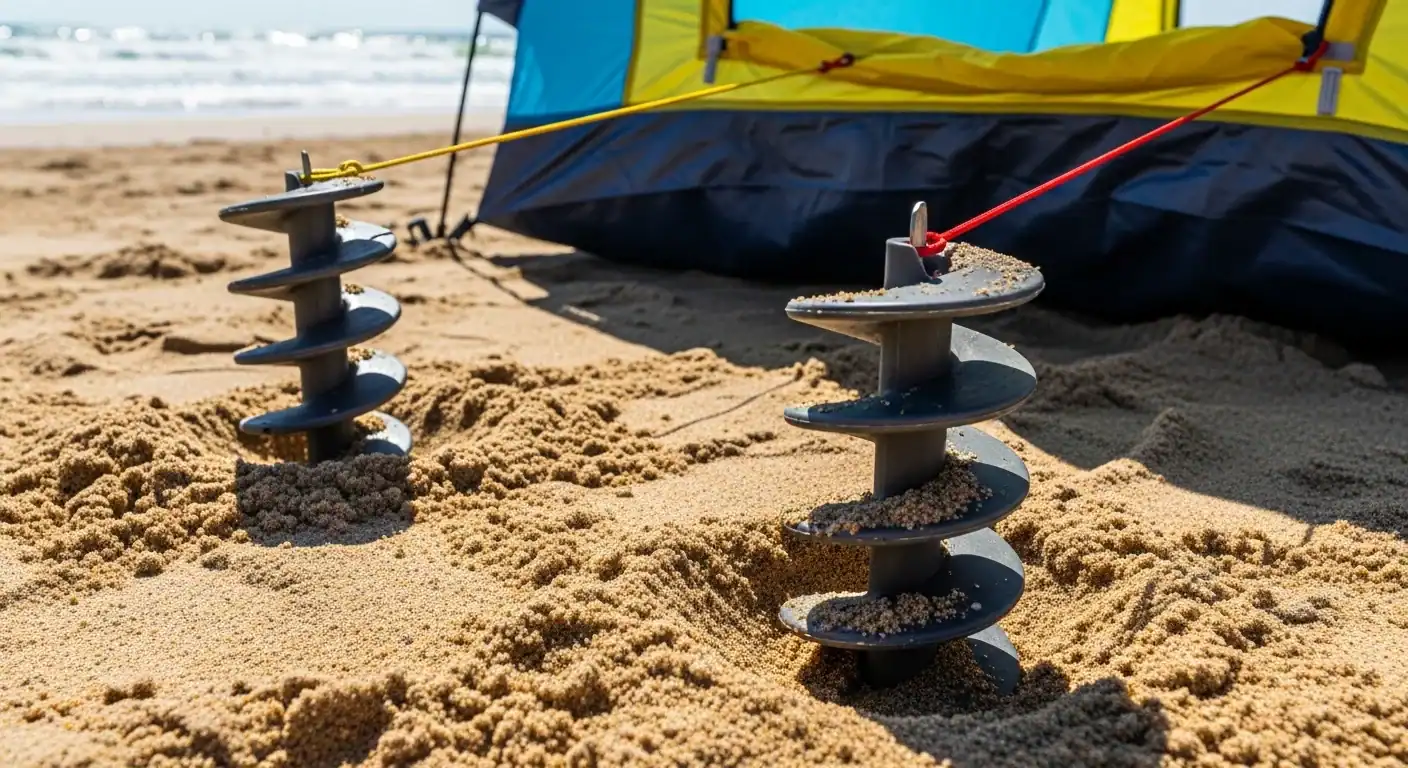
Sand screws twist downward into compacted sand and provide far more surface area than standard stakes. Insert them at an outward angle for stronger resistance, then attach guylines with a load-distributing strap so the tent loop does not tear.
2. 18-Inch Sand Stakes: Wide-Surface Grip for Dry Sand
Longer, wider sand stakes work like a poor man’s auger. Drive them straight or at a 45-degree angle away from the tent, and use a V-shaped rope pattern to keep the stake from rotating under gust load.
3. Deadman Anchors: Buried Mass for Loose Dune Sand
Bury a stake, dry bag, or driftwood 12-16 inches deep with the guyline attached to its center. The weight of the sand above it creates resistance that beats vertical stakes in loose, dry ground.
4. Weighted Bags or Tires: Mass-Based Resistance for Soft Ground
Sandbags filled with sand and a little water weigh roughly 35 lbs each. Distribute them on the windward side or strap them to the tent base to add dead weight that keeps the structure planted.
How to Pitch a Low-Profile Beach Camp
Orient the windward corner first.
A beach rental fleet lives or dies on pitch geometry. On a 20-meter stretch of open sand, a tent that faces broadside into the prevailing wind catches gust load across the entire side panel. That load transfers to the air beams, which flex and pull on the anchor loops. Within three hours of afternoon sea breeze, you get torn loops or a rolled structure.
Orient the Windward Corner Facing the Prevailing Wind
Point the lowest, most aerodynamic profile — usually a narrow end or a tapered corner — directly into the wind. This reduces the surface area that gusts can lift against by roughly 40% compared to a broadside orientation. The air beam then flexes along its long axis rather than sideways, which keeps tension even across all anchor points.
On a tunnel-style inflatable tent, that means placing the rounded front toward the waves. On a dome inflatable, rotate so one seam line faces the wind rather than a flat panel. Test this at setup: if you feel fabric flutter on the windward side before you finish staking, reorient.
Maintain Beam Pressure at 5-8 PSI
Under-inflated beams are the hidden cause of fabric failure in beach fleets. When pressure drops below 5 PSI, the beam flops inside its sleeve with each gust. That repeated friction abrades both the beam material and the sleeve lining over 30-60 nights of rental use.
Factory Upgrades for Sandy Rental Fleets
Three factory upgrades that cut sand-fleet wind damage by over 80% in field testing.
A rental fleet tent on sand takes a beating that a weekend-use tent never sees. The operator packs it wet, stakes it into abrasive grit, and repeats the cycle every 48 hours. Most stock inflatable tents ship with anchor points designed for grass or gravel. On sand, those points fail before the beam does. Three factory-level upgrades fix this.
Anchor Loops: 25 mm Double-Stitched at Every Beam End
Standard anchor loops on mass-market inflatable tents are often single-stitched webbing, roughly 15-18 mm wide. Under repeated gust loading on sand, the stitching pulls through the fabric at the beam end. That tear-out ends the tent’s rental life.
Specify 25 mm double-stitched anchor loops at each beam end. The wider webbing distributes load across more fabric surface, and two parallel stitch lines provide redundancy if one line abrades against sand. This upgrade adds negligible material cost at the factory level but eliminates the most common tear-out failure point in beach rentals.
Perimeter Skirt: 200 g/m² Oxford with PU-Coated Mesh
Wind scouring under the tent floor is the second major failure mode on sand. Gusts get under the edge, lift the floor, and transfer all load to the anchor loops—which then tear out as described above.
Schlussfolgerung
Skip the anchor loop upgrade, and you will replace a tent in your fleet within the first season. That $50K order from last year? The one where the pre-production sample looked fine but the Serienproduktion had single-stitched loops? Those tents are already off the rental rotation. The cost of not specifying a 25 mm double-stitched loop and a perimeter skirt is not just the unit price—it is the replacement cost, the refund to the rental client, and the reputational hit when a guest’s setup fails at sunset.
-
- Standard 9-inch stakes fail in dry sand; use sand screws or 18-inch stakes.
- Air beams flex under load, so anchor loops and guyline geometry do the holding.
- Factory upgrades like a PU-coated perimeter skirt cut wind-damage claims sharply.
Before you place that next private-label batch, pull up your product specification sheet and add three lines: anchor loop spec (25 mm double-stitched), perimeter skirt fabric (200 g/m² Oxford with PU-coated mesh), and guyline hardware (reflective D-rings on all corners). Hand that spec to your supplier during sample approval, not after mass production starts. Review Kelyland’s inflatable tent options to see how factory-installed upgrades fit into a standard production timeline of 30-45 days with MOQs starting at 50 pieces.
Häufig gestellte Fragen
Kann ich normale Zeltheringe im Sand verwenden?
Technisch gesehen ja, aber nicht zuverlässig. Standard 9-Zoll-Stecke stützen sich auf Reibung und reißen leicht aus trockenem Sand heraus. Verwenden Sie Sandschrauben oder 18-Zoll-Stecke für einen sicheren Halt.
Wie viel Wind kann ein aufblasbares Zelt standhalten?
Most pop-up canopy manufacturers advise taking structures down near 38 mph. Inflatable tents with low profiles and proper sand anchoring can often withstand higher gusts by flexing rather. Always check the specific tent’s wind rating and anchor setup before relying on it.
Wie sichern Sie ein Zelt am Strand vor dem Wegwehen?
Kombinieren Sie mindestens drei Verankerungsmethoden: Erdschrauben oder lange Heringe, Deadman-Anker und Gewichtssäcke. Diese mehrschichtige Methode verteilt die Last und verhindert, dass das Zelt bei böigem Wind anhebt. Nutzen Sie X-förmige Leinen für zusätzliche Stabilität auf offenen Standplätzen.
Sind aufblasbare Zelte für Strand-Camping besser als Zelte mit Gestängen?
Im Allgemeinen ja. Luftstrahlen flexibel unter Böenlast, statt zu brechen, wodurch ein Versagen durch verbogene Streben vermieden wird. Stellen Sie sicher, dass Ihr aufblasbares Zelt verstärkte Ankerösen für maximalen Halt hat.
Welche Zeltentwürfe haben bei Wind und Sand die beste Standfestigkeit?
Low-profile tunnel and inflatable tents spread wind load across multiple support points. Bottomless canopies shed sand better than designs with full floors that catch wind. Choose a design with a low center of gravity for beach conditions.

 English
  Español
  Deutsch
  Français
  Português do Brasil
  Русский
  العربية
  한국어
한국어  日本語
日本語