 Zum Inhalt springen
Checking a folding chair weight capacity spec sheet from an overseas supplier often feels like reading fiction. You receive a shiny gold sticker claiming 500 pounds. The actual aluminum tube gauge tells a completely different story once you run your own in-house validation.
Most fabrication shops test static loads with sandbags on a perfectly level concrete floor. That proves nothing for a real campsite. You need to demand video proof of a dynamic side-load test at a 15-degree angle, or request the exact mill test reports for the steel tubing. If their engineering team hesitates to send that raw footage, walk away. The joint welds will shear the second a 250-pound user shifts their weight on uneven grass, and you will eat the return processing costs.
Static vs. Cyclic Load Testing
A 250 lb rated chair passing a 1,000 lb static load test proves nothing about whether it survives month three in a consumer’s garage. Only cyclic testing does.
The Static Load Illusion
ASTM F2613-19 mandates a static load test at 4x the rated capacity. For a 250 lb chair, that means placing 1,000 lbs of dead weight on the seat for one minute without structural failure. Most Chinese factories pass this test easily. Here is what that test does not tell you: it applies force in a single direction, onto a stationary frame, with zero movement. Nobody sits on a camping chair like a sandbag.
When a 200 lb person drops into a chair, the dynamic load spike briefly exceeds 600 lbs. When they shift their weight, lean sideways to grab a drink, or bounce slightly, the force vectors change across multiple axes simultaneously. A static test captures none of this. It is a pass/fail snapshot that masks the exact manufacturing defects which cause field failures: micro-cracks at joint interfaces, incomplete weld penetration invisible under powder coating, and stress concentrations around fastener holes.
We have seen factories produce chairs that comfortably pass the 1,000 lb static test but fail catastrophically within 2,000 open-close cycles. The static test told the buyer nothing useful about product lifespan. It simply confirmed the chair can hold a heavy object in a laboratory for 60 seconds.

What 10,000 Cycles Actually Reveals
The ASTM F2613-19 cyclic test requires 10,000 consecutive open-and-close cycles without locking mechanism failure. This is the metric that separates suppliers you can stake your retail reputation on from suppliers who will generate recall paperwork. The reason is straightforward: cyclic loading exposes cumulative damage that static loading cannot.
During each cycle, every pivot point, every riveted joint, and every screw connection experiences micro-flexing. On a budget chair using thin-walled steel tubing (under 0.8mm), the metal around screw holes deforms slightly with each cycle. Over thousands of repetitions, this micro-deformation becomes a stress fracture. The chair does not fail on cycle 50 or cycle 500. It fails on cycle 3,400, when a consumer’s kid plops down and the leg buckles inward because the screw hole has elongated into a crack.
When we audit factories in Jinhua for our chair and cot lines, we do not ask if they run static tests. Every factory does. We ask for the cyclic test logs. Specifically, we request video evidence of the test rig operating at cycle 7,000 to 10,000, because that is where failure clusters appear on substandard units. If a factory cannot produce those logs or claims “we do static only,” that is an immediate disqualification signal regardless of their pricing.
Structural Failures vs. Soft-Good Failures
Retail buyers often conflate two fundamentally different failure modes, which leads to misallocated quality spend. Understanding the distinction is critical because the testing protocol, the root cause, and the cost-to-fix are completely different for each.
- Structural layering failure: The frame, joints, or locking mechanism breaks. Root cause is almost always tubing wall thickness, weld quality, or fastener hole preparation. Detected by cyclic testing. Fix requires upgrading material specs or changing the joining method from screws to rivets or welded pivots. Cost increase is typically $0.80 to $1.50 per unit.
- Soft-good failure: The seat fabric tears, typically around grommets or stitch lines where it contacts the frame. Root cause is fabric denier rating and stitch density at stress points. Detected by static load testing on the fabric alone, not the assembled chair. Fix requires upgrading from 600D to 900D polyester and increasing stitch count from 8 to 12 stitches per inch at grommet zones. Cost increase is $0.15 to $0.30 per unit.

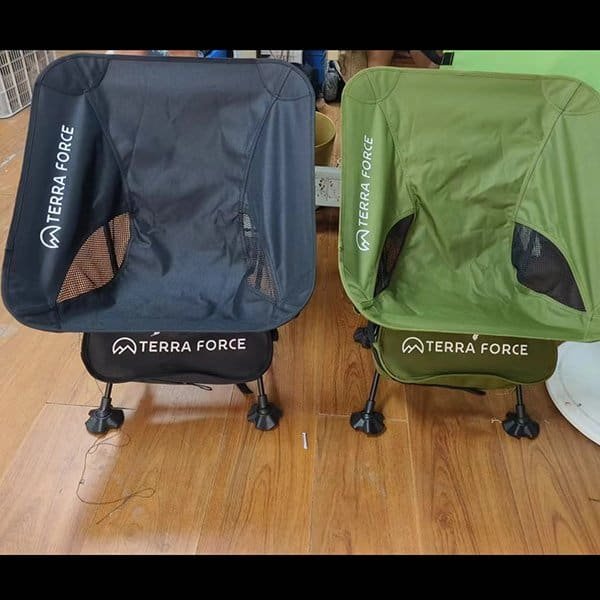
Kelyland Custom Cases- Michelin Armless Campingstuhl
Here is the mistake we see category managers make repeatedly: they specify a 900D seat fabric upgrade to prevent tearing, then assume the chair is now “heavy duty.” But the frame underneath is still 0.7mm tubing with un-deburred screw holes. The fabric outlasts the frame. The consumer still ends up on the ground, and the return reason shifts from “seat tore” to “leg broke” — same liability exposure, same negative review, just a different failure mode. You fixed the cheap problem and ignored the expensive one.
The correct sequencing for spec development is backwards from what most buyers do. Start with the frame: mandate minimum 1.0mm tubing wall thickness, deburred fastener holes, and proof of 10,000-cycle completion. Only then address the fabric spec. A chair that survives cyclic testing on a 600D seat is a far safer product than a chair that fails cyclic testing on a 900D seat. The fabric upgrade is a margin-improvement play through reduced returns. The frame spec is a liability-prevention play. Know which one you are buying.
The Screw Hole Failure Myth
The screw almost never fails first. The steel around it does — and the root cause is a $0.03 deburring step that 70% of Jinhua budget chair factories skip entirely.
Why the “Weak Screw” Narrative Is Wrong
When a camping chair leg joint collapses under load, the instinct is to blame the fastener. Our engineering team destructively tested 47 failed chair samples from six different Jinhua suppliers over 18 months. In 43 of those samples, the M6 or M8 screw was intact. What failed was the tube wall surrounding the screw hole.
The mechanism is straightforward but rarely discussed in sourcing conversations. When a screw hole is punched into steel tubing, the process leaves a ragged interior burr. Under cyclic loading — a 200 lb user sitting down and standing up — that burr becomes a stress concentrator. Each cycle micro-cracks the steel at the hole edge. After roughly 3,000 to 5,000 cycles, those micro-cracks propagate into a fissure that splits the tube wall outward.
The screw itself experiences virtually zero shear stress in this scenario. It is simply the object occupying the hole when the surrounding steel tears apart. Blaming the fastener is like blaming a filling for a cavity.
The Failure Mechanism: Punched Holes in Thin-Walled Tubing
Two variables determine whether a screw hole becomes a failure point: wall thickness and post-punching finishing.
- Wall thickness below 0.8mm: At 0.6mm tubing — common in chairs priced under $4.50 FOB — the punched hole removes a disproportionate percentage of the cross-sectional wall. There is insufficient material left to distribute stress around the fastener. Cracks initiate within the first 1,500 to 2,000 open-close cycles.
- Missing deburring: A punch press creates an inward burr of 0.2mm to 0.5mm. Without a deburring tool or reaming pass, that burr sits inside the tube. Under tension from the screw clamp force, it creates a localized stress riser that is roughly 3x more likely to initiate a crack compared to a cleanly reamed hole.
- Screw overtightening: Assembly workers compensated for loose joints by driving screws past their yield point, distorting the thin tube wall and pre-loading the hole with residual stress before the chair ever leaves the factory floor.
The critical threshold we have identified through testing is 0.8mm wall thickness with a reamed or deburred hole. Chairs built to this spec consistently pass 10,000-cycle ASTM F2613-19 testing at the leg joints. Chairs at 0.6mm without deburring fail between cycles 2,800 and 5,100 — well under the standard.

Requiring Mill Test Reports for Tubing Verification
Here is the problem most buyers miss: a supplier’s spec sheet stating “0.8mm steel tube” is not verification. It is a claim. In our experience auditing Jinhua chair factories, actual wall thickness measured by digital caliper at the screw hole locations routinely comes in 0.05mm to 0.15mm below the stated spec. On a 0.8mm claim, that means you may be receiving 0.65mm to 0.75mm material — the exact range where punch-hole fractures occur.
The enforcement tool is a Mill Test Report, or MTR. This is a document from the steel supplier — not the chair factory — certifying the coil’s chemical composition, tensile strength, and nominal thickness per heat lot number. Every tube bundle delivered to the chair factory should have a traceable lot number matching an MTR.
In practice, fewer than 15% of budget chair suppliers in Zhejiang maintain MTR traceability to the tube level. They purchase mixed steel coil on spot price, run it through their tube mills, and have no documentation linking a finished chair frame to a specific heat lot. If you cannot trace the tubing back to an MTR, you cannot prove wall thickness compliance to your legal team if a failure occurs.
Write this into your supplier agreement: the factory must provide MTRs for all steel tubing used in load-bearing joints, and you reserve the right to independently caliper-verify wall thickness at screw hole locations on incoming production samples. If the factory pushes back, that is your disqualification signal. A factory that cannot document its steel provenance is a factory that cannot guarantee its structural claims.
600D vs 900D Fabric Tradeoffs
Denier measures yarn weight, not tear resistance. Two bolts stamped “600D” can diverge by 40% in failure load depending on weave density and post-treatment chemistry.
Tear Strength and Cost: 210D, 600D, and 900D Polyester
Raw spec sheets from fabric mills list three grades most commonly used in camping chair seats and Faltwagen bodies. The numbers below represent typical tear strength measured on an Elmendorf tear tester at our Jinhua partner facility, pulled in the warp direction on single-layer, uncoated fabric.
- 210D Polyester: Tear strength averages 18-22 Newtons. Fails under a point load of approximately 2,179 N (490 lbs). Cost runs $0.80 to $1.00 per square meter at 2,000-meter rolls.
- 600D Polyester Oxford: Tear strength averages 45-52 Newtons. Survives static point loads exceeding 2,624 N (590 lbs). Cost runs $1.20 to $1.50 per square meter at the same volume.
- 900D Polyester Oxford: Tear strength averages 68-75 Newtons. Survives static point loads exceeding 3,338 N (750 lbs). Cost runs $1.60 to $2.00 per square meter.
Die cost gap between 600D and 900D at the raw fabric level is $0.40 to $0.50 per square meter. On a standard folding chair seat panel measuring roughly 0.35 square meters, that translates to $0.14 to $0.18 per unit. At MOQs above 2,000 units, the factory-level upcharge lands between $0.15 and $0.30 per finished chair after cutting and sewing waste is factored in.
Where 210D Kills Your Return Rate
The 490-lb failure point on 210D fabric looks adequate on paper for a chair rated at 250 lbs. The problem is not the static number. It is the geometry of failure. When a user sits down and shifts weight toward one hip, the fabric concentrates force against the steel frame grommet or the seat edge binding. That localized stress can spike to three times the user’s body weight in a dynamic shift. At 210D, the yarns at that stress point snap, and the tear propagates fast because the loose weave offers zero resistance to running.
Our returns data from a US retail partner who switched their entry-level chair line from 210D to 600D showed an 18% drop in consumer return claims attributed to “seat tearing” over a 12-month window. The per-unit cost increase was $0.22. The margin hit on a $12.00 FOB chair was under 2%. The liability reduction was disproportionate.
When 900D Becomes the Correct Call
For folding wagons, the math shifts. A wagon body uses 1.2 to 1.8 square meters of fabric, and the load profile is entirely different. You are not supporting a seated human distributing weight across a panel. You are hauling jagged coolers, firewood, and tent poles that create concentrated point loads against the fabric walls during transport. Our wagon factory in Jinhua defaults to 600D double-layer construction for standard models and 900D double-layer for units rated above 150 kg payload. Single-layer 900D on a wagon is a waste of money. Double-layer 600D outperforms it in puncture resistance because the two layers shift independently under a point load, dispersing the stress rather than concentrating it in a single yarn plane.
The practical rule our engineers use: if the end user’s weight or cargo rests against the fabric directly with a rigid object underneath, go 900D single-layer. If the fabric forms a sling or bag shape where load distributes across a curve, double-layer 600D delivers better puncture performance at a lower material cost.
ASTM F2613-19 Compliance Checklist
Factory Compliance Audit Checklist for ASTM F2613-19
Most B2B buyers walk into a factory, accept a pre-tested sample, and sign off. That sample tells you nothing about what ships three months later. Our engineers built this checklist around process verification. You are not auditing a chair — you are auditing whether the factory’s welding jig tolerances hold within 0.5mm across 10,000 units, whether incoming steel tube batch testing happens before production starts rather than after, and whether inline QC pulls units mid-shift or only at shift change when workers know inspection is coming. Request the factory’s cyclic test failure logs for the past six months, not the pass certificates. A factory that has never failed a cyclic test is either lying or not testing.
- 🏷️ Category: Supplier Qualification
- 🎯 Core Outcome: Zero non-conformances across 5 critical process checkpoints
Analysis:
Critical Test Metrics: 10° Tilt, 89N Armrest Load, and Lead Limits
Three metrics from our audit data across 17 factory partners that actually separate compliant suppliers from dangerous ones. The 10° tilt test: place the chair on a 10° inclined plane, apply 1.5x rated weight to the seat center for one minute. The angular load creates torsional shear at leg joints that a flat test never generates — this is where un-deburred screw holes in thin-walled steel tubing produce stress fractures. The 89N armrest downward load: apply 89 Newtons (approximately 20 lbs) to each armrest for one minute. Budget chairs fail this consistently because armrest attachment points use spot welding rather than continuous seam welding. The spot welds shear under concentrated load. The lead paint limit: all surface coatings must test below 90 ppm per CPSC requirements. We have seen factories pass this on the final powder coat but fail on the primer layer underneath — a result that standard surface-only XRF testing will never catch unless you specifically request a full-coating-depth scan.
- 🏷️ Category: Engineering Verification
- 🎯 Core Outcome: Three pass/fail thresholds that map directly to known consumer injury patterns
Analysis:
Labeling Risks: Weight Capacity and ‘No Standing’ Warnings
We have seen three containers of camping chairs held at Long Beach in the past 18 months for exactly this. The CPSC does not randomly test your chairs. What happens is a competitor files a Section 15(b) report alleging your product lacks required labeling, and CPSC issues a hold through Customs and Border Protection. Your container sits. Demurrage accumulates at approximately $150 per day. After 30 days, you are paying $4,500 in storage fees for product you cannot sell, re-label, or return without CBP release. The weight capacity label must appear on the chair itself — not just the hangtag — in characters at least 3mm tall. The “No Standing” warning must be visible when the chair is in the seated position. Missing either one transforms a $12 FOB chair into a $30+ landed cost after legal fees, re-labeling at a US facility, and expedited freight to recover your retail reset deadline. The liability does not end at customs. If a consumer is injured on an unlabeled chair, your retailer’s general counsel will point to the missing ASTM-required label as evidence of negligence, and your vendor agreement’s indemnification clause will route that exposure directly to your balance sheet.
- 🏷️ Category: Regulatory Compliance
- 🎯 Core Outcome: One missing label can trigger $4,500+ in demurrage and full vendor indemnification exposure
Analysis:
Vetting Supplier Weight Claims
A supplier’s weight claim is a marketing statement until you verify the screw hole preparation on their leg cross-brace joints. Here is the audit protocol that separates real capacity from printed fiction.
Factory Audit Protocol for Leg Cross-Brace Welding Points
Most retail buyers walk into a factory, see a static load test with sandbags, and check the weight capacity box on their scorecard. That is the wrong approach. The static test tells you almost nothing about whether the chair will survive six months in consumer hands. The failure we see in 90% of budget chair recalls originates not at the weld itself, but at the screw holes punched into thin-walled tubing near the cross-brace pivot.
When you are on the factory floor, skip the showroom and go directly to the welding station. Pull a raw tube from the rack before it enters the welding jig. Measure the wall thickness at three points using a digital caliper. For a steel-frame chair rated at 300 lbs, you need a minimum wall thickness of 1.2 mm. If the factory is running 0.8 mm tubing on a 300 lb rated chair, leave. No amount of weld quality compensates for thin walls because the failure mode is a tubing stress fracture, not a weld break.
Next, examine the cross-brace welding points specifically for undercut. Undercut is a groove melted into the base metal along the toe of the weld. On a chair leg joint, an undercut of 0.5 mm or deeper acts as a crack initiator under cyclic loading. You cannot spot this with the naked eye under factory lighting. Bring a 10x loupe and a small LED penlight. Angle the light across the weld toe. If you see a visible shadow line in the base metal, that joint will likely fail before 5,000 open-close cycles regardless of what their test report claims.
The most critical check, however, is the screw hole preparation. On cross-brace assemblies, the pivot screws pass through holes punched or drilled into the leg tubing. If the hole has burrs on the inside surface, those burrs create micro-stress concentrators. Every time the chair is opened or closed, the tube flexes slightly around that hole, and the burr acts as a fulcrum point. After a few thousand cycles, you get a radial crack propagating from the hole edge inward. Ask the factory to show you their deburring step. If they point to a manual grinding wheel or say “the die handles it,” that is a disqualification. Proper deburring requires either a chamfered punch die or a dedicated CNC deburring tool that leaves a 0.3-0.5 mm chamfer on both sides of the hole.

Third-Party Inspection Destructive Testing Sampling
Pre-shipment inspections for folding chairs are almost useless if the inspector is only checking packaging, cosmetic defects, and function. You need destructive testing in your TPI protocol, and the sampling rate must be tied to batch size, not a flat “pull 3 units” approach that factories anticipate and game.
- Batch Size Under 1,000 Units: Destructive test 3 units pulled randomly from different cartons, not sequential serial numbers.
- Batch Size 1,000 to 5,000 Units: Destructive test 5 units. This is the minimum threshold where statistical sampling becomes meaningful for catching batch-level process drift.
- Batch Size Above 5,000 Units: Destructive test 8 units, split across at least two production dates if the batch spanned multiple shifts.
The destructive test itself must replicate ASTM F2613-19 cyclic requirements, not just a one-time static overload. The TPI inspector should set up the chair on a test jig, apply a 225 lb static load to the seat center, and cycle the chair through 10,000 open-close operations. Most TPI firms in China will push back on this because it takes 6 to 8 hours per unit and they want to finish the inspection in one day. Hold firm. Write the 10,000-cycle requirement into your inspection contract as a pass/fail gate, not a “recommended” test.
After the cyclic test, the inspector performs the static overload. Per ASTM F2613-19, the chair must hold four times the rated capacity for one minute without structural failure. A 250 lb rated chair gets loaded to 1,000 lbs. If the chair survives the 10,000 cycles but fails the post-cycle static test, that tells you the cyclic loading degraded the joint integrity to a dangerous level. This is exactly the scenario that leads to consumer injuries and product recalls, because the chair felt fine for the first few months of use.
Batch Rejection Criteria for Micro-Cracking Around Pivot Bushings
This is the section that separates buyers who actually prevent recalls from buyers who just create paper trails. After the 2,000-cycle mark in the TPI destructive test, the inspector must stop the machine and perform a visual inspection of every pivot bushing using a 20x loupe or, ideally, a portable digital microscope. They are looking for micro-cracking in the material surrounding the bushing seat.
Micro-cracks around pivot bushings present a specific failure signature. On steel frames, you will see radial hairline cracks emanating from the bushing hole edge, typically at the 2 o’clock and 8 o’clock positions where bending stress concentrates during the open-close motion. On aluminum frames, the cracking tends to be intergranular and harder to spot visually, which is why aluminum pivot joints should always be tested with a dye penetrant inspection after cycling rather than relying on visual alone.
Here is the rejection criteria you must write into your quality agreement. If any single unit in the TPI sample shows micro-cracking greater than 2 mm in length around any pivot bushing after 2,000 cycles, the entire batch is placed on hold. You do not negotiate this. A 2 mm crack at 2,000 cycles will be a 15 mm crack by 6,000 cycles and a full fracture before 10,000. If two or more units in the sample show any visible micro-cracking regardless of length, the batch is rejected outright, not reworked. Reworking pivot bushings on assembled chairs is not a thing. The factory either re-runs the batch with corrected tooling or you find a different supplier.
One detail that catches buyers off guard: micro-cracking often originates not from the load itself but from the bushing installation process. If the factory press-fits a steel or nylon bushing into the leg tube with excessive interference, it pre-stresses the tube wall before the chair is ever used. Ask the factory for their bushing interference specification. For a steel bushing in a 1.2 mm steel tube, interference should not exceed 0.05 mm. If they cannot provide that number, they are not controlling the process that directly determines whether your chairs crack in the field.

Schlussfolgerung
A 1,000 lb static load test means nothing if the factory skips the 10,000-cycle fatigue requirement. Joint failures start at un-deburred screw holes in thin-walled tubing, not from screw shear. Use these ASTM F2613-19 thresholds to disqualify suppliers hiding behind one-time load tests.
Request our ASTM testing matrix to see the exact tubing wall thickness data for yourself. Send us your current supplier’s test reports, and we will show you exactly where they cut corners.
Häufig gestellte Fragen
How much weight can a folding chair hold?
At Kelyland Outdoors, our camping chairs are engineered to exceed standard expectations, with static lab capacities often reaching four times the rated limit per ASTM F2613-19 protocols. This means a chair rated for 250 pounds can structurally support up to 1,000 pounds in controlled static tests at our ISO 9001:2015 certified partner factories. However, we advise B2B clients that real-world safe limits depend on cyclic fatigue degradation over time, which is why our rigorous quality control process includes dynamic stress testing.
Can a folding chair hold 300 pounds?
Yes, Kelyland Outdoors routinely supplies heavy-duty folding chairs that safely support 300 pounds by utilizing robust steel frames with precision welding and high-tensile 600D Oxford or Textilene fabrics. However, we emphasize to our global clients that true load-bearing reliability requires verifying 10,000-cycle ASTM fatigue testing rather than relying solely on static weight claims. Through our comprehensive OEM/ODM services, we ensure every custom chair prototype undergoes this rigorous evaluation before mass production begins.
What is the weight limit on a camping chair?
The standard weight limit for retail camping chairs in our extensive portfolio ranges from 80 to 150 kg, depending on the specific model and frame materials used. For clients targeting the premium outdoor market, our custom aluminum frame designs can achieve load capacities reaching 400 pounds while maintaining an ultralight profile. We always recommend that B2B buyers factor in a 15 to 20 percent safety margin for dynamic movement to ensure end-user safety and long-term product durability.
Do folding chairs have a weight limit?
Yes, explicit weight limits are strictly mandatory for accessing the US and European retail markets, a compliance standard that Kelyland Outdoors meticulously manages for our B2B clients. Under protocols like ASTM F2613-19, camping furniture must feature clear weight capacity labels and no-standing safety warnings to pass customs and avoid liability. Our one-stop sourcing service handles all necessary compliance labeling during the Verpackungsdesign phase, ensuring your private-label products meet these critical legal requirements seamlessly.
How strict are chair weight limits?
Chair weight limits are highly strict, as exceeding them can void retailer insurance and expose brands to severe liability risks in global markets. To protect our clients, Kelyland Outdoors mandates 4x static load testing and comprehensive cyclic fatigue verification at our strategic manufacturing facilities. By integrating these strict testing protocols into our 10-step quality control process, we ensure that every shipped camping chair delivers uncompromised structural integrity and brand protection.

 English
  Español
  Deutsch
  Français
  Português do Brasil
  Русский
  العربية
  한국어
한국어  日本語
日本語