
1. Un pedido de $50,000 unidades se fue a la deriva porque la muestra preproducción aprobó, pero el lote de producción masiva no — y ahí es cuando empieza a tener sentido analizar el desglose de costes de un carrito plegable. La muestra aprobada tenía un marco de acero de 1,0 mm y ruedas con rodamiento suave; las unidades enviadas tenían perfiles de 0,8 mm, centros de buje de plástico y pasadores de eje que se rompieron en un camino de grava.
2. Para los reactivistas que comparan opciones de carritos plegables baratos frente a los de alta gama, la primera trampa es leer el precio unitario como coste total. Una unidad promocional de $0 o una cotización FOB China de $15 parece atractiva hasta que llegan los devoluciones y contracargos. Los carritos de gama baja en el rango de $15–25 FOB suman habitualmente entre $6 y 10 por unidad en defectos detectados en control de calidad — tejido desgarrado, soldaduras rotas, ruedas inestables — lo que puede elevar el coste unitario efectivo hasta en un 40% antes de que entre el coste del flete. el precio FOB 3. El otro factor de coste está dentro del mecanismo plegable. Pasar de un diseño plano básico a una opción de almacenamiento compacto agrega $8–12 en materiales y mano de obra, pero puede reducir el volumen de envío LCL hasta en un 25%. El.
4. debe verificar ese mecanismo bajo carga, no solo el logotipo impreso — porque la tolerancia de calidad de bisagras y ejes varía más entre fábricas que cualquier otro componente. proceso de aprobación de muestras 5. El piso de precio.

6. Trampa de costes ocultos
11. El carrito plegable más económico de cualquier plataforma de sourcing es un artificio de marketing, no un producto real. Esa unidad promocional de $0 fabricada para una campaña de supermercados tiene una única función: parecer convincente en una foto de regalo. El tubo de acero, el tejido y los bujes de rueda llevan un presupuesto de material prácticamente cero. Se desmonta con la primera carga real.
12. Por qué existe el piso FOB de $15.
13. En 2026, la realidad del coste de fabricación en Zhejiang se puede rastrear línea por línea: acero tubular, tejido Oxford, conjuntos de ruedas, tornillería, mano de obra de ensamblaje y embalaje. Un modelo estándar construido con acero Q195, espesor de pared de 0,8 mm y tejido Oxford simple de 300D puede situarse entre $12 y 14 FOB. Ese especificación no resiste una temporada completa. Si pasamos a acero Q235 de 1,0 mm, tejido doble capa de 600D-900D y un eje reforzado, solo los materiales elevan la cotización a la decena alta.
14. Acero del marco:.
-
- Marco de acero: Los modelos económicos especifican acero Q195 con un grosor de pared de aproximadamente 0,8 mm. Se flexiona y dobla en terrenos irregulares. La mejora a Q235 / 1,0 mm es el punto donde se separan los niveles de precios al por mayor de los carros plegables.
- Tejido: El Oxford 300D sin recubrimiento se desgarrará en los pliegues tras un uso repetido. El stock funcional para reventa utiliza Oxford de doble capa 600D–900D con un recubrimiento de PU o PVC, la misma especificación que usted debe verificar durante la aprobación de la muestra.
- Ruedas y ejes: Ruedas de PVC con centros de plástico se agrieta bajo carga lateral. Las llantas más grandes de PU o TPE con rodamientos de bolas y un perno de eje más grueso añaden entre $1–2 USD en fábrica y eliminan la falla más común en las comparativas entre carros económicos y costosos.
La trampa del coste oculto aparece después de la cotización. Los carros económicos en el rango de precios FOB de $15–25 USD aparecen en la inspección previa al envío con marcos rotos, tejido del suelo desgarrado y centros colapsados. Ese coste de reprocesamiento y devolución de entre $6–10 USD por unidad incrementa el precio efectivo hasta en 40% USD. Cada fallo también genera un contracargo que impacta en el P&L del revendedor, no en el de la fábrica.
El suelo de $15 USD no es un número arbitrario. Kelyland Outdoors abastece carros plegables a través de una fábrica certificada CE e ISO 9001 en Jinhua, Zhejiang, con una producción anual de aproximadamente 1.000.000 de unidades. El modelo aprobado incluye tejido Oxford de doble capa 600D–900D, marcos de acero con recubrimiento en polvo o aluminio, y ruedas giratorias de 360° con frenos. Esta es la base técnica que define el coste de un carro de calidad para reventa. Fabricar por debajo de este estándar significa desplazar el punto de falla hacia el cliente.
El carro promocional de $0 USD desaparece tras el primer uso porque está diseñado para ello. Es un producto líder de pérdida, con un precio destinado a encajar en el presupuesto de marketing, nunca en el inventario de reventa. Trátelo como referencia de abastecimiento y estará creando un departamento de devoluciones, no una línea de producto.
| Característica | Carro promocional de $0 USD | Piso de precio de $15 USD | Impacto en el coste del revendedor |
|---|---|---|---|
| Grado del acero del marco | Pared de Q195 / 0,6 mm | Pared de Q235 / 0,8–1,0 mm | El acero delgado se rompe en senderos de grava; el Q235 evita el colapso estructural y las costosas devoluciones |
| Especificación del tejido | 300D Oxford, sin recubrimiento | 600D Oxford con recubrimiento de PU | La tela sin recubrimiento se agrieta tras 2-3 usos; el 600D con recubrimiento de PU resiste el uso repetido al aire libre |
| Conjunto de rueda y buje | Buje completamente plástico, neumático de PVC sólido | Buje con rodamientos de bolas, neumático de PU | Los bujes de plástico se agrietan bajo carga; los rodamientos de bolas alargan la vida útil de las ruedas y reducen las reclamaciones de garantía |
| Pasador de eje y tornillería | Pasador de eje de menor diámetro, remaches mínimos | Pasadores de eje reforzados, uniones soldadas | Los pasadores de eje se doblan y bloquean las ruedas; la tornillería reforzada es el estándar mínimo de fiabilidad |
| Control de calidad e inspección | Ninguno / verificación aleatoria de lotes | Inspección básica en línea conforme a ISO 9001 | Sin control de calidad, los fallos ocultos suman $6-10 por unidad en devoluciones de cargo y gastos de envío de devoluciones |
| Costo unitario eficaz | $12-18 tras los fallos de control de calidad | $15-18 estable y predecible | El carrito ‘barato’ no tiene una ventaja real de precio cuando se consideran los fallos |
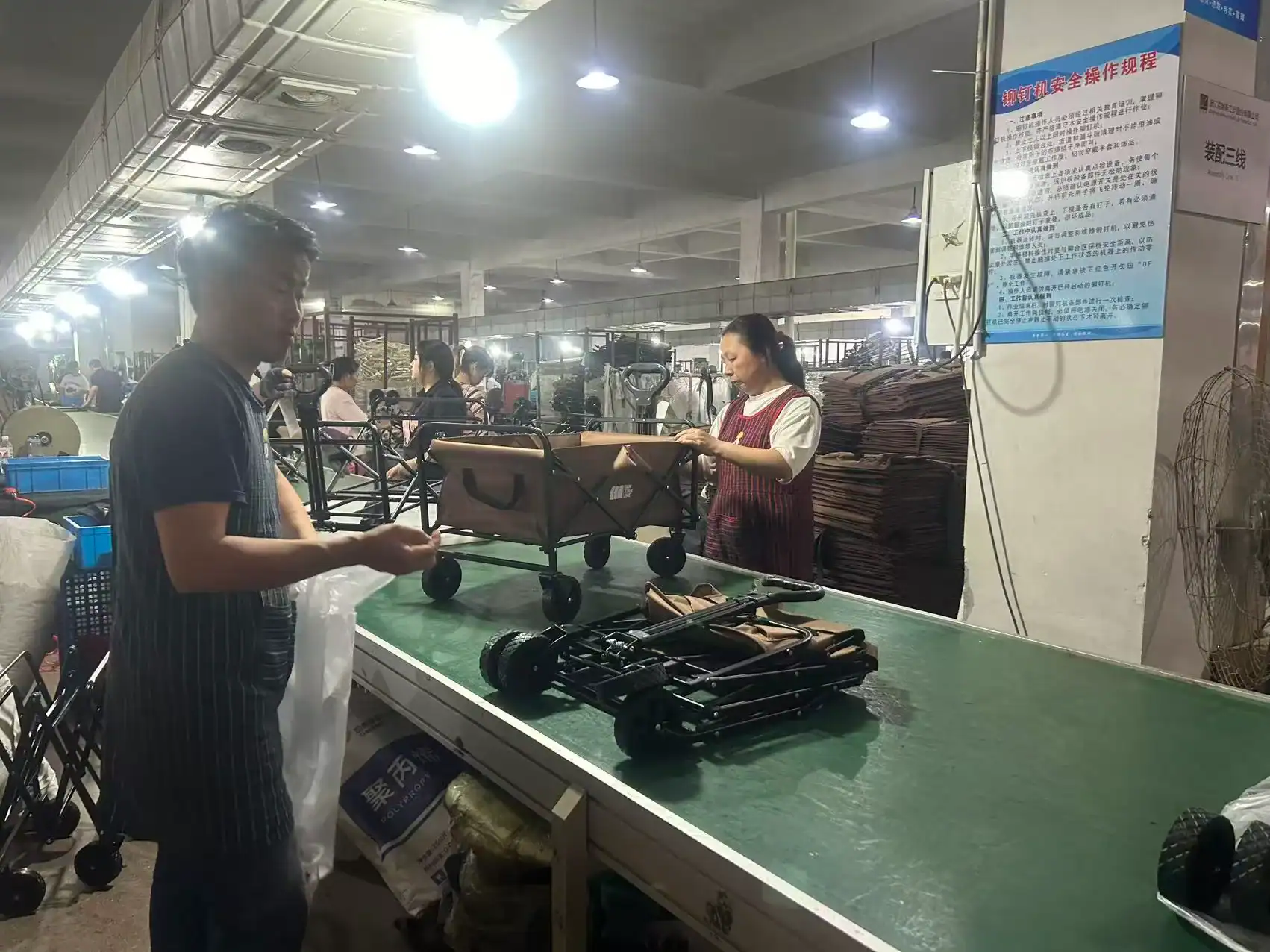
7. Brecha de ingeniería
El carrito $15 no es barato si se tienen en cuenta los fallos de control de calidad.
First-time resellers see a $15–25 FOB quote for a folding wagon and lock it in. The real cost shows up later: broken frames on gravel paths, fabric splitting after three trips, wheel hubs cracking in the parking lot. Each failure adds $6–10 in returns and handling. On a $20 wagon, that’s a 40% increase in effective unit cost before you spend a dollar on marketing.
Where Budget Wagons Cut Corners
-
- Frame Steel: Budget wagons commonly use Q195 steel with thin walls. Under load, the tube bends at the hinge, and a bent hinge makes the wagon unusable. Q235 steel with thicker walls holds up to repeated folding and heavier loads.
- Fabric Density: 300D Oxford without coating tears at stress points within weeks. The internal standard for a wagon meant to survive a second season is 600D–900D double-layer Oxford fabric — the difference between a $0.40 and a $0.90 per-meter material cost.
- Wheel Assembly: Small PVC wheels with plastic hub centers crack on uneven terrain. The extra $1–2 for PU wheels with ball bearings removes the most common return reason. Skipping that upgrade saves pennies but costs the entire margin when a hub shatters mid-use.
QC standards separate the $20 wagon from the $45 wagon before the container ships. The folding wagon factory in this supply network runs CE and ISO 9001 certified lines in Jinhua, Zhejiang, with mid-production stitching inspections and a pre-shipment check on frame alignment and wheel torque. That checks-and-balances layer is the $6–10 per unit most budget quotes simply omit.
Skip that layer and the failure moves downstream. The customer doesn’t complain to the factory — they file a return against your brand. A single bad batch can wipe out the margin on an entire season. The $15 wagon and the $45 wagon are not competing on price. They are competing on how many units you replace before the customer walks away.
| 7. Brecha de ingeniería | Budget Wagon ($15-25 FOB) | Premium Wagon ($45+ FOB) | Impacto en el margen |
|---|---|---|---|
| QC Failure Rate | 8-12% defect rate (broken frame, torn fabric) | 1-2% defect rate with multi-stage inspection | Adds $6-10 per unit; up to 40% effective cost increase |
| Frame Material & Gauge | Q195 steel / 0.8mm wall, snaps on gravel paths | Q235 steel / 1.0mm+ or aluminum alloy | Warranty claims and replacement costs |
| Durabilidad del tejido | 300D Oxford, no coating, splits after 3 uses | 600D-900D Oxford with PU/PVC coating | Return rate spikes in first 30 days |
| Wheel & Axle Assembly | Small PVC wheels, plastic hub, undersized axle pins | PU wheels with ball bearings, reinforced axle | Field failures trigger negative reviews |
| Shipping Volume Efficiency | Flat-fold only, bulky LCL footprint | Gather-up/compact fold cuts volume up to 25% | Lower freight cost per unit |
| Chargebacks & Brand Risk | Single bad batch wipes out seasonal margin | Reliable quality protects brand equity | Chargebacks and refunds erode net revenue |

8. Por qué la mayoría de los carritos “baratos” fallan: los riesgos ocultos
The $8 to $12 frame upcharge cuts LCL shipping volume by up to 25%.
Basic flat-fold wagons use one pivot set and an X-frame collapse. Gather-up designs add sliding tracks, locking collars, and a second hinge group. That mechanical upgrade costs $8 to $12 more per unit before fabric or wheels change.
Flat-Fold vs. Gather-Up Frames
In Jinhua, the Kelyland partner factory has built folding wagons under CE and ISO 9001 approval since 2017. The fabric and frame materials remain 600D to 900D Oxford and powder-coated carbon steel. The moving parts are where the money goes. Sliding tracks need tighter tolerances. Locking collars add assembly minutes. Together, those minutes and tolerances make the $8 to $12 jump.
The assembly difference shows up on the line. A flat-fold frame gets its pivots welded, then the fabric slips over the frame and the wheels snap on. A gather-up frame requires rail alignment and a locking collar test at the end of the line. That test adds a few seconds per unit, but it catches the failures that create chargebacks later.
-
- Capacidad de carga: Gather-up frames still need to hold the same 50 to 200 kg rating as flat-fold frames. The locking mechanism carries the load, so the steel grade or aluminum wall thickness cannot drop even though the collapsed size shrinks.
- Tolerance risk: A factory that saves money on the sliding track wall thickness will see early failures at the locking collar. Ask for caliper verification photos of the rail profile before mass production. Pre-shipment inspection should cover lock snap force on every batch.
- Transit damage: Gather-up frames tuck the moving hardware inside the fabric pocket. Flat-fold frames leave exposed tube ends that bend during LCL loading. The gather-up design cuts damage claims and replacement freight.
Shipping Volume Impact
LCL freight is billed by cubic volume, not by weight. A gather-up wagon collapses into a shorter, tighter package than a flat-fold. That reduces the shipping volume per unit by up to 25%. For a container that mixes folding tables, chairs, and wagons, the space saving can offset a significant share of the mechanism upcharge.
On a 500-unit order, the $8 to $12 upcharge equals $4,000 to $6,000. A 25% shipping volume cut trims the freight line by one quarter. The same cube saving shows up later in warehouse density. A flat-fold wagon order of the same quantity takes more pallet spaces. Buyers should compare freight and storage savings against the mechanism cost for their specific lane.
9. Desglose de costes reales de los carritos plegables en 2026
The cheapest wagon you can import is often the most expensive one you can sell.
First-time resellers chase the $9 wagon on Alibaba. They also snap up pallets from Amazon liquidation sales. The unit cost looks unbeatable. Then the steel tube bends on a gravel path. Or the fabric splits after three trips to the beach. That is where the cheap price ends.
For a private label, the invoice is only the opening number. Return shipping, refunds, and chargebacks stack up fast. A single bad batch can consume an entire season’s margin. Chargebacks turn a healthy margin into a loss.
What breaks first in a sub-$15 wagon
-
- Marco de acero: Budget wagons often spec Q195 steel. This low-cost carbon grade has lower yield strength than Q235. Pair it with a 0.8mm wall thickness and the frame bends under a normal family load. A bent frame ends the wagon.
- Powder coating: The coating on a cheap wagon is thin. It chips when the wagon hits a curb. Exposed steel rusts. Rusted joints stick, then snap.
- Axle pins: Undersized pins shear on uneven terrain. When the wheel folds under, the customer photographs it, posts it, and asks for a refund.
The folding wagon line Kelyland works with in Jinhua uses 600D to 900D double-layer Oxford fabric and powder-coated carbon steel frames. The factory holds ISO 9001:2015 and runs inspections at every production stage. Those checks add cost at the factory. They remove cost from your return rate.
How a low quote becomes a high loss
Between the $15 FOB and a stockable wagon sits the failure rate. A weak wagon often adds $6 to $10 per unit in returns and replacement work. That lifts the effective unit cost by up to 40%. At that point, the premium wagon is the cheap one.
To hit a $15 FOB number, a factory skips the second layer of Oxford, drops the steel wall thickness, and uses a thinner powder coat. Ask for the exact steel grade, wall thickness, and coating spec. A supplier with a real QC process will answer. A supplier selling on price alone will deflect.

10. Una cotización inferior a $15 FOB indica que el proveedor ha reducido el marco, el tejido o las ruedas.
Steel grade, fabric denier, wheel hub, and fold geometry quietly create a $30 landed-cost gap.
The gap between a $15 FOB wagon and a $45 FOB wagon is rarely the logo. It is a chain of specifications: tube steel grade, wall thickness, fabric denier and coating, wheel hub and axle connection, folding geometry, hardware finish, and the QC tolerance behind each batch. A supplier quoting one number without breaking these out is asking you to buy blind.
Seven layers inside a folding wagon quote
-
- Frame material and wall thickness: Budget builds spec Q195 at 0.8mm; mid-range jumps to Q235 at 1.0mm; premium uses aluminum or thick-walled steel. Under 1.0mm, a steel wagon folds under load.
- Fabric denier and coating: The entry tier uses 300D Oxford with no coating. Mid-range uses 600D with PU; the heavy tier uses 900D double-layer Oxford with PVC.
- Wheel assembly and axle connection: Small PVC wheels with plastic hub centers fail on gravel. Larger PU wheels with ball bearings and foot brakes survive; a reinforced axle pin adds roughly $1-2 per unit.
- Hardware finish quality: Zinc-plated hardware, consistent welds, and rivets that seat flush cost more in labor but prevent callbacks.
- Folding mechanism: Flat-fold is cheaper to assemble. Gather-up frames use more linkages and labor, adding $8-12 FOB per wagon.
- LCL freight volume: Gather-up boxes pack smaller, cutting shipping volume by up to 25%. Heavier budget steel adds freight weight instead.
- Customs brokerage and handling: LCL consolidation, customs brokerage, and port fees add a hidden per-unit expense that never appears on the factory quote.
Most buyers compare FOB prices as if steel and fabric were commodities. They are not. Two quotes can both say 600D Oxford and Q235 steel, but one uses a thinner coating and a lower wall thickness at the low end of the tolerance. Loose quality tolerance becomes your problem when the frame kinks in the field.
That is why the sample approval step matters. A pre-production sample confirms the frame grade, wheel hub, and fabric construction before money moves into mass production. A mid-production inspection catches the drift between sample and batch. Skip either, and a wagon that saves $10 at the factory can cost $6-10 more in QC failures, returns, and freight exceptions — pushing effective unit cost up by 40% before it reaches a warehouse.
A sourcing partner who wants a long-term reseller relationship gives you a component-level quote. In the Kelyland network, the folding wagon factory in Jinhua, Zhejiang runs a million units a year under CE and ISO 9001. Its standard specification starts with 600D-900D double-layer Oxford, powder-coated carbon steel or aluminum frames, rotating wheels with foot brakes, and detachable components. That floor removes the $15 failure tier before you ever compare prices.
| Componente de coste | Budget Tier ($15 FOB) | Mid-Range Tier ($30 FOB) | Premium Tier ($45+ FOB) | Margin Risk / Insight |
|---|---|---|---|---|
| Material del marco | Q195 steel / 0.8mm wall | Q235 steel / 1.0mm wall | Aluminum alloy or 1.2mm Q235 steel | Cheap vs expensive folding wagon: thin tubes bend permanently on curbs, causing up to 8% structural returns. |
| Fabric & Coating | 300D Oxford / no coating | 600D Oxford / PU coat | 900D Oxford double-layer / PVC backing | Uncoated fabric tears after ~15 uses; warranty replacements add $8-12 per unit to folding wagon manufacturing cost. |
| Wheel Assembly | Small PVC wheels / plastic hub | Larger PU wheels / ball bearings | 360° PU/TPE wheels / foot brakes | Plastic hub fracture on gravel costs $4-6 per wheel; upgrading axle thickness is only +$1-2 at factory. |
| Folding Mechanism | Basic flat-fold | Flat-fold with locking braces | Gather-up / compact storage | Gather-up adds +$8-12 between folding wagon wholesale pricing tiers and shifts b2b folding wagon price analysis — while cutting LCL volume by 25%. |
| Hardware & Finish | Standard rivets / thin powder coat | Reinforced rivets / powder-coated frame | CNC-machined joints / anodized finish | Rust within 3-6 months triggers $20-30 per unit retailer chargebacks — a hidden cost of folding wagon import. |
| Control de calidad | Visual inspection only | Inline checks / sample load testing | ISO 9001:2015 certified / pre-shipment inspection | QC failures add $6-10/unit — up to 40% margin erosion — the biggest swing factor in reseller folding wagon china price. |
| Freight & Logistics | Heavy / bulky dimensional weight | Balanced volume-to-weight ratio | Compact fold / 25% less LCL volume | Budget wagons cost $4-7 more per unit in freight; heavy duty folding wagon bulk cost must include customs and warehousing. |
Conclusión
Choosing a folding wagon on the FOB line item alone is how resellers erase a season’s margin. A $16 budget wagon that fails in testing becomes a $24 unit after return shipping, restocking, and chargebacks. Skip the spec review and that math repeats with every batch.
-
- The price floor for a resellable wagon is $15 FOB; below that, frame and fabric quality collapse.
- QC failures on sub-$25 wagons add $6–10 per unit, raising effective cost by up to 40%.
- Gather-up folding adds $8–12 per unit but cuts LCL shipping volume by up to 25%.
- A 500-unit budget order can cost $4,000+ in hidden replacements within one season.
Before you commit to your next container, compare supplier quotes against the specs that actually drive durability: frame steel grade, wall thickness, fabric denier, and wheel hub construction. Request a material spec sheet and a pre-shipment inspection report before signing off. To see how the folding wagon category stacks up across those specs, review the product range at Kelyland Outdoors.
Preguntas frecuentes
¿Cuál es el coste mínimo real de un carro plegable?
A durable folding wagon for retail resale can’t be sourced under $15 FOB China for standard models. Anything below that usually means the supplier cut frame, fabric, or wheel quality to. Use $15 FOB as your floor and verify materials before ordering.
¿Por qué son riesgosos los carritos plegables $15 para los revendedores?
Los carritos Sub-$15 fallan el control de calidad porque los proveedores económicos reducen la calidad del chasis o de la tela. Esos fallos pueden sumar entre $6 y 10 por unidad en devoluciones y contracargos, elevando efectivamente tu coste hasta 401TP3. Presupuesta inspecciones de control de calidad antes de cerrar un presupuesto bajo.
¿Cuánto añade el plegado compacto al coste?
Pasar de un almacenamiento plegado plano a uno compacto o plegado hacia arriba añade aproximadamente $8–12 por unidad en materiales y ensamblaje. Esto puede reducir el volumen de envío LCL hasta en un 25%, por lo que el mayor costo por unidad suele compensarse. Compare el costo total de importación, no solo el precio FOB.
Además del precio FOB, los revendedores deben incluir fallas de QC, devoluciones, volumen de envío y costos de configuración de personalización. Un carrito $15 puede convertirse en una unidad $21 una vez que se carguen los costos relacionados con fallas. Precio del coste final después de todos los buffers de fallo.

 English
  Español
  Deutsch
  Français
  Português do Brasil
  Русский
  العربية
  한국어
한국어  日本語
日本語