
You’ve approved the sample for your folding wagon, signed off on the camp chair design, and now you’re staring at two separate purchase orders with two separate freight bills. That’s where the math on mixed container loading camp gear starts to make or break your landed cost. I’ve seen brand managers burn through a quarter’s margin because they shipped folding wagons in one container and chairs in another — paying for empty air around the wagon frames twice.
The fix is simpler than most buyers assume. A folding wagon carton typically runs about 60 cm tall, while a standard camp chair carton sits at 30 cm. Those dimensions share a common divisor, which means you can stack two layers of chairs on top of one layer of wagons inside a single 40HQ container and fill what would otherwise be dead space. Sleeping bags and mats compress further — they work as soft void fillers around the rigid furniture cartons, squeezing value out of every cubic meter you’ve paid for under FOB pricing terms.
Skip this planning step, and you’re looking at an extra $600 to $900 per container in wasted volume — money that never reaches your product budget. A sourcing partner who understands carton height compatibility for camp gear shipping can consolidate those SKUs into one load, one customs clearance, and one freight invoice.
Why Mixed-SKU Loads Reduce Freight per Unit
A 40HQ container pays the same base freight whether it’s 60% full or 100% full — the math favors consolidation.
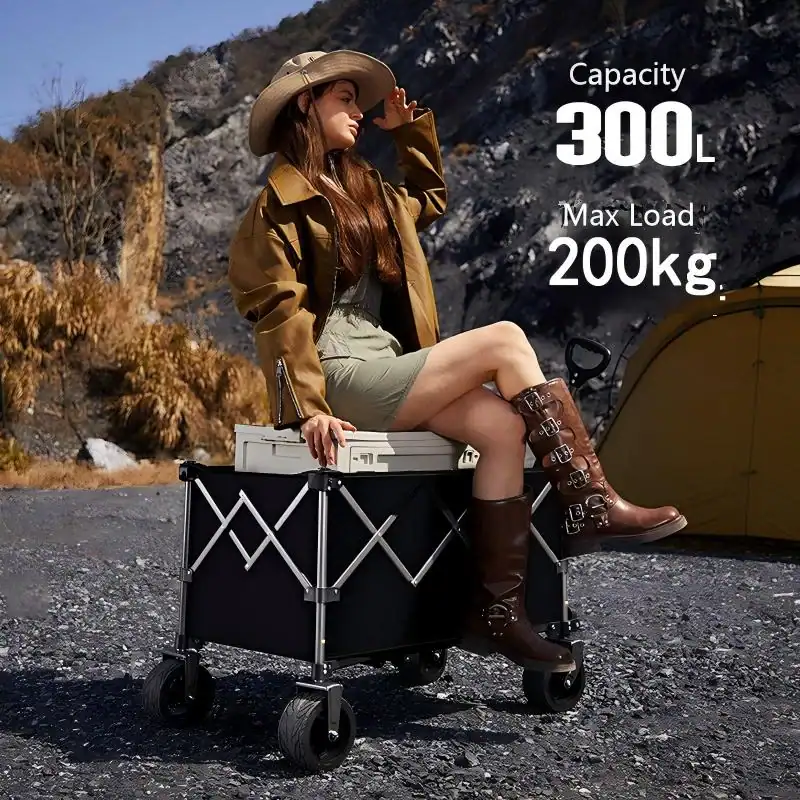
Most buyers think about freight cost per container. The smarter metric is freight cost per unit sold. A folding wagon carton measures roughly 80cm x 45cm x 60cm. That leaves a lot of air around it when stacked alone in a 40HQ container — air you already paid for. Mixed-SKU loading turns that dead space into revenue.
Filling Air Gaps Around Bulky Wagon Cartons
A folding wagon’s steel frame and fabric body determine its collapsed carton size, but those dimensions rarely divide evenly into a container’s interior height (2.69m for a standard 40HQ). A single layer of wagon cartons at 60cm tall leaves roughly four layers possible — but the top layer often sits with partial clearance that can’t hold another wagon layer without crushing.
This is where carton height compatibility matters. If your chair cartons are exactly half the height of your wagon cartons — say, folding chairs at 30cm versus wagons at 60cm — you can stack two layers of chairs in the space one wagon layer occupies. The result: clean stacking without compression risk, and no vertical gap wasted.
-
-
- Stacking Rule: Carton heights should share a common divisor (e.g., 30 cm) to avoid partial layers that shift during transit.
- Load Distribution: Place heavier wagon cartons on the bottom layer; lighter chair or table cartons on upper layers to prevent frame distortion.
-
Spreading Carton Handling Costs Across SKUs
A single-SKU container of folding wagons might ship only enough units to fill half the floor space before hitting weight limits. The rest of that container — and its freight charge — is essentially overhead allocated to one product line. Mixed loads change this equation by distributing the fixed ocean freight cost across multiple SKUs.
If your order includes wagons, chairs, tables, and sleeping bags from Kelyland Outdoors’ network of Fábricas certificadas ISO 9001:2015, you can plan a single PO that draws from different production lines but ships together. The handling cost at origin (loading, palletizing, documentation) gets spread across four product categories instead of one.
-
- Cost Allocation: A $4,500 ocean freight bill split across wagons (30%), chairs (25%), tables (25%), and sleeping bags (20%) reduces per-unit burden significantly compared to a single-SKU shipment.
- Warehousing Benefit: Receiving one mixed container instead of four separate LCL shipments cuts warehouse receiving time by roughly three-quarters and eliminates interim storage fees.
The key is working with a sourcing partner who coordinates production timing so all SKUs finish within the same window. Kelyland Outdoors’ standard lead time of 30-45 days allows synchronization across factory partners in Jinhua (wagons), Shaoxing (sleeping mats), and Zhenjiang (sleeping bags) — all feeding into one consolidated load.
Compatible Camp Gear for 40HQ Mixed Loads
A 40HQ container gives you roughly 2.69 meters of vertical space. Most buyers look at floor area and forget the height dimension entirely. That’s where the real savings live when you’re planning a mixed-SKU container loading for camping gear.
Folding Chairs and Tables with Similar Carton Heights
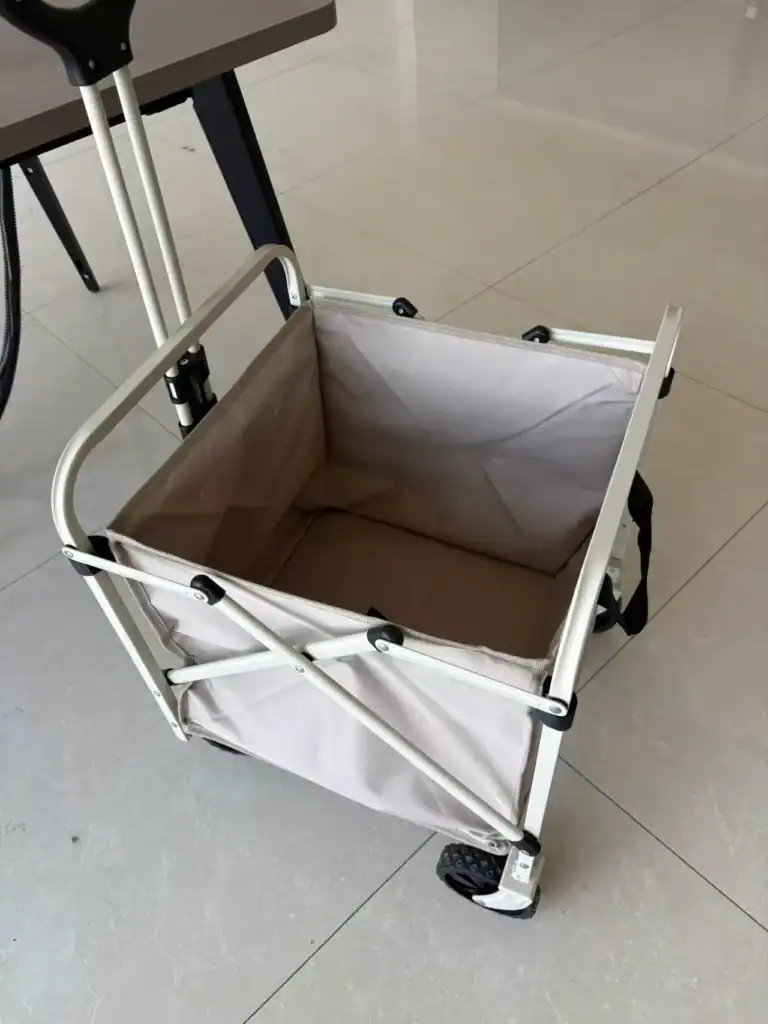
En carton height compatibility question is the first thing to solve. Folding wagon cartons typically land around 60 cm tall — that’s from the single-fold and multi-fold models in our Jinhua factory lines, which produce over a million units annually under ISO 9001 certification. A standard folding chair carton from the same region runs about 30 cm. That ratio — two chairs stacked per one wagon layer — is not a coincidence.
You can fit four layers of chair cartons (4 x 30 cm) or two layers of wagon cartons (2 x 60 cm) within the same vertical column, leaving roughly 29 cm for pallet base height and top clearance. The math works because both products share a common divisor at 30 cm. This is how to combine folding wagons and chairs in one container without crushing lower cartons or leaving unstable air gaps.
Camping tables add another option. Foldable roll-up tables from partner factories in Jinhua ship in cartons around 25-35 cm tall depending on frame material — aluminum, steel, or wood options are available with powder-coated or anodized finishes. A table carton at 32 cm pairs cleanly with chair cartons at 30 cm if layers are alternated and load spreader sheets are used between tiers.
Planning Mixed Loads with Your Sourcing Partner
Clean stack layers require carton heights divisible by 30 cm.
A brand manager launching a private-label line of folding wagons, camp chairs, and sleeping bags has a choice: ship each category in separate containers or consolidate everything into one 40HQ. The per-unit freight difference between those two options can be substantial — often 15–25% lower on the consolidated load.
Sharing a 40HQ Load with Multiple SKUs per PO
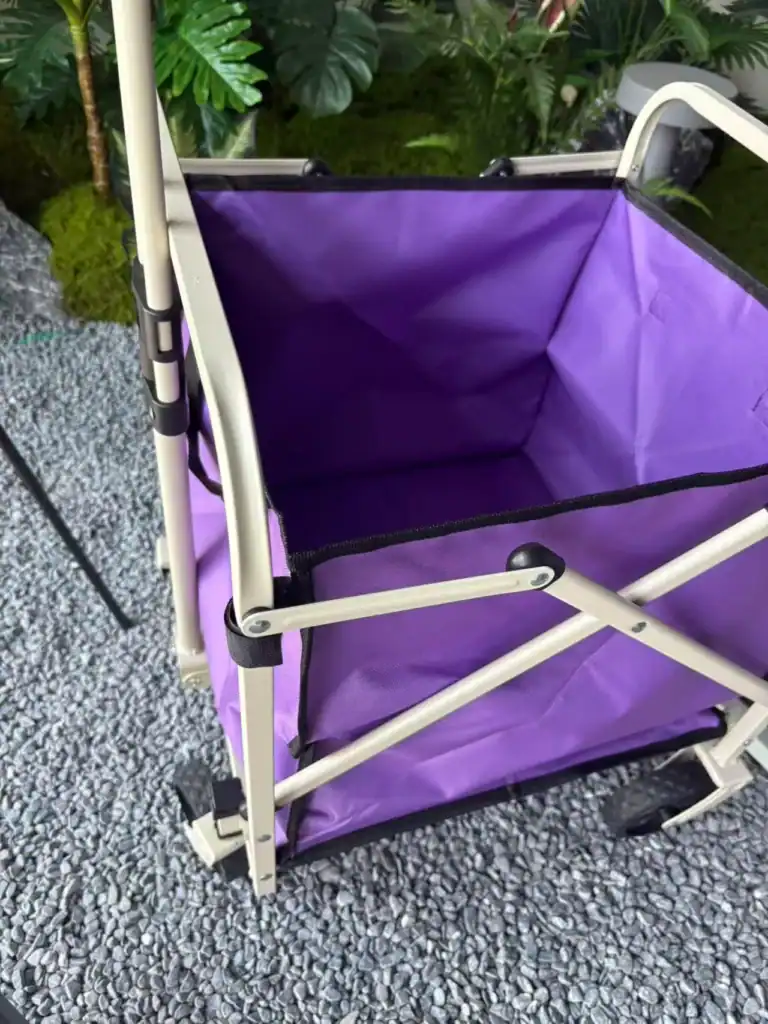
The standard approach is to allocate container volume by cubic meters. A folding wagon carton might measure 60 × 40 × 30 cm (0.072 CBM). A camp chair carton might be 45 × 35 × 30 cm (0.047 CBM). A sleeping bag carton could be as small as 30 × 25 × 20 cm (0.015 CBM). The trick is matching carton heights so they stack cleanly without crushing the lower layer.
Mixed-SKU consolidation works best when carton heights share a common divisor such as 30 cm. Wagon cartons at 60 cm high stack directly on top of chair cartons at 30 cm, creating stable columns across the pallet. Sleeping bag cartons at 20 cm need a shim layer or a separate pallet position to avoid shifting during transit.
Kelyland Outdoors manages this coordination through its network of factories — the folding wagon factory in Jinhua, Zhejiang produces powder-coated carbon steel frames that ship in standardized cartons, while the camping chair factory in the same province uses compatible packaging dimensions. When both factories coordinate on box height during the la etapa de aprobación de muestras, the final consolidation plan becomes predictable.
Avoiding Customs Delays with Consistent HS Codes
Customs clearance is another factor that separates a smooth mixed load from a costly hold-up. If every SKU falls under a different HS code heading, customs officers may flag the shipment for physical inspection — especially when items like metal-framed wagons and fabric sleeping bags appear unrelated on paper.
“Camping furniture” covers a specific HS heading range: typically HS code 9401.79 for seats with metal frames (folding chairs) and HS code 9403.89 for furniture of other materials (camping tables, folding wagon frames). Sleeping bags fall under HS code 9404.90 — still within Chapter 94’s broader furniture and bedding classification.
Conclusión
Mixed-SKU container loading is a direct lever on per-unit freight cost, but the savings only hold if the carton geometry and HS code alignment are planned before production starts. A 40HQ plan that pairs 60cm wagon cartons with 30cm chair cartons creates stable layers and eliminates wasted air space. That math is simple. The execution requires a sourcing partner who coordinates packaging specs across multiple factory lines.
-
- Verify all SKU carton heights share a common divisor, ideally 30 cm.
- Confirm all items fall under HS heading range 9401.79 or 9403.89.
- Use compressed sleeping bags as soft void fillers around wagon frames.
- Require a pre-shipment load plan from your supplier before container stuffing.
Before you finalize your next purchase order for folding wagons and camp chairs, ask your sourcing partner for a detailed container loading diagram that maps each SKU’s carton dimensions against the internal volume of a standard high-cube container. Review how they handle sample approval and quality tolerance across mixed product categories in the same shipment — inconsistencies there can offset any freight savings with rework costs or customs delays at destination.
Preguntas frecuentes
¿Cómo reducen los costos de envío las cargas con SKU mixtos?
A 40HQ container pays the same base freight whether it’s 60% or 100% full, so mixing SKUs like folding wagons and camp chairs fills unused space and spreads the shipping cost across more. Plan your carton dimensions to maximize every cubic meter.
¿Qué equipo de camping combina bien en un contenedor mixto?
Las sillas y mesas plegables con alturas de cartón similares se apilan ordenadamente junto a los carros, mientras que los sacos de dormir y las colchonetas actúan como relleno suave para los espacios sobrantes. Esta combinación maximiza el espacio vertical de 2,69 metros. Utiliza artículos blandos para rellenar espacios irregulares y lograr una mayor densidad.
¿Puedo combinar múltiples SKUs en un mismo pedido?
Sí, Kelyland Outdoors permite consolidar en un solo contenedor 40HQ múltiples SKUs dentro de un mismo pedido, coordinando la producción a través de su red de fábricas para alinear los plazos de entrega. Es fundamental garantizar la coherencia en los códigos HS. Confirme con su proveedor la compatibilidad de los códigos HS antes del envío.
¿Cuál es la cantidad mínima de pedido (MOQ) para contenedores con SKUs mixtos?
Las cantidades mínimas de pedido (MOQ) varían según el producto, pero pueden empezar desde 50-100 unidades para artículos específicos, mientras que los modelos estándar suelen oscilar entre 300 y 1.000 unidades por SKU. Para una carga mixta, puede negociar términos flexibles. Converse sobre la flexibilidad del MOQ al planificar su pedido con varios SKUs.

 English
 Español
 Deutsch
 Français
 Português do Brasil
 Русский
 العربية
 한국어
 日本語