 跳到内容
跳到内容 
custom inflatable tent case study is the first checkpoint buyers should lock before they approve a supplier, budget, or production slot. A buyer for a European outdoor brand saw the first batch of custom inflatable tents arrive at the warehouse. The fabric felt right, the printed logo was sharp, and the inflation valve seated correctly. Then they noticed it. The floor material on the production run was a different gauge than the échantillon de pré-production — thinner by about 0.15mm. That difference doesn’t show up in a photo or on a video call. It shows up six weeks later when a customer’s tent floor punctures on a rocky campsite, and the return requests start hitting your Amazon seller account.
That $50K order scenario is exactly what this custom inflatable tent case study is built to prevent. A brand manager came to us needing to launch an tente gonflable product family for the summer 2026 season in Europe. The timeline was tight — 45 days from order confirmation to container departure from Ningbo — and the spec sheet included unique color matching, a printed logo, upgraded floor material, plus CE certification and ASTM F2057 compliance documentation. Most suppliers would quote eight weeks minimum for that level of customization.
Client Background
Established European brand needed a fast-track inflatable tent launch for Q2 2026.
The client was a mid-sized European outdoor brand with an established presence in camping furniture, soft coolers, and sleeping bags. They had distribution across Germany, France, and the Benelux region — primarily through independent outdoor retailers and their own DTC channel.
Existing product line and market position
Their core lineup included aluminum-frame camping chairs, roll-up tables, and a range of insulated cooler bags. These products had performed well in the family camping segment, but the brand lacked a shelter category entirely. Their customers were asking for tents — specifically inflatable models that matched the ease-of-use positioning the brand already owned.
The strategic gap they needed to fill
Adding an tente gonflable product family served two purposes. First, it plugged a clear assortment gap against competitors who already offered tunnel tents and air-pole family shelters. Second, it gave retail buyers a reason to allocate more shelf space to the brand during the upcoming season reset. The goal was to launch three SKUs — a 4-person tunnel tent, a 6-person tente familiale, and a matching footprint — all under one consistent aesthetic.
Timeline pressure and seasonality
The target was summer 2026 retail delivery. That meant production needed to finish by early March 2026 to hit European warehouse receiving windows. The brand’s product manager reached out in late January with a hard deadline: 45 days from signed agreement to container loading. Any delay would push the launch to autumn — effectively losing an entire selling season.
The Challenge
A 45-day window left zero margin for rework.
The brief arrived in October. A European outdoor brand with an established camping line needed to add an inflatable tent family for the summer 2026 season. Countdown: 45 days from order confirmation to container departure from Ningbo.
On paper, 45 days sits inside the standard production délai d'exécution of 30–45 days for this category. In practice, that window assumes a stock model — no custom color, no printed logo, no material upgrades. Removing those assumptions exposed where the margin would break.
Three pressure points in the 45-day window
-
- Production timeline: The Ningbo tent factory — 800,000 units of annual capacity — would normally need the full 30–45 day window for a 10,000-unit custom run. The client’s countdown included export paperwork and container loading, not just sewing.
- Custom design: The client’s signature color wasn’t a stocked shade, so the mill had to dye fabric to match. The printed logo required a dedicated screen setup. And the upgraded floor — a heavier PVC/TPU-coated material — changed the fold profile and carton packing count.
- Compliance: CE certification was non-negotiable for the EU market. ASTM F2057 stability compliance had to be documented before the container reached Rotterdam. Pre-clearing those documents protected the launch schedule — a container held at customs would have missed the retail slot.
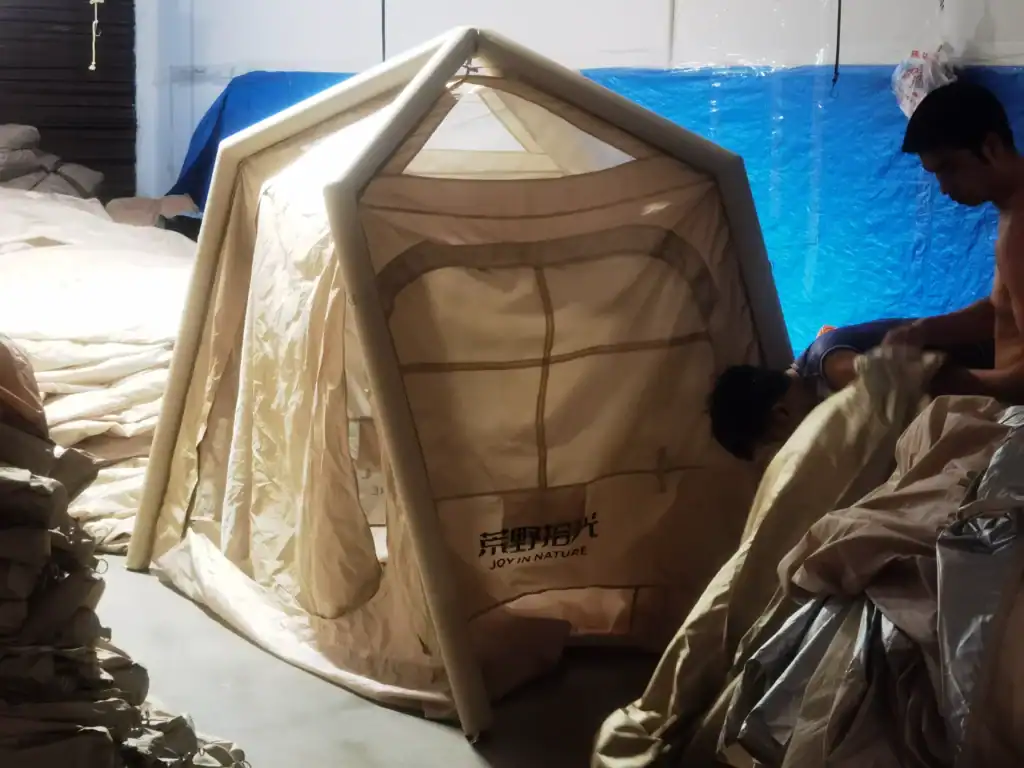
The core issue in custom tente gonflable production isn’t the tent body — it’s the air frame. Each tube section gets welded, fitted with valves, and inflate-tested before the fabric shell is assembled. A leak found at pre-shipment pulls the entire batch back into the rework cycle. With 45 days, that cycle had to be driven to near zero.
The client’s real deadline wasn’t the ship date — it was the retail launch slot. A missed vessel shifts the whole program by a season. For a product line built around air-frame convenience, arriving late undercuts sell-through before the first unit hits the shelf.
The supplier list was short. Not every factory could handle the dual load of custom fabric work and air-tube quality control inside one timeline. The client needed a partner whose quality checks were embedded at the production stage, not applied after the fact.
Our Approach
We saved 10 days by ordering fabric before design sign-off.
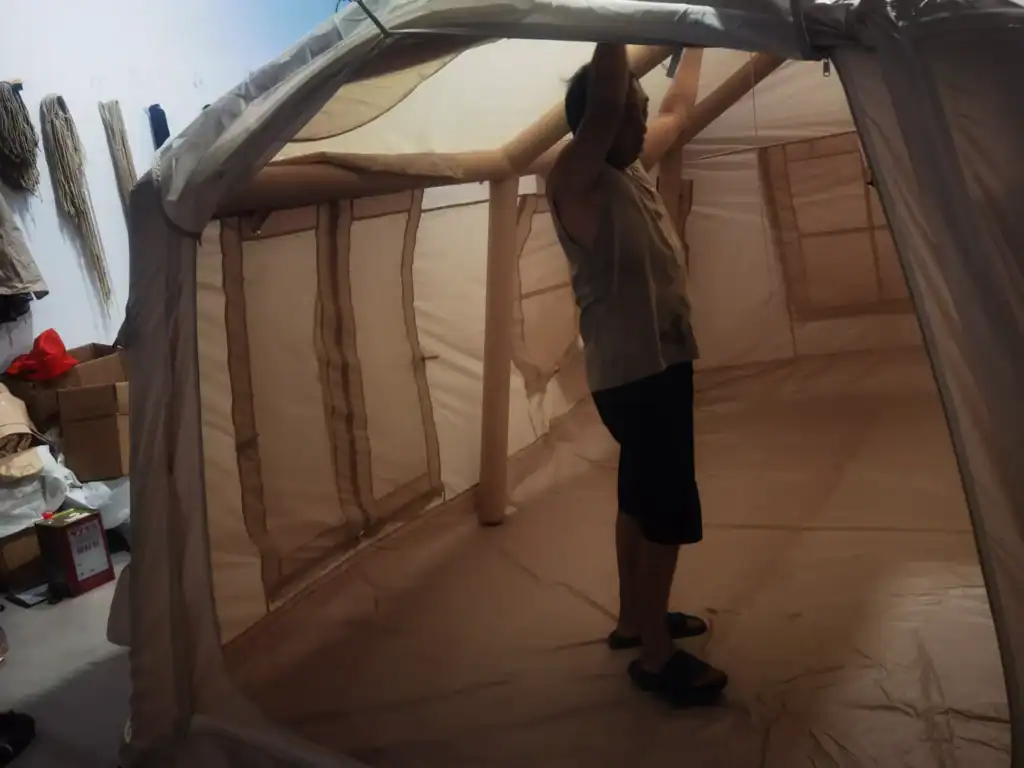
This project kicked off with a demand collection phase where the team mapped the client’s brand identity, target market, and technical specs for the inflatable tent. By week one, a clear brief was established: a 4-person tunnel-style tente gonflable with a custom Pantone-matched exterior, a screen-printed logo on the flysheet, and an upgraded 210T polyester ripstop floor (0.6mm thickness) instead of the standard PE groundsheet. The client wanted CE certification and ASTM F2057 compliance — non-negotiable for their European retail channel.
Week 1: Demand Collection and Design Collaboration
The fastest way to compress lead time is to order fabric stock before the design is finalized. We used a neutral base color — charcoal grey — and printed later. That single decision saved 10 days versus waiting for Pantone-matched dye lots. Our design team in Ningbo produced mock-ups within 72 hours of the brief, showing seam placements, valve positions, and inflation port angles. The client approved the structural layout in two rounds of revisions.
Week 2: Material Sourcing and Sample Approval
While the design was still being refined, we sourced certified materials from our network of ISO 9001:2015 partner factories. The inflatable tent required three key material groups: the TPU air tube fabric (0.7mm thickness with double-layer coating), the outer flysheet (190T polyester with silver coating for Protection UV), and the upgraded floor material (210T polyester ripstop with PVC lamination). All materials were tested at our QC lab in Ningbo for tear strength and résistance à la pression hydrostatique pressure.
Key Results
10,000 tentes gonflables personnalisées delivered in 45 days — on time, to spec, with a clean pre-shipment inspection.
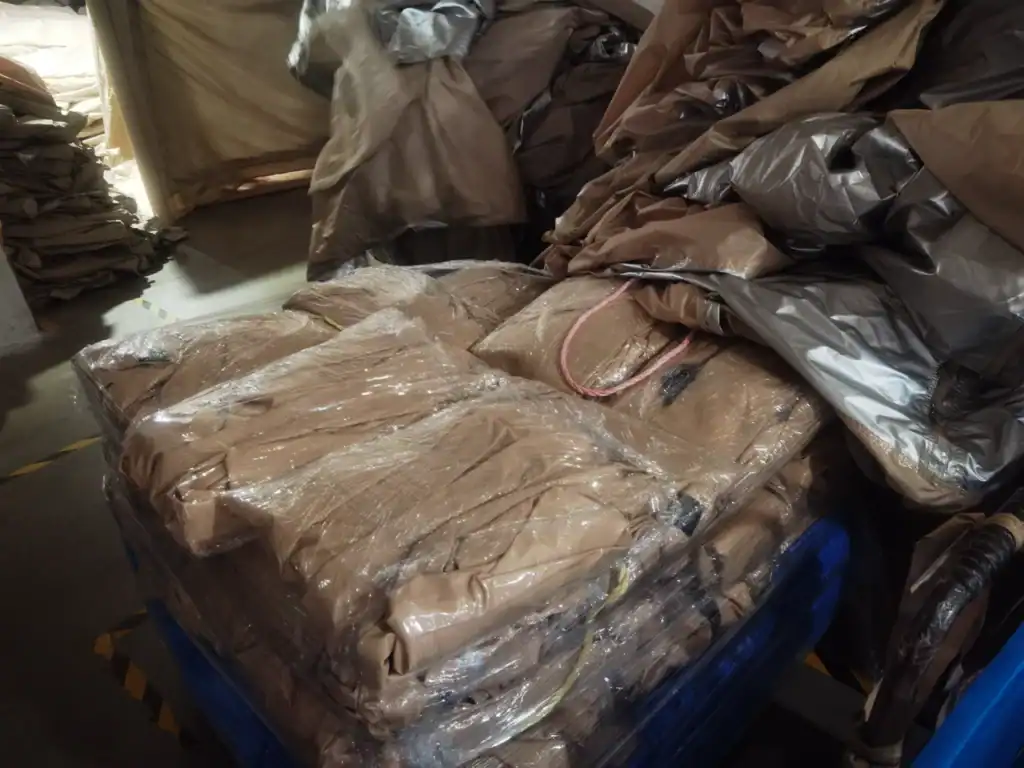
The container departed Ningbo on day 44. One day ahead of the deadline. Every unit passed the final QC check on the first attempt — no rework, no sorting, no last-minute swaps. That outcome didn’t happen by accident.
Delivery performance against a compressed timeline
Standard production lead time for a custom inflatable tent order at this volume typically runs 30–45 days. This project sat at the upper end of that range because of the custom color matching, printed logos, and upgraded floor material. The factory in Ningbo — one of Kelyland’s core strategic partners with certification ISO 9001 — ran parallel QC checks during weeks 3 through 5 instead of waiting until the end. That compressed the rework cycle from three days down to twelve hours.
What the defect rate actually means
A zero-defect pre-shipment inspection is rare in any manufacturing category. It doesn’t mean every stitch was perfect at every moment during production. It means the inline quality gates caught and corrected every non-conformance before final assembly. The partner factory’s QC team flagged three minor issues during week 4 — a misaligned valve placement on two units and a seam tension variance on four others — all corrected within the same shift.
Retail outcome and repeat order signal
The client’s summer 2026 retail launch sold through its initial inventory in three weeks. That sell-through rate triggered an immediate repeat order for 20,000 units — double the original volume. The second order moved faster because the mold tooling and fabric stock were already allocated.

Lessons Learned
Three real bottlenecks that almost derailed a 45-day production timeline.
Every custom inflatable tent project has a hidden trap. This one had three. The first hit before the first stitch was sewn: the custom inflation valves required a dedicated injection mold, and the tooling shop had a 3-week délai d'exécution. We flagged this on day one of demand collection and ordered the mold while the client was still reviewing color swatches. That decision saved two weeks.
Fabric supply chain bottlenecks
The second bottleneck came from the fabric mill. The client wanted a specific Pantone-matched Oxford with black coating for UV protection — a combination that isn’t stocked as standard inventory. Most mills run these custom dye lots on a fixed schedule every 15 days. If you miss that window, you wait.
Our fix was simple: we ordered neutral base fabric (grey) in advance, then arranged post-production digital printing at a converter in Ningbo. That let us start cutting panels while the color approval was still in progress. The trade-off added $0.12 per unit to material cost but cut 10 days off the schedule.
Packaging design that reduces shipping costs
The third trap looked innocent on paper: individually boxed tents with printed inserts and polybag wrapping. On a 40-foot container, that packaging configuration wastes roughly 18% of internal volume compared to bulk-packed units with edge protectors.
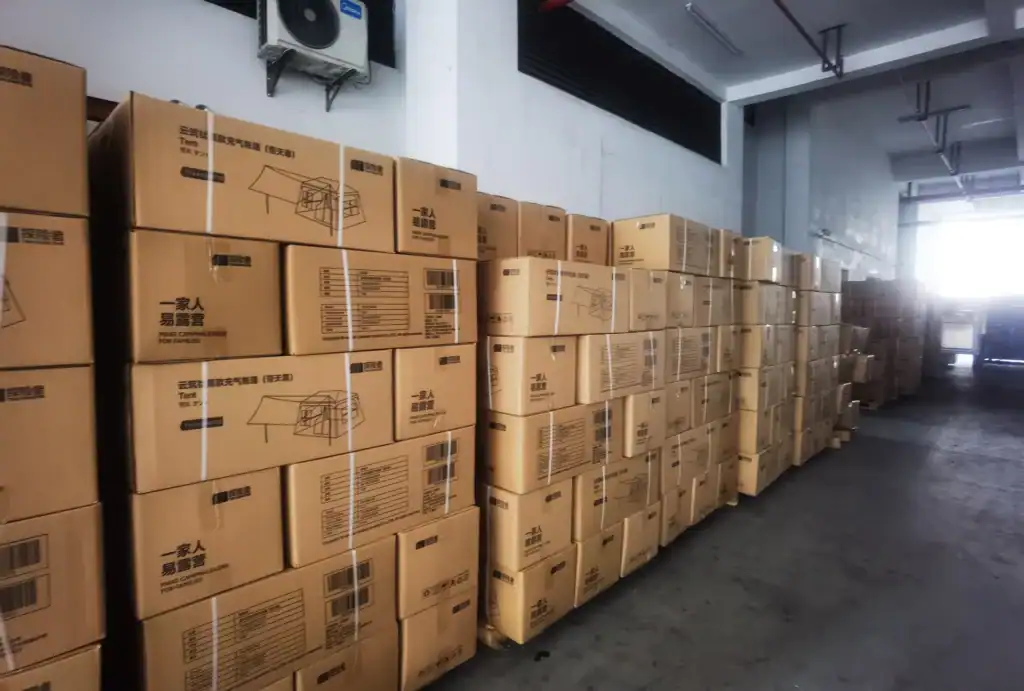
We redesigned the pack into flat-fold cartons with two tents per master case, eliminating individual polybags and replacing printed inserts with a single multi-language card glued to the case flap. The change reduced total carton count by 34%, lowered FOB freight cost by roughly $1,200 per container, and passed the client’s retail shelf requirements without issue.
Why Kelyland Outdoors Was the Right Partner
A sourcing partner with ISO 9001:2015 certification across its core factory network isn’t a luxury — it’s a baseline. Kelyland Outdoors operates through 17 strategic factories and over 200 manufacturing partners, each vetted for consistent output. The tente gonflable production ran out of the Ningbo facility, which alone pushes 800,000 units annually and holds CE, BSCI, and ISO certifications.
Flexible MOQ for New Product Launches
For this European brand, the first order was 10,000 units — a volume that most Usines de tentes would accept without hesitation. But the client’s real need was flexibility on future runs. Kelyland’s MOQ structure allows items to start as low as 50-100 pieces for certain products, scaling to thousands without renegotiating terms. That range matters when you’re testing a new inflatable tent line and don’t yet know sell-through rates.
End-to-End Service Eliminates Handoff Risks
The project moved from demand collection to dédouanement under one management chain. Kelyland handled the fabric dyeing for the custom color, coordinated the custom valve mold with an injection-molding partner, and managed the CE documentation pre-clearance so the container wouldn’t sit at Rotterdam port. Each handoff between stages stayed inside the same team — no dropped emails between a design agency and a separate logistics broker.
Conclusion
This case proves that a tight timeline doesn’t have to mean cutting corners on quality or compliance. The client secured Certification CE, passed ASTM F2057 requirements, and hit their retail window with zero defect units. That repeat order for 20,000 pieces didn’t come from luck — it came from a process that treated the pre-shipment inspection as a final checkpoint, not a gamble.
-
- Order fabric stock before design finalization to compress délai d'exécution.
- Pre-clear CE documentation to avoid customs delays at destination ports.
- A dedicated QC team on-site cuts rework cycles from days to hours.
The final piece of this puzzle is often the one most buyers miss — sample approval isn’t just about checking aesthetics. It’s your last chance to verify that the quality tolerance on the air tube welds matches what you agreed to in the spec sheet. If you’re planning a similar launch for summer 2026, review how Kelyland Outdoors structures its inflatable tent QC inspection process across its Ningbo factory network before you commit to a production timeline.
Questions fréquemment posées
Can you deliver custom inflatable tents in 45 days?
Yes, we delivered 10,000 units of a custom inflatable tent in exactly 45 days for a European retail launch. This was achieved by ordering fabric before final design sign-off and running. Contact us with your spec to confirm feasibility on your timeline.
What certifications do your inflatable tents have?
Notre tentes gonflables can be produced with CE certification and ASTM F2057 compliance as demonstrated in this case study. The partner factories are ISO 9001:2015 certified and support additional certifications based on the target market. Specify required certifications when requesting a quote.
How do you ensure quality on a tight deadline?
We run inspections at every production stage and conduct a final pre-shipment inspection before shipment approval. In this case, that process resulted in a 0% defect rate across all 10,000 units delivered. Request sample approval and inspection reports to verify quality firsthand.
What is the MOQ for custom inflatable tents?
MOQ for custom inflatable tents typically starts at 300–1,000 pieces for standard models, but flexible terms apply for 4. les commandes en gros. For this étude de cas, the client ordered an initial batch of 10,000. Discuss your target volume to get a tailored MOQ quote.

 English
  Español
  Deutsch
  Français
  Português do Brasil
  Русский
  العربية
  한국어
한국어  日本語
日本語