 콘텐츠로 건너뛰기

Inflatable Tent Air Retention Test: Pressure Drop Limits is the first checkpoint buyers should lock before they approve a supplier, budget, or production slot. Subject: Inflatable Tent Air Retention Test – Pressure Drop Limits. Forwarding this because a five-minute inflation check in the sample room does not predict how a tent behaves after twelve hours in the field. A buyer on a $50K order approved a pre-production sample that held air beautifully, then watched the mass production run lose pressure overnight at the weld junction where the valve base meets the beam. Sample approval without a retention test is just a hope.
Pressure readings move with temperature. A tent can drop roughly 0.5 PSI per 10 degrees Fahrenheit, which means an unheated winter warehouse can create false failures on tents that pass in a warm factory. Standardize the ambient temperature, or apply a correction factor before rejecting a lot. The leak itself, when it fails, usually sits at the Schrader valve core or the valve base weld junction, so a targeted soapy water check at those points is the most efficient detection method.
Here is the number to keep: for a three-beam 풍선 텐트 inflated to 7-8 PSI, a 12-hour pressure drop below 10% is a reasonable pass limit — under 5% for TPU beams. Write that into the QC spec before the factory starts cutting. Pull the test units according to an AQL 샘플링 plan, and if the supplier offers only a five-minute visual check instead of a 12-hour hold test, treat that as a quality tolerance warning.
Why Air Retention Testing Is Non-Negotiable for Inflatable Tents
A 12-hour pressure hold catches leaks a 5-minute visual check misses.
A slow leak does not fail an inflatable tent dramatically. It does it overnight. The beams sag, the canopy goes slack, and the customer wakes up in a collapsing shelter. That experience ends in a return, a chargeback, or a social media post with a photo. For a 공급망 manager, those returns carry freight, restocking, refurbishment, and the silent cost of a lost repeat customer.
How air loss destroys trust and drives returns
This is why pre-shipment inspection is the point of control, not the customer field. Kelyland’s partner factories run inspections at every production stage under ISO 9001:2015 procedures, and reports are available upon request. A pressure test on samples before packing gives the buyer the documented evidence they need to release a shipment with confidence.
Permeability vs. defect leaks
-
- Permeability: Normal. Every TPU or PVC air beam loses trace air at a molecular level. The pressure stays within a predictable range and the tent holds its shape overnight.
- Defect leak: Reject. A gap at a weld, a pinched seam, or a faulty Schrader valve core creates a measurable pressure drop that worsens as the beam stresses over time.
Most micro-leaks show up at two places: the Schrader valve core and the weld junction where the valve base meets the beam. Inspectors should coat these spots with soapy water first and watch for bubbles before searching the rest of the surface.
Temperature also skews the pass/fail call. A pressure reading can shift by roughly 0.5 PSI per 10 degrees Fahrenheit. A tent inflated in an unheated December warehouse can wrongly fail, while the same tent passes at 70°F. Run the test in a controlled room, or apply temperature correction before rejecting a batch.
The longer hold test is the only way to catch slow seam leaks. A 5-minute inflated visual check verifies that the tent stands, but it cannot reveal a leak that takes several hours to show. Use the 12-hour test on samples and a short hold test on every production unit.
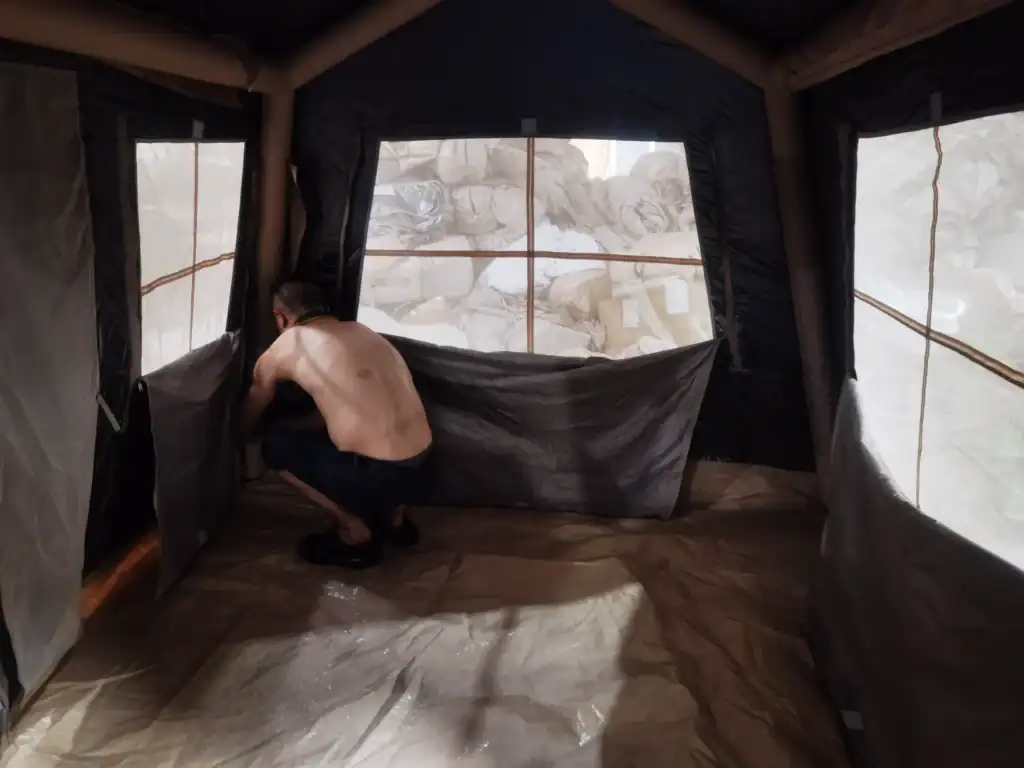
Pass/Fail Limits for a 12-Hour Pressure Drop Test
Correct the temperature first, then compare pressure loss against the agreed tolerance.
A tent can pass a five-minute inflated visual check and still lose pressure overnight. The 12-hour test is designed to catch slow seam leaks, and the pass/fail line should be set before mass production, not improvised when the inspector is standing in the factory.
Start with rated pressure, not a universal number
The starting pressure is the rated pressure printed on the 제품 사양 sheet. PVC/TPU air tubes in inflatable tents are commonly specified in the 6-12 PSI range; smaller single-beam tents sit near the upper end, while large multi-room 글램핑 텐트 run lower to reduce stress on long welded seams. Inflate to that number, allow 15 minutes for stabilization, then record the gauge and the room temperature.
What counts as a reject
The quality tolerance for the 12-hour test belongs in the inspection contract. A practical rule is to reject any unit whose temperature-corrected pressure falls below the minimum operating pressure specified for the beam. That catches the slow leaks a 5-minute check misses, while still allowing for normal membrane permeability.
-
- 샘플 승인: Run the full 12-hour test on the pre-production sample, and keep the pressure log with the approved sample record.
- Production check: Use a short hold test on every production unit, and pull units for the full 12-hour test according to the agreed AQL sampling plan.
Correct for temperature before judging the reading
Pressure readings shift by roughly 0.5 PSI per 10 degrees Fahrenheit. In an unheated winter warehouse, the gauge can drop simply because the air cooled. Adjust the end reading for the temperature change before comparing it to the pass/fail limit, and record the room temperature at both ends of the test.
When a unit fails, most micro-leaks are at the Schrader valve core and the weld junction where the valve base meets the beam, not on the panel surface. Check those two spots with soapy water first. Kelyland’s partner factories inspect at every production stage, and air retention logs are available on request, so the corrected pressure data can be verified before shipment.
Tools and Equipment Needed
Micro-leaks almost always form at the Schrader valve core or the weld junction, not on the beam panel.
An inflatable tent air retention test is only as reliable as the instruments used to measure it. A hand pump with a built-in gauge is fine for a campsite check, but it will not produce the repeatable readings a 공급업체 감사 requires. Use a calibrated digital pressure gauge, a pump with a built-in gauge rated to the tent’s working pressure, a soap solution, and a stopwatch.
At Kelyland’s partner factories — including the Ningbo tent and tarp facility that produces 800,000 units a year under CE, BSCI, and ISO 9001:2015 certification — these tools sit on the QC bench, not in a locked office. The gauge is checked against a reference before each inspection round, and the soap solution is mixed to a standard concentration so bubbles form consistently at micro-leak sites.
What a Standardized Test Sheet Must Capture
A standardized test sheet turns a 12-hour pressure test from a casual observation into an auditable record. Without one, a factory inspector can write ‘OK’ next to a unit that lost 2 PSI overnight and nobody will know the difference. With one, you can compare every sample across production runs and spot drift before it becomes a return problem.
-
- Unit ID: Ties the result to a specific sample or production unit, not a batch average.
- Time and pressure: Record start PSI, end PSI, and the exact 12-hour window so temperature drift can be calculated.
- Temperature log: Note room temp at start and end. Pressure drops about 0.5 PSI per 10°F, so an unheated warehouse can fail a good tent in winter.
- Leak location: Inspect the Schrader valve core and the weld junction where the valve base meets the beam first — that is where most micro-leaks live.
- Inspector signature: Assigns accountability and makes the data usable in a rework or replacement negotiation.
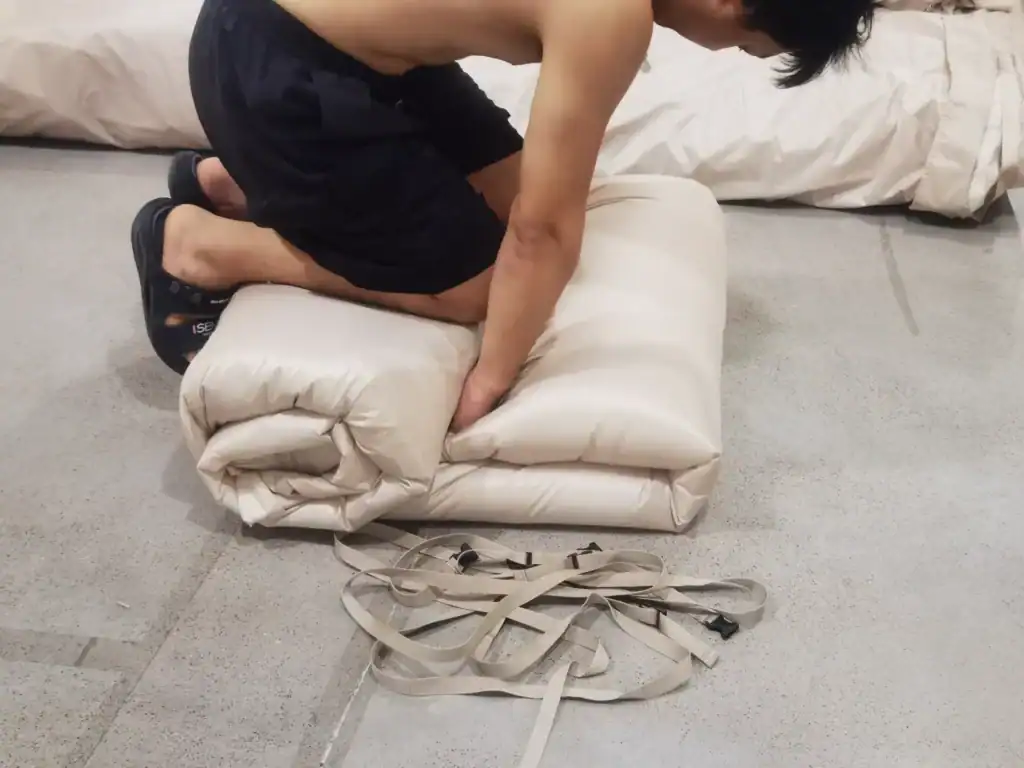
Step-by-Step On-Site Testing Procedure
대부분 풍선 텐트 leaks sit at the valve core or the valve-base weld — not the beam panel.
Inflate the tent to the rated pressure stamped on the beam or listed in the approved spec sheet, then wait 15 minutes before recording anything. That stabilization window lets the TPU or PVC membrane stretch and seat into the fabric weave. A tent that looks soft after five minutes is often just settling, not leaking. Skip this step and the baseline reading tells you nothing about the actual air retention.
Record Start and End Pressure
Log the stabilized reading as the start pressure, then leave the tent undisturbed for 12 hours. Temperature shifts are the silent variable — pressure changes by roughly 0.5 PSI per 10°F, so an unheated winter warehouse can turn a passing tent into a false reject. Keep the test room at a stable temperature and note the ambient reading on the test sheet.
Kelyland’s partner factories follow ISO 9001:2015 procedures and document these readings during pre-shipment inspection. A buyer can request the full pressure log — start PSI, end PSI, test duration, and room temperature — before goods leave the warehouse. If any of those fields are blank, treat the test as incomplete.
Soap Spray Targets Valve and Weld Junctions
When a tent fails the pressure check, most people inspect the beam panels for pinholes. The micro-leak usually sits at the Schrader valve core or the weld junction where the valve base meets the beam. Mix a few drops of dish soap into a spray bottle of water, then spray the valve stem, the valve base weld, the zipper ends, and every seam termination. A steady stream of tiny bubbles pinpoints the defect in seconds.
After rework — typically a valve core swap or a re-weld at the junction — run the full 12-hour cycle again. A 30-minute re-inflate that shows no bubbles confirms the visible fix but misses slow seam leaks. Samples and reworked units go through the complete cycle; production units get a shorter hold at rated pressure before packing.
Sampling Strategy for Bulk Orders
Use a 12-hour pressure test on AQL samples; run a short hold test on every production unit.
A 12-hour air retention test on every tent isn’t realistic in a 30-45 day production window. At Kelyland’s partner factories, inspectors run a 2-3 minute inflated hold test on each unit for gross leaks, then apply AQL sampling for the full 12-hour pressure drop test. That split catches systematic failures without stalling the line.
AQL sampling for pressure testing vs. 100% visual checks
Visual checks run 100% on every tent: seam alignment, fabric defects, valve seating, and zipper integrity. The 12-hour pressure test applies to a random sample using AQL 2.5 for critical defects and 4.0 for major defects, or whatever your contract specifies. That split works because most micro-leaks trace to a consistent root cause. If the sample fails, the whole batch is suspect.
Which units to pull from the production line
Never take all samples from one shift or one machine. Stratify the pull across the production run so the sample reflects the full batch, not just the cleanest hour.
-
- Start of run: Pull after the line stabilizes — catches setup errors in beam welding and valve installation.
- Mid-run: Pull after roughly 50% of the quantity is produced — catches fabric batch shifts or tool wear.
- Final units: Pull just before packing — catches end-of-line fatigue and rushed finishing.
- After rework: Any unit repaired after failing the hold test must be retested for 12 hours before approval.
Focus the sample inspection on the Schrader valve core and the weld junction where the valve base meets the beam. That’s where most micro-leaks hide. With ISO 9001:2015 partner factories, this sampling plan is standard practice, and the pressure logs are available for every batch.
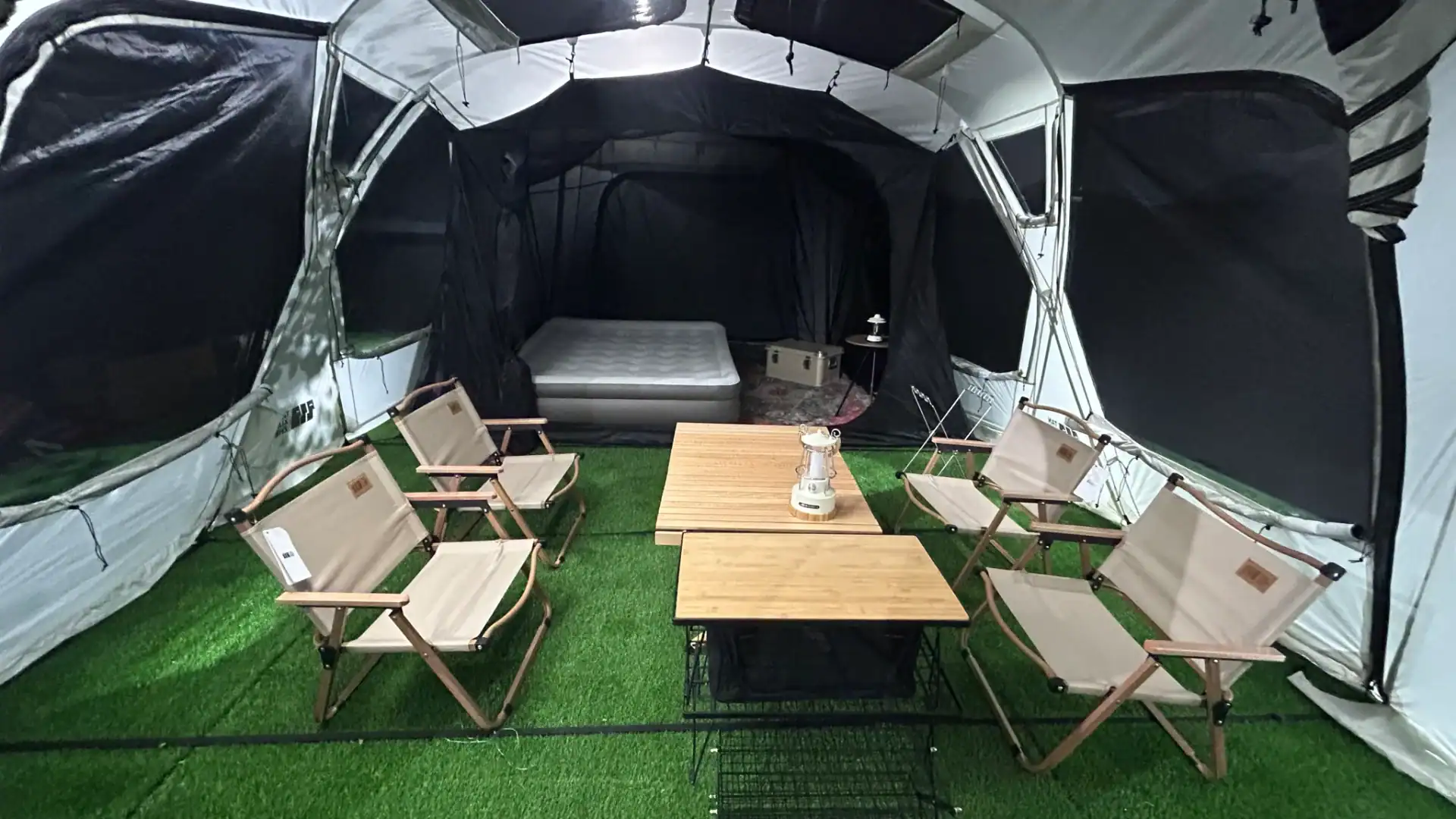
What to Do When a Batch Fails
A failed batch is a negotiation — but only with pressure logs and photos that hold up.
A batch fails the moment the pressure-drop limit is exceeded. Before you call the supplier, lock down the evidence. Photograph the beam, the weld, the valve core, and the gauge reading in one frame. If a soap solution test located a pinhole, capture the bubbles expanding. That image ends most arguments about who caused the leak.
Most micro-leaks show up at the Schrader valve core or the weld junction where the valve base meets the beam, not on the panel itself. Pressure logs must include unit number, start and end PSI, room temperature at both readings, gauge ID, and inspector name. Temperature correction matters: readings shift by roughly 0.5 PSI per 10 degrees F, so a tent that failed in an unheated warehouse can pass at 20°C. Send the corrected calculation with the log.
What the supplier can and cannot dispute
A supplier can question your gauge, your test method, or your temperature correction. They cannot dispute a timestamped photo of a leaking valve base. Make the evidence batch-specific, not general. Vague complaints get a polite email back. Timestamped photos with serial numbers get a rework plan.
-
- Pressure log: Unit ID, start/end PSI, room temp at both readings, gauge ID, inspector name, and temperature-corrected value.
- Photo set: Wide shot of the whole tent, close-up of the leak point, and the final gauge reading with the batch tag in every frame.
- 시험 규격서: State the starting pressure, stabilization time, and hold duration. If you ran the 12-hour test, write down the exact start and stop times.
Rework, replacement, or partial shipment
Start by demanding rework for repairable defects. A leaking Schrader valve core is a two-minute fix. Full replacement makes sense when the beam panels themselves leak or welds are failing across multiple units. Partial shipment is only acceptable if conforming units are physically segregated and the rejected pieces stay at the factory for rework.
Kelyland’s partner factories adhere to ISO 9001:2015 and run inspections at every production stage, with reports available on request. Use that same discipline when a batch fails. If your supplier cannot produce a pressure log that matches the batch number, you have a traceability problem, not just a leak problem.
How Kelyland Outdoors Runs Air Retention Tests
A 12-hour hold test at rated pressure catches leaks a 5-minute visual check never sees.
켈리랜드 Outdoors runs air retention checks through the same factory network that holds ISO 9001:2015 certification. Before packing, every production unit gets a short inflation hold to catch gross leaks. AQL samples go further: they sit fully inflated at rated pressure for 12 hours, with pressure logged at the start, after 15 minutes of stabilization, and at the end. The QC report includes start and end PSI, room temperature, humidity, and the inspector’s name.
Where micro-leaks actually hide
Most returned inflatable tents do not leak through the beam panel. The two weak points are the Schrader valve core and the weld junction where the valve base meets the beam. A soapy-water spray test at those two spots finds the problem in minutes. Without that step, a slow seep at the valve core can pass a visual inspection and then arrive at the customer as a sagging tent by morning.
Temperature corrections and pass/fail reporting
Pressure readings shift about 0.5 PSI per 10 degrees Fahrenheit. If a test room is unheated in winter, a good tent can fail on paper simply because the air cooled overnight. Kelyland records the room temperature at both readings and flags any batch where the drop exceeds the agreed threshold after temperature correction. Buyers should ask for that adjusted figure before rejecting a shipment.
-
- Valve core leak: Loose or damaged Schrader core; confirms by wetting the core with soapy water and watching for bubbles. Core replacement is a two-minute fix.
- Valve base weld junction: A stress crack forms at the seam where the valve boss fuses to the beam. It appears only at full pressure, so test at rated pressure, not half inflated.
- Slow seam leaks: These need the full 12-hour hold to appear. A 5-minute visual check will miss them, which is why Kelyland uses the long test on samples and a short hold on every production unit.
결론
A 12-hour air retention test with temperature-corrected readings gives you the one piece of evidence that separates a field-ready 풍선 텐트 from a return waiting to happen. The pass/fail limit matters less than the discipline of running the test the same way every time, on every sample batch. Your contract should name the pressure drop threshold, the test duration, and the correction method — so a factory cannot argue about results after shipment.
-
- Inflate to rated pressure, stabilize 15 minutes, then log pressure at hour 0 and hour 12.
- Correct readings by roughly 0.5 PSI per 10°F when the test room temperature shifts.
- Check the Schrader valve core and valve-base weld first — that is where micro-leaks concentrate.
- Run the full 12-hour test on samples; use a short hold test on every production unit.
Before you lock in your next purchase order, review the air retention test protocol with your supplier and ask for the pressure drop log from the pre-shipment sample. If the factory cannot produce a clean 12-hour record with temperature data attached, that gap will surface later as customer complaints. Browse the air mattress and 풍선 텐트 lineup on the Kelyland product page to compare how different beam materials and valve constructions hold up under the same test standard.
자주 묻는 질문
What is a 12-hour air retention test?
It is a pass/fail quality check where an inflatable tent is inflated to its rated pressure and monitored for 12 hours to measure pressure loss. This catches micro-leaks that a quick. Use it as a pre-shipment inspection step, not a sample-room demo.
What pressure drop limit is acceptable for inflatable tents?
There is no universal number, but many TPU air-beam tents reject at roughly 15% pressure loss over 12 hours after temperature correction. The exact pass/fail limit must be agreed with the factory based. Set the limit in writing before mass production starts.
How does temperature affect pressure drop readings?
Pressure naturally drops when air cools, so you must record temperature at the start and end and correct the reading for temperature change. Without this correction, a 추운 밤 can. Always do the 12-hour test in a stable or monitored temperature environment.
How do you find micro-leaks in an inflatable tent?
Use a soapy water solution on high-risk areas like Schrader valve cores, weld joints, and zipper ends and watch for bubbles. Inflate to rated pressure first, then check each suspect spot systematically. Mark every leak point and retest after rework.
Does Kelyland test inflatable tents before shipment?
Yes, Kelyland runs air retention testing at factory level before packing and can provide pressure drop reports on request. We also flag common weak points like valve cores and weld junctions so overseas. Request test reports and photos before approving a batch.

 English
 Español
 Deutsch
 Français
 Português do Brasil
 Русский
 العربية
 한국어
 日本語