
A buyer in California just learned what a Prop 65 folding wagon warning costs when it arrives as a demand letter. The $50K order had passed pre-production sample approval two months earlier. But the mass production run shipped with a different powder coating, and that mismatch — not a failed test — is what triggered the notice.
The frustrating part is that no one skipped a quality check on purpose. The buyer never asked whether the frame’s powder coating contained lead above California’s 0.1 micrograms per day exposure limit, and the factory never volunteered the information. That’s the pattern in most of these cases: private-label sellers get sued not because their wagon fails a test, but because they never verified the coating chemistry before the container left the factory. A single third-party test from a California-certified lab is cheaper than a settlement, and it gives you something concrete to push back with when the supplier insists the material is fine.
The fix belongs in the sourcing conversation, long before FOB 가격 gets compared. Ask for the exact powder coating spec and the batch test report. Ask whether the PVC or TPU handles and wheels contain phthalates. Ask what quality tolerance the factory holds between sample approval and bulk production. A supplier who hesitates on those questions is telling you where their margin lives — and it isn’t in compliant materials.
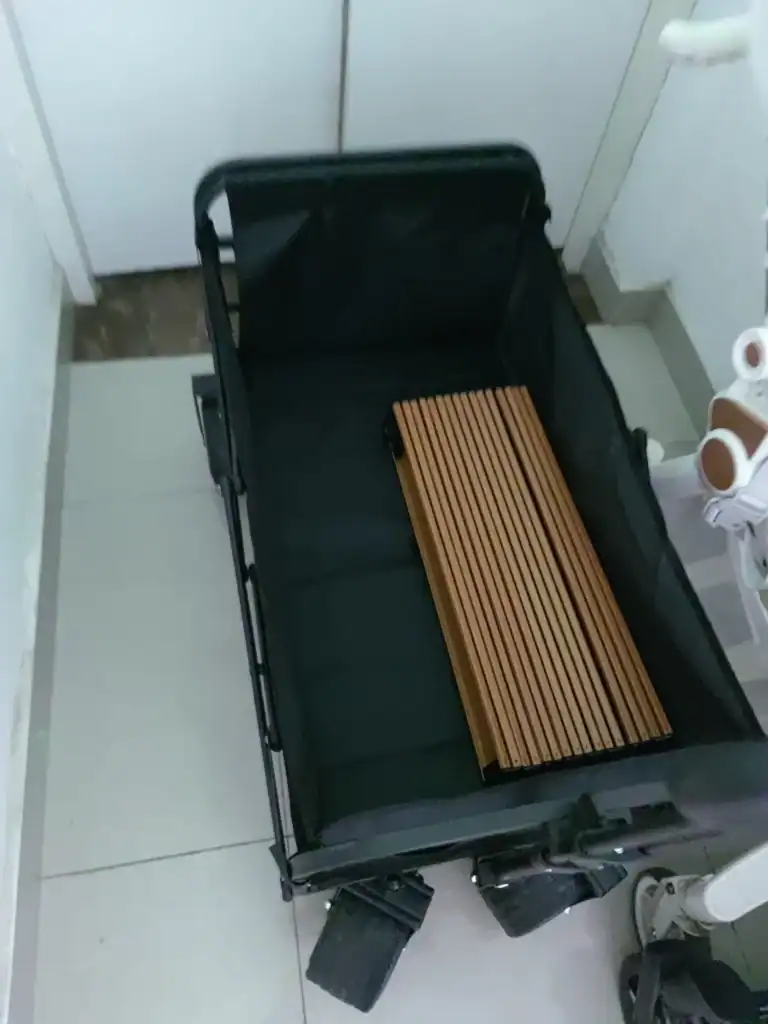
When Does Prop 65 Apply to Folding Wagons?
Selling or shipping into California triggers Prop 65.
Proposition 65 applies the moment a folding wagon is sold, offered for sale, or shipped for sale into California. Where your company is registered does not matter. Delaware holding company, Nevada warehouse, Zhejiang factory — if the wagon reaches a California consumer, the law reaches you.
The legal trigger is exposure to a listed chemical above the state’s safe harbor level, not the product category. A wagon is not flagged for being a wagon. It gets flagged when someone handles the grips, wheels, or painted frame and is exposed to lead, phthalates, or another listed chemical at a level California considers significant.
The practical test for an e-commerce operator is simple. If a California resident can order the wagon and have it delivered, assume Prop 65 applies. Plan for it when comparing quotes, not after a listing goes live. The obligation follows the product, not the paperwork.
Selling into California or shipping there
-
- Direct shipments: Any order delivered to a California address puts the seller in scope, even without a physical presence in the state.
- FBA or 3PL distribution: Inventory placed in California fulfillment centers for California-bound orders carries the same warning obligation as a direct sale.
- Marketplace sales: A listing that accepts California delivery addresses triggers the duty at the point of sale. The seller of record — not the platform — carries the liability.
Internet sales are treated as exposures in California. You do not need a storefront, sales tax nexus, or a California business license. A shipping label with a California ZIP code establishes the exposure. Prop 65 notices can follow FBA orders even when the seller’s entire operation sits in another state.
Returns add an edge case. A customer who buys in Oregon and crosses into California with a wagon is not your exposure. But relisting a returned unit and shipping it to a California address attaches the warning requirement to that transaction. Multi-channel sellers miss this until a notice arrives.
Why the supplier chain matters
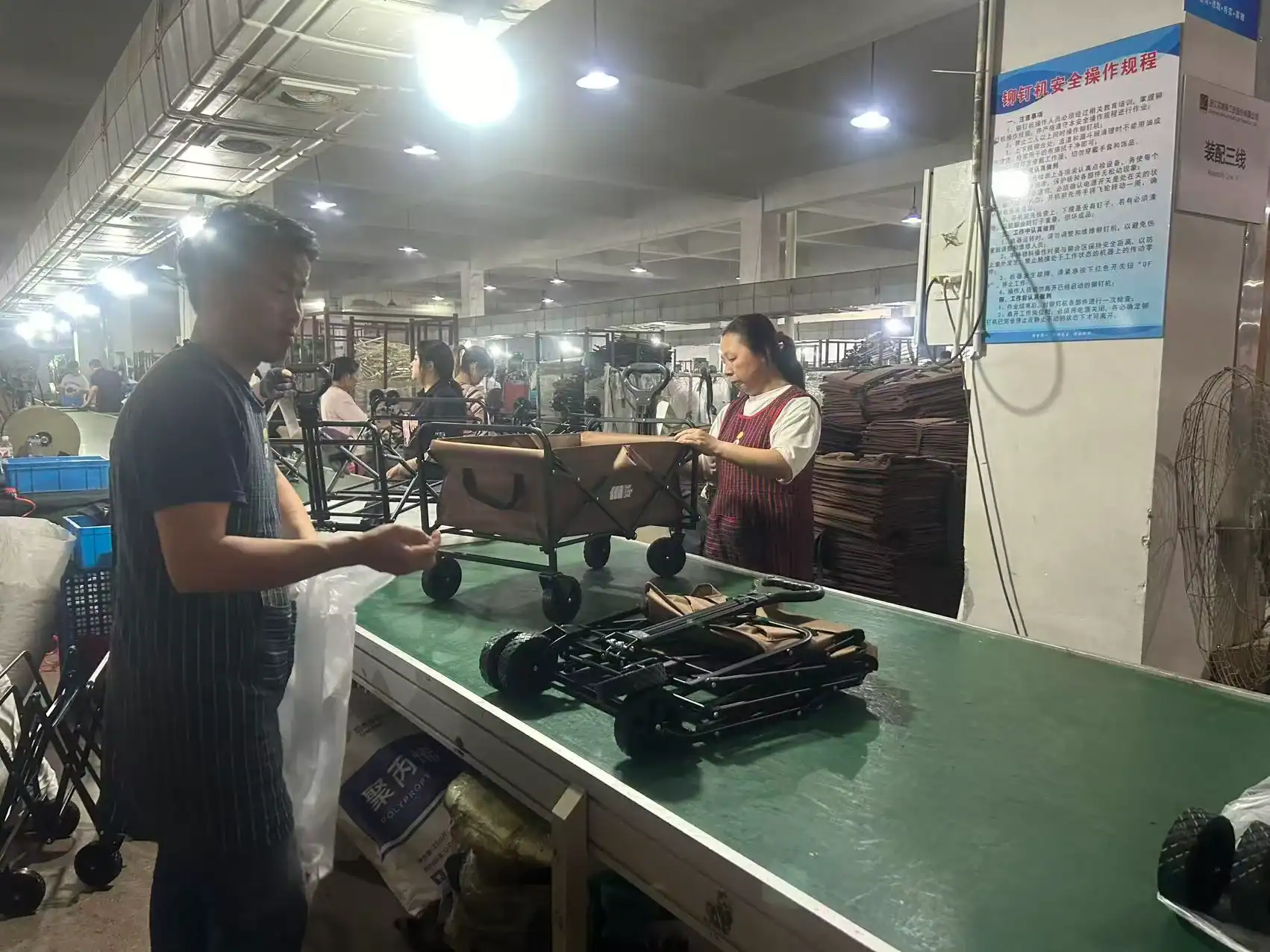
Before you finalize FOB pricing, ask what the factory’s compliance paperwork actually covers. A Chinese-made wagon is not exempt, and an ISO 9001 certificate does not make a product Prop 65-compliant. The useful output is a component-level material declaration for the powder-coated frame, wheels, and handle grips, requested at the 샘플 승인 단계. Kelyland Outdoors coordinates its folding wagon line at a factory in Jinhua, Zhejiang with an annual output of one million units — a supplier with that production scale should be able to produce the declarations without delaying the timeline.
Most private-label sellers learn about Prop 65 from a 60-day notice, not from their own testing. The violation is not always that the wagon failed a lab test. It is that no warning appeared on the listing or label. One independent lab report covering the coated metal and plastic components costs less than a settlement demand. Run the test before the container ships; by the time the listing gets screenshotted, the cheapest exit has passed.
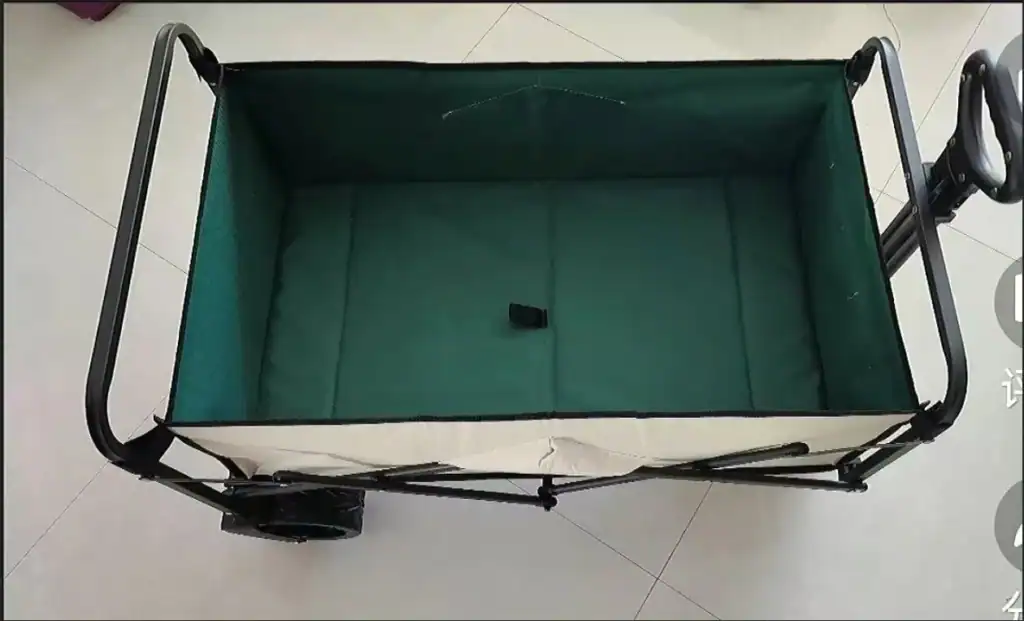
Common Prop 65 Chemicals in Wagons
ISO 9001 controls process, not chemistry.
Folding wagons are simple products: a steel frame, fabric basket, plastic wheels, and a few die-cast parts. The chemicals that trigger California Prop 65 warnings usually hide in the powder coating on the frame, the plating or paint on zippers, and the soft plastic handles or wheels. The fabric is almost never the problem.
Lead in paint, powder coating, and zippers
Lead shows up in powder coating more often than most buyers expect. Budget suppliers sometimes use low-cost pigment formulations that contain lead, and the frame’s coating is the largest exposed surface on the wagon. California’s safe harbor limit for lead exposure is 0.1 micrograms per day. A wagon frame above that number triggers the warning requirement.
-
-
- Frame powder coating: The biggest exposure surface. Request a third-party test of the powder coating itself, not just the finished fabric. A California-certified lab can test a coated sample before mass production, and that single test costs less than a Prop 65 settlement.
- Zippers and hardware: Zipper pulls, buckles, and rivets often get plated or painted with lower-grade coatings. Repeated hand contact increases the exposure route. Make sure the test report covers these small parts specifically. A report limited to fabric tells you nothing.
-
Phthalates in PVC/TPU handles or wheels
The second trigger is phthalates in soft plastic parts. Many folding wagons use PVC for wheel treads and molded handles, while TPU appears in brake grips and accessory mounts. Phthalates soften PVC, and several are on the Prop 65 list. Thick, flexible wheel compounds are the highest risk because hands grip them during folding and pulling.
-
- PVC 휠: Budget wheel compounds frequently contain DEHP or DINP. Ask the supplier to confirm whether the wheel is PVC or TPE. TPE is more often phthalate-free, but you still need the test report. Verbal assurance is not compliance documentation.
- TPU handles: TPU is generally safer, but molded handles can still contain plasticizers depending on the resin batch. The report must list DEHP, DBP, BBP, and DINP by name. A statement that says phthalate-free without lab backing is worthless.
ISO 9001 controls process, not chemistry. The folding wagon factory in Kelyland’s supplier network is in Jinhua, Zhejiang, certified to ISO 9001, with an annual capacity of 1,000,000 wagons. That tells you the production line is managed and inspected. It does not tell you whether the powder coating meets California’s chemical thresholds. That answer comes only from a third-party Prop 65 test report.
A written supplier guarantee that the wagon is Prop 65 compliant helps with contract allocation, but it does not stop a lawsuit. The warning obligation sits with the seller, regardless of supplier promises. Get the test report as part of the sample approval step, before any mass production begins.
Choosing a Prop 65 Warning Label
The short-form warning is your default.
Some brands chase the long-form warning because they think naming specific chemicals looks more credible. Under California law, both formats carry identical weight. For a folding wagon, the short-form wins for a practical reason: it fits on a hang tag or a small decal. You do not have space on the handle or frame to list a paragraph of chemical names.
The harder issue is what the label actually does. A short-form warning creates the legal presumption that you warned. It does not prove the product is safe. If the powder coating on the frame contains lead above the 0.1 microgram per day exposure threshold, the label only moves you from ‘no warning’ to ‘inadequate warning.’ The test report is the only thing that shuts down a settlement demand.
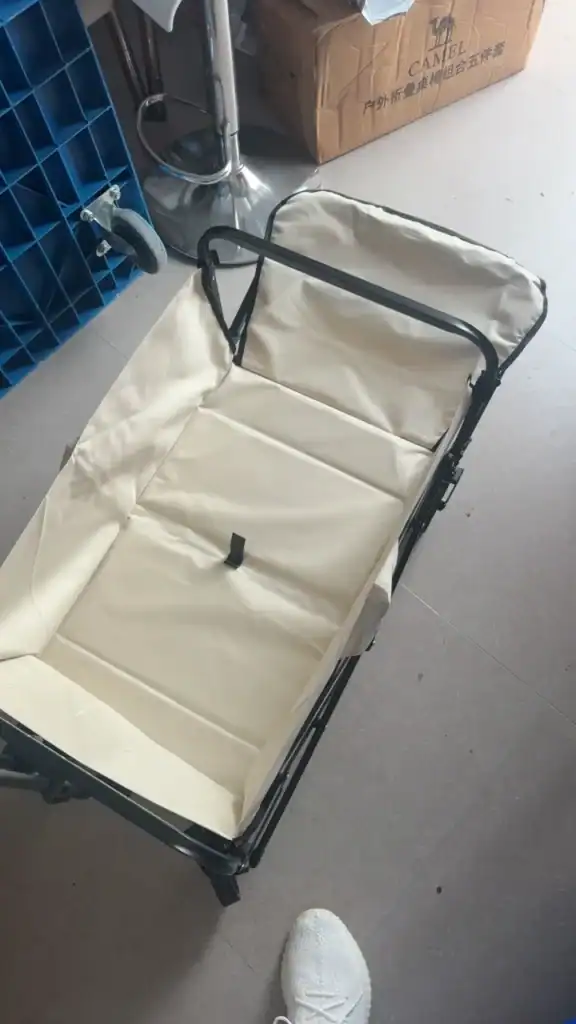
Short-form vs. long-form: what changes
-
- Short-form: The text reads: ‘WARNING: This product can expose you to chemicals including lead, which is known to the State of California to cause cancer and birth defects or other reproductive harm. For more information go to www.P65Warnings.ca.gov.’ Fits on a 2-inch hang tag. Accepted in court for any consumer product.
- Long-form: Names the specific chemical and the health endpoint. Uses the same warning language but requires space for a full paragraph. Impractical for a wagon handle or a small folding tab.
- Legal consequence: Either format satisfies the warning requirement. The short-form carries the same penalties for non-compliance as the long-form. The label choice is a packaging decision, not a legal loophole.
What to ask before approving packaging
Ask your supplier for a Prop 65 label template on the packaging proof. Then ask for the lab report that supports that label. Not a generic material certificate from the mill — the report for the exact powder-coated frame you are buying. Lead in 파우더 코팅 is the classic miss on folding wagons. If the supplier cannot produce that test result, you are paying for a label that means nothing.
When you source through a manufacturing partner with ISO 9001:2015 certification, the quality control documentation trail exists — you just have to request it. A single third-party test from a California-certified lab is cheaper than a settlement. Most private-label sellers get sued not because the wagon failed the test, but because they never asked for it in the first place.
Avoiding Prop 65 Lawsuits
Most Prop 65 folding wagon lawsuits start with no test at all — not with a failed one.
Private-label sellers get hit with Prop 65 notices because the wagon’s powder coating was never checked for lead. The exposure limit that matters is 0.1 micrograms per day. A single test from a California-certified lab costs a fraction of a settlement — and it tells you whether the supplier’s coating is clean.
Test reports and supplier guarantees
When you order a 맞춤형 접이식 왜건, the first document to request is not the ISO certificate. It’s the material test report for every component that contacts skin. For the folding wagons produced at Kelyland’s partner factory in Jinhua, the frames are powder-coated carbon steel or aluminum, and the wheels are PVC, PU, EVA, or TPE. Each material carries a different Prop 65 exposure profile.
-
- 분체 도장: Lead is the classic culprit. Ask for a heavy metals test on the frame coating. If the supplier hesitates, that’s a signal.
- Handles and wheels: Phthalates are the issue in soft PVC or TPU parts. A phthalate test on these components matters more than the fabric.
- Zippers and hardware: Some cheap zippers carry lead in the plating. Include them in the test scope.
A supplier guarantee is only worth something when it names the specific chemicals and test methods. A signed statement that says “this product complies with Prop 65” means nothing if the supplier never tested the actual production run. The guarantee should cover lead, phthalates, and the exact test standard used.
Kelyland’s QC process runs inspections at every production stage, and the folding wagon factory in Jinhua operates under ISO 9001:2015. Ask to see the inspection reports for the specific batch you’re ordering — not a generic certificate from last year. A strong supplier agreement also includes a Prop 65 indemnification clause, so you have recourse if a batch fails after shipment.
결론
Prop 65 exposure on a folding wagon rarely comes from the fabric. It comes from lead in the powder-coated frame, paint, zippers, or phthalates in PVC/TPU handles and wheels — and any sale into California makes the warning duty real. One third-party test from a California-certified lab is cheaper than a settlement.
-
- A folding wagon sold into California carries Prop 65 label duties even if your brand is registered elsewhere.
- Lead above 0.1 micrograms per day in powder coating, paint, or zippers drives most folding wagon settlement risk.
- PVC and TPU handles or wheels can add phthalate exposure, so test those components in the same batch.
- Use a short-form WARNING label that names the chemical, and get a written supplier guarantee for coating composition.
Before you approve the next production batch, ask the supplier for a sample approval report that documents powder-coating composition, handle material, and a written quality tolerance on coating thickness. Compare FOB pricing only after those compliance documents match across shortlisted factories. If the factory hesitates, treat that as a folding wagon Prop 65 settlement risk and browse the product page to review suppliers who document compliance through the full sourcing process.
자주 묻는 질문
Prop 65는 언제 폴딩 와гон에 적용됩니까?
폴딩 와건이 캘리포니아에서 판매되거나 운송될 경우 Prop 65가 적용됩니다. 해당 주에서 판매되는 제품에 지정된 화학물질이 안전 한계치 이상으로 포함되어 있으면 경고 표시가 필요합니다. 캘리포니아로 배송할 경우, 사전에 Prop 65 규정 준비를 계획하시기 바랍니다.
트롤리에 포함된 프롭65 지정 화학물질은 무엇인가요?
도료, 분체 코팅, 지퍼, 그리고 PVC/TPU 손잡이나 바퀴의 프탈레이트가 주요 유발 원인입니다. 캘리포니아로 판매되는 폴딩 워건의 일반적인 위험 요소를 대량 생산 전에 테스트해야 합니다.
폴딩 와건에는 어떤 라벨을 부착해야 하나요?
단축 경고는 대부분의 차량 포장재 및 온라인 판매의 기본 형식입니다. 경고 기호와 캘리포니아주 특화 노출 문구를 포함해야 합니다. 법률 고문의 다른 권고가 없는 한 단축 형태를 사용하십시오.
Prop 65 소송을 어떻게 피할 수 있나요?
Require material test reports and a contractual guarantee from your supplier. ISO 9001 controls process, not chemistry, so test paint, powder coating, handles, and wheels independently. Ask your supplier for Prop 65 test data before PO confirmation.

 English
 Español
 Deutsch
 Français
 Português do Brasil
 Русский
 العربية
 한국어
 日本語