 Ir para o conteúdo

en 13573 en 14960 inflatable is the first checkpoint buyers should lock before they approve a supplier, budget, or production slot. When a supplier tells you their inflatable tent is CE certified, the first question should be: certified to which standard? EN 13573 and EN 14960 are not interchangeable, but I still see RFQs where they get treated that way. The wrong choice can stall customs clearance or trigger a recall notice from a European retailer six months into the season.
The difference comes down to how the structure is classified. EN 13573 covers camping tents designed for sleeping and shelter — think family dome tents or glamping bell tents with inflatable beams. EN 14960 applies to inflatable amusement equipment meant for play and bouncing, which includes large event domes and party shelters. A glamping tent with inflatable frame members sits right in the gray zone between them. Some European buyers now request both standards for those hybrid products, especially when floor area exceeds 50 square meters.
The practical cost of getting this wrong is time. Re-testing under the correct standard adds four to six weeks to your lead time and eats into your margin if FOB pricing was already locked in. A pre-assessment with a notified body before sample approval stage can flag which standard applies — and whether your material choice, particularly PVC-TPU hybrid fabrics, will pass the stricter air retention requirements of EN 14960.
EN 13573:2012 – Camping tents
EN 13573 is the standard for camping shelters; EN 14960 governs inflatable play equipment.
A supply chain manager at a European outdoor retailer once rejected a full container of glamping tents because the CE certificate referenced EN 14960 instead of EN 13573. The supplier had tested to the wrong standard. That container sat at Rotterdam port for six weeks while re-testing was arranged. The cost: €12,000 in storage and demurrage, plus a three-month delay to the retail season.
Scope: for sleeping and shelter
EN 13573:2012 applies to tents designed for human habitation during camping activities. The standard covers any tent structure where people sleep or take shelter — family dome tents, tunnel tents, bell tents, and glamping structures with inflatable beam frames. It does not cover bivouac bags, trailer tents, or play equipment.
Key tests: wind resistance, water penetration, seam strength
The standard runs three core mechanical tests. Wind resistance is assessed by anchoring the tent to a test rig and applying lateral forces that simulate gusts up to 28 m/s (Beaufort force 10). Water penetration is measured by spraying the fabric at 10 L/min per square meter for five minutes — no droplets should form on the inner face. Seam strength requires a minimum tensile force of 200 N per 50 mm width for main seams. These thresholds are non-negotiable for CE marking under this standard.
Typical use cases: family tents, glamping tents
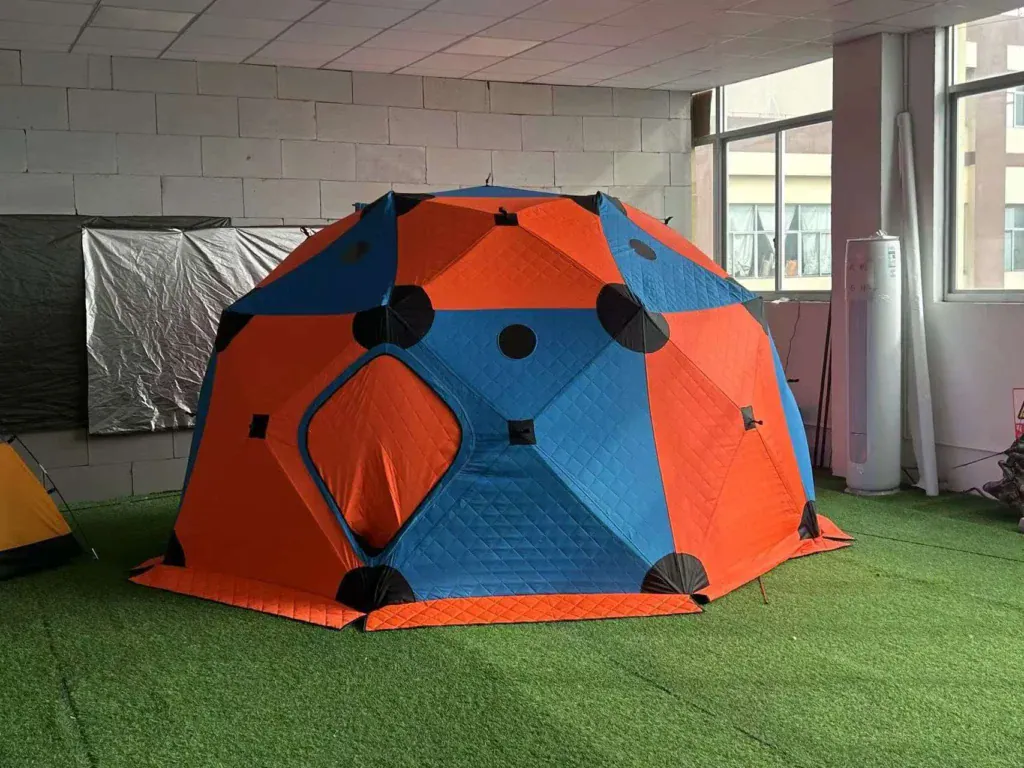
Family camping tents from Kelyland Outdoors’ partner factories in Ningbo and Shaoxing are routinely tested to EN 13573 before shipment to EU buyers. The glamping tent factory in Shaoxing — established in 2019 with an annual capacity of 300,000 units — produces bell tents and yurt-style shelters that must pass these same wind and water tests before receiving CE certification. For inflatable beam models specifically, the frame material (PVC or TPU-coated fabric) must also demonstrate air retention over a minimum period defined in the standard’s annex.
EN 14960:2019 – Inflatable amusement equipment
EN 14960:2019 was written for bounce houses, not camping tents — but retailers now demand it for large inflatable shelters.
If your supplier offers you an EN 14960 certificate for a glamping tent, ask why. This standard was drafted for inflatable amusement equipment — the kind kids jump on at fairs and festivals. Its scope covers play structures where impact attenuation and child safety dominate the test regime. That does not mean it is irrelevant to tents.
What EN 14960 actually tests
Os testes fundamentais são carga estática (a estrutura deve suportar 4 vezes o peso recomendado pelo fabricante sem entrar em colapso), retenção de ar (a queda de pressão deve permanecer abaixo de 15% durante um período determinado) e amortecimento de impacto (a superfície deve amortecer uma queda de alturas definidas). Isso faz sentido para um castelo inflável. Para uma tenda de glamping com vigas infláveis, o requisito de retenção de ar é o que importa — e é mais rigoroso do que o exigido pela EN 13573.
-
- Teste de carga estática: A EN 14960 exige que a estrutura inflada suporte 4 vezes o peso nominal dos usuários sem ruptura ou colapso. Para uma cúpula festiva com capacidade para 20 pessoas, isso significa suportar cerca de 2.400 kg distribuídos uniformemente sobre a área do piso.
- Air retention test: A perda de pressão não deve exceder 15% após um período determinado (normalmente 30 minutos). Tecidos híbridos de PVC/TPU têm dificuldade nesse quesito se a soldagem das costuras for inconsistente — e é exatamente onde muitos produtos infláveis de fabricação chinesa falham nos testes realizados por organismos notificados.
- Amortecimento de impacto: “Os valores do ”critério de lesão cefálica” (HIC) devem permanecer abaixo de um limite estabelecido. Isso se aplica a superfícies de salto, não a pisos de tendas, portanto raramente afeta abrigos de camping, a menos que funcionem também como áreas de recreação.
Onde a EN 14960 é mal aplicada
“Pesquisas por ”requisitos de marcação CE tenda de camping inflável” frequentemente retornam a norma EN 14960 porque os laboratórios de ensaio a oferecem como opção genérica para qualquer estrutura inflável. O problema: a EN 14960 não avalia resistência ao vento, impermeabilidade ou resistência das costuras — três fatores decisivos quando seu cliente passa a noite dentro dessa tenda. Uma tenda de sino com vigas infláveis que seja aprovada na EN 14960 ainda pode falhar catastróficamente diante de uma rajada de vento, já que a norma nunca verifica cargas laterais do vento.
“Ensaios por organismo notificado de estrutura inflável na UE” — o que esperar
“Pesquisas por ”ensaios por organismo notificado de estrutura inflável na UE” geralmente direcionam compradores a TÜV Rheinland, SGS ou Bureau Veritas. Esses laboratórios testarão conforme a EN 14960 se você solicitá-la, mas também sinalizarão lacunas se seu produto claramente funciona como abrigo e não como equipamento de entretenimento. Alguns organismos notificados já oferecem avaliações combinadas que abrangem ambas as normas em uma única sessão — isso economiza semanas de idas e vindas quando seu produto se situa nessa zona cinzenta.
Side-by-side comparison table
EN 13573 tests for shelter safety; EN 14960 tests for structural air integrity.
Most supply chain managers assume one CE standard covers all inflatable tents. That assumption costs time and money. EN 13573:2012 applies to camping tents used for sleeping and shelter — think family dome tents or glamping bell tents with inflatable beams. EN 14960:2019 covers inflatable amusement equipment — bouncy castles, event domes, and large party shelters where occupants are active rather than resting.
Test parameters that separate the two standards
-
- Wind resistance: EN 13573 requires a static wind load test simulating forces up to Force 8 on the Beaufort scale (approximately 62–74 km/h). EN 14960 does not mandate wind testing as a primary pass criterion.
- Resistência das costuras: EN 13573 specifies a minimum seam tensile strength of 150 N per 50 mm width for main structural seams. EN 14960 focuses on welded joint integrity under continuous inflation pressure rather than fabric seam pull.
- Air retention: EN 14960 enforces a strict air retention test: after reaching working pressure, the structure must hold above 80% of that pressure for at least one hour without pump intervention. EN 13573 has no equivalent air-retention requirement — it assumes constant inflation from an attached blower.
- Static load (occupant simulation): EN 14960 applies a distributed static load of up to three times the maximum user weight per anchoring point. EN 13573 tests only the floor structure for a uniform load of approximately 1.5 kN/m², reflecting sleeping occupants rather than jumping or bouncing.
Pass criteria and notified body involvement
Gray areas: glamping tents and large shelters
A 6-meter glamping bell tent with inflatable beams can legally fall under either standard — the notified body decides based on intended.
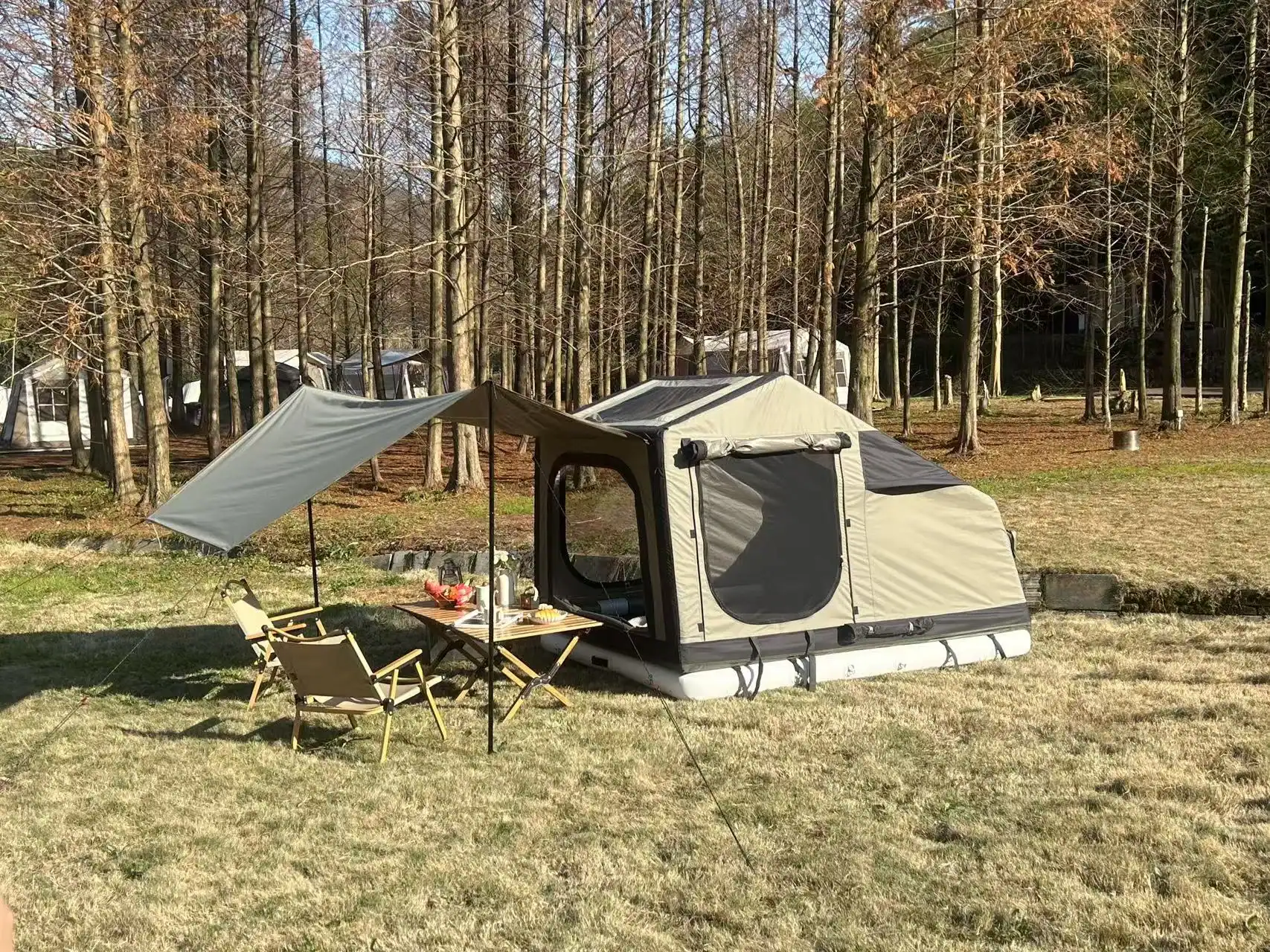
This is where the certification process gets messy. A glamping tent with inflatable beams sits at the intersection of two standards. EN 13573 treats it as shelter for sleeping. EN 14960 treats it as an inflatable structure subject to amusement-equipment loads. The notified body makes the final call based on the declared use, and different bodies in different EU member states sometimes reach opposite conclusions.When both standards may applyThe gray zone opens when a product exceeds roughly 20 square meters of floor area or uses inflatable columns as primary structural supports rather than traditional poles. A shipment was held at Rotterdam because the buyer’s legal team decided the product was an ‘inflatable structure’ under local building codes — even though the same model had cleared customs six months earlier under EN 13573. Some European retailers now require both standards for large inflatable shelters, citing liability concerns.The air retention test is the main friction point. EN 14960 demands a stricter pressure-hold threshold than EN 13573, which becomes a real challenge for PVC-TPU hybrid fabrics where seam welding consistency varies across production batches. One supplier audited by a third party lost six weeks re-engineering their heat-seal parameters because their initial samples bled pressure below the EN 14960 threshold.How to get a single assessment covering bothThe smart play is a pre-compliance gap analysis before you commit to mass production tooling. Send your design drawings and material specs to a notified body that handles both standards — TÜV Rheinland and SGS both offer combined assessments. They will identify which tests overlap (wind resistance, seam strength) and which ones are unique to each standard.A single assessment covering both standards typically adds about three weeks to the timeline but saves four to six weeks versus running separate tests after discovering a gap mid-production. Kelyland Outdoors coordinates this step through its partner factories in Shaoxing and Ningbo, where CE-certified glamping tent lines already carry ISO 9001:2015 protocols that align with both EN frameworks.
Practical advice for buyers
A certificate without a test report is just a piece of paper.
Most suppliers will send you a PDF of their CE certificate when you ask about compliance. That certificate tells you the product was tested against a standard — but it doesn’t tell you the results. A certificate is a summary. A full test report is the evidence. For EN 13573 and EN 14960, the difference matters because each standard has multiple sub-tests, and passing one does not guarantee passing all.Questions to ask before accepting any certificate
- Which standard was tested?: Ask for the exact standard number and year — EN 13573:2012 or EN 14960:2019. Some suppliers list “CE certified” without specifying which standard applies to your product type.
- Was it tested by a notified body?: EN 14960 requires testing by an EU-notified body (e.g., TÜV, SGS, Bureau Veritas). EN 13573 can be self-declared or third-party. If your retailer demands notified body involvement, confirm the lab’s status.
- Which specific tests were passed?: “CE certified for inflatable tents” is vague. Ask whether wind resistance, air retention, seam strength, and static load were all tested individually. For glamping tents with inflatable beams, request the air retention test data specifically.
- What were the actual pass/fail values?: A full report includes measured pressure drop over time (EN 14960 requires less than 25% loss over 30 minutes), seam tensile strength in Newtons, and wind speed thresholds. Without these numbers, you cannot verify if the design margin meets your market requirements.
Certificate vs. full test report: what to requestA CE certificate typically shows the product name, model number, standard reference, and issue date. A full test report runs 10-30 pages and includes photographs of the setup, raw data tables, pass/fail criteria for each clause, and the laboratory’s scope of accreditation. When evaluating a supplier for inflatable tent certification under EN 13573 or EN 14960, always request both documents.The factory network that Kelyland Outdoors works with holds ISO 9001:2015 certification across its core partner facilities — including those producing camping tents in Ningbo (800,000 units annually) and glamping tents in Shaoxing (300,000 units annually). When we evaluate an inflatable tent project for European market entry, we coordinate directly with these factories to obtain pre-compliance test data from their internal quality labs before sending samples to an EU-notified body.One practical benchmark: if a supplier cannot produce a full test report within two weeks of your request — or if they offer only a photocopy of someone else’s certificate — that is a red flag. The cost of re-testing after production can delay your launch by six weeks or more. Pre-assessment with a notified body before mass production saves that timeline.How Kelyland Outdoors handles standard selection
A pre-assessment with a notified body can save 4-6 weeks of re-testing for hybrid structures.
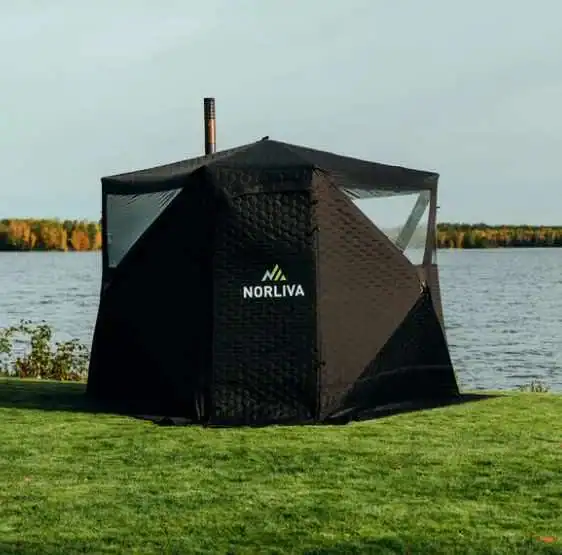
As tendas para glamping com vigas infláveis — tipo tenda de sino, iurte ou grandes abrigos estilo safari — encontram-se em uma zona cinzenta regulatória. A EN 13573 trata-as como tendas de camping. A EN 14960 as considera equipamentos de entretenimento. Nenhuma das normas foi escrita para essa categoria híbrida, e escolher a norma errada significa que sua marcação CE pode não se sustentar quando um varejista exigir o relatório de ensaios.Quando ambas as normas se aplicamUma tenda vendida para dormir e abrigo está sujeita à EN 13573. Mas, se a estrutura exceder determinado tamanho ou for comercializada para eventos em que as pessoas fiquem de pé, caminhem ou saltem dentro dela, alguns varejistas europeus agora exigem também a conformidade com a EN 14960. O ensaio de retenção de ar na EN 14960 é mais rigoroso — mede a decaimento da pressão ao longo do tempo em uma pressão inicial superior à exigida pela EN 13573. Materiais híbridos de PVC-TPU frequentemente falham nesse ensaio porque as zonas de solda escapam ar sob carga sustentada.Como obter uma única avaliação abrangendo ambas normasO caminho mais eficiente é uma avaliação combinada com um único organismo notificado que trate das duas normas. A Kelyland Outdoors coordena isso diretamente com suas fábricas parceiras — a fábrica de tendas para glamping em Shaoxing (certificada ISO 9001) realiza verificações pré-compatibilidade de retenção de ar e resistência das costuras antes de enviar as amostras ao laboratório de ensaios na UE. Isso detecta falhas de solda antecipadamente, quando o reparo leva dias em vez de semanas.ConclusãoA lacuna entre a EN 13573 e a EN 14960 não é apenas uma distinção burocrática. Ela determina quais ensaios sua tenda inflável deve superar — resistência ao vento a 28 m/s para camping, ou carga estática de 500 kg por metro quadrado para estruturas de entretenimento. Escolher a norma errada faz com que seu lote seja retido na alfândega ou rejeitado pelo varejista.
- A EN 13573 aplica-se a tendas usadas para dormir e como abrigo.
- A EN 14960 cobre estruturas infláveis para brincadeiras ou eventos.
- As tendas para glamping com vigas infláveis frequentemente ficam numa zona cinzenta.
- Uma pré-avaliação com um organismo notificado pode economizar de quatro a seis semanas.
Para gestores da cadeia de suprimentos, é aqui que os últimos dez por cento do devido diligence separam um lançamento tranquilo de um ciclo de reensaios dispendioso. Revise a ficha técnica atual do seu produto em relação aos parâmetros de ensaio descritos acima — em especial os requisitos de retenção de arpara híbridos de PVC-TPU, caso esteja a adquirir abrigos de grande dimensão. Se o fornecedor não conseguir produzir um relatório de ensaio emitido por um organismo notificado da UE que corresponda à classificação pretendida para o seu mercado, conteste antes que a aprovação da amostra defina o tooling de produção.Perguntas Frequentes
Qual norma CE se aplica a tendas infláveis?
A EN 13573 é a norma correta para tendas de camping infláveis usadas para dormir e abrigo. A EN 14960 aplica-se a equipamentos infláveis de entretenimento, como casas saltadoras, não a tendas. Verifique sempre qual norma o seu fornecedor utiliza nos ensaios antes de efetuar o pedido.
O que a EN 13573 ensaia?
A EN 13573 ensaia a resistência ao vento, a penetração de água e a resistência das costuras em abrigos de camping. Garante que a tenda é segura para dormir e para exposição às intempéries. Solicite um relatório de ensaio completo, e não apenas um certificado.
Can EN 14960 be used for glamping tents?
EN 14960 is designed for play equipment, but some retailers may request it for large event domes. For glamping tents used as shelters, EN 13573 is the appropriate standard. Confirm intended use with your buyer before selecting a standard.
How do I confirm my supplier’s CE certification?
Ask for the specific standard number (EN 13573 or EN 14960) and a full test report from a notified body. A generic CE certificate without the standard reference may not cover. Insist on seeing the test parameters that match your tent design.

 English
 Español
 Deutsch
 Français
 Português do Brasil
 Русский
 العربية
 한국어
 日本語