 跳到内容
跳到内容 
folding wagon shipping costs frame is the first checkpoint buyers should lock before they approve a supplier, budget, or production slot. Folding Wagon Shipping Costs: Frame Material Impact is the first checkpoint buyers should lock before they approve a supplier, budget, or production slot. Most sourcing guides tell you to compare three supplier quotes before you lock in a folding wagon shipping cost. That advice misses the variable that actually drives your freight budget: the frame material and the packed carton weight, not the unit price on the quotation.
Run the math yourself before asking for quotes. Get the gross weight per packed carton, ask for the container loading diagram, and compare FOB pricing plus your own freight rates instead of defaulting to DDP with the supplier’s risk margin baked in. On a 40HQ, steel-frame wagons often hit the 22-ton road weight limit before the container cubes out, so the limiting factor is mass, not volume. Aluminum frames, being roughly 30% lighter, open up 35-40% cheaper air freight and express scenarios if you ever need to split shipments. Also set a quality tolerance for packed weight in the purchase agreement so the carton weight can’t drift after sample approval. That one decision may be the difference between a defensible стоимость земли and a margin surprise.
Why Frame Material Changes Your Freight Quote
Frame choice changes freight math twice: chargeable weight and how many units fit before hitting road limits.
Two nearly identical складных тележек can generate different freight quotes even from the same supplier. The variable is frame material. A typical mid-size steel-frame wagon specs around 22kg net; the same wagon with an aluminum frame drops to roughly 14kg. That 8kg difference per unit is what separates an air-freight budget from a red-line overage. Always model with the packed carton gross weight, not the frame net weight.
Weight Comparison: 14kg Aluminum vs 22kg Steel Wagon
Kelyland’s folding wagon partner factory in Jinhua, with 1,000,000 units of annual capacity under ISO 9001, builds wagons from powder-coated carbon steel or aluminum frames with 600D-900D double-layer Oxford fabric and PP or MDF baseboards. The same carton volume carries a heavier product when steel is specified. For a 1,000-unit order, that is 8,000kg more cargo. Ask for the per-carton gross weight before comparing quotes; the difference changes not only the складной вагон freight cost per unit but also whether the shipment fits road limits.
-
- Steel frame: Net weight around 22kg per wagon. Use the supplier’s packed carton gross weight for the freight model, not the bare frame number.
- Aluminum frame: Net weight around 14kg per wagon. Packed gross weight sits roughly 30% lower, which directly cuts per-unit freight on weight-based lanes.
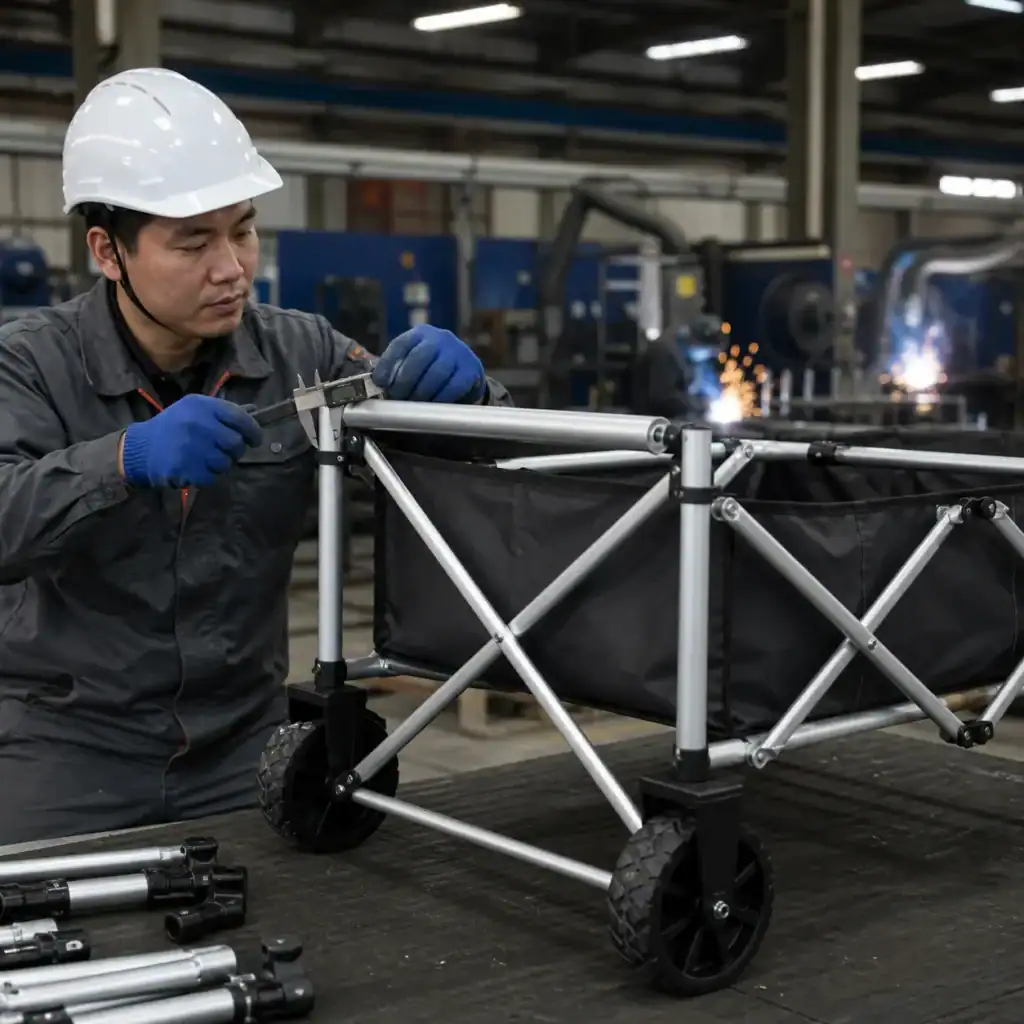
Dimensional Weight vs Actual Weight: The Impact
Ocean freight mostly charges by volume, but air and express carriers charge whichever is higher: actual weight or dimensional weight. Dimensional weight comes from carton length × width × height ÷ 5,000 (cm³/kg). A складной вагон carton is bulky, so dimensional weight often dominates. When that happens, frame material seems irrelevant. But when the wagon is heavy enough to make actual weight the chargeable weight, the aluminum wagon’s 8kg advantage delivers 35-40% lower air quotes.
Container Loading Basics
A 40HQ container typically holds 600-800 складных тележек depending on carton size and stacking pattern. Volume is never the only constraint. With 22kg steel frames, the cargo gross weight approaches the 22-ton road weight limit as you push toward 700 units, even though cube remains. Aluminum frames let you load to the volume ceiling, spreading the container and inland freight across more units and lowering the folding wagon shipping cost per unit.
| Фактор | Steel Frame Wagon | Aluminum Frame Wagon | Impact on Freight Quote |
|---|---|---|---|
| Typical Frame Weight | 22 kg per wagon | 14 kg per wagon | Aluminum is about 36% lighter, lowering chargeable weight for every shipment mode. |
| Packed Carton Gross Weight | 25–27 kg with carton and accessories | 17–19 kg with carton and accessories | Складная тележка gross weight packed carton drives ocean, air, and inland trucking calculations. |
| 40HQ Container Capacity | Weight-limited before the container is volume-full | Volume-limited, allowing more units per container | Steel raises the folding wagon freight cost per unit despite similar carton volume. |
| Air Freight and Express | Charged on high actual weight, increasing cost | 35–40% cheaper for air freight and express | Favorable for folding wagon dimensional weight air freight scenarios. |
| Road Weight Limits | Hits the 22-ton trucking limit sooner | More wagons fit per legal truckload | Aluminum lowers inland drayage and trucking cost per unit. |
| Landed Cost from China | Lower FOB price, higher freight per unit | Higher FOB price, lower freight per unit | Model the full folding wagon landed cost from China before PO placement. |
| FOB vs DDP Quote Strategy | DDP suppliers add risk margins on heavy loads | FOB pricing with your own forwarder stays transparent | Avoid DDP quotes that can double the folding wagon shipping cost. |
Step-by-Step Guide to Calculating Landed Cost
Frame weight changes container loading, per-unit freight, and dimensional weight.
Five numbers drive a folding wagon landed cost model: packed carton dimensions, gross weight, container capacity, freight rate, and duty rate. Get one wrong by 10% and the per-unit cost shifts enough to erase margin on an 800-unit order. The steps below follow the same sequence your forwarder uses when building the quote.
Step 1: Get Packed Carton Dimensions from Your Supplier
Suppliers quote product dimensions, not shipping dimensions. The фабрика складных тележек in Jinhua, ISO 9001 certified with an annual capacity of 1,000,000 units, packs each wagon in a carton that runs larger and heavier than the brochure suggests. Ask for outer carton L x W x H and gross weight per carton. If the answer is approximate, red-flag the quote.
-
- Packed carton dimensions (L x W x H): The volume the forwarder uses for container stuffing and dimensional weight billing.
- Gross weight per carton: Includes product, packaging, and inserts. Not the net product weight.
- Loading orientation: Whether cartons can be turned sideways changes how many fit in a row across the container.
- Cartons per pallet: Affects total volume and weight if your forwarder palletizes the load.

Step 2: Calculate Units per 40HQ Container
A 40HQ container offers roughly 68 cubic meters of usable space. Folding wagons typically fill 600-800 units before hitting a constraint. With 22kg steel frames, the gross weight approaches the 22-ton road limit while the container is still underfilled. Aluminum frames at around 14kg avoid that ceiling, letting you load closer to the volume capacity.
Step 3: Add Sea Freight Cost per Unit
Divide the full freight quote by the loadable units. On a $4,000 40HQ to the US West Coast, 700 steel wagons work out to $5.71 per unit in sea freight. The same container stacking 780 aluminum wagons drops that to $5.13 per unit. Frame material shifts per-unit freight by roughly 10% without the supplier changing anything else.
DDP quotes from suppliers often embed a risk margin that doubles the freight component. Request FOB pricing and source commodity freight rates through your own forwarder. The pricing becomes auditable, and your landed cost model holds up to internal review.
Step 4: Compare Air Freight and Express Options
Air freight and express bill on the greater of actual weight or volumetric weight. A 22kg steel wagon charges at 22kg every time. An aluminum wagon at 14kg charges at 14kg. The gap compounds across hundreds of units, making aluminum frame shipments roughly 35-40% cheaper for air and express scenarios.
Step 5: Add Customs Duty, VAT and Broker Fees
The freight quote is not the landed cost. Apply the import duty rate for the складной вагон HS classification, add VAT or its equivalent for the destination, and include the broker fee. Kelyland includes export paperwork and customs guidance as part of the process, which removes the missing-document risk. Run the final calculation with your broker before signing the purchase order.
| Шаг | What to Do | Key Data Required | Output / Purpose |
|---|---|---|---|
| Step 1: Get Packed Carton Dimensions from Your Supplier | Request exact packed carton length, width, height, and folding wagon gross weight packed carton for both steel and aluminum frame versions | Carton dimensions, gross weight per carton, units per carton, carton packing diagram | Establishes the baseline for container loading math and avoids using unfolded dimensions that ruin freight quotes |
| 2: Calculate Units per 40HQ Container | Convert the 40HQ container’s usable volume (approx. 68-70 CBM) and payload into a maximum unit count; verify whether volume or weight limits bind first | стоимость перевозки контейнера 40HQ folding wagon capacity, carton CBM, total gross weight, pallet configuration | Determines how many units ship per container, revealing whether steel wagons hit the weight ceiling before filling the box |
| 3: Add Sea Freight Cost per Unit | Divide the all-in FOB-to-destination ocean freight quote (including forwarder fees, port charges, and fuel surcharges) by the number of units per container | складной вагон freight cost per unit, commodity freight rate, FOB vs DDP folding wagon quotes | Calculates the per-unit ocean freight component for steel vs aluminum frame wagon shipping comparisons |
| 4: Compare Air Freight and Express Options | Calculate dimensional weight (L x W x H / 6000) and compare it against actual gross weight; chargeable weight is the higher value, then multiply by air or express rate | Folding wagon dimensional weight air freight, actual gross weight, air/express rate per kg, delivery speed requirements | Quantifies the 35-40% air freight savings typical with lighter aluminum-frame wagons when urgent replenishment is needed |
| 5: Add Customs Duty, VAT and Broker Fees | Confirm the folding wagon import duty HS code (typically 8716.80 for wagons), apply the destination country duty and VAT rates, and add customs broker and clearance fees | Folding wagon import duty HS code, insurance value, VAT rate, broker charges, compliance documents | Produces the true folding wagon landed cost from China, giving цепочка поставок managers an auditable, PO-ready cost model |
| Bonus Check: Validate Road Weight Limits | Confirm the loaded container’s gross weight stays under destination road limits (e.g., 22-ton legal truck/container limits in the US) before finalizing the loading plan | Container tare weight, cargo gross weight, chassis/truck legal limits, weighbridge certificates | Prevents overweight penalties and forced unloading, a critical risk when shipping 22kg steel-frame wagons at full volume |
Container Loading Comparison: Steel vs Aluminum Frames
Steel wagons hit road weight limits before 40HQ volume fills.
A 40HQ container offers roughly 76 cubic meters of space and a payload ceiling of 26,500 kg for sea freight. Folding wagons rarely fill that box by volume alone. With a typical packed carton measuring 60 x 40 x 25 cm and a steel-frame wagon at 22 kg net weight, you reach the road weight limit before you reach the container’s volume capacity. That distinction matters when you model freight per unit.
Steel Frame Wagon Loading Estimates per 40HQ
Assume each steel-frame wagon ships in a carton with a gross weight of 23 kg including packaging. A 40HQ’s 26,500 kg payload allows roughly 1,150 units by weight. Carton volume of 0.06 cubic meters allows 1,266 units by volume. But the legal road weight limit for most US and EU trucking corridors is 22,000 kg or lower. That caps you near 950 units. In practice, the safe loading figure lands between 700 and 800 units because pallet weight, dunnage, and axle distribution reduce usable payload.
Aluminum Frame Wagon Loading Estimates per 40HQ
Aluminum-frame wagons come in around 14 kg net weight, a 30% reduction. A packed carton with an aluminum wagon carries a gross weight of roughly 15 kg. On the same 22-ton road limit, you can load about 1,400 units by weight. Volume becomes the binding constraint. The same 0.06 cubic meter carton maxes out around 1,266 units. That means a full 40HQ of aluminum wagons holds roughly 40% more units than a steel load. Your folding wagon freight cost per unit drops by the same margin.

Road Weight Limits That Shorten Your Load
The 22-ton limit is not a container limit. It is a highway regulation set by national and state transport authorities. A 40HQ container weighs about 3,800 kg empty. Add 22,000 kg of cargo and your rig grosses out near the legal maximum. Exceeding it means fines, offloading delays, or a second partial shipment. Most freight forwarders build in a 5% safety buffer against scale tickets, which pulls your usable payload down further.
-
- Pallet weight: A standard wood pallet adds 20-25 kg. Twenty pallets add 500 kg to the shipment. That is roughly 25 fewer wagons on a steel load.
- Сертификат фумигации: Pallets must be ISPM-15 certified. Missing the stamp means customs holds the container until treatment or replacement, which adds days and storage fees.
- Axle distribution: A load can meet gross weight yet exceed axle limits. Skewed stacking forces rework or a lighter container.
The folding wagon factory in Jinhua that Kelyland Outdoors works with produces 1,000,000 units annually and holds CE and ISO 9001 certifications. When you request a container loading diagram, ask for the gross weight per carton in writing, not just the frame weight. That single number determines whether you book a full 40HQ or discover the load only reaches 700 units.
| Метрика | Steel Frame | Aluminum Frame | Impact for Sourcing |
|---|---|---|---|
| Frame Weight (Net) | ~22 kg per wagon | ~14 kg per wagon (~36% lighter) | Lighter frame reduces chargeable weight in every shipping mode |
| Packed Carton Gross Weight | ~23–25 kg per carton | ~15–17 kg per carton | Always quote gross weight, not net weight, for accurate freight |
| 40HQ Container Capacity | ~600–700 units (weight-limited before volume is full) | ~700–800 units (volume-limited within legal road weight) | Steel typically hits the 22-ton road limit before the container is physically full |
| Primary Loading Constraint | Road weight limit (~22 metric tons gross) | Container volume (~68 CBM usable in 40HQ) | Aluminum allows better use of container volume and more units per shipment |
| Sea Freight Cost per Unit | Higher—total freight is spread over fewer units | Lower—more units share the same container cost | Frame choice directly changes folding wagon freight cost per unit |
| Air Freight / Express Cost | Higher chargeable weight, larger bill | ~35–40% cheaper per unit for air and express lanes | Aluminum is strongly preferred for urgent, small-batch or DDP e-commerce shipments |
| Landed Cost Efficiency | Better for short-haul, volume-limited or palletized retail orders | Better for long-haul, weight-sensitive and mixed-SKU containers | Run a per-unit landed cost model before choosing frame material for your PO |
Worked Example: Shipping 800 Folding Wagons to the US West Coast
At 800 wagons, steel maxes the road weight limit before the container is full.
Run the example with a real supplier context. Kelyland’s folding линейки Jinhua wagon comes out of Jinhua, Zhejiang, where partner factories hold ISO 9001:2015 certification and produce around 1,000,000 wagons per year. The two specs under comparison: a 22kg steel-frame wagon and a 14kg aluminum-frame wagon, both with powder-coated frames and 600D double-layer Oxford fabric. Both ship FOB Ningbo/Shanghai to Los Angeles or Long Beach.
Steel Frame Scenario: Freight Cost per Unit
Eight hundred steel wagons at 22kg net each is 17.6t of cargo before packaging. Add cartons, the PP baseboard, and pallet weight, and total loaded weight pushes the 22-ton road weight limit. The container has more cube, but you cannot use it. At a $2,500 all-in 40HQ spot rate to the US West Coast, freight lands at $3.13 per unit if all 800 fit. If the packer adds too much weight and the trucker flags the chassis, you drop to 750 units and the rate climbs to $3.33.
Aluminum Frame Scenario: Freight Cost per Unit
Aluminum cuts the frame to 14kg, a 36% weight reduction. Eight hundred wagons become 11.2t of cargo — about 6.4t lighter before packaging. The load is cube-limited now, not weight-limited. The same $2,500 freight bill spread over 800 units comes to $3.13 per unit, with no overweight surcharge and no argument about chassis ratings at pickup.
Landed Cost Comparison and Break-Even Analysis
-
- Ocean freight delta: Steel costs $3.13-$3.33 per unit in sea freight versus $3.13 for aluminum. The saving is roughly $0.20 per unit or less — too small to justify a frame upgrade on the container rate alone.
- Air and express delta: For small-batch launches in the 50-100 unit MOQ band, actual weight drops from 2.2t to 1.4t. At typical air cargo rates in the $5-7/kg range, that saves $4,000-$5,600 per shipment, or $40-$56 per unit — a 35-40% freight reduction.
- Break-even rule: If the aluminum frame’s ex-works premium is smaller than the air-freight saving per unit, the lighter wagon pays for itself in one shipment. For pure ocean programs, the premium is recovered through handling weight limits, not freight economics.
Model this with FOB pricing plus commodity freight rates from your own forwarder. Buyers who request DDP quotes often see the freight line doubled because suppliers embed risk margins. FOB numbers let you run the same math against actual rates and keep control of the break-even.
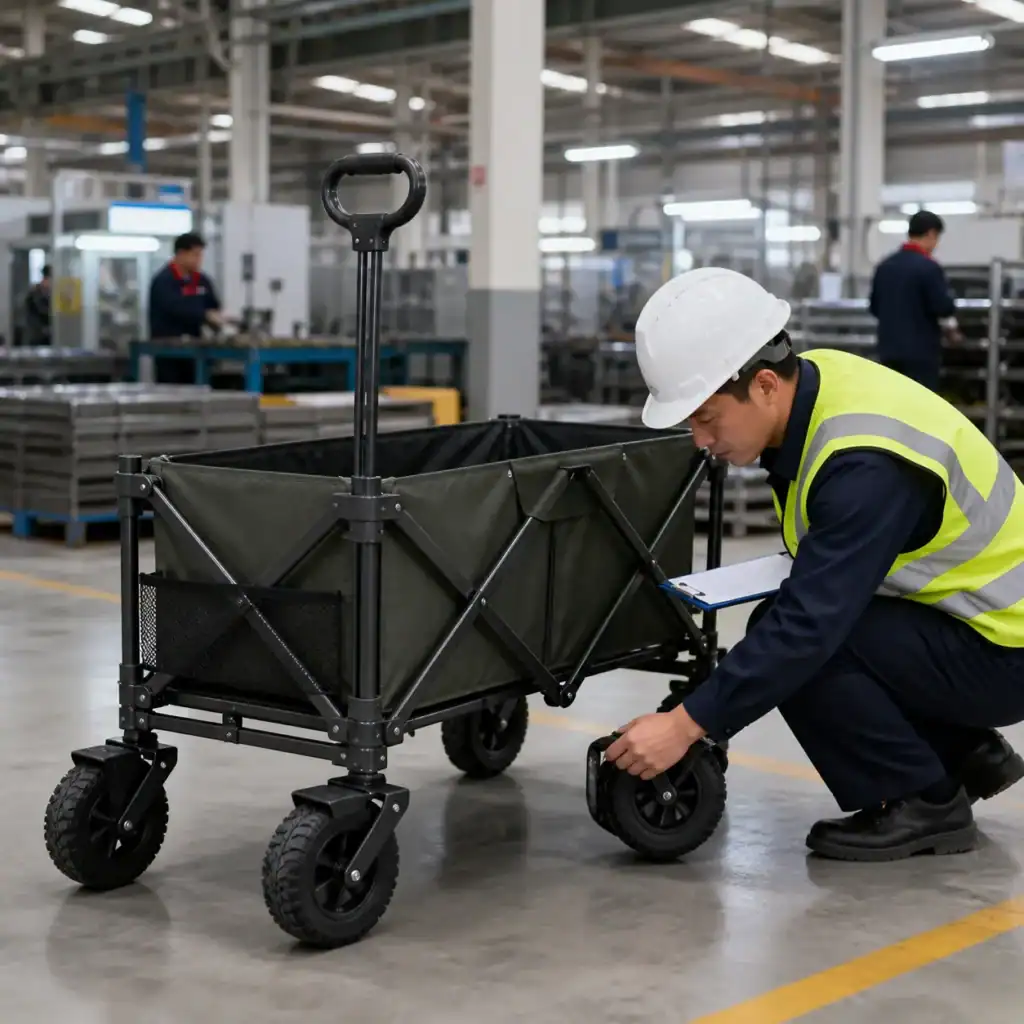
4 Common Freight Calculation Mistakes
Most freight overruns on folding wagons trace back to booking-form errors, not rate increases.
Freight overruns on folding wagon imports rarely come from rate changes. They come from incorrect inputs on the booking form. A supplier quotes a carton volume based on the unfolded product, you assume net weight is enough, and the forwarder recalculates at the last mile. By then the PO is in motion and the extra charge is on your side.
Using Unfolded Dimensions Instead of Packing Size
Most folding wagon listings show assembled dimensions because that is what the end customer sees. Freight runs on the packed carton. If the supplier sends a спецификации with the wagon unfolded, the cubic meters can be overstated significantly. Get the carton dimensions in writing after sample approval, and confirm whether that measurement includes handles, wheels, and accessories.
Quoting Net Weight Instead of Gross Weight
Net weight is the wagon alone. Gross weight includes the carton, inner packing, straps, and accessories. For a 22 kg steel-frame wagon, a full 40HQ load of steel units can hit the 22-ton road weight limit while the container still has cube to spare. Carriers bill on the higher of actual or volumetric weight, so quoting only net weight sets up a repriced shipment at the terminal. For steel vs aluminum frame wagon shipping, this is the main reason steel units surprise you at invoice time.
Ignoring Pallet Weight and Configuration
Wood pallets bring tare weight and take up cube. A palletized load with overhanging or misaligned cartons wastes space and can trigger handling surcharges on either end of the journey. The fix is a palletization diagram before booking. Ask the supplier to specify cartons per pallet, pallet dimensions, and total pallet count, and put that data in the shipping document set.

Forgetting Fumigation Certificates for Wood Pallets
Solid wood pallets usually require ISPM 15 treatment and a certificate. Ship without it, and the container can sit at the destination port while the pallets are treated or replaced. That delay eats demurrage and misses the selling season. Specify fumigated or plastic pallets in the purchase order, and ask the forwarder to verify the certificate before the container is sealed.
-
- Packed carton dimensions: L x W x H in centimeters, with accessories included, not the unfolded product spec.
- Gross weight per carton: The number the terminal scale will actually register, not the product weight on your marketing page.
- Pallet plan: Cartons per pallet, pallet weight, and a loading diagram that avoids overhang.
- Сертификат фумигации: ISPM 15 document if wood pallets are used, confirmed before the container is loaded.
Suppliers with a documented inspection process—like the ISO 9001:2015 partner factories used by Kelyland Outdoors—should be able to share this data before mass production. If they hesitate, treat that as a warning. A freight quote is a logistics document, not a sales estimate.
Questions to Ask Your Supplier for a Realistic Freight Quote
Ask for the loading diagram, not just a container number.
Most freight quotes fall apart because the buyer asked for a unit price instead of the data behind it. Before you commit to a purchase order, put these three questions to the supplier and get answers in writing.
Packed Carton Dimensions and Gross Weight
Ask for the master carton dimensions and gross weight, not the product dimensions or net weight. A folding wagon with 600D-900D double-layer Oxford fabric and a powder-coated steel frame may look compact when folded, but the packed carton includes the frame, fabric, wheels, straps, inner padding, and the carton itself. That gross weight is what the freight forwarder uses to calculate both sea freight and trucking limits.
For a 22kg steel-frame wagon, the math gets tight quickly. A 40HQ container can typically hold 600-800 folding wagons, but with 22kg steel frames, the gross weight often hits the 22-ton road weight limit before the container reaches full volume capacity. If the supplier gives you only net weight, you cannot model that constraint. Get the exact packed carton weight and the number of cartons per pallet.
Container Loading Diagram or Loading Guide
A credible supplier can hand over a loading diagram, not just a container count. The diagram should show how many cartons fit along the length, width, and height of a 40HQ, and how many pallets fit on the floor. That document becomes the basis for your folding wagon freight cost per unit.
Kelyland’s core folding wagon factory in Jinhua runs ISO 9001:2015 and holds an annual production capacity of 1 million units. A factory at that scale is expected to have a verified loading plan based on actual carton dimensions. If a supplier hesitates or sends a vague estimate instead of a dimension-based plan, treat it as a red flag.

Options for Mixed-Material or Mixed-Model Shipments
If your order combines steel-frame and aluminum-frame wagons, ask how the supplier staggers the mixed load. Aluminum frames are roughly 30% lighter than steel frames, which can keep you under the road weight limit while filling the cube. But if the supplier simply packs by model without a weight plan, you lose container capacity and may end up paying for a second shipment.
Also ask how mixed models are distributed inside the container. Steel wagons should sit on the bottom, aluminum wagons on top, and cartons with different heights need a stepped loading pattern. A sourcing partner with multiple factories can consolidate these loads, but the plan must be confirmed before production starts, not after the container door closes.
Заключение
The freight math for folding wagons comes down to three inputs: packed carton dimensions, gross weight, and frame material. A 22kg steel frame can push a 40HQ to the 22-ton road weight limit before the volume is full, while a 14kg aluminum frame keeps air freight and express delivery within budget. Frame choice is not just a product spec — it is the single largest variable in your per-unit freight cost.
-
- A 40HQ container usually holds 600-800 folding wagons, but steel-frame models hit the 22-ton road limit first.
- At 14kg, aluminum frames run about 30% lighter than 22kg steel frames, making air freight 35-40% cheaper.
- Ask for packed carton dimensions and gross weight so dimensional weight charges do not surface after booking.
- FOB pricing with your own forwarder typically beats DDP quotes, where suppliers build in risk margins.
Before you place the next purchase order, ask your supplier for a container loading diagram and a per-unit freight breakdown across steel and aluminum frame options. If your target market depends on air freight or express fulfillment, the 14kg aluminum frame protects your margin in ways a steel frame cannot. Review the складной wagon specifications on the Kelyland Outdoors product page and request a container loading plan from the sourcing team before you finalize the PO.
Часто задаваемые вопросы
How does frame material affect shipping cost?
Steel frame wagons cost more to ship because they hit weight limits faster, while aluminum frames add less freight per unit. The deciding factor is packed carton gross weight and dimensions, not the frame alone. Get packed carton specs before comparing quotes.
What is dimensional weight for folding wagon shipping?
Dimensional weight is the freight charge based on carton volume, not physical weight. Folding wagons are bulky, so carriers often bill by dimensional weight even when actual weight is lower. Confirm the chargeable weight basis with your forwarder.
How many folding wagons fit in a 40HQ?
The number depends on packed carton height and pallet configuration. Steel wagons usually fill a 40HQ by weight before volume, so calculate units per container from the supplier’s loading diagram. Ask for a container loading plan, not just a unit count.
What should be included in landed cost?
Landed cost includes sea freight, customs duty, VAT, broker fees, and inland haulage on top of the unit price. For US imports, also add port handling and any additional tariffs that apply to your. Build the full cost chain before negotiating terms.
Why do steel wagons hit weight limits before 40HQ fills?
Because a 40HQ has a max payload around 26-28 metric tons, and steel wagon frames often exceed that before the container is full. That is why heavy wagons require fewer units per load and. Confirm the max payload with your freight forwarder.

 English
  Español
  Deutsch
  Français
  Português do Brasil
  Русский
  العربية
  한국어
한국어  日本語
日本語