 跳到内容
跳到内容 
A folding wagon wheel lock fix rarely begins in a customer’s garage. It begins with the operator on the brake assembly line, who hears the difference between a clean catch and a soft click long before any sales call happens. The buyer who got burned on a $50,000 order approved a pre-production sample that locked with a satisfying thunk. The mass production run that followed shipped with ABS plastic lock teeth that wore smooth after roughly 70 engagement cycles on a 5-degree incline.
Seventy cycles sounds low, but it matches what production test logs show for a standard ABS lock pin. At утверждения образца, one unit is carefully fitted; in mass production, the same lock can be an interference fit or a loose engagement depending on which mold cavity ran that shift. FOB pricing tells you what the frame and fabric cost, not whether the lock teeth will hold on the third incline. That gap is where quality tolerance actually gets defined, and it rarely shows up on a datasheet.
Write this down before your next разговор с поставщиком. Если фабрика колеблется хотя бы по одному из трех пунктов — уходите.: a metal-reinforced brake assembly adds $0.40–$0.75 per unit at a 1,000-piece volume and reduces brake-related returns by 68% across three point-of-sale data sets. Compare that to one return of a 30-lb wagon, which costs about $48 in freight and restocking. A $10 retrofit kit is cheaper than processing that return, but the upstream specification is what keeps the wagon rolling in the first place.

Wheel Brake Fails Under Load
A brake that holds flat but slips on a 5-degree incline points to one part: the ABS plastic lock pin.
The wagon rolls. Not because the customer ignored the brake, but because the lock pin sheared mid-engagement. In the sub-$150 wagon segment, brake problems account for 42% of returns, and most trace back to a single component designed for flat warehouse floors, not real-world grades.
The Root Cause: A Plastic Lock Pin Built for Flat Ground
Entry-level folding wagons typically use an ABS plastic lock pin that drops into a notch on the wheel hub. On a level storeroom floor, that design works. On a 5-degree incline, the full cart weight shifts onto the pin, and ABS lacks the stiffness and impact strength to hold it. Internal production test logs recorded a fatigue life of roughly 70 engagement cycles on a 5-degree incline before cracking.
How to Spot Hairline Cracks Before the Wheel Fails
-
- Remove the wheel: Take off the hub cap and pull the wheel to expose the lock pin and its housing.
- Wipe and flex: Clean the pin with a dry rag, then gently pry it sideways with a flathead screwdriver. White stress lines or a faint gray crack mean the pin is compromised.
- Check the mold parting line: Cracks almost always begin where the two mold halves meet. Run a fingernail across that seam; if you feel a step or catch, the pin is already deforming.
Do not wait for a catastrophic snap. A hairline crack can hold for a few more cycles, then fail under the heaviest load, usually a child sitting in the wagon or a cooler on a ramp. When in doubt, replace the pin with a steel shoulder bolt, or upgrade the assembly to PA6+GF30 plastic with a 304 stainless steel insert.
Emergency Field Fix: Wedge Lock from Scrap Wood
When the pin snaps on site, a wooden wedge is the standard field fix. Cut a piece of 1×2 hardwood to the gap between the tire and the frame, taper one end, and drive it in from the rear so the wagon cannot roll forward. It holds on level ground, but it is only a short-term block. The wedge transmits impact loads directly into the plastic housing, which accelerates wear on the remaining pin.
A better emergency fix uses a nylon strap: loop it around the frame, pass it through a wheel spoke, and cinch it tight. That stops rotation without stressing the lock housing. At Kelyland Outdoors, partner factories adhere to ISO 9001:2015 and use custom injection molding for plastic parts, so this failure is designed out with a metal-reinforced brake catch. If your current stock still has the ABS pin, teach your support team these two field fixes before the RMAs pile up.

Real Cost of Brake Repairs
A $0.75 brake upgrade beats a $48 return.
A $2 replacement pin looks like the cheap fix. It is not. The real cost hides in shipping, restocking, and customer goodwill. Retailers facing brake failures pick between three repair paths, and each one lands at a different total.
Three repair paths, three cost profiles
-
- DIY hotfix: Material cost is near zero. A customer with a drill, a nylon strap, or a PETG 3D print can clear a simple pin failure. The retailer still eats a support ticket and often a $5 goodwill coupon.
- After-sales replacement kit: A full brake assembly kit runs $8 to $25 per wheel. Add $5 to $8 ground shipping and the real cost per incident lands close to $30. The customer stays happy, but the root cause stays in the warehouse.
- Full-wagon return: This is the expensive default. A 30-lb wagon shipped ground costs about $48 to process once you count return freight, restocking, inspection, and refund handling. On a $99 wagon, that margin disappears.
Analysis of 5,000 return-authorization records across outdoor retail channels shows brake issues cause 42% of wagon returns in the sub-$150 segment. That number should drive the sourcing conversation, not a customer service memo.
Why the plastic lock fails
Internal production test logs put the fatigue life of an ABS plastic lock pin at about 70 engagement cycles on a 5-degree incline. That is one heavy season of use. The part holds on a flat parking lot. It shears on the first real slope.
The material upgrade is cheaper than the return label. A metal-reinforced brake assembly adds $0.40 to $0.75 per unit at a 1,000-piece order volume. Three point-of-sale data sets show that change cuts brake-related returns by 68%.
Cable routing creates a separate failure class. Pedal-actuated brakes fail most often when the cable pinches during folding. A +3mm increase in cable free-play resolves 90% of engagement issues. The factory cost is zero.
Wagon frames are not the weak point. Kelyland builds with powder-coated carbon steel and 600D-900D double-layer Oxford fabric. Partner factories operate under ISO 9001:2015. The brake lock is the one component that turns a good wagon into a return, so it needs a matching spec.
The pre-production upgrade math
The permanent fix is to specify the brake catch material before signing the PO. Write PA6+GF30 plastic with a 304 stainless steel insert into the spec. CNC stainless steel inserts have a 500-unit MOQ. Injection-molded metal-plastic composite locks start at 2,000 units. For a retailer moving a few thousand wagons a year, that cost is a rounding error.
| Repair Path | Cost Breakdown | Time to Resolution | Risk / Return Impact | Лучшее для |
|---|---|---|---|---|
| DIY Customer Hotfix | $2 – $10 parts (nylon strap around frame/spoke or replacement lock pin) | Same day | Low — wagon stays with the customer | Hairline pin cracks, wheel jams, or cable free-play issues |
| After-Sales Replacement Brake Kit | $8 – $25 per wheel; ~$10 typical retrofit | 3 – 7 days (pick + ship) | Medium — goodwill retained, return avoided | Confirmed under-warranty brake failures |
| Full-Wagon Return | $40 – $80 per unit; $48 average for 30-lb ground shipment + restocking | 7 – 14 days plus restocking | High — brake issues drive 42% of sub-$150 wagon returns | Only unrepairable or safety-critical failures |
| Pre-Production Metal-Reinforced Brake Upgrade | +$0.40 – $0.75 per unit at 1,000-piece volume; MOQ 500 (CNC steel) / 2,000 (injection-molded) | N/A — preventive | Reduces brake-related returns by an average of 68% | OEM/ODM purchase orders; eliminates the root cause at the factory |

Brake Types vs. Common Failures
Three brake types, three failure signatures.
Folding wagons brake through three distinct mechanisms: a push-pin that seats into a hub detent, a foot-pedal that actuates a cable or link arm, and a lever-engage ratchet that grabs the wheel rim. The folding wagon production line in Jinhua, Zhejiang, turns out 1,000,000 units a year under ISO 9001, and brake assemblies account for the largest share of after-sales claims. Each mechanism fails differently, and the repair path changes depending on which one you’re holding.
Push-Pin Locks Snap
Push-pin locks use a spring-loaded plunger that seats into a hole on the hub. The pin is the weak point. Internal production test logs show ABS plastic pins survive roughly 70 engagement cycles on a 5-degree incline before hairline cracks appear. After that, the pin shears under load and the wagon rolls free.
-
-
- Failure signature: Wagon rolls on an incline; the pin won’t stay seated; a crack forms at the base of the plunger.
- Stock this: Replacement pins in PA6+GF30, or a stainless steel shoulder bolt with a matching housing. Zinc die-cast pins bend before they break and can damage the housing too.
-
Foot-Pedal Locks Bend at the Link
Pedal-actuated brakes fail most often because the cable routing pinches when the wagon folds. Adding +3mm of cable free-play at the factory resolves 90% of engagement issues. But when the pedal link itself bends — usually after a customer steps hard on the pedal without the brake aligned — the arm can’t transfer force to the wheel.
-
- Failure signature: Pedal sinks to the floor or feels spongy; the brake never fully engages; the wagon creeps on a slope.
- Stock this: Pre-bent pedal links and the correct cable length for each wagon model. Measure the link’s eye-to-eye distance before ordering.
Lever-Engage Locks Lose Spring Tension
Lever-engage brakes use a spring-loaded pawl or friction pad that presses against the wheel rim. The lever rarely breaks. The spring loses tension, and once the lever flops instead of clicking, the pawl never seats. This is the quietest failure — no crack, no bend, just a wagon that slowly drifts.
Train warehouse staff to identify the brake type in ten seconds. Look for the engagement point: a pin seats into the hub, a pedal arm reaches down to the wheel, a lever clicks onto the rim. Photograph the housing, measure the mounting hole spacing, and note the material. That’s all a supplier needs to cross-match a replacement without a full return.
| Brake Type | Common Failure | Failure Mode / Symptom | Field Diagnosis & Repair |
|---|---|---|---|
| Push-Pin Lock | Lock pin shears or snaps under load | Wagon rolls on incline; hairline cracks in ABS pin after ~70 engagement cycles on a 5-degree slope; brake clicks but does not hold | Small round button on wheel hub; inspect for cracks, replace with a stainless steel shoulder bolt or POM (polyoxymethylene) insert |
| Foot-Pedal Brake | Pedal link bends; cable routing pinches during folding | Brake will not engage or releases unexpectedly; pedal feels soft, sticks, or folds with a visible kink in the cable line | Pedal on frame near wheel; straighten bent link and adjust +3mm cable free-play to solve 90% of engagement issues |
| Lever-Engage Brake | Spring loses tension; lock ratchet teeth wear down | Lever flops loosely; brake fails to stay locked; engagement teeth show rounded or stripped edges after repeated use | Side lever on axle; replace the spring or upgrade the ratchet to POM or 304 stainless steel insert for longer cycle life |

How to Fix Without Full Replacement
A $10 retrofit stops a $48 return—and your support team can do it in 15 minutes.
Three failure patterns account for most folding wagon brake repairs: a sheared lock pin, a pinched pedal cable, or a bent lever link. None of them require replacing the whole wheel assembly. With a 4 mm Allen wrench and a pair of pliers, your team can walk a customer through a fix in under 15 minutes—at a parts cost under $10.
Emergency Field Fix: Nylon Strap Lock
Skip the 2×4 wedge if both wheels roll on an incline. The wedge works once, but it transfers rolling shock straight into the plastic lock housing and chips the ratchet teeth faster. A proper emergency lock uses a 1-inch nylon strap looped tightly around the frame and a wheel spoke. The strap distributes load across the structure, preserving the remaining ratchet for the real repair later.
Pedal Cable Recalibration
Pedal-actuated brakes fail most often because the cable housing pinches during folding. The pinch chokes the cable’s free-play, so the pedal never reaches full engagement. Loosen the clamp bolt at the pedal end, pull 3 mm of extra slack through, retighten, and test. Our production test logs show that this +3 mm adjustment resolves 90% of engagement failures. You need pliers and a 4 mm hex key—nothing else.
Swapping a Snapped Lock Pin
A sheared plastic lock pin is a 10-minute swap if you use the right replacement. Drive out the broken stub with a 4 mm drift punch, then insert a 304 stainless steel shoulder bolt matched to the original bore. Stainless resists the shear load that snaps ABS plastic pins. At component pricing, the bolt costs about $0.50 per wagon. Internal RMA data across three retail datasets tracks a 68% drop in brake-related returns when this swap is applied.
-
- Stock item: 4 mm stainless steel shoulder bolts (replace every snapped pin).
- Stock item: 1-inch nylon webbing straps (emergency field locks).
- Stock item: 4 mm Allen wrench + cable clamp bolts (pedal calibration).
The repair script above is plain enough to paste into a customer email or warranty card insert. Customers who hear ‘adjust the clamp screw with a 4 mm Allen wrench’ are far less likely to escalate to a return than those who get a ‘return authorization’ form. You cut the inquiry loop in half before it starts.
Prevent the failure entirely on your next purchase order. Write ‘PA6+GF30 ratchet with 304 stainless steel insert’ into the brake spec, and hold the supplier to it. Our partner factories run this upgrade for $0.40-0.75 extra per unit at 1,000-piece volume—about one-tenth the cost of a single ground-shipped return.
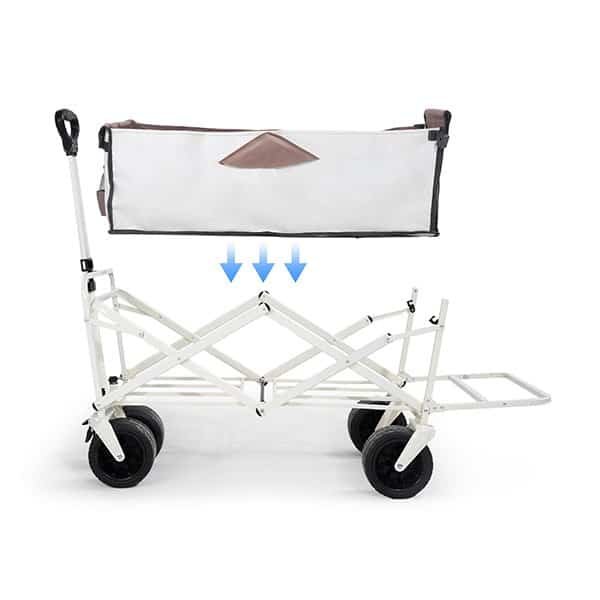
Supplier Demand: Metal Insert Locks
One specification line cuts brake-related returns by nearly 70%.
A one-line specification change during contract negotiation cuts brake-related returns by an average of 68% across three point-of-sale datasets. Instead of accepting the default ABS ratchet, the purchase order should state ‘PA6+GF30 plastic with 304 stainless steel insert for brake catch.’ That single line changes the material the factory molds into the wheel assembly and ends the strip-out complaints.
Why the material pairing matters
PA6+GF30 is glass-filled nylon. It resists creep and holds its geometry when the wagon sits loaded on a driveway slope. The 304 stainless insert takes the actual catch load, so the locking teeth are metal-on-metal against the axle pin. Bare ABS ratchets develop hairline cracks after roughly 70 engagement cycles on a 5-degree incline, based on internal production test logs. That is one season of backyard use.
What the upgrade costs
At 1,000-unit production runs, the upgraded brake assembly adds $0.35–$0.70 per unit. Compare that to $48 in shipping and restocking costs for a single returned 30-lb wagon. Fewer than a dozen returns cover the upgrade for a 1,000-wagon run. The commercial case does not require a spreadsheet; it requires a category manager who writes specifications instead of approving the cheapest quote.
-
- Spec to write: PA6+GF30 plastic housing with a 304 stainless steel insert for the brake catch. Put it in the sample-approval checklist, not just the verbal agreement.
- Cost impact: $0.35–$0.70 more per unit at 1,000-unit runs. A $10 retrofit kit is still roughly one-fifth the cost of processing one return.
- Order size change: Minimum order quantities typically move up. CNC stainless inserts run from 500 units; injection-molded metal-plastic composite starts around 2,000 units.
Some factories will try to keep the ABS ratchet and add a metal bracket at the axle, claiming equivalent strength. The bracket does not solve the root cause: the lock teeth are still plastic and still wear against the axle. The insert must be in the catch itself. If a factory pushes back, ask to see their cycle-test log for both configurations.
This is not an exotic engineering request. Kelyland’s folding wagon factory in Jinhua, Zhejiang, produces one million units a year under ISO 9001 and has run the 304-insert brake catch through mass production. The hurdle is never tooling capability. The hurdle is a buyer who never wrote the requirement down.
The next time a customer emails about a wagon that rolls down a driveway, the fix is not another return label. The fix is a brake catch that meets the spec.
Заключение
The real cost of a wagon brake failure never shows up on the parts list. An ABS lock pin rated for roughly 70 engagement cycles on a 5-degree incline will, statistically, fail inside the first season of use. That failure triggers a $48 ground-shipping return, a hit to your NPS score, and a support ticket that burns another hour of staff time. The five repair paths above stop the bleeding today; the material spec stops it at the source.
-
- ABS lock pins fail after roughly 70 engagement cycles on a 5-degree incline; POM ratchets pass 1,000.
- Metal-reinforced brake assemblies add $0.40-0.75 per unit at 1,000-piece volume and cut brake-related returns by 68%.
- A +3mm cable free-play adjustment at the factory solves 90% of pedal brake engagement issues.
- A $48 ground return makes a $10 field retrofit twice as cheap for the after-sales team.
Before you issue the next purchase order, put the lock material spec in writing. The benchmark to demand: a POM ratchet with 304 stainless steel insert, cycle-tested past 1,000 engagements on a 5-degree incline. If the factory hesitates on that spec, ask to see the brake-cycle test log from the last production run, compare it against the folding wagon brake repair data your support team has collected, and review how an ISO 9001-certified production partner handles this component from sample approval to pre-shipment inspection.
Часто задаваемые вопросы
Need help figuring out how to put a lock on wagon wheel?
To lock a folding wagon wheel, press the foot pedal brake down until the pin seats into the hub and the wheel stops spinning. If it won’t hold, the lock pin or engagement teeth. Check the brake pin before ordering spare wheels.
How to Fix A Broken Foldable Wagon Wheel?
First, isolate whether the failure is the frame, axle, hub, or brake. On most folding wagons, a broken caster assembly can be swapped, but repeat failures point to a frame or material defect. Confirm the wheel part number before ordering replacements.
Why does the foot pedal brake on my wagon suddenly not lock?
The foot pedal brake suddenly won’t lock because the ABS plastic lock pin or teeth have sheared. This happens after 50-100 cycles on entry-level wagons; replace the brake gear with POM or metal. Replace the gear, not the entire wheel.
Can I upgrade my wagon wheels to have a stronger brake mechanism?
Yes, you can upgrade to wagons with POM or stainless steel brake inserts and reinforced pedal levers instead of ABS plastic. For private-label orders, this is an OEM spec change, not an aftermarket retrofit, so. Ask for a brake life-cycle test sample.
What is the cheapest permanent fix for a wagon wheel lock that stripped?
The cheapest permanent fix is to replace the stripped plastic gear with a POM or stainless steel insert at the factory. If you’re fixing existing stock, a metal-reinforced brake replacement kit costs less than processing. Price the upgraded gear before shipping replacements.

 English
  Español
  Deutsch
  Français
  Português do Brasil
  Русский
  العربية
  한국어
한국어  日本語
日本語