 Ir al contenido
anchor inflatable tent snow is the first checkpoint buyers should lock before they approve a supplier, budget, or production slot. To anchor an inflatable tent on snow, you start by watching what the factory operator measures instead of what the sales call shows you. The operator pulls the guy-out loop until something tears and reads the number on the gauge. The buyer who got burned on a $50,000 order never saw that number. The pre-production sample passed, but the mass production run carried a lighter anchor pad, and the first winter storm found the difference.
The gap between sample approval and mass production is where winter tent failures hide. A standard V-stake holds 10-20 kg of pull-out force in packed snow; a buried webbing deadman holds 200-300 kg and costs under $3 in material. Most retail “snow stakes” are just longer V-stakes with a marketing tag. So “how to stake a tent in snow” is the wrong question — the right one is whether the anchor point on the tent fabric can survive the load at all.
Para un private-label buyer, this shifts the quality tolerance discussion during sample approval. The MOQ decision should hinge on whether the anchor points survive a loaded pull test, not on which stake accessory looks heavier in the catalog. A 50 g webbing loop in the accessory kit holds ten times more than a branded snow stake set that retails for $8-15, and it costs under $2 at production.
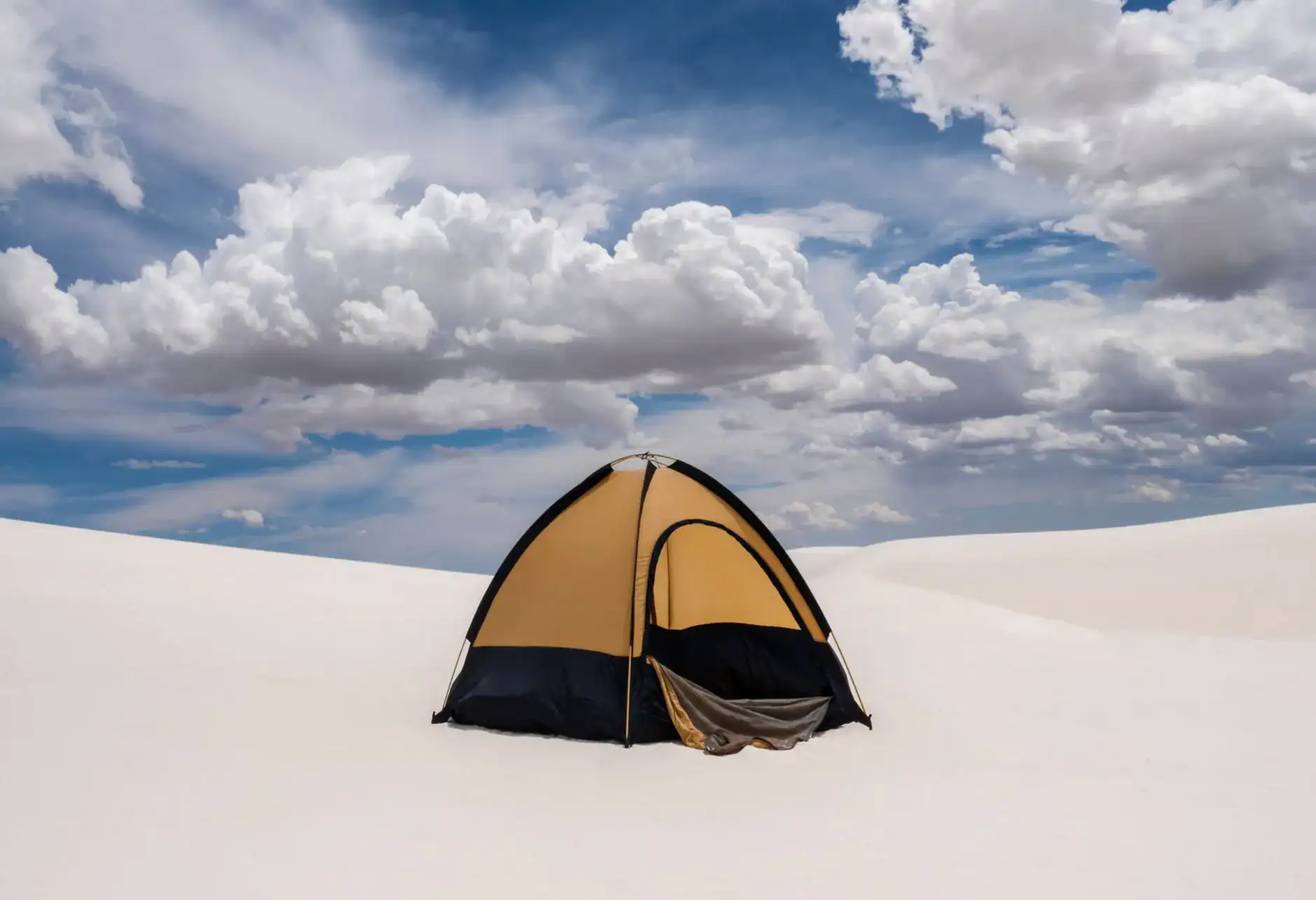
Why Regular Tent Stakes Fail on Snow and Ice
A stake standing above the snowline is not an anchor — it is a hinge waiting to fail.
A standard aluminum V-stake driven into firm snow holds just 10–20 kg of pull-out force. The same stake in dry soil holds 60–80 kg. That gap is the difference between a tent that survives a storm front and one that rolls across a frozen lake.
Snow Never Clamps the Stake
Soil works because granular particles interlock around the stake shaft, creating friction on every surface. Snow lacks that mechanical grip. It packs, but the crystals shear past each other under load. The buried section of a V-stake has only lateral friction against loose snow — and that friction collapses fast when the wind starts pulling.
The exposed shaft becomes the real problem. Wind load pushes the tent, the guy line pulls the stake’s eyelet, and the exposed length acts as a rotating arm. The stake pivots around the snow surface, lifting the buried tip upward. What you see in deep snow is not the stake sliding out — it is the stake tipping out because the snow above the buried half cannot hold it down.
Longer Steel and Heavier Stakes Do Not Fix the Physics
A 12-inch steel stake buried to its eyelet still fails on snow. Steel-on-ice friction is far too low without aggressive barbs or an angled blade geometry. Buying longer or heavier stakes is paying for more lever arm, not more grip.
-
- Mechanical reality: Stakes only hold when the medium packs around them. Snow cannot interlock like soil, so V-stakes become hinges instead of anchors.
- Production priority: Reinforced guy-out webbing at anchor points matters more than stake length. Kelyland’s tent factories add extra anchor pad layers on airbeam walls so the fabric tears less under repeated wind load — the anchor fails before the tent does.
If a supplier quotes a winter tent kit loaded with heavy steel stakes but no reinforced guy-out loops, the design logic is backward. The stitching and webbing at the anchor point determine storm survival, not the metal you hammer into the snow.
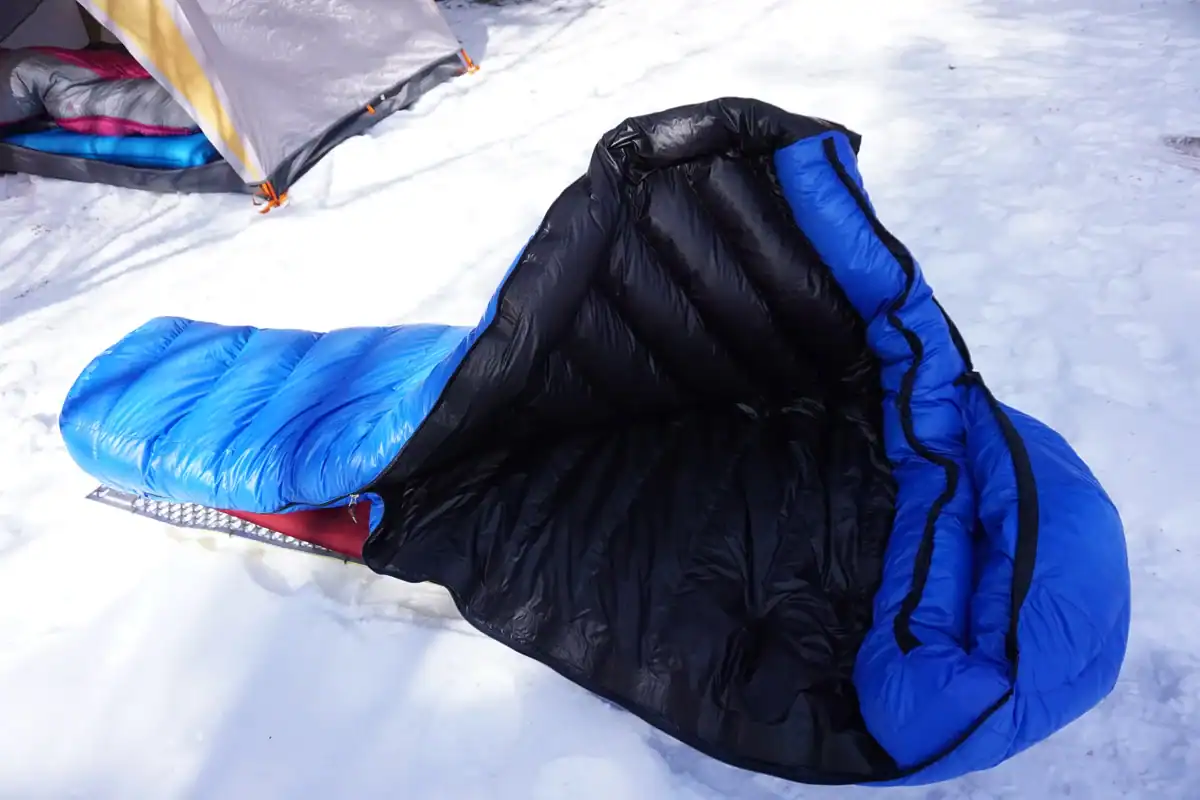
Snow Anchor Systems: Deadman, Ice Screws, and V-Stakes
Buried webbing deadman holds 200–300 kg.
Snow does not grip stakes like soil. A standard aluminum V-stake driven into packed snow holds 10–20 kg of pull-out force, while the same stake in dry soil holds 60–80 kg. When wind hits the tent, the exposed shaft becomes a lever arm and pops out. One loose inflatable tent can trigger $2,500+ in replacement and repair claims.
Deadman Anchor: Weight-to-Hold Ratio Winner
A deadman is any object buried perpendicular to the pull direction. A webbing loop, stuff sack, or snow-filled bag in a 6–12 inch trench holds 200–300 kg at a material cost of $0–3. The production-grade version is a 50 g webbing loop with the guy line tied at the center. Tie around the bag’s neck and the single-point pull slides out; a centered webbing loop distributes tension and holds the bury intact.
Ice Screw: When Hard Ice Changes the Rules
On solid glacial ice, alpine ice screws deliver more than 600 kg once seated. That performance costs $25–40 per screw and requires technical placement skill. For inflatable glamping tents on packed snow, ice screws are overkill. Expedition outfitters should stock them; consumer winter tent kits should not.
V-Stake: A Hinge, Not an Anchor
In snow, a V-stake is a hinge. Even a 12-inch steel stake buried to its eyelet has near-zero grip because steel-on-ice friction is too low without barbs or angled geometry. In shallow snow, lay a trekking pole sideways and parallel to the surface, tie the guy line around the shaft, and bury it. That converts a standard pole into a 200 kg-class deadman.
Anchor Specs for Private-Label Winter Tents
The fabric attachment point often fails before the stake. Reinforced guy-out loops and extra anchor pad layers on airbeam walls reduce tear risk, which is why Kelyland engineers winter tents with additional webbing reinforcement instead of just heavier accessories. Kelyland’s factory network includes 17 core strategic factories, mostly ISO 9001:2015 certified, with standard production lead times of 30–45 days. Minimum order quantities for selected items start at 50–100 pieces, leaving room for sample-level field testing before the full run.
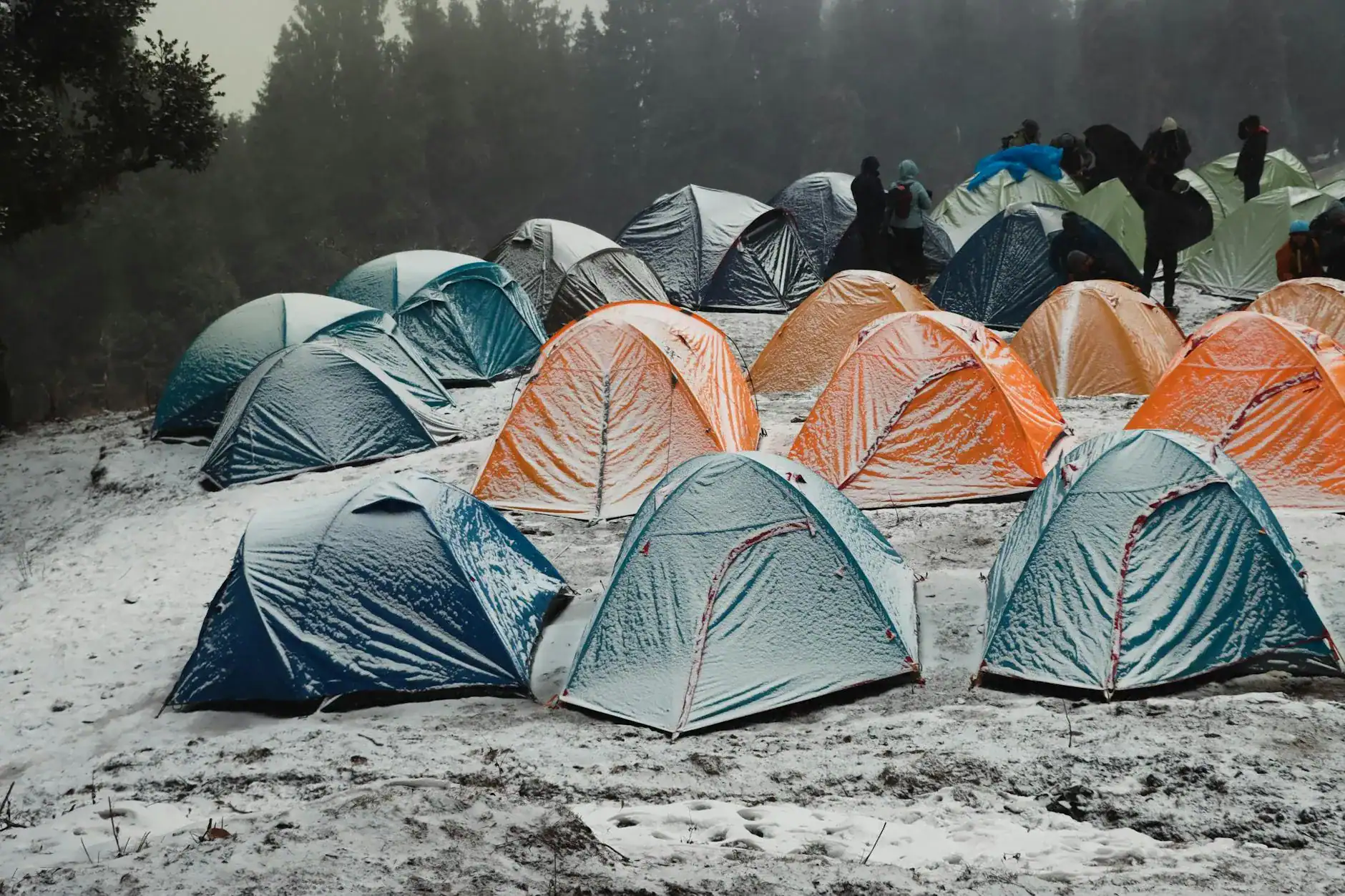
Deadman Anchor: The Weight-to-Hold Ratio Winner
A buried webbing deadman holds 200–300 kg in packed snow.
Snow lacks the mechanical interlock that gives soil its grip. A standard V-stake in dry soil holds 60–80 kg; the same stake in packed snow holds 10–20 kg. Any object buried perpendicular to the pull direction works as a deadman — a webbing loop, a stuff sack, or a snow-filled freezer bag. Bury it in a 6–12 inch trench and it transfers the tent’s load across a broad area of compacted snow instead of a single stake point. Pull-out resistance jumps to 200–300 kg. Material cost: $0–3.
The technique fails in one predictable way: the guy line tied around the bag’s neck or a corner. That creates a single-point pull, the object rotates in the trench, and the anchor slides out. The production-grade fix is to tie around the center with a tautline hitch or trucker’s hitch. Tension distributes evenly, the bury keeps its shape, and the system holds.
The Cost-Per-Kilo Argument
-
- 50 g webbing loop with pre-sewn loops: Under $2 to produce, holds 200–300 kg in packed snow, and adds almost no weight to a winter tent accessory kit.
- Branded snow stake set: Retails for $8–15, weighs 200–400 g, and still delivers only 10–20 kg of hold because the exposed shaft acts as a lever arm.
The buried anchor is only as strong as the tent’s attachment point. That is why Kelyland engineers airbeam tents with extra anchor pad layers at guy-out points — adding webbing reinforcement at the attachment reduces tear risk and lets the deadman carry the load. Buyers should spec that reinforcement at the sample approval stage, before committing to a 300–1,000 piece production run.
Ice Screw: When Hard Ice Changes the Rules
Ice screws are mountaineering hardware.
A Mountaineering Tool, Not Camp Gear
Bare glacial ice is the one surface where nothing else works. A properly placed alpine ice screw delivers more than 600 kg of pull-out force — enough to hold in winds that would rip a deadman clean out of the snowpack. The threads cut into solid ice and freeze in place, which is why expedition crews rely on them for high-altitude camps and crevasse rescue.
That performance does not come cheap. Each screw retails for $25–40 and demands real placement skill: the angle against the pull direction has to be right, the ice has to be free of air pockets, and the screw must seat fully. Miss one of those and the holding power drops toward deadman range.
The Cost Case Against Consumer Kits
For a commercial expedition outfitter who needs to secure inflatable tents on glacier ice, a rack of ice screws is a legitimate line item. For a private-label glamping tent brand, it is overkill in two ways. A six-screw kit adds $150–240 to a consumer bundle, and the target user — weekend glampers, festival campers, family winter trips — will never place a screw correctly anyway.
Soft powder conditions make the argument worse. In unpacked snow, an ice screw has nothing to bite into; a buried webbing deadman holds 200–300 kg of pull-out force for under $3. A buyer who asks for ice screws is paying a premium for a problem that does not exist at their price point.
What to Spec Instead
The weak link in a winter inflatable tent is rarely the anchor hardware. It is the fabric-to-webbing joint where the guy line meets the airbeam. That is why Kelyland engineers airbeam tents with extra anchor pad layers at guy-out points rather than shipping heavier accessories — reinforcement at the attachment point prevents tear-out before a stake ever moves.
B2B buyers should spend the sample-approval phase pull-testing those reinforced loops, not spec’ing ice screws. Kelyland’s network of 17 core strategic factories, most ISO 9001:2015 certified, can production-validate anchor-point strength before you commit to MOQs. Standard lead time of 30–45 days leaves room for a snow-season field test on pre-production samples.
Stock ice screws if your client runs guided glacier trips or high-altitude expeditions. Keep them out of consumer glamping kits — the holding power is real, but the commercial logic only works at the expedition end of the market.

V-Stake: A Hinge, Not an Anchor
A V-stake on snow is a hinge, not an anchor.
Drive a standard aluminum V-stake into packed snow and it resists only 10–20 kg of pull-out force. The same stake in dry soil holds 60–80 kg. Snow lacks the mechanical interlock of soil: the stake wings have nothing to bite into, just smooth ice crystals pressing back with lateral friction.
That gap changes how the stake fails. When wind pushes the tent, the exposed shaft acts as a lever arm. The buried tip becomes a pivot, the top rotates forward, and the stake pops out of the snow like a hinge. Inflatable tents make it worse: airbeam surfaces catch more wind, so the load at each guy-out point spikes fast.
The 4–6 Inch Fix
If the snow is only 4–6 inches deep, longer stakes are the wrong answer. Use what is already in the kit: a buried stick, a trekking pole, or a snowshoe laid sideways and parallel to the surface. Any of these spreads the anchor force across a broad buried surface instead of a single point.
-
- Lay the object flat and perpendicular to the pull direction.
- Tie the guy line around the center so tension spreads evenly.
- Bury it under 4–6 inches of snow and pack the snow down hard.
- Pour a little water over the spot and let it refreeze into a solid block.
The wetting step matters more than most buyers realize. Compressed snow holds okay, but refrozen snow locks the object into a solid block of ice. This method works with the standard guy lines that ship with the tent, so the end user never needs an aftermarket snow stake.
On the production side, the weakest link sits at the fabric, not the stake. Kelyland engineers airbeam tents with extra anchor pad layers at the guy-out points for this reason: a reinforced loop survives the load and passes it to the anchor, instead of tearing before the stake even moves.
What to Spec Instead
A branded snow stake set retails for $8–15 and still fails the hinge test. A 50 g webbing loop costs under $2 and holds 200–300 kg when buried as a deadman. For private-label kits, spec deadman-compatible guylines and reinforced anchor pads. That is the difference between a tent that survives a storm and a claim you absorb.
Anchor Specs for Private-Label Winter Tents
A stake failure costs you a tent.
Most buyers shopping snow anchors focus on the stake. The stake is rarely the weakest link. On an inflatable tent, the fabric attachment point fails first — a guy-out loop that rips under load turns the most expensive anchor system into a useless accessory.
Reinforced webbing at every guy-out point
The production-grade fix is webbing reinforcement sewn into the attachment zone. Kelyland’s tent factory in Ningbo, which runs 800,000 units of annual capacity, builds extra anchor pad layers at each guy-out point instead of adding heavier accessories. That stops the lever-load from tearing the canopy before the anchor can do its job.
360° anchor loops along airbeam channels
Airbeam tents flex in wind. The beam channels move. If anchor loops only sit at the four corners, the middle sections lift and load the end points unevenly. Spec 360° anchor loops along the full length of the airbeam channels so each buried deadman shares the load across the whole footprint.
Test anchor points before you commit to a MOQ
Kelyland’s OEM/ODM sampling process includes sample approval before mass production. That window matters. Send the sample to a snowy field site, load the guy-outs with a trucker’s hitch, and see what fails. A standard plazo de producción of 30–45 days gives you room to run that test and still hit your season launch window.
The entry threshold makes this practical. Kelyland runs MOQs from 50–100 pieces on selected items, so a winter tent line with proper anchor engineering doesn’t require a massive first order. You can validate the design in the field, then scale the reorder once the snow data proves it.
-
- Webbing reinforcement: Every guy-out point gets an extra anchor pad layer. A single bartack row is not a winter spec.
- Loop spacing: Anchor loops run the full length of the airbeam channels. Gaps between loops let the middle sections lift under wind load.
- Sample pull test: Load-test a sample guy-out during sample approval. If the loop tears before the deadman holds, the spec fails.
Conclusión
A standard V-stake holds 10–20 kg in packed snow. A buried webbing deadman holds 200–300 kg at a material cost under $2. That gap is the difference between a tent that stays through a storm and a $2,500 replacement claim.
-
- V-stakes act as levers in snow and pull out below 20 kg of force.
- A buried webbing deadman holds 200–300 kg and costs under $2.
- Reinforced guy-out loops matter more than heavier stakes.
- Spec deadman-compatible guylines and tear-tested anchor loops before production.
Before you lock MOQ or production lead time, check the anchor system on the tent spec. Ask for a sample that includes webbing deadman loops, reinforced guy-out points, and a pull-out test report. Kelyland’s OEM/ODM sampling process can validate those anchor points in 30–45 days, before mass production and pre-shipment inspection. That benchmark—a buried anchor holding 200–300 kg—gives you a number to write into your supplier call.
Preguntas frecuentes
¿Cómo anclas una tienda de campaña en nieve profunda sin estacas?
Use a deadman anchor: dig a trench 6–12 inches deep, tie the tent guy line around the center of a buried webbing loop, then let it freeze or compact in. This turns snow itself into the. Spec pre-sewn webbing loops for production.
Can trekking poles be used as snow anchors?
Yes, but only in shallow snow. Lay a trekking pole sideways and parallel to the surface, tie the guy line around the center, and bury it under snow; for production, a webbing deadman is more. Use deadman kits for reliable pull-out strength.
What is the best deadman anchor material?
Webbing loops are best for production kits because they weigh about 50 g, cost under $2, and bury with a small trench. Aluminum stakes are cheaper initially but fail in snow. Plan deadman loops as a standard accessory.
How much weight can a snow anchor hold?
A buried webbing deadman holds 200–300 kg of pull-out force in packed snow, while a V-stake holds only 10–20 kg. Use deadman anchors where wind loads are high. Apply deadman anchors for high-wind winter sites.
What anchor system should I spec for an inflatable glamping tent?
Spec reinforced guy-out webbing and a deadman accessory kit; ice screws are unnecessary unless the site is solid ice. This gives clients a ready-to-use snow anchor without engineering changes. Add deadman kits to the quote for winter builds.

 English
  Español
  Deutsch
  Français
  Português do Brasil
  Русский
  العربية
  한국어
한국어  日本語
日本語