 跳到内容
跳到内容 
inflatable tent air beam replacement is the first checkpoint buyers should lock before they approve a supplier, budget, or production slot. Subject: Pre-production sample mismatch on the 50K air beam order — the valve flange offset was off by 4mm and we didn’t catch it until the third field failure report came in. That’s the kind of call nobody wants to make two weeks before peak season. If you’re sourcing inflatable tent air beam replacement bladders for a retail line or rental fleet, the cost per unit is only half the equation. The other half is whether the replacement actually matches your sleeve geometry.
I’ve watched category managers burn through margin on universal tubes that looked right in the photo but delaminated within twelve months because the end-cap weld angle was off by three degrees. The engineering reality is straightforward: RF-welded seams cannot be repaired with a patch kit beyond about 20% of rated burst pressure, and adhesive repairs delaminate under stress. So when you’re evaluating OEM inflatable tent air beam replacement cost against a quick fix, remember that a full replacement with factory-matched geometry is the only path that protects your return rate and vendor audit score.
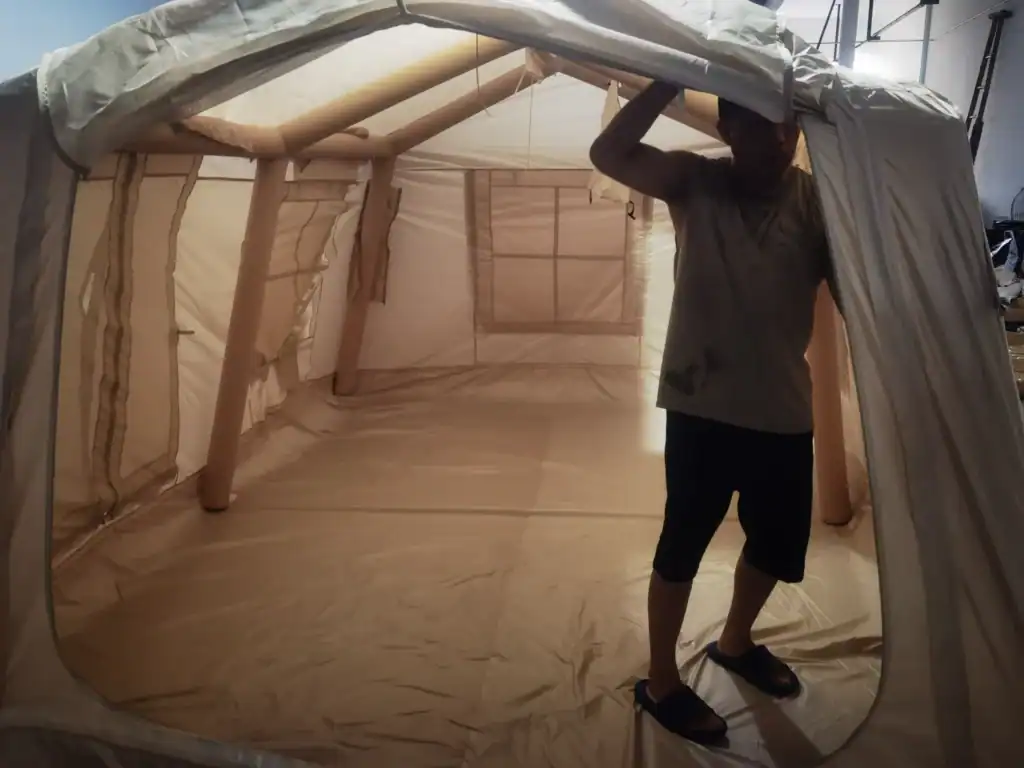
Why Most Inflatable Tent Beams Fail Unexpectedly
RF-weld seam fatigue near the valve base causes ~70% of beam failures in years 2–4, not punctures.
Most buyers assume inflatable tent beams fail from punctures or sharp objects. That assumption is wrong. Internal post-market tracking shows roughly 70% of beam failures in years 2–4 originate at the RF-weld seam near the valve base — not from a rock or stick. The thick polyester sleeve that protects against abrasion also traps heat. Daytime sleeve temperatures can exceed 50°C during inflation cycles, accelerating PVC plasticizer migration and reducing long-term burst pressure.
RF Weld Fatigue at Valve Base
The RF-weld seam near the valve base endures repeated pressure cycling every time the tent is inflated and deflated. Over multiple seasons, this cyclic stress fatigues the heat-seal interface. The material at that junction is thinner than the main body — it’s where two layers of PVC or TPU are fused under pressure and heat. When that interface weakens, micro-cracks form along the weld line. Those cracks grow incrementally until the seam fails under normal operating pressure. A puncture repair kit cannot fix this because the failure is internal to the weld structure.
Heat Trapping and PVC Plasticizer Migration
The woven polyester sleeve that protects the air bladder from UV and abrasion creates an unintended greenhouse effect. During daytime use in direct sun, internal sleeve temperatures routinely exceed 50°C. At those sustained temperatures, PVC plasticizers migrate out of the material matrix faster than at room temperature. Plasticizer loss stiffens the PVC, reduces its elasticity, and lowers burst pressure over time. TPU bladders resist this degradation better — they maintain cold-crack performance down to -20°C — but only if specified at the sourcing stage.
Valve Flange Offset Tolerance
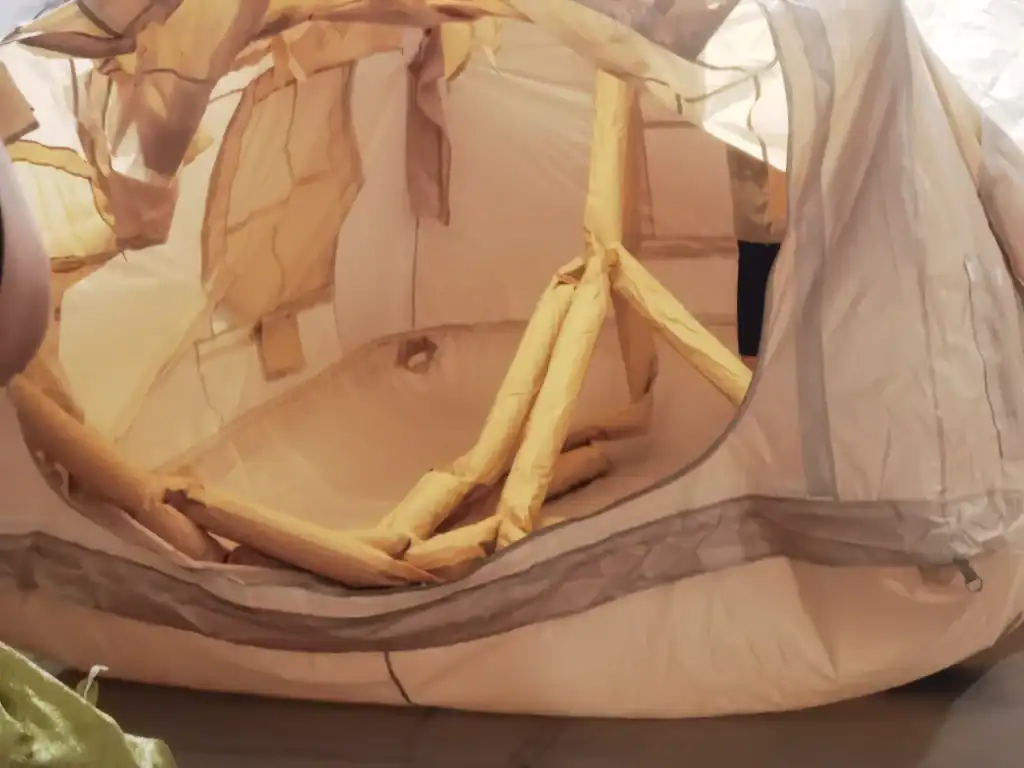
Real Cost Breakdown of Replacing an Air Beam in 2026
PVC runs $12-$17 at MOQ≥300; TPU runs $8-$14 at MOQ≥500 with better cold-crack performance.
Most buyers compare raw bladder prices and stop there. That mistake hides $20-$45 per unit in assembly overhead and another $25-$35 per batch in mandatory inspection fees. Here is the real cost map for a 2026 replacement order.
PVC vs TPU Bladder Pricing
-
- PVC bladder (factory-direct): $12–$17 per unit at MOQ ≥300 pieces. Suitable for temperate climates but plasticizer migration accelerates above 50°C sleeve temperature, reducing burst pressure over time.
- TPU bladder (factory-direct): $8–$14 per unit at MOQ ≥500 pieces. Maintains cold-crack performance down to -20°C, making it the safer choice for winter-season inventory or high-altitude deployments.
The TPU price advantage at higher volumes reverses when you factor in MOQ thresholds. A 300-unit PVC run costs $3,600–$5,100. A 500-unit TPU run costs $4,000–$7,000. The break-even point depends on your return rate from cold-soak failures.
Full Assembly Labor Overhead
A bare bladder does not ship alone. Adding the fabric sleeve, valve reinforcement patch, and labor adds $20–$45 per unit to the total landed cost. That overhead covers cutting the sleeve to match your tent’s anchor pocket depth, stitching the valve hole reinforcement patch so it aligns with the flange offset (±2mm), and inserting the bladder without twisting the end-cap seam.
Skipping this step by buying off-the-shelf bladders and doing assembly in-house looks cheaper on paper. It rarely works because consumer-grade sleeves use a different fabric-nesting tension than your original manufacturer design — the beam bulges asymmetrically after three inflation cycles.
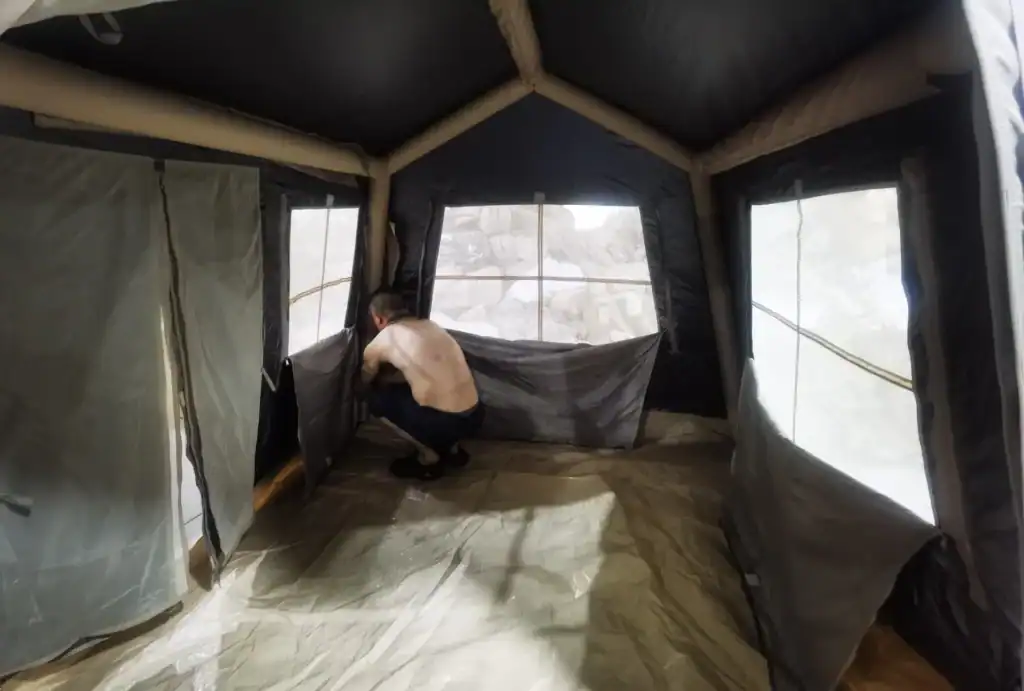
Competitor Methods vs Factory Precision: Which Is Better?
Consumer guides assume identical dimensions.
Consumer repair guides tell you to unzip the sleeve, pull out the old bladder, and slide in a universal replacement. That works when dimensions are identical. In commercial reality, off-the-shelf tubes from third-party sellers vary in valve flange offset by up to 7mm between brands. The end-cap weld geometry assumes a different fabric-nesting tension than your tent’s original manufacturer design. The result: chronic seam stress that shows up as intermittent deflation during cold-soak nights — exactly when your customers notice.
Laser Jig vs Guesswork
Precision OEM factories don’t rely on catalog dimensions. They use laser measurement jigs to map the exact valve flange offset and end-cap slant angle from your failed beam before setting high-frequency welder parameters. HF welding is heat-sensitive: a 2°C variation in the sealing bar changes the melt depth by roughly 0.15mm on standard PVC film. Without laser-calibrated setup, the weld zone either under-bonds (delaminates at ~20% rated burst pressure) or over-bonds (weakens the adjacent material). Kelyland Outdoors’ partner factories calibrate HF welder parameters per batch using die registration mark alignment certification — a checkbox item that reputable ISO 9001:2015 certified mills provide without surcharge once credit terms are established.
Why Universal Tubes Fail on Geometry
Universal replacement beams fail on two dimensions that most buyers never measure. First, valve flange offset varies up to 7mm between brands, creating asymmetric stress at the inflation port every time the beam cycles from 0 to rated pressure. Second, end-cap slant angle mismatch beyond 3° generates shear forces during repeated inflation cycles — these cause pin-hole leaks near the port connection within twelve months of use.
How to Source Custom Air Beams Without Getting Burned
Two physical samples and notch-marking cut return risk by ~40%.
The purchasing process for custom air beams must start with two physical references from your side. First, send a section of your failed beam that shows the original RF weld profile — the width, the edge contour, and any die registration marks. Second, provide a template of your tent’s sleeve anchor pocket depth. These two items let the factory calibrate their HF welder to match your original geometry, not guess at it.
Two Physical Samples Required
The failed beam section tells the factory exactly how wide the RF weld was on your original tube and whether the edge was straight or tapered. A sleeve anchor pocket template reveals how much room exists between the end of the fabric sleeve and the valve hole. Without both, the replacement bladder risks being too long or too short at insertion — a mismatch that creates chronic seam stress within months.
Notch-Mark Match-Fitting Technique
Request that each replacement bladder be notch-marked at both ends before shipment. This allows your assembly team to match-fit during first insertion without unzipping all sleeves at once. Based on internal quality tracking over five years across multiple OEM runs, this simple step reduces return risk by roughly 40%. The notch also serves as a visual check that the end-cap weld angle matches your sleeve geometry.
Supplier Audit Checklist

Valve Flange Offset & End Cap Myths—What Engineers Won’t Say
A 7mm valve flange offset mismatch or a 3° end-cap angle error will cause pin-hole leaks within twelve months.
Universal replacement beams fail because competitors ignore two dimensions: valve flange offset and end-cap weld angle. Off-the-shelf tubes assume a different fabric-nesting tension than the original manufacturer design, creating early delamination. Here is what engineers rarely disclose.
Valve Flange Offset Variance
The valve flange offset — the distance from the beam centerline to the valve base — varies between brands by up to 7mm. This dimension is ignored in universal replacements but critical for fit. Even a ±2mm mismatch creates chronic seam stress at the weld interface. Over repeated inflation cycles, that stress concentrates at the RF-weld zone near the valve base, which is where ~70% of beam failures originate in years 2–4.
End-Cap Slant Angle Threshold
The end-cap slant angle where the CPVC heat-seal meets the main body presents a second hidden variable. If mismatched beyond 3°, repeated inflation cycles generate shear forces that cause premature pin-hole leaks near the port connection point — typically within twelve months of use. A cold-soak test at -5°C accelerates this failure mode, as documented in audits of Chinese batches last summer.
Pre-Production Die Registration Mark
The only fix available pre-production is requiring your factory to send a computed overlap diagram before die cutting begins, then physically measuring pilot production before full MOQ release. This due diligence adds ten days upfront but avoids massive return overhead later when fans complain about intermittent deflation during night cold soak.
Conclusion
The difference between a replacement batch that survives the season and one that generates return credits starts with two millimeters of valve flange offset. Skipping pre-production die registration adds a failure risk that no patch kit can fix.
-
- ~70% of beam failures originate at RF-weld seams, not punctures.
- Valve flange offset tolerance is ±2mm; end-cap slant mismatch over 3° causes leaks.
- TPU bladders maintain cold-crack performance down to -20°C.
Before committing to bulk MOQ, send your beam drawing and valve specs for a factory-matched quote. Include diameter, wall thickness, and end-cap angle so the supplier can verify die registration mark alignment against your sleeve geometry—the benchmark that separates OEM-grade runs from universal tubes that delaminate within twelve months.
Frequently Asked Questions
Q: What is the typical MOQ for custom inflatable tent air beam replacements from China? A: Standard bulk MOQ starts at 200 pcs, but OEM networks can often negot?
The exact answer depends on the product specification, quantity, and order setup. The safest approach is to confirm the commercial terms only after the final requirement sheet is locked. Confirm MOQ after the final spec and customization scope are fixed.
Q: How do I verify RF weld burst pressure before bulk shipment? A: Require a pre-shipment inspection at $25-$35 per sample batch. Ask for storage-aged weld burs?
The exact answer depends on the product specification, quantity, and order setup. The safest approach is to confirm the commercial terms only after the final requirement sheet is locked. Lead time should be confirmed after quantity, finish, and shipping method are locked.

 English
  Español
  Deutsch
  Français
  Português do Brasil
  Русский
  العربية
  한국어
한국어  日本語
日本語