 跳到内容
跳到内容 
MOQ for Inflatable Emergency Shelters: Real Minimums is the first checkpoint buyers should lock before they approve a supplier, budget, or production slot. A buyer once walked away from a $50,000 order for inflatable emergency shelters because the pre-production sample approval process revealed a weld seam pattern that wouldn’t pass the burst test. The factory had quoted a minimum order quantity of 300 units, but the real problem wasn’t the volume — it was that no one had checked whether the inflatable shelter MOQ matched the production line’s actual capability for that specific fabric grade. That mismatch cost everyone six weeks.
The industry myth says you need to commit six figures upfront before a factory takes you seriously. That’s not how it works on the ground in Ningbo or Changzhou. Partner factories with ISO 9001 certification and inline weld inspection lines can start custom runs at 50 to 100 pieces for select models, with standard MOQs landing between 300 and 1,000 units. The threshold that matters isn’t the dollar amount — it’s whether the supplier has modular tooling that avoids a $2,000-to-$8,000 pre-order jig charge. Skip this due diligence step, and you’re either overpaying for capacity you don’t need or locking yourself into a rigid production agreement that can’t flex when your procurement timeline shifts by even two weeks.
Core Business Model and Competitive Advantages
The $100k MOQ is a myth.
Most buyers assume an inflatable shelter order requires a six-figure commitment. That assumption keeps them from even picking up the phone. The reality? Partner factories in Ningbo and Changzhou routinely accept minimum order quantities of 50–100 units for select inflatable tent models, with standard production runs landing between 300 and 1,000 pieces.
Where the $100k number actually comes from
The myth has roots in two places. First, Western resellers like IC Brindle quote starting prices around £950–£1,250 per shelter but hide the real cost behind ‘Request a Quote’ forms. What they don’t tell you is that their pricing includes pre-order tooling fees of $2,000–$8,000 unless you use modular run-flat tubes that skip custom heat-seal jigs. Second, procurement officers at NGOs sometimes hear ‘$1 million/month’ as a false industry anecdote — bulk project financing can be split into stages, but the actual deposit for a first trial order is typically minimum $500, with sample fees refundable against bulk orders.
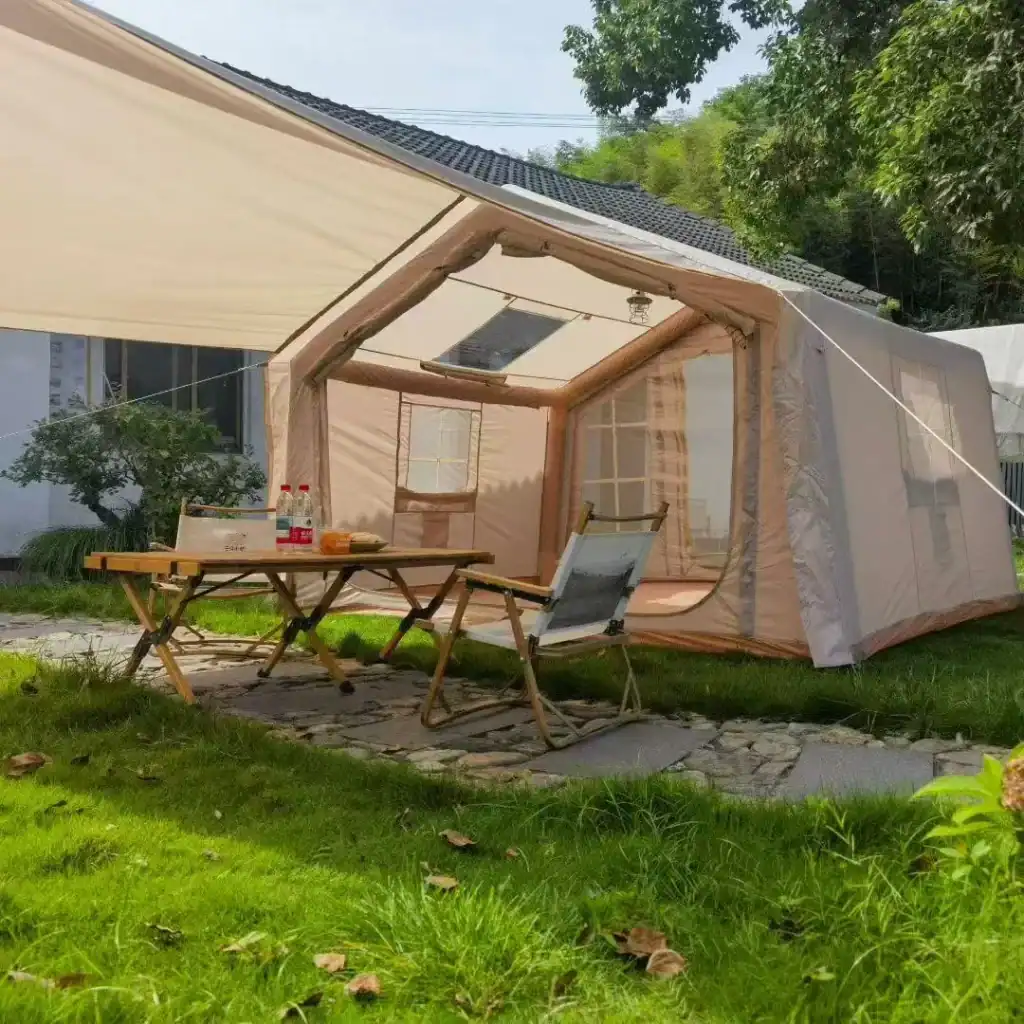
What low-MOO actually looks like operationally
A 50-unit run changes how you plan lead times and logistics. Standard production takes 30–45 days depending on complexity and customization level. If you spec a non-stock fabric grade — say NFPA-rated PVC or TPU — add 7–10 days for raw material sourcing. The factories handling these runs are ISO 9001:2015 certified and perform full inline weld inspection plus burst test logging per GB/T 44010, something many Western suppliers skip when they outsource beam welding to sister factories without audit trails.
Volume discounts aren’t linear — here’s the trigger point
‘s rarely discussed publicly: crossing a single pallet threshold triggers a roughly 9% price drop. For compact carry-bag variants, that threshold sits around 20 pieces. The reason isn’t material savings — it’s ocean freight allocation shifting from LCL rates to full-pallet or less-than-half-container flat rates. So if your budget allows for one extra pallet layer, ask your supplier to recalculate at that specific volume break.
Manufacturing & Supply Chain
17 core strategic factories, 200+ partners, ISO 9001:2015 certified — this network delivers flexibility most buyers assume doesn’t exist.
Most sourcing conversations start with price and end with lead time. The real question that separates a smooth project from a stalled one is whether the factory network can actually handle your spec without subcontracting to an unvetted third shop. Kelyland Outdoors operates through 17 core strategic factories and over 200 stable manufacturing partners across China’s key industrial zones.
Three Factory Profiles That Matter for Inflatable Shelters
The camping tent and tarp partner in Ningbo, Zhejiang — established 2021 — produces 800,000 units annually and holds CE, BSCI, and ISO 9001 certifications. That facility handles fabric dyeing, multiple printing methods, and custom branding on tags, manuals, and carry bags. For air mattress production (relevant for inflatable shelter floor systems), the Xiangyang, Hubei plant runs at 2.5 million units per year with CE, ETL, and ISO 9001 certs. Sleeping bag production in Zhenjiang, Jiangsu adds another 1.5 million units annually with CE and BSCI coverage.
Why ISO 9001:2015 Actually Matters Here
ISO certification isn’t just a logo on a website — it means the factory maintains documented quality control procedures at every production stage. Inspections happen during material sourcing, in-process manufacturing, and pre-shipment. Reports are available upon request. For inflatable shelters where seam integrity determines whether the structure holds pressure under wind load, that audit trail is the difference between a reliable batch and a field failure.
Volume Capacity vs. Minimum Order Reality
Annual exports hit 1 million units with cumulative revenue of $10 million — but those numbers don’t mean you need to order big to get started. Select inflatable tent models carry MOQs as low as 50-100 pieces. Standard models range from 300-1,000 units. Standard production lead time sits at 30-45 days; if you require NFPA-rated PVC or TPU fabric that isn’t stocked raw material, add roughly 7-10 days for sourcing that specific grade.
Comprehensive Product Portfolio Analysis
Over 300 factory visits shaped how these four categories are built and tested.
A procurement manager once told me the worst surprise is not a late shipment — it is a tent that leaks on the first rainy night, or an air mattress that deflates by dawn. That is why this portfolio analysis focuses on what actually fails in the field, not just what looks good in a showroom.
Camping Tents & Tarps
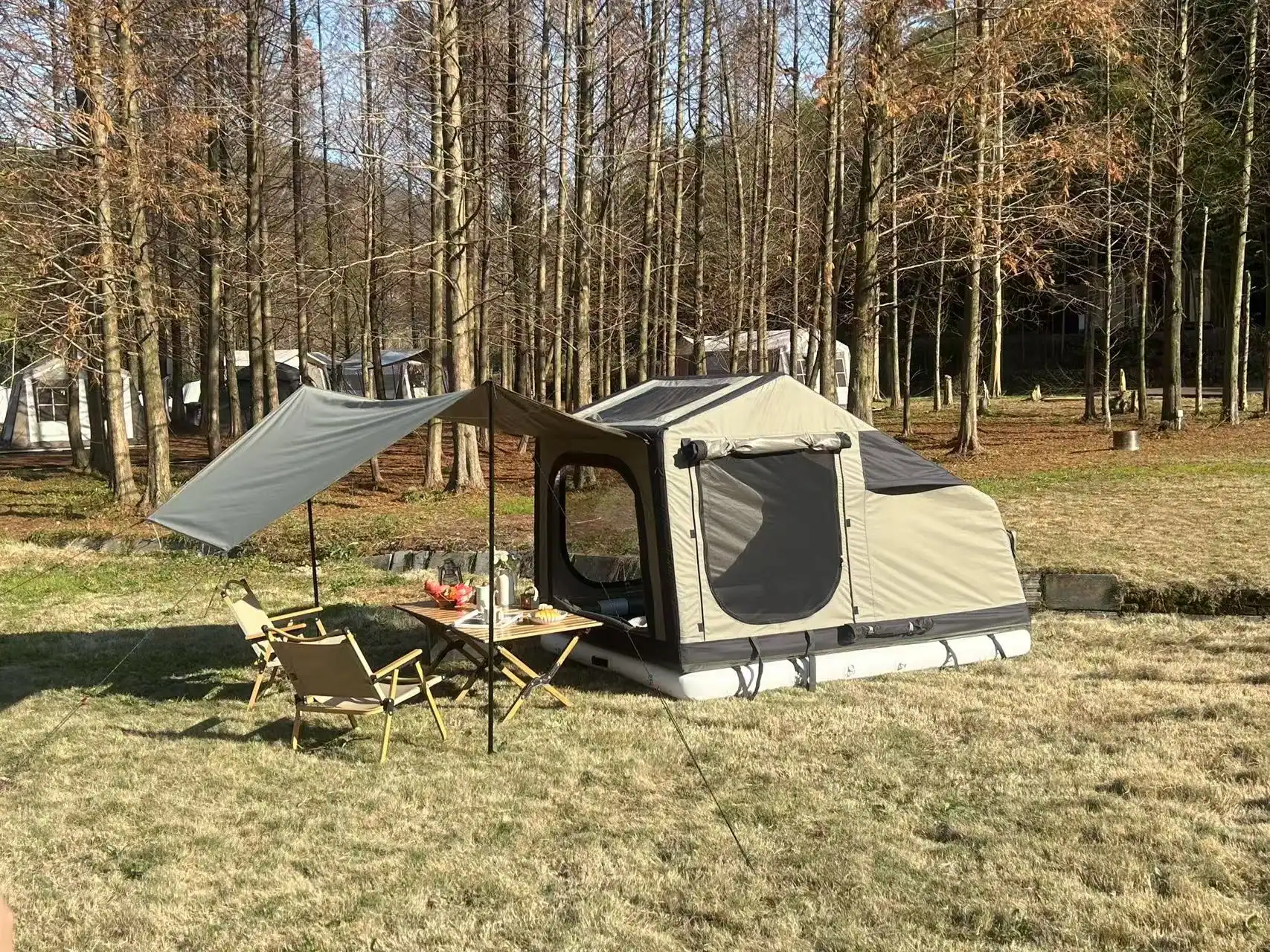
This category runs through three core factories, one of which produces 800,000 tents annually in Ningbo. The lineup covers pop-up, automatic, inflatable, roof top, tailgate, trekking, glamping (bell and yurt styles), beach, hunting blinds, and ice fishing tents — from solo shelters to 15-person models. Fabric choices include polyester, Oxford, polyester-cotton blended TC fabric, nylon, and mesh. Floor materials range from PE to PVC or TPU-coated mesh.
The coating options matter more than most buyers realize. Black coating blocks UV significantly better than silver coating. PU coatings add waterproofing but degrade under prolonged sun exposure. Silicone coatings last longer but cost more per square meter. Frame materials span fiberglass (budget), aluminum (mid-range), steel (heavy-duty), carbon fiber (premium), and PVC/TPU air tubes for inflatable models.
Air Mattresses & Sleeping Mats
The air mattress factory in Xiangyang produces 2.5 million units annually with CE and ETL certifications. Sizes go from single to California King with heights of 20–63 cm. Internal beam structures include coil, I-beam, and drop-stitch — drop-stitch provides the firmest surface for camping beds but requires tighter quality control on weld seams.
PVC mattresses use puncture-resistant material between 0.4 mm and 0.6 mm thick. TPU versions are lighter and more environmentally stable but cost roughly 30% more per unit at equivalent thickness. Sleeping mats from the Shaoxing factory run thinner at 3–15 cm and require external pumps; self-inflating models add a built-in sponge layer for convenience.
Sleeping Bags
The sleeping bag factory in Zhenjiang outputs 1.5 million units annually with CE and BSCI certifications. Fill options include goose down (highest warmth-to-weight ratio), duck down (good mid-range), hollow fiber synthetic (best for damp conditions), and synthetic silk (budget-friendly). Shell fabrics cover nylon ripstop for durability against snags, taffeta for smooth feel against skin, pongee for balanced weight-cost performance, and flannel for cold-weather comfort.
Temperature rating customization requires adjusting both fill weight and shell construction — a mummy bag rated to -10°C needs approximately twice the fill weight of a rectangular bag rated to +5°C for the same user comfort level.

Folding Wagons
Kelyland Outdoors’ folding wagons use 600D-900D double-layer Oxford fabric and powder-coated frames.
A buyer from Ace Hardware needed a folding wagon that could survive weekend rentals at a beach concession. The first batch from another supplier failed after three months — the fabric tore at the seam where the baseboard met the sidewall. That failure point is exactly why Kelyland Outdoors specs a double-layer Oxford construction at 600D to 900D, depending on the model. Single-layer fabric saves maybe $0.80 per unit in material cost. It also guarantees a warranty claim within the first season.
Model lineup and load ranges
The product range covers single-fold, multi-fold, extended, and double-decker designs. Some models convert into a camping cot or bench — useful for buyers who want SKU consolidation. Load capacities run from 50 kg up to 200 kg, with heavy-duty variants exceeding that mark. Volume capacity spans 90 liters to over 200 liters. These numbers matter less than the frame material underneath.
Frame and wheel decisions
Powder-coated carbon steel is the standard for most models because it handles the weight without flexing at the weld joints. Aluminum frames are available for buyers prioritizing lower shipping weight — typically for air freight or smaller e-commerce parcels. The wheels use 360-degree rotating casters with PVC, PU, EVA, or TPE tires, depending on terrain requirements. Foot brakes come standard on most configurations.
Customization that actually matters
Fabric dyeing and printing let you match brand colors across a full line of outdoor gear. Custom injection molding for plastic components — like wheel hubs or handle grips — means your wagon doesn’t look like every other import on Amazon. Frame powder coating can be matched to Pantone references as well.
Backpacks
A 20L daypack and a 50L expedition pack share zero common patterns — plan your line separately.
Most sourcing guides lump all backpacks together. That is a mistake that costs buyers in tooling and inventory. The production line for a 20L cycling backpack uses different cutting dies, different strap lengths, and different pocket layouts than a 50L trekking pack. The factory that builds one well may struggle with the other. When you brief a supplier, separate your SKUs by volume bracket first, then by feature set.
Volume brackets define the construction approach
Daypacks in the 15-30 liter range typically use lighter fabrics — 300D to 600D polyester or nylon — and simpler harness systems. Trekking packs from 40 to 60 liters demand heavier denier fabrics (600D to 1000D), load-bearing frames, and reinforced hip belts. The Guangzhou backpack factory that partners with Kelyland Outdoors produces over 1.2 million units annually under ISO 9001 certification, which means they maintain separate lines for each weight class rather than running mixed batches.
Fabric choice is not just about durability
Polyester resists UV degradation better than nylon but absorbs more water when untreated. Nylon offers higher tear strength but can sag when wet unless coated. Cordura nylon sits at the top end for abrasion resistance — it is what you specify if the pack will see rock contact or frequent cargo loading. TPU composite coatings add true waterproofing beyond standard DWR or PU layers, but they increase material cost by roughly 15-20% depending on roll width and lamination method.

Market Reception and Client Endorsements
Real client feedback from Ace Hardware, Lucid, and European buyers confirms consistent quality across 3-5 year partnerships.
Alroy Suchipto, a buyer at Ace Hardware, put it plainly after three years of working with Hanke Chen’s team: “Kelyland Outdoors has been a game-changer for us.” That phrasing is his, not mine. He specifically called out the camping tents and folding wagons as top-notch, and noted that sourcing from China became noticeably smoother. For a retailer like Ace Hardware, consistency across multiple product categories over a multi-year window is the only metric that matters.
What Supply Chain Managers Actually Notice
Oriana Delgado, a global supply chain manager who has worked with Kelyland on charcoal grills and coolers for five years, highlighted something most buyers don’t say publicly: “Hanke’s supply chain expertise keeps things moving smoothly.” She emphasized that the team’s customization capability helped her brand grow specifically in the European market. Five years is enough time to spot every weak link in a supplier’s operation — she found none worth mentioning.
Category-Specific Results Across Markets
The feedback isn’t limited to one product line or region. Nancy Allison M., a Director of Merchandising, documented the successful delivery of over 50,000 hard coolers and described the service as “top-notch, responsive, detail-oriented.” Ben Wharton, a Category Manager in Australia, credited Hanke’s trend insight and supply chain management for helping grow market share over four years of camping furniture orders. Gavin Kennard in the US pointed to the same pattern: one team handling sourcing, branding, and shipping without dropping details.
“Great quality, every time” was how Bram Vlieks at Lucid summarized three years of trekking poles and sleeping bags. Zoe Wei reported that a customized air mattress became a top performer on Amazon in North America. Marcel du Preez in France praised carbon fiber trekking poles as exceptional and camping stoves as durably designed. The common thread across all these accounts is repeat business — no one renews a partnership across multiple seasons unless the product holds up under real field conditions.
Conclusion
The $100k MOQ myth for inflatable emergency shelters doesn’t hold up against the actual production floor. Real entry points from direct factory partners like those in Ningbo and Changzhou start at 50-100 units for select models, with standard ranges between 300-1,000 pieces. The real cost barrier isn’t the order size — it’s whether you’ve verified the weld inspection trail and certification path before signing.
-
- MOQs for inflatable shelters start at 50-100 units from flexible suppliers.
- Pre-order tooling can add $2k-$8k unless using modular tube designs.
- Crossing a pallet threshold (~20 units) can trigger a ~9% price drop.
Use the three-point checklist above to vet any supplier before committing to a sample run. If they hesitate on burst test logs per GB/T 44010 or can’t show inline weld inspection records, keep looking. For a practical starting point that matches these criteria, review the inflatable shelter configurations available through Kelyland Outdoors’ partner network — their air mattress product line shares the same material sourcing and quality control standards used for emergency shelter production.
Frequently Asked Questions
What is the typical price range for military-grade inflatable shelters?
Pricing starts around £950 for single personnel variants and climbs above £2,200 for multi-room stamping-certified command posts with built-in electrical bulkheads. The final cost depends heavily on material grade (e.g. Request a quote only after defining your required size and certification level.
What certifications are mandatory for relief tent imports under GB/T standard?
China Customs requires GB/T Symposium P244 lamp-size fire rating tests; CE marking only covers EU markets—UK imports need UKCA-equivalent flame-spread report. Always verify which specific GB/T standard applies to your shelter type. Confirm the exact GB/T sub-standard with your supplier before production.
Do manufacturers offer free samples of complete shelf systems?
No, free samples of complete shelf systems are not standard practice due to high material and logistics costs. Most suppliers offer paid samples that may be refundable upon bulk order. Ask about sample fee refund terms when placing your first trial order.

 English
  Español
  Deutsch
  Français
  Português do Brasil
  Русский
  العربية
  한국어
한국어  日本語
日本語